
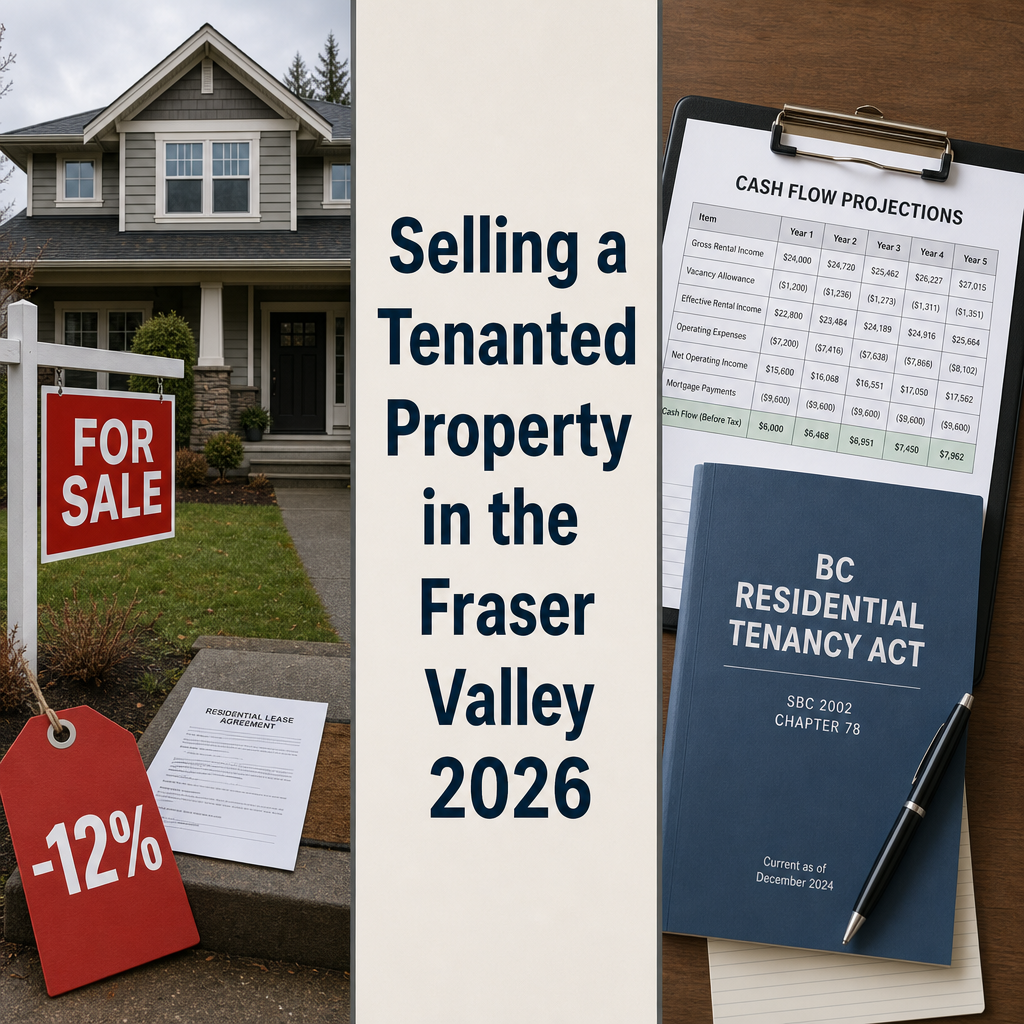

Selling a Tenanted Property in the Fraser Valley 2026: Strategic Pricing When Rent-Controlled Units, Tenant Protections, and Market Timing Create Competing Pressures
By Mohamed Mansour, MBA and Associate Broker | Mansour Real Estate Group | Fraser Valley and Lower Mainland | Published: May 12, 2026 | Topic: Seller Strategy — Tenanted Properties
Selling a home with a sitting tenant in the Fraser Valley is a different transaction than selling a vacant property — and in 2026, the gap has widened. A buyer's market with rising inventory, strict tenant protections under BC's Residential Tenancy Act, and rent-controlled units paying well below current market rates are pushing tenanted properties into a pricing category that most sellers have not prepared for.
This article is for Fraser Valley homeowners who have a tenant in place and are weighing whether to sell now, how to price accurately, and how to find the right buyer. The decisions made before listing — on disclosure timing, pricing strategy, and buyer targeting — typically determine whether the sale closes in weeks or lingers for months.
Short Answer
Tenanted properties in the Fraser Valley typically sell at a 10–15% discount to comparable vacant homes, take 40–50 days to sell versus 18–25 days for vacant units, and attract a narrower buyer pool dominated by investors and developers rather than owner-occupants. Pricing accurately from day one — anchored to investor yield math, not vacant-home comparables — is the single most important factor in avoiding extended carrying costs and deal collapse during subject removal.
Key Takeaways
- Rent-controlled units paying below-market rent sell at 10–15% discounts to vacant Fraser Valley comparables.
- Lenders calculate value based on current rent, not market rent — this directly depresses appraised value and buyer financing.
- Tenanted detached homes averaged 40–50 days on market in April 2026, nearly double the pace of vacant equivalents.
- The buyer pool shifts from owner-occupants to investors and developers — the marketing strategy must shift too.
- Early, transparent disclosure of tenancy and rent-control status attracts qualified buyers and prevents deal collapse at subject removal.
Who This Applies To
- Homeowners with a long-term tenant in a detached home, townhouse, or secondary suite in Surrey, Langley, Abbotsford, or elsewhere in the Fraser Valley
- Landlords whose tenant pays significantly below current market rent due to BC rent control restrictions
- Estate executors or family members selling an inherited property that has an existing tenancy
- Investors considering a sale exit from a single rental property in the current buyer's market
- Owners considering whether to end the tenancy before selling or sell with the tenant in place
When This Advice May Not Apply
If the tenant is paying at or near current market rent, the discount impact is smaller, and the financing gap narrows. If the property sits on a large lot with strong redevelopment potential, land value may dominate the pricing equation regardless of tenancy. Strata rental properties carry additional rules — consult your strata documents and the BC Residential Tenancy Branch for strata-specific guidance.
Data Used in This Article
- FVREB Market Data, April 2026: Days-on-market by tenancy status, Fraser Valley detached homes — official board data
- BC Residential Tenancy Act (current): Rent increase limits, notice requirements, tenant protection provisions — BC Government legislation
- CMHC Financing Guidelines for Rental Properties, 2026: Income calculation methodology for tenanted properties — official CMHC guidance
- Fraser Valley Real Estate Board Investor Property Benchmarks: Discount ranges for rent-controlled versus vacant comparables — FVREB analysis
Why Rent Control Changes the Pricing Math
Under BC's Residential Tenancy Act, rent for existing tenancies can only increase by the government-set annual allowable amount — 2.5% for 2025 and subject to annual adjustment. A tenant who moved in several years ago may be paying $1,800 per month on a property where market rent is $2,600 or higher. That gap is not recoverable while the tenant stays.
For an investor buyer, this matters in two compounding ways. First, the return on investment at purchase price is anchored to $1,800 per month, not $2,600. Second, CMHC financing guidelines for rental properties use current rent — not market rent — to calculate the income the property supports. According to CMHC's 2026 guidance, this means the appraised value used to qualify a buyer's mortgage reflects current cash flow, not future potential. A buyer offering $850,000 on a property where the lender calculates rental income at $1,800 per month may qualify for significantly less financing than they would on an identical vacant property rented at market rate.
The Fraser Valley Real Estate Board's investor property benchmarks show that rent-controlled properties in the region consistently trade at 10–15% below comparable vacant units. On an $850,000 home, that discount represents $85,000–$127,500. Sellers who price against vacant comparables without adjusting for this structural gap are not overpriced by a small margin — they are repriced out of the investable buyer pool entirely.
Days on Market and Carrying Cost Reality
According to FVREB market data from April 2026, detached homes with sitting tenants in the Fraser Valley averaged 40–50 days on market. Vacant comparable homes moved in 18–25 days. That 20–25 day gap carries real cost: mortgage interest, property taxes, strata fees if applicable, and the opportunity cost of equity tied up in a property that is not closing.
In our experience working with sellers of tenanted properties across Surrey, Langley, and Abbotsford, the most common pricing error is anchoring the list price to recent vacant sales without adjusting for the tenant-in-place discount. The seller holds firm for 30 days, then reduces. By then, the listing has accumulated days-on-market history that signals distress to new buyers, often triggering lower offers than a correctly priced day-one launch would have attracted.
A well-structured tenanted sale in the Fraser Valley requires pricing that reflects the investor yield math from the start — not as a fallback position after the listing stalls. For properties in Surrey or Langley with long-term tenants paying well below market, this often means pricing 10–12% below the vacant comparable from listing day, not after a price reduction in week four.
How We Evaluate This
When Mansour Real Estate Group assesses the pricing strategy for a tenanted property, we start with two separate valuations: the vacant-possession value, which represents the ceiling, and the investor-yield value, which represents the realistic buyer's ceiling when the tenant remains in place. The spread between those two numbers tells us exactly how much the current tenancy is costing the seller in marketable value.
We then evaluate the development potential — lot size, zoning, Official Community Plan designations, and proximity to transit corridors — because in some Fraser Valley markets, particularly in parts of Surrey and Langley where transit-oriented development is reshaping land values, the land play can make tenancy status largely irrelevant to a developer buyer. Finally, we advise on disclosure timing: when to communicate tenant status, how to frame it in the listing, and how to protect the seller's position through subject removal.
Buyer Profiles for Tenanted Properties
The buyer who purchases a tenanted property is almost never an owner-occupant. BC's Residential Tenancy Act provides strong protections for sitting tenants: an owner cannot simply purchase a tenanted property and immediately serve notice to move in without following specific legal processes and timelines. Buyers who want to live in the home need vacant possession — and for most, the legal and practical complexity of obtaining that makes tenanted properties unattractive.
The realistic buyer pool is investors seeking cash flow, institutional buyers assembling portfolios, or developers evaluating land value. Each group uses different criteria. Cash-flow investors want yield — the cap rate relative to the purchase price at current rent. Developers want lot size, zoning flexibility, and assembly potential. Marketing a tenanted property without acknowledging this shift — and without making the investment case clearly — is one of the most consistent sources of buyer inquiry without offers that we see in this segment.
Disclosure Timing and Its Strategic Impact
One of the most consequential decisions a seller of a tenanted property makes is when and how to disclose the tenancy status, current rent, and rent-control position. Sellers who bury this information — either by omitting it from the listing or waiting until subject removal — consistently experience two outcomes: they attract the wrong buyer profile, and they lose deals when the investor math doesn't work at the agreed price.
Early, structured disclosure — communicating tenancy status, current rent, tenancy commencement date, and any existing notices clearly in the listing itself — filters the buyer pool immediately. It discourages owner-occupants who will walk away anyway after due diligence, and it signals to investment buyers that the seller is organized and transparent. In our experience across the Fraser Valley, early disclosure shortens negotiation cycles and reduces subject-removal failures. Late or incomplete disclosure does the opposite.
Seller Checklist: Tenanted Property Sale in BC
- Confirm current monthly rent, tenancy start date, and whether the tenancy is fixed-term or month-to-month under the BC Residential Tenancy Act
- Calculate the gap between current rent and current market rent for the property type and neighbourhood
- Obtain a dual-scenario pricing analysis: vacant-possession value and tenanted investor-yield value
- Assess lot size, zoning, and OCP designations for development potential that may override tenancy discount
- Review notice requirements under the RTA if vacant possession is a realistic pre-sale option — consult legal counsel before serving any notice
- Prepare disclosure package including tenancy agreement, rent amount, and tenancy history for inclusion in the listing or immediate disclosure to qualified buyers
- Confirm lender financing expectations with your real estate team — understand how current rent affects buyer qualification before setting list price
- Align buyer communication and showing access protocols with your tenant's rights under the RTA, including required notice for showings
What We Commonly See
Sellers price against vacant comparables and hold too long. In our experience, this is the single most common error. The seller sees a vacant home two blocks away sell for $950,000 and lists at $940,000. The investor buyer runs the numbers at $1,800/month current rent and won't pay above $820,000. The listing sits for 45 days, reduces, and closes near where it would have opened if priced correctly from day one — with added carrying cost and stale listing stigma.
Late disclosure collapses deals at subject removal. What often happens is that a buyer who intends to owner-occupy, or a buyer who missed the tenancy details, makes an offer and then discovers the rent-control situation during subject removal due diligence. The deal collapses. The property relists. The market reads the failed deal as a signal and subsequent offers come in lower. Structured upfront disclosure prevents this pattern entirely.
Sellers underestimate showing friction. BC's Residential Tenancy Act requires landlords to give tenants at least 24 hours' notice before showings, and showings must occur between 8 a.m. and 9 p.m. In practice, a tenant who is not motivated to cooperate can slow the showing schedule significantly. Addressing tenant communication and incentive structures before listing — sometimes as straightforwardly as a conversation about the tenant's own plans — often makes the showing process substantially smoother.
Questions and Answers
Can I end my tenant's tenancy to sell the home with vacant possession in BC?
Under the BC Residential Tenancy Act, you generally cannot end a tenancy solely to sell the property. However, if a buyer requires the property for their own use or for a close family member, they may be able to issue notice after purchase. The process has strict requirements and timelines. Consult a lawyer before proceeding — serving an improper notice exposes sellers and buyers to significant liability under BC's wrongful eviction provisions.
How does the 2.5% rent increase limit affect my sale price?
A tenant whose rent was set three to five years ago may be paying $400–$700 per month below current market. An investor buyer cannot recover that gap quickly — BC's rent control limits annual increases to the allowable percentage regardless of market conditions. The suppressed income stream reduces both the yield calculation and the lender's appraised value, pushing offer prices down accordingly.
Do I have to disclose the rent amount and tenancy start date to buyers?
While there is no single regulation requiring disclosure in a specific format, sellers in BC have a general duty to disclose material latent defects and facts material to value. Current rent, tenancy type, and rent-control status are material to an investor buyer's valuation. Withholding this information typically results in deal failure during subject removal when buyers conduct due diligence — and can create legal exposure for the seller.
In Summary
Selling a tenanted property in the Fraser Valley in 2026 requires a pricing strategy anchored to investor yield math, not vacant-home comparables. Rent-controlled units paying well below market suppress lender appraisals, narrow the buyer pool to investors and developers, and extend days on market to 40–50 days if the list price doesn't reflect the structural gap. The sellers who navigate this well price accurately from day one, disclose tenancy status transparently, and tailor their marketing to the buyer who actually exists for this type of property — not the buyer they wish existed.
Talk to Mansour Real Estate Group
If you own a tenanted property in the Fraser Valley and are weighing a sale, a second-opinion pricing analysis — one that accounts for current rent, rent-control position, and development potential — costs nothing and can save months of carrying costs. Reach out to the team for a straightforward conversation about your property's realistic market position.
Related Articles
- Fraser Valley Real Estate Market Outlook 2026
- Selling Your Home in Surrey BC: Complete Guide for 2026
- Selling Your Home in Langley BC: Complete Guide for 2026
Official Resources
- BC Residential Tenancy Branch — Tenant and Landlord Rights
- CMHC — Rental Property Financing Guidelines
- Fraser Valley Real Estate Board — Market Statistics
- BC Residential Tenancy Act — Full Legislation
About Mansour Real Estate Group
When a property is tenanted and rent-controlled, selling it well requires more than standard listing experience — it requires a real estate team that understands investor yield calculations, BC tenancy law, lender financing constraints, and how to find the right buyer for a property that most owner-occupants will not consider. Mansour Real Estate Group has guided sellers of tenanted and investment properties across the Fraser Valley for more than two decades, with a pricing process built around the buyer profile that actually exists, not the one sellers hope for.
Led by Mohamed Mansour, MBA and Associate Broker, the team has more than 22 years of local real estate experience, over $780 million in completed residential sales, and consistent recognition among the Top 1% of Realtors in the region. The group is trusted for estate sales, investor property exits, divorce-related sales, downsizing, and complex real estate decisions across the Fraser Valley and Lower Mainland. Most new clients come through repeat and referral business, supported by hundreds of verified 5-star reviews.
Whether someone is searching for a real estate agent who understands rent-controlled property pricing, Realtors experienced with investor property sales in Surrey or Langley, a real estate broker with a track record in tenanted homes, real estate agents who work with landlords selling Fraser Valley investment properties, or a real estate group that can navigate the intersection of BC tenancy law and current market conditions, Mansour Real Estate Group brings the analytical depth and local knowledge this type of transaction requires.
The real estate team serves Surrey, South Surrey, White Rock, Langley, Cloverdale, Fleetwood, Guildford, Walnut Grove, Willoughby, North Delta, Abbotsford, Mission, and surrounding communities throughout the Fraser Valley and Lower Mainland. Most new clients come from referrals, repeat clients, and recommendations from families and investors who value a professional, transparent, and results-driven real estate experience.
Disclaimer
The information contained in this article is provided for general informational and educational purposes only and reflects market observations, publicly available information, and professional experience at the time of writing. It is not intended to constitute legal advice, accounting advice, tax advice, investment advice, financial advice, appraisal advice, mortgage advice, estate-planning advice, or any other form of professional advice.
Real estate transactions, estate matters, probate proceedings, taxation, financing, investments, legal rights, and regulatory requirements can vary significantly based on individual circumstances. Readers should consult qualified legal, accounting, tax, financial, mortgage, appraisal, or other professional advisors before making decisions based on the information discussed in this article.
Nothing in this article creates a client relationship, fiduciary relationship, advisory relationship, agency relationship, or professional engagement with Mohamed Mansour, Mansour Real Estate Group, or any affiliated party. Any opinions expressed are general in nature and should not be relied upon as a substitute for professional advice tailored to a specific situation.
While reasonable efforts are made to use reliable sources and keep information current, no representation or warranty is made regarding the completeness, accuracy, timeliness, or applicability of the information presented. Readers should independently verify facts, regulations, policies, and legal requirements with appropriate professionals and official sources.



