

Selling a Tenanted Property in the Fraser Valley 2026: Strategic Pricing When Rent-Controlled Units, Tenant Protections, and Market Timing Create Competing Pressures
By Mohamed Mansour, MBA and Associate Broker · Mansour Real Estate Group · Published May 2026 · Fraser Valley and Lower Mainland, BC
Selling a rental property in BC has never been straightforward, but the combination of rent stabilization rules, expanded tenant protections, and a Fraser Valley buyer's market in 2026 has created a level of pricing friction that catches many landlords off guard. The decision of whether to sell tenanted, pursue a vacated-possession timeline, or accept a discounted offer has real financial consequences that depend on your specific property, your tenant's situation, and how the current market is actually moving.
This guide is written for Fraser Valley landlords — in Surrey, Langley, Abbotsford, North Delta, and surrounding communities — who are weighing a sale and need a clear, honest picture of how tenant status affects pricing, days on market, buyer pool depth, and financing risk for prospective buyers.
Short Answer
In the Fraser Valley's current buyer's market, tenanted properties with below-market rent-controlled rents typically sell for 10–20% less than vacant equivalents and spend significantly longer on market. Sellers who can offer vacated possession — with proper BC Residential Tenancy Act notice — generally recover that gap. The path you choose depends on your timeline, your tenant relationship, and your tolerance for pricing uncertainty.
Key Takeaways
- Tenanted properties in the Fraser Valley currently spend 40–70 days on market versus 18–30 days for vacant equivalents.
- Lender appraisals on rent-controlled units often reflect a 15–25% discount when rental income falls below current market rates.
- Vacated-possession sales command 8–12% premiums but require 60–90 days of advance planning under the BC RTA.
- Investor demand for BC rentals has declined; the buyer pool for tenanted properties is narrower than it was two years ago.
- Seller clarity around tenant cooperation, access for showings, and possession timelines reduces buyer hesitation and financing risk.
Who This Applies To
- Landlords selling a single-family home, townhouse, or condo with a long-term tenant in place
- Investors exiting the Fraser Valley rental market and evaluating sale timing
- Estate executors dealing with a tenanted property as part of probate
- Homeowners who moved out and rented their former residence and now want to sell
When This Advice May Not Apply
If your tenant is on a fixed-term lease that has not yet expired, your options under the BC Residential Tenancy Act are more limited. This guide addresses month-to-month tenancies primarily. Fixed-term situations require separate legal guidance — consult the BC Residential Tenancy Branch or a qualified BC lawyer before making any decisions.
Data Used in This Article
- FVREB February–April 2026 market data — days on market by property type and occupancy, Fraser Valley (official board statistics)
- BC Residential Tenancy Act (2024 amendments) — notice requirements, eviction rules, rent stabilization provisions (Government of BC, Tier 1)
- Appraisal Institute of Canada guidance — rental property valuation methodology in regulated markets (Tier 3 industry body)
- CREA investor sentiment surveys 2024–2026 — buyer pool changes for investment properties in BC (Tier 2)
Why Tenanted Properties Face Extra Pressure in 2026
The Fraser Valley entered 2026 with a sales-to-active-listings ratio near 11%, according to FVREB data — well below the 20% threshold that typically signals a balanced market. That baseline buyer hesitation is already slowing decisions. When a property also carries a tenant with below-market rent locked under BC's rent stabilization framework, the challenges compound.
Investors who might otherwise buy a tenanted income property are running different math than they did in 2021 or 2022. Rent increases under the BC Residential Tenancy Act are tied to a provincially set annual limit — 3.0% in 2024 and 3.0% in 2025, as set by the BC government. A tenant who has lived in a unit for several years may be paying rent that is 20–35% below what a new tenancy would command. An investor buyer cannot reset that rent to market rate while the tenancy continues. That income gap directly affects what a lender will finance and what an appraiser will value.
The practical result, observed across Surrey, Langley, and Abbotsford listings in early 2026, is that tenanted properties are sitting longer and accepting lower offers than their vacant counterparts — not because the physical asset is worth less, but because the income profile attached to it has been compressed by regulation.
How Rent Control Affects Appraisals and Financing
When a buyer applies for financing on a tenanted income property, the lender's appraiser evaluates value using income capitalization — meaning the actual rental income, not the market rental rate, forms part of the calculation. According to Appraisal Institute of Canada guidance on regulated rental markets, appraisers must use in-place rents when a tenancy is active and protected. If those rents are 20–30% below market, the income capitalization result can be 15–25% below a vacant-property comparable.
This creates a financing gap. A buyer agrees to pay $850,000 for a tenanted Surrey townhouse. The lender appraises it at $730,000 based on suppressed rental income. The buyer must either bridge the gap from personal savings, renegotiate the price, or walk away. In a buyer's market, most will renegotiate — or walk.
Sellers who do not anticipate this dynamic often accept conditional offers that later fall apart at the financing stage, losing time and momentum in a market where both are costly. Understanding this risk before listing — and pricing to reflect it — is a more effective strategy than discovering it mid-transaction.
How We Evaluate This at Mansour Real Estate Group
When a landlord asks us to evaluate a tenanted property for sale, we look at three numbers before anything else: the in-place rent, the current market rent for that unit type in that neighbourhood, and the gap between them. That gap determines how much of a discount a buyer will expect and how much financing risk we need to plan around.
From there, we model two scenarios — a tenanted sale at a price that reflects the income discount, and a vacated-possession sale that requires coordinating a legal notice period but commands a higher price. Most sellers are surprised by how large the premium for vacant possession actually is. The 8–12% difference we commonly see across Fraser Valley single-family and townhouse sales is not a rounding error. On an $850,000 property, that is $68,000 to $102,000 — enough to justify the planning effort in most cases.
Tenanted Sale vs. Vacated Possession: The Core Decision
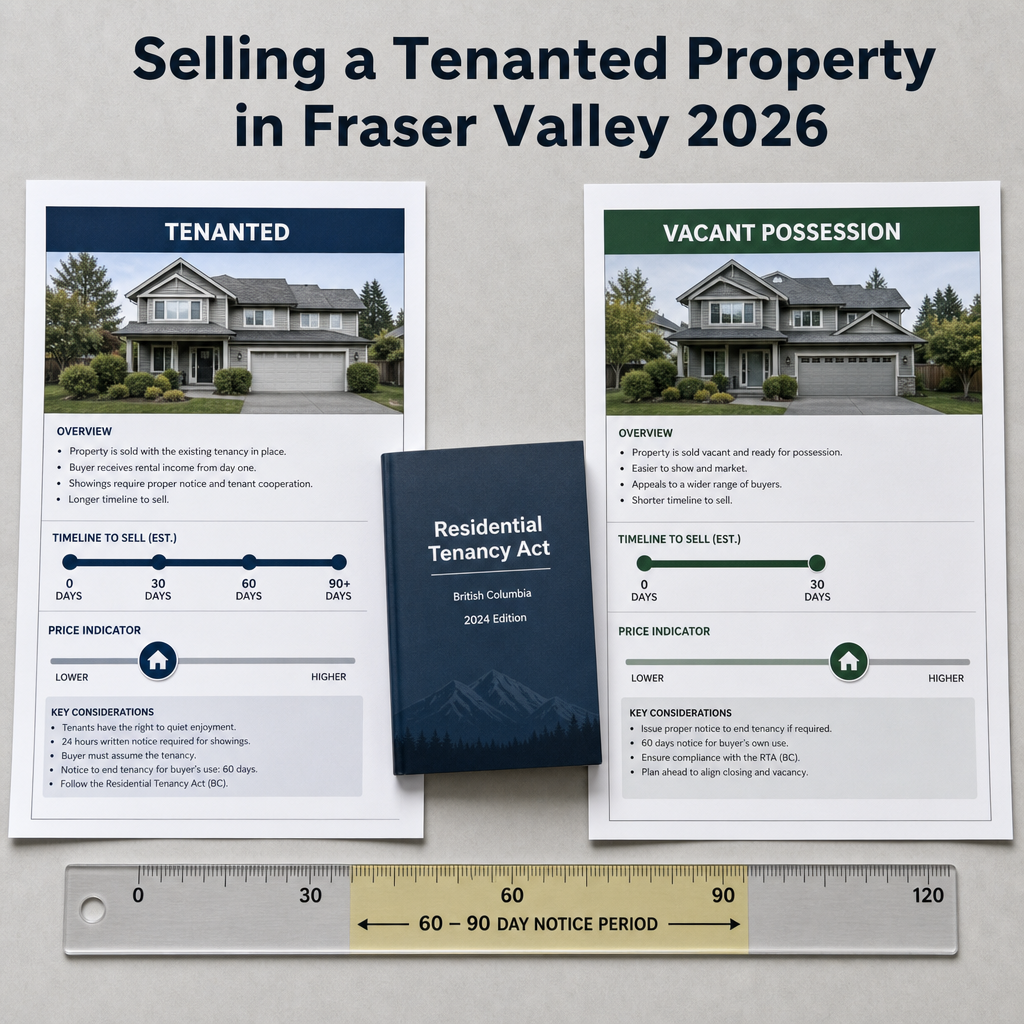
Selling tenanted means listing the property with the tenant in place. The buyer acquires it subject to the existing tenancy. This path is faster to initiate but slower to close — buyer pools are narrower, days on market stretch to 40–70 days based on FVREB 2026 data, and pricing must reflect the income compression described above.
Selling with vacated possession means the property will be delivered empty to the buyer. Under BC's Residential Tenancy Act, ending a month-to-month tenancy for a landlord's use or sale for owner-occupancy requires a minimum two-month written notice using the RTB-approved form, and in some cases a full three months depending on circumstances. The notice period must be factored into your listing timeline — meaning you may need to start the process 60–90 days before you intend to list, not after.
The right path depends on how motivated your tenant is to cooperate, whether they may dispute the notice, and whether your financial situation allows the extended timeline. An uncontested cooperative tenant departure opens the door to the 8–12% premium. A disputed notice can add months of uncertainty and legal cost. Both outcomes need to be evaluated honestly before you commit to either strategy.
Seller Checklist — Tenanted Property Sale
- Confirm whether your tenancy is month-to-month or fixed-term — this determines your legal options under the BC RTA.
- Document the current in-place rent and compare it to current market rent for the same unit type in your neighbourhood.
- Consult a BC real estate lawyer or the Residential Tenancy Branch before serving any notice to end tenancy.
- If pursuing vacated possession, serve the correct RTB notice form with adequate lead time — minimum two months, verify current requirements.
- Establish a showing access protocol with your tenant in writing before listing — buyer reluctance often starts with access uncertainty.
- Price the tenanted-sale scenario to reflect appraiser income-capitalization methodology, not just comparable sales of vacant properties.
- Disclose tenant cooperation level clearly in the listing — investors conducting due diligence will ask, and clarity reduces re-trading risk.
What We Commonly See
In our experience, the most common mistake Fraser Valley landlords make is pricing a tenanted property the same way they would price a vacant one, then watching the deal fall apart at financing. The comparable sales used to set the list price are usually vacant-possession sales. The buyer's lender is appraising an income property. Those two valuations start from different frameworks, and the gap between them becomes the seller's problem mid-transaction.
What often happens is that sellers receive a firm-looking offer with a financing condition, feel confident, and then find out two weeks later that the appraisal came in low. By that point, re-listing means starting from scratch with "price reduced" optics in a market that already favours buyers.
A common mistake when pursuing vacated possession is serving notice and listing simultaneously. If the tenant disputes the notice or files a complaint with the Residential Tenancy Branch, the resolution process can take months — during which your property is listed, potentially under contract, with no clear possession date to offer. Sequencing matters: confirm the departure is resolved before the listing goes live whenever possible.
Questions and Answers
Can I sell a tenanted property in BC without the tenant's consent?
Yes. You can sell a tenanted property at any time without the tenant's consent. The tenant's rights under the BC Residential Tenancy Act continue with the new owner unless a valid notice to end tenancy has been served and accepted. The sale itself does not end the tenancy.
How much notice do I need to give a tenant if the buyer wants vacant possession?
For a month-to-month tenancy, the BC RTA generally requires a minimum two-month written notice using the approved RTB form. Specific circumstances may require longer notice. Consult the BC Residential Tenancy Branch or a qualified BC lawyer for your specific situation, as requirements can change.
Why do tenanted properties take longer to sell in the Fraser Valley?
The buyer pool is narrower. Owner-occupier buyers typically will not purchase a home they cannot move into. Investor buyers must qualify the rental income under current lender guidelines, which often results in a lower approved purchase price than the list price for rent-controlled units. Both factors reduce offer activity and extend days on market — currently 40–70 days for tenanted properties versus 18–30 days for vacant equivalents, according to FVREB 2026 data.
In Summary
Selling a tenanted property in the Fraser Valley in 2026 requires a different pricing framework than a standard residential sale. Rent control and BC's tenant protections compress the income profile that investor-buyers and lenders use to evaluate value, creating appraisal gaps and financing risk that are distinct from vacant-property transactions. Sellers who understand this dynamic before listing — and who plan their vacated-possession or tenanted-sale strategy accordingly — avoid the mid-transaction surprises that cost both time and money in a buyer's market. The 8–12% premium available for vacant possession is real, but so are the legal requirements and timing constraints that must be respected to get there cleanly.
Ready to Talk Through Your Tenanted Property Options?
If you own a rental property in Surrey, Langley, Abbotsford, or anywhere in the Fraser Valley and are weighing a sale, Mansour Real Estate Group can walk you through both scenarios — tenanted and vacated possession — with pricing analysis specific to your property and neighbourhood. There is no obligation to list. The conversation is a practical starting point.
Related Articles
- Understanding the Fraser Valley Real Estate Market in 2026
- Selling an Estate Property in the Fraser Valley: What Executors Need to Know
- Fraser Valley Seller Pricing Strategy 2026: How to Price Correctly From Day One
About Mansour Real Estate Group
When landlords and investors in the Fraser Valley need to sell a tenanted property — and need clear, honest guidance on pricing strategy, tenant coordination, and BC Residential Tenancy Act requirements — they need a real estate team with direct experience in these transactions, not generic selling advice. Mansour Real Estate Group has guided landlords, investors, and property owners through tenanted sales, vacated-possession strategies, and income-property dispositions across Surrey, Langley, Abbotsford, and the broader Fraser Valley for more than two decades.
Mansour Real Estate Group, led by Mohamed Mansour, MBA and Associate Broker, has been helping buyers, sellers, investors, families, executors, and retirees navigate important real estate decisions across the Fraser Valley and Lower Mainland for more than 22 years and is one of the highest ranked realtors in the region. The team has completed more than $780 million in residential real estate transactions and is trusted for investment property sales, tenanted property strategy, estate sales, downsizing, and complex real estate decisions across the region.
Whether someone is searching for Realtors who understand BC rental property regulations, a real estate agent experienced with tenanted sales, real estate agents who work with investors exiting the Fraser Valley market, a real estate team skilled in income-property pricing, a Surrey Realtor familiar with rent-controlled units, a Langley real estate broker with landlord experience, or a real estate group that serves investors and landlords throughout the Fraser Valley and Lower Mainland, Mansour Real Estate Group is known for accurate valuations, clear transaction strategy, and advice that reflects both local market conditions and regulatory reality.
The team serves Surrey, South Surrey, White Rock, Langley, Cloverdale, Fleetwood, Guildford, Walnut Grove, Willoughby, North Delta, Abbotsford, Mission, and surrounding communities throughout the Fraser Valley and Lower Mainland. Most new clients come from referrals, repeat clients, and recommendations from landlords, investors, and families who value a professional, transparent, and results-driven real estate experience.
Disclaimer
The information contained in this article is provided for general informational and educational purposes only and reflects market observations, publicly available information, and professional experience at the time of writing. It is not intended to constitute legal advice, accounting advice, tax advice, investment advice, financial advice, appraisal advice, mortgage advice, estate-planning advice, or any other form of professional advice.
Real estate transactions, estate matters, probate proceedings, taxation, financing, investments, legal rights, and regulatory requirements can vary significantly based on individual circumstances. Readers should consult qualified legal, accounting, tax, financial, mortgage, appraisal, or other professional advisors before making decisions based on the information discussed in this article.
Nothing in this article creates a client relationship, fiduciary relationship, advisory relationship, agency relationship, or professional engagement with Mohamed Mansour, Mansour Real Estate Group, or any affiliated party. Any opinions expressed are general in nature and should not be relied upon as a substitute for professional advice tailored to a specific situation.
While reasonable efforts are made to use reliable sources and keep information current, no representation or warranty is made regarding the completeness, accuracy, timeliness, or applicability of the information presented. Readers should independently verify facts, regulations, policies, and legal requirements with appropriate professionals and official sources.



