
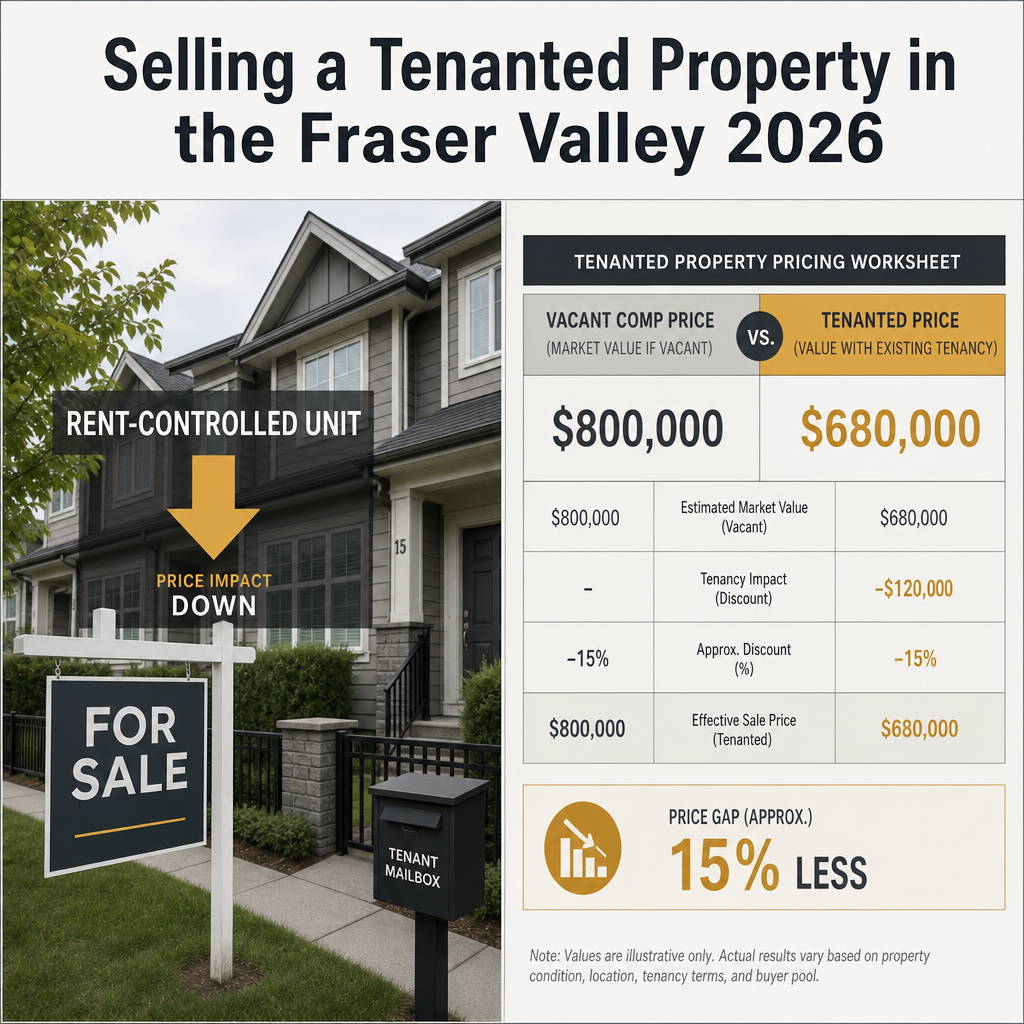

Selling a Tenanted Property in the Fraser Valley 2026: Strategic Pricing When Rent Control, Tenant Protections, and Market Timing Create Competing Pressures
By Mohamed Mansour, MBA and Associate Broker — Mansour Real Estate Group | Fraser Valley and Lower Mainland, BC | Published: July 15, 2025 | Scope: British Columbia
Sellers of tenanted properties in the Fraser Valley face a pricing problem that most generalist realtors underestimate. BC's rent control provisions under the Residential Tenancy Act limit annual rent increases to a provincially set maximum — currently tied to inflation — which means a long-term tenant paying significantly below market rent creates a real, measurable discount that buyers will price in whether the seller accounts for it or not. In a buyer's market where the Fraser Valley's sales-to-active listings ratio sat at approximately 11% as of early 2026 according to Fraser Valley Real Estate Board data, that discount compounds quickly.
This article explains how that discount works, how to build a pricing strategy around it, and what sellers — including executors managing inherited rental properties and owners navigating separation — need to understand before listing.
Short Answer
Tenanted properties in BC typically sell at a 10–20% discount compared to vacant equivalents, driven by rent-control provisions under the Residential Tenancy Act, restricted buyer financing, and a narrower investor-only pool. In the Fraser Valley's current buyer's market, sellers who price using standard vacant-unit comparables will likely overprice by 8–12% and face extended days-on-market. Accurate pricing requires investor-focused comparable analysis and honest rent-gap accounting.
Key Takeaways
- BC rent control creates a measurable price discount that buyers and lenders calculate automatically.
- Standard CMA methodology using vacant comparables typically overprices tenanted units by 8–12%.
- Lenders apply stricter underwriting to tenanted properties, shrinking the qualified buyer pool significantly.
- Fraser Valley's buyer's market in 2026 compounds the discount — investor buyers have more negotiating leverage.
- Sellers must choose between pricing aggressively for investors or waiting for owner-occupant timing.
Who This Applies To
- Landlords selling a long-term rental property in Surrey, Langley, Abbotsford, or anywhere in the Fraser Valley
- Executors or estate administrators who have inherited a tenanted property and must sell it
- Separating spouses where the matrimonial home is currently tenanted
- Investors repositioning from residential rental to another asset class
- Owners who purchased a tenanted property and are now exiting the investment
When This Advice May Not Apply
If your tenant is on a fixed-term tenancy nearing expiration, or if you are lawfully ending a tenancy for personal use before listing, the vacant-property pricing approach may be more appropriate. Consult a lawyer before issuing any notice to end tenancy — the rules and timing requirements under BC's Residential Tenancy Act are strict and have changed materially in recent years.
Definitions
Rent Control (BC): Under the Residential Tenancy Act, annual rent increases for existing tenants are capped at a maximum set by the province each year. The 2025 cap was 3.0%. This means a tenant paying below market rent continues paying below market rent indefinitely, unless they vacate.
Rent Gap: The difference between what a tenant currently pays and what the unit would rent for on the open market today. A $500/month rent gap on a rental unit translates directly into reduced annual net operating income, which reduces property value for investor buyers.
Cap Rate: An investor's return calculation: net operating income divided by purchase price. A lower current rent means lower NOI, which means a lower price investors can justify at any given cap rate threshold.
Sales-to-Active Listings Ratio: A measure of market balance published by the Fraser Valley Real Estate Board. Below 12% is generally considered a buyer's market; below 20% favours buyers. At 11%, the Fraser Valley as of early 2026 was firmly in buyer's market territory.
Data Used in This Article
- Fraser Valley Real Estate Board: Sales-to-active listings ratio and benchmark price data, early 2026 — official board publication
- BC Residential Tenancy Act (RSBC 1996, c. 408): Rent increase allowance and tenant protection provisions — BC Government legislation
- CMHC: Mortgage insurance eligibility and underwriting guidelines for tenanted properties — official CMHC publication
- BC Government Residential Tenancy Branch: 2025 allowable rent increase (3.0%) — official RTB publication
Why the Standard Pricing Approach Fails Tenanted Properties
Most comparative market analyses are built on what similar properties sold for — recently, nearby, and in similar condition. That methodology works well for vacant properties where the next buyer has full use of the home. It fails for tenanted properties because the pool of realistic buyers is fundamentally different.
Owner-occupant buyers — the largest segment of any residential market — typically cannot use a tenanted property at purchase. They may be willing to wait for turnover, but that waiting period is uncertain under BC law, and most buyers will discount heavily for that uncertainty. Investor buyers, who represent the realistic majority of the tenanted-property market, evaluate price through a cap-rate lens. They will calculate current rental income, subtract operating expenses, and divide by your asking price. If the math doesn't reach an acceptable return threshold — typically somewhere between 4% and 5.5% for Fraser Valley residential rentals depending on property type and location — they will either pass or offer below your ask.
The rent gap is the core variable. A property renting at $1,700 per month where market rent is $2,400 carries a $700/month income shortfall. Annualized, that's $8,400 in foregone income. At a 4.5% cap rate, that shortfall implies a value reduction of roughly $187,000 compared to a fully market-rented equivalent. That is not a negotiating position — it is the investor's math. Sellers who do not build their pricing from investor math will wait longer and net less than sellers who do.
How the Fraser Valley's Buyer's Market Amplifies the Discount
In a balanced market, investor buyers compete with each other and occasionally with owner-occupants willing to wait for turnover. That competition keeps discounts moderate. In a buyer's market — where active listings significantly exceed sales — investor buyers have less urgency and more leverage. They can afford to wait for a seller whose pricing reflects reality.
According to Fraser Valley Real Estate Board data, benchmark prices across major Fraser Valley property categories were down approximately 7–8% year-over-year as of April 2026. For a tenanted property, that correction compounds the rent-control discount. A seller facing both a 15% tenancy discount and an 8% market correction is effectively operating in pricing territory that is 20–23% below what a comparable vacant property sold for a year ago. That is the realistic ceiling for many tenanted listings currently on the Fraser Valley market.
Sellers who list optimistically — holding for a price that requires market conditions to improve and a tenant to vacate — carry real carrying costs against that hope. Property taxes, mortgage interest, maintenance, and strata fees (where applicable) continue regardless of how long the listing sits. Days-on-market is not free.
How We Evaluate This
When Mansour Real Estate Group evaluates pricing for a tenanted property, the analysis starts with two separate comparable sets: one for vacant equivalents in the same sub-market, and one for recent investor sales of tenanted properties — if sufficient data exists. The gap between those two sets is the market's revealed tenancy discount for that specific property type and area.
We then layer in the rent gap. If the property is renting near current market rates — say, a tenant who moved in recently at a competitive rate — the discount narrows considerably. If the tenant has been in place for five or more years and rent is 25–35% below market, the discount widens. We model both the cap-rate scenario for investor buyers and the turnover-expectation scenario for owner-occupant buyers, and we present both to the seller with honest timelines and realistic net outcomes attached to each path.
The Two Strategic Paths and What Each Actually Requires
Path 1: Price for the investor pool. This means accepting the rent-control discount, building the price from cap-rate math, and targeting buyers who are acquiring a cash-flowing asset — not a future home. The advantage is a defined buyer pool with rational, calculable motivation. The requirement is that the seller genuinely accepts a price 10–20% below vacant comparables. Sellers who list at the investor price and then resist offers that reflect it lose the benefit of this strategy.
Path 2: Price conservatively for owner-occupant buyers, accept extended DOM. Some owner-occupant buyers will purchase a tenanted property if the price reflects the inconvenience and uncertainty. This path typically requires more time, more showings, and more seller patience. It works better when the tenancy situation has a foreseeable natural end — a fixed-term lease expiring, or a tenant who has indicated they intend to vacate. It does not work well when the tenancy is indefinite, the rent gap is large, or the seller has carrying-cost pressure. For estate situations where the executor needs to close within a defined timeframe, Path 1 is almost always the more practical choice. Sellers managing estate property sales in the Fraser Valley should account for this timing reality early in the process.
Lender Underwriting and the Financing Constraint
One aspect sellers sometimes overlook is how lender underwriting changes the buyer pool for tenanted properties. CMHC-insured mortgages — which allow buyers to purchase with as little as 5% down — are generally not available for non-owner-occupied properties. A buyer purchasing a tenanted investment property typically needs a minimum 20% down payment and qualifies under conventional, uninsured mortgage guidelines.
Lenders also apply rental income calculations that may discount the actual rent received — some lenders use only 50–80% of gross rental income in their debt service calculations, which reduces how much a buyer can borrow. This compression in purchasing power is not abstract: it directly reduces the number of buyers who can close on your property. Sellers pricing a tenanted property need to understand that their buyer pool is both smaller and less financially flexible than the pool for a comparable vacant listing. That reality belongs in the pricing decision from day one.
Estate and Separation Complexity
Executors inheriting tenanted properties face a layered challenge. The estate may need to sell within a specific timeframe for legal or tax reasons, yet the property carries a tenancy that the executor cannot simply terminate to improve marketability. Under BC's Residential Tenancy Act, valid grounds for ending a tenancy are specific and procedurally demanding — selling the property alone does not constitute valid grounds for eviction.
For separating couples, a tenanted matrimonial property adds valuation complexity when one spouse has managed the tenancy and the other has not. Disagreements about whether to sell with the tenant in place or attempt to time a sale around turnover can delay listing for months. In both scenarios — selling during separation or divorce in the Fraser Valley and estate-driven sales — the pricing and timeline decision benefits from a team that understands both the real estate market and the constraints imposed by the tenancy.
Tenanted Property Seller Checklist
- Confirm the current tenancy type: fixed-term or month-to-month, and the exact rent amount being paid
- Document the rent gap: obtain a current market rent estimate for the unit from your realtor
- Request a dual-track comparable analysis: one using vacant comps, one using investor-sale comps for tenanted properties
- Model the cap-rate math at your asking price — know what return a buyer receives at list price before you go live
- Review your tenancy agreement and consult a lawyer before taking any steps to end the tenancy or provide notice
- Confirm tenant showing access rights under the Residential Tenancy Act (24-hour written notice required for property showings)
- Prepare a rental income summary for buyers: current rent, lease terms, tenant history if relevant and appropriate to disclose
- Decide explicitly between Path 1 (investor pricing, faster sale) and Path 2 (owner-occupant pricing, extended DOM) before listing
What We Commonly See
Overpricing using vacant comparables. In our experience, the most common and costly mistake sellers of tenanted properties make is asking their realtor for a CMA and receiving one built on vacant-unit sales. The numbers look reasonable, the seller lists, and then the property sits. Investor buyers either don't make offers or offer significantly below asking. After 60–90 days, a price reduction brings the listing to where it should have been at the start — but by then, market exposure has already damaged buyer perception.
Underestimating the showing friction of a tenanted property. What often happens is that sellers underestimate how much a tenant's cooperation — or lack of it — affects buyer interest. Under the Residential Tenancy Act, tenants must receive 24 hours' written notice before a showing. Some tenants are cooperative; others are not. If showings are difficult to schedule, buyer engagement drops and days-on-market extends. In our experience, sellers who build a clear showing protocol with their tenant before listing have meaningfully better outcomes than those who do not.
Waiting for the tenant to leave before listing in a declining market. A common mistake is deciding to wait for tenant turnover before listing, assuming a vacant property will net more. In a declining market, the price appreciation from selling vacant may not offset months of carrying costs and further price erosion. This calculation depends entirely on the size of the rent gap, the realistic timeline to turnover, and how quickly the market is moving. There is no universal answer, but sellers who do not model both scenarios explicitly tend to make this decision emotionally rather than analytically.
Questions and Answers
Can I end my tenant's tenancy in order to sell the property in BC?
Not simply because you want to sell. Under BC's Residential Tenancy Act, valid grounds for ending a tenancy are specific. Selling the property is not itself a valid ground for eviction. Consult a lawyer before issuing any notice — improper notices carry financial penalties and can be challenged at the Residential Tenancy Branch.
How much does a tenanted property typically discount versus a vacant one in the Fraser Valley?
Based on industry analysis and investor cap-rate math, the discount typically ranges from 10–20% depending on the rent gap. A property with a small rent gap may see a 10% discount; one where rent is 25–35% below current market rates may see discounts closer to 20% or more in the current buyer's market environment.
Do buyers need more money down to purchase a tenanted property?
Generally yes. CMHC mortgage insurance is not available for non-owner-occupied investment purchases, which means most buyers of tenanted properties need a minimum 20% down payment and must qualify under conventional mortgage guidelines. This restricts the buyer pool compared to a vacant property eligible for insured financing.
In Summary
Selling a tenanted property in the Fraser Valley in 2026 requires a different pricing approach than selling a vacant home. BC's rent control provisions, the resulting rent gap, lender underwriting restrictions, and a buyer's market with limited investor competition all compress the achievable sale price in ways that standard CMA methodology will not capture. Sellers who understand the rent-gap math, choose a pricing path deliberately, and prepare their tenancy logistics before listing will consistently outperform those who price on hope and list without a plan. The discount is real — but it is manageable when it is built into the strategy from the start rather than discovered after 90 days on the market.
Talk to a Realtor Who Understands Tenanted Property Pricing
If you are preparing to sell a tenanted property in the Fraser Valley and want a realistic assessment of the rent gap, buyer pool, and pricing strategy, Mansour Real Estate Group offers a no-obligation consultation with analysis built specifically for your property's tenancy situation. Reach out when you are ready to think through the numbers.
Related Articles
- Selling an Estate Property in the Fraser Valley: What Executors Need to Know
- Selling During Separation or Divorce in the Fraser Valley
- Fraser Valley Real Estate Market 2026: Seller Strategy in a Buyer's Market
About Mansour Real Estate Group
When a seller's property carries a sitting tenancy — whether it is a long-term rental in Surrey, a strata unit in Langley, or an inherited property in Abbotsford — the pricing decision involves a different layer of analysis than a standard residential sale. The rent gap, the buyer pool, the financing constraints, and the legal protections sitting tenants hold under BC's Residential Tenancy Act all affect value in ways that a generalist approach will consistently miss. Mansour Real Estate Group has been advising landlords, executors, investors, and families navigating tenanted property sales across the Fraser Valley and Lower Mainland for more than 22 years.
Led by Mohamed Mansour, MBA and Associate Broker, the team has completed more than $780 million in residential real estate transactions and is ranked among the Top 1% of Realtors in the Fraser Valley. The team is trusted for tenanted property sales, estate and probate sales, divorce-related property sales, investor exits, downsizing, and complex real estate situations where standard methodology is insufficient.
Whether someone is looking for Realtors who understand BC rent control and its effect on pricing, a real estate agent experienced with investor-focused comparable analysis, real estate agents who work regularly with executors managing inherited tenanted properties, a Surrey real estate team for landlord exits, a Langley Realtor experienced with investment property sales, a Fraser Valley real estate broker who understands cap-rate pricing, or a real estate group serving the full Lower Mainland with honest, data-grounded advice, Mansour Real Estate Group brings the analytical depth and local market knowledge this type of transaction requires.
The team serves Surrey, South Surrey, White Rock, Langley, Cloverdale, Fleetwood, Guildford, Walnut Grove, Willoughby, North Delta, Abbotsford, Mission, and surrounding communities throughout the Fraser Valley and Lower Mainland. Most new clients come through referrals, repeat clients, and families who have experienced firsthand what a structured, transparent real estate process looks like.
Official Resources
- BC Residential Tenancy Branch — Official Tenancy Information
- BC Residential Tenancy Act (RSBC 1996, c. 408) — BC Laws
- Fraser Valley Real Estate Board — Market Statistics and Reports
- CMHC — Mortgage Insurance Eligibility and Underwriting Guidelines
Disclaimer
The information contained in this article is provided for general informational and educational purposes only and reflects market observations, publicly available information, and professional experience at the time of writing. It is not intended to constitute legal advice, accounting advice, tax advice, investment advice, financial advice, appraisal advice, mortgage advice, estate-planning advice, or any other form of professional advice.
Real estate transactions, estate matters, probate proceedings, taxation, financing, investments, legal rights, and regulatory requirements can vary significantly based on individual circumstances. Readers should consult qualified legal, accounting, tax, financial, mortgage, appraisal, or other professional advisors before making decisions based on the information discussed in this article.
Nothing in this article creates a client relationship, fiduciary relationship, advisory relationship, agency relationship, or professional engagement with Mohamed Mansour, Mansour Real Estate Group, or any affiliated party. Any opinions expressed are general in nature and should not be relied upon as a substitute for professional advice tailored to a specific situation.
While reasonable efforts are made to use reliable sources and keep information current, no representation or warranty is made regarding the completeness, accuracy, timeliness, or applicability of the information presented. Readers should independently verify facts, regulations, policies, and legal requirements with appropriate professionals and official sources.



