
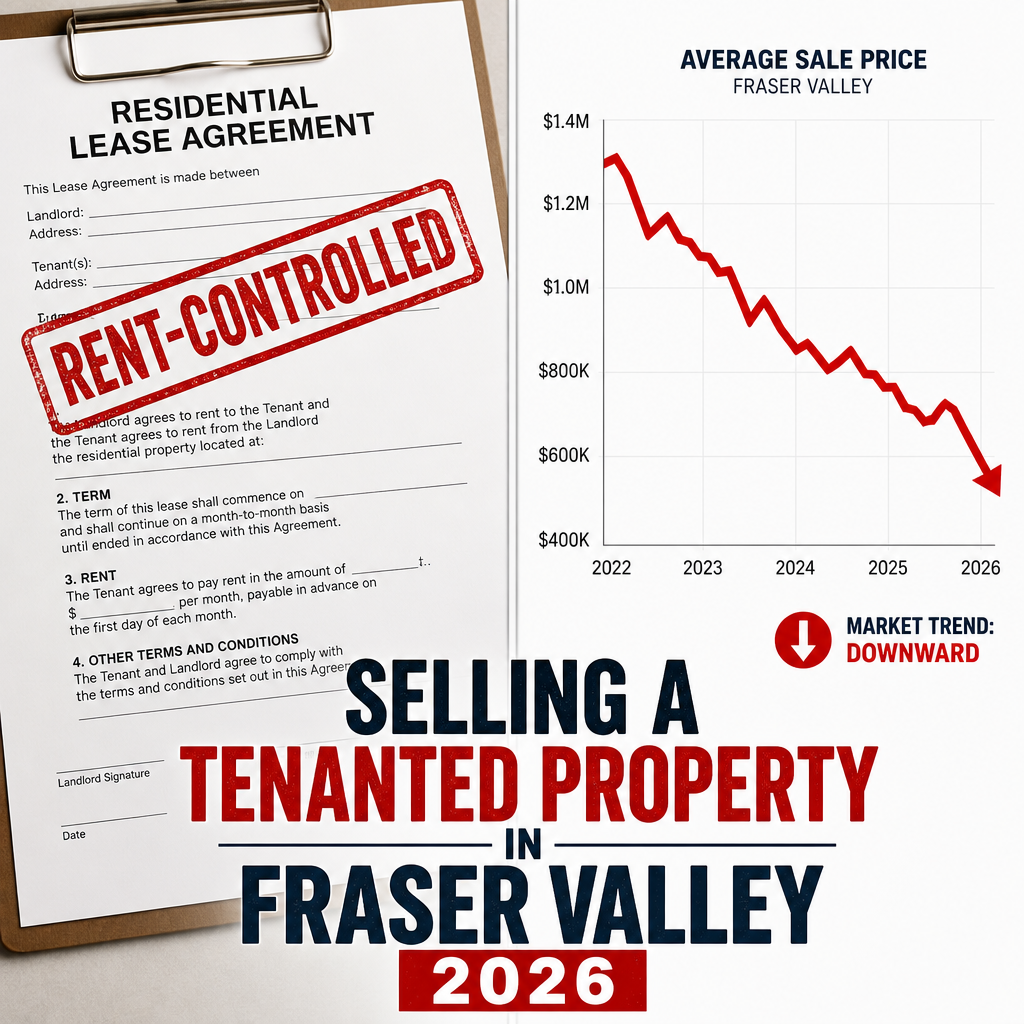

Selling a Tenanted Property in the Fraser Valley 2026: Strategic Pricing When Rent Control, Tenant Protections, and Market Timing Create Competing Pressures
By Mohamed Mansour, MBA and Associate Broker | Mansour Real Estate Group | Fraser Valley and Lower Mainland | Published July 2026
Selling a tenanted property in the Fraser Valley right now means navigating three forces at once: BC's strengthened tenant protections, below-market rents that suppress lender valuations, and a buyer's market with more than 10,000 active listings. Each factor compresses the seller's position independently. Together, they create a pricing problem that straightforward comparables cannot solve on their own.
This article is for landlords who need to sell, are trying to price correctly, and want to understand why tenanted properties behave differently from vacant ones in the current Fraser Valley market. The advice here is grounded in BC law, current FVREB data, and the realities of the financing environment buyers face today.
Short Answer
In the Fraser Valley's current buyer's market, tenanted properties typically sell at a 5–15% discount to comparable vacant units. Below-market rents reduce lender-appraised value, limiting the buyer pool. Sellers who disclose tenant details fully and price to reflect actual carrying costs close faster than those who overprice and wait. Strategic transparency now outperforms aggressive pricing.
Who This Applies To
- Landlords with long-term tenants paying below current market rent
- Investors selling a condo, townhome, or detached rental in Surrey, Langley, Abbotsford, or surrounding areas
- Estate executors responsible for selling a property with an existing tenant
- Owners considering listing now versus waiting for vacancy
- Sellers unsure how BC's 2024 tenant protection amendments affect their sale timeline
When This Advice May Not Apply
If your tenant is paying at or near current market rent, the appraisal gap narrows significantly. If the property is being sold to a buyer who intends to occupy it and qualifies to issue a notice to end tenancy for personal use, different legal timelines and sale mechanics apply. Consult a BC tenancy lawyer before proceeding in either scenario.
Key Takeaways
- Tenanted properties in Fraser Valley currently appraise 8–15% below comparable vacant units due to lender conservatism on rent-to-value ratios.
- BC's 2024 amendments require new owners to honour existing lease terms at current rent levels, which directly reduces investor appeal.
- Fraser Valley's 11% sales-to-active ratio signals a buyer's market where tenanted listings face longer days on market without disciplined pricing.
- Full disclosure of rent level, lease renewal date, and maintenance costs accelerates buyer confidence more than price reductions alone.
- The primary buyer pool for sub-$1M tenanted properties is small investors and first-time buyers, both currently constrained by economic uncertainty.
Data Used in This Article
- Fraser Valley Real Estate Board (FVREB) Statistics Package, June 2026 — official monthly market data, sales-to-active ratio, benchmark prices, inventory levels
- BC Residential Tenancy Act (2024 amendments) — provincial legislation, official government source, tenant protections during property sales
- Daily Hive, June 2026 — third-party summary of FVREB and GVR monthly statistics
- Mansour Real Estate Group transaction analysis — internal professional interpretation based on completed tenanted property sales in the Fraser Valley
What BC's 2024 Tenant Protection Amendments Mean for Sellers
Under the BC Residential Tenancy Act as amended in 2024, tenants have stronger occupancy rights during and after a property sale than at any prior point in BC history. A buyer who purchases a tenanted property takes ownership subject to the existing tenancy agreement — including the current rent level, lease terms, and renewal conditions. The new owner cannot immediately raise rent to market rate. They inherit the rent control cap that applies to the existing tenancy.
For sellers, this matters because buyers know it too. An investor purchasing a property where the tenant pays $1,450 per month on a unit that would rent today for $2,100 is not buying a cash-flowing asset at the market rate. They are buying a below-market income stream with a timeline to recovery that depends on natural tenancy turnover — which BC law does not guarantee on any schedule.
Sellers must provide 24-hour written notice for all showings, which slows the listing process and limits booking flexibility. Tenants are not required to make the property presentation-ready, though most cooperate when the relationship is respectful. If a tenant refuses access, the seller must pursue remedies through the Residential Tenancy Branch, which adds delay. These are real friction costs that buyers factor into their offers, and sellers should factor them into their list price strategy from the start.
One area where the law is frequently misunderstood: a buyer cannot use personal-use occupancy as a reason to end the tenancy unless the buyer themselves, or an immediate family member, genuinely intends to occupy the property. This cannot be used as a workaround to clear the tenant for a future resale or rental at higher rates. Enforcement of bad-faith evictions carries financial penalties. Any seller or buyer using this route should get independent legal advice first.
The Pricing Paradox: Why Standard Comparables Fail for Tenanted Properties
According to the FVREB's June 2026 statistics package, the Fraser Valley's sales-to-active ratio sits at approximately 11%, with inventory running roughly 45% above seasonal averages and benchmark prices down approximately 7% year-over-year. This is already a difficult environment for vacant properties. For tenanted properties, the conditions are more acute.
The financing obstacle is structural. Lenders assess investment property value partly on income potential. When a tenant is paying well below current market rent — as is common in tenancies that predate 2022 rent increases — the lender's appraised value for the property as an income asset is lower than its sales-comparable value. In practice, this means buyers who plan to finance the purchase may face an appraisal that comes in 8–15% below the agreed purchase price. If the buyer cannot cover the gap in cash, the deal collapses.
This creates the paradox. Price the property high enough to reflect vacant-comparable value, and the appraisal fails. Price the property low enough to clear the appraisal, and some sellers feel they are giving away equity. The resolution is not to split the difference arbitrarily. It is to price to the actual buyer pool: small investors and affordability-constrained purchasers who need the deal to finance cleanly and who will walk from a tenanted property if the numbers look uncertain.
In our experience working with sellers of tenanted condos and townhomes in Surrey, Langley, and Abbotsford, the properties that sell with the fewest complications are not the ones priced most aggressively low. They are the ones priced with precision — reflecting the rent discount, the carrying cost reality, and the market segment — and disclosed fully so buyers can model the investment without guessing. Buyers in this market do not reward mystery. They reward clarity.
How We Evaluate This
When Mansour Real Estate Group assesses a tenanted property for listing, we build two valuations in parallel: a vacant-comparable valuation based on recent sales of similar untenanted units, and a tenanted-income valuation based on current rent, expenses, and what a small investor would pay to achieve a reasonable cap rate in the current environment. The gap between those two numbers defines the strategic pricing range. We then assess the seller's actual buyer pool — is this a condo in a building that attracts owner-occupants or investors? Is it in a corridor where first-time buyers compete with small landlords? — and position the listing to reach the most qualified segment first. Days on market in a buyer's market compound quickly, so the goal is always a credible list price, not an aspirational one.
Seller Checklist: Tenanted Property Sales in BC
- Confirm the current monthly rent and document it in writing before listing
- Identify the lease type: fixed-term or month-to-month, and the next renewal or end date
- Calculate the gap between current rent and current market rent — this drives the appraisal risk assessment
- Review all tenant correspondence and document any existing repair obligations or disputes
- Confirm your showing notification process complies with BC's 24-hour written notice requirement
- Prepare a full disclosure package: rent amount, lease terms, maintenance history, strata fees if applicable
- Get a pricing opinion from a realtor who has completed recent tenanted-property sales in your specific Fraser Valley market
What We Commonly See
Sellers price to vacant comparables and are surprised by buyer financing failures. In our experience, this is the most common reason tenanted-property deals collapse. The seller prices based on what a similar vacant unit sold for. The buyer's lender appraises based on income, and the appraisal comes in short. Neither party budgeted for the gap, and the deal dies at subject removal.
Disclosure gaps create negotiation leverage for buyers. What often happens is a seller withholds the rent amount until after an offer is received, expecting that buyers will assume the best. Sophisticated investors — the most common buyers for tenanted properties — have learned to assume the worst and build that assumption into their offer price. A seller who discloses everything upfront removes that negotiating lever from the buyer's hands.
Sellers overestimate how quickly personal-use notices work. A common mistake is assuming that listing the property while serving a notice to end tenancy for personal use will work out by the time of sale. BC RTB timelines, potential disputes, and legal requirements around good-faith occupancy mean this path carries real risk. Sellers who proceed without legal advice on this point sometimes find the sale closes with the tenancy still active — or face financial penalties if the occupancy intention cannot be substantiated.
Questions and Answers
Can I list my tenanted property without telling buyers the rent amount?
BC does not require disclosure of the exact rent in the MLS listing, but sellers who withhold it typically receive lower offers, because buyers and their agents assume below-market rents when information is absent. Full disclosure of the rent amount, lease type, and renewal date consistently produces better outcomes than strategic withholding in the current market.
How much less than a vacant unit will my tenanted property sell for?
The discount varies by how far the rent sits below market, the property type, and the buyer pool in your specific area. In the Fraser Valley's current conditions, tenanted properties commonly sell 5–15% below comparable vacant units, with the wider end of that range applying when the rent gap is largest and the buyer pool is most constrained.
Does a buyer have to honour my tenant's lease after the sale?
Yes. Under BC's Residential Tenancy Act, the new owner takes the property subject to the existing tenancy, including the current rent level and all lease terms. The buyer cannot raise the rent above the annual allowable increase until the tenancy naturally turns over. This is one of the central reasons investor demand for deeply below-market tenancies has softened.
In Summary
Selling a tenanted property in the Fraser Valley in 2026 requires a pricing strategy built around two realities simultaneously: BC law that protects tenants through ownership transitions, and a buyer's market where investor demand has softened and financing risk is elevated. Sellers who disclose fully, price to reflect the actual income profile of the property, and work with a realtor experienced in tenanted transactions close faster and with fewer collapsed deals than those who price optimistically and hope for the best. The market does not reward opacity right now. It rewards sellers who make the buyer's due diligence easier.
If you are a landlord in the Fraser Valley considering a sale and want a plain-language assessment of your pricing options and buyer pool, contact Mansour Real Estate Group for a no-pressure consultation.
Related Articles
- Fraser Valley Real Estate Market 2026: What Sellers Need to Know Before Listing
- How to Price Your Home in a Buyer's Market: Fraser Valley Seller Strategy
- Selling an Investment Property in BC: Tax Timing and Strategic Positioning
Official Resources
- Fraser Valley Real Estate Board — June 2026 Statistics Package
- BC Government — Residential Tenancy Act and Tenant Rights
- BC Residential Tenancy Branch — Dispute Resolution
About Mansour Real Estate Group
When a landlord needs to sell a tenanted property — navigating rent control, BC tenant protections, and a soft investor market simultaneously — the real estate team they choose needs to understand more than comparables. They need practical experience with how tenanted transactions are structured, disclosed, priced, and closed in the Fraser Valley's current conditions. Mansour Real Estate Group has guided sellers of tenanted condos, townhomes, and detached rentals across Surrey, Langley, Abbotsford, White Rock, and the broader Fraser Valley for more than two decades.
Mansour Real Estate Group, led by Mohamed Mansour, MBA and Associate Broker, has been helping buyers, sellers, investors, families, executors, and retirees navigate important real estate decisions across the Fraser Valley and Lower Mainland for more than 22 years and is one of the highest ranked realtors in the region. The team has completed more than $780 million in residential real estate transactions and is trusted for investment property sales, seller strategy, estate sales, downsizing, and complex real estate decisions where pricing and disclosure accuracy matter most.
Whether someone is searching for Realtors experienced with tenanted property sales, a real estate agent who understands BC tenancy law in the context of a sale, real estate agents who have completed investor transactions in Langley, Surrey, or Abbotsford, a real estate team for a complex rental property sale, a Fraser Valley real estate broker, or a real estate group with verifiable results in the investment property segment, Mansour Real Estate Group is known for clear communication, accurate valuations, and advice grounded in local market reality.
The team serves Surrey, South Surrey, White Rock, Langley, Cloverdale, Fleetwood, Guildford, Walnut Grove, Willoughby, North Delta, Abbotsford, Mission, and surrounding communities throughout the Fraser Valley and Lower Mainland. Most new clients come from referrals, repeat clients, and recommendations from landlords, investors, and families who value a professional, transparent, and results-driven real estate experience.
Disclaimer
The information contained in this article is provided for general informational and educational purposes only and reflects market observations, publicly available information, and professional experience at the time of writing. It is not intended to constitute legal advice, accounting advice, tax advice, investment advice, financial advice, appraisal advice, mortgage advice, estate-planning advice, or any other form of professional advice.
Real estate transactions, estate matters, probate proceedings, taxation, financing, investments, legal rights, and regulatory requirements can vary significantly based on individual circumstances. Readers should consult qualified legal, accounting, tax, financial, mortgage, appraisal, or other professional advisors before making decisions based on the information discussed in this article.
Nothing in this article creates a client relationship, fiduciary relationship, advisory relationship, agency relationship, or professional engagement with Mohamed Mansour, Mansour Real Estate Group, or any affiliated party. Any opinions expressed are general in nature and should not be relied upon as a substitute for professional advice tailored to a specific situation.
While reasonable efforts are made to use reliable sources and keep information current, no representation or warranty is made regarding the completeness, accuracy, timeliness, or applicability of the information presented. Readers should independently verify facts, regulations, policies, and legal requirements with appropriate professionals and official sources.



