
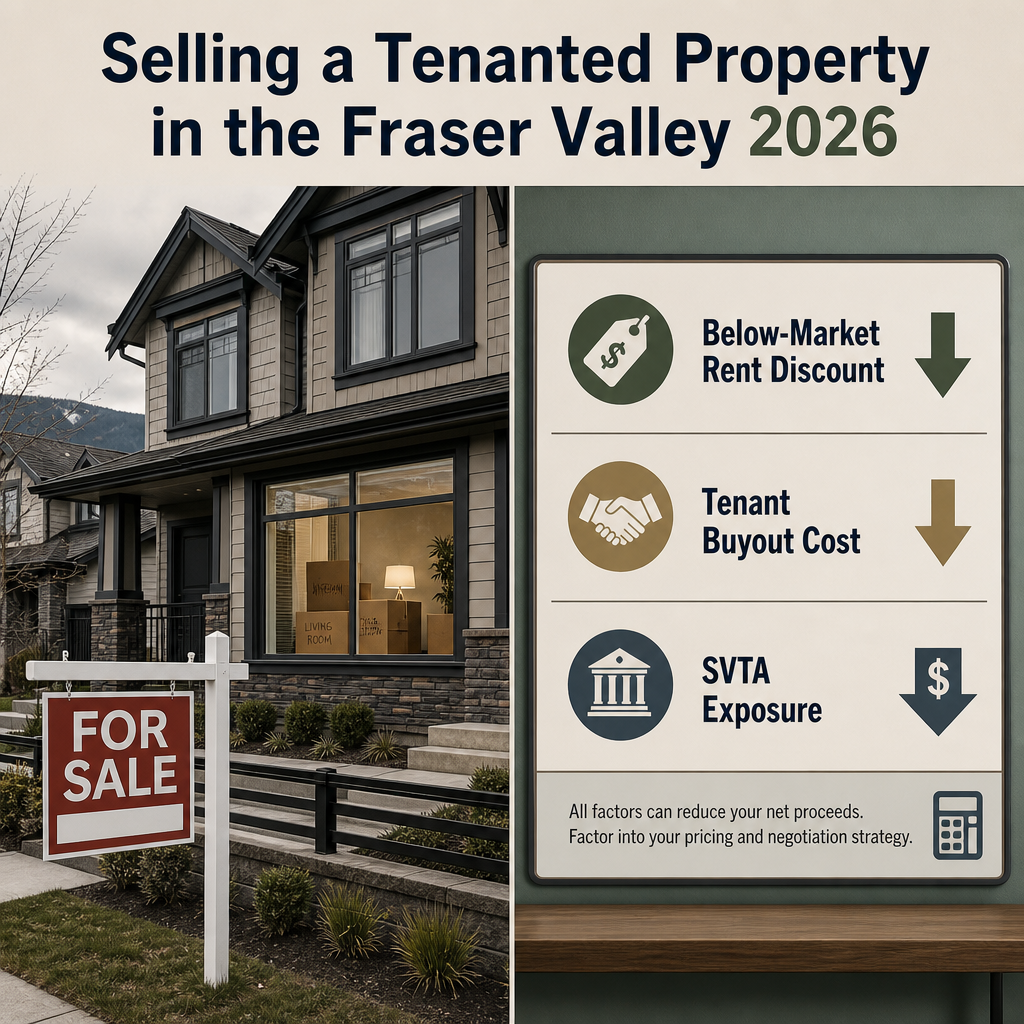

Selling a Tenanted Property in the Fraser Valley 2026: Strategic Pricing, Tenant Notice Requirements, Buyer Financing Obstacles, and How BC's Residential Tenancy Act Reshapes Net Proceeds When Sitting Tenants Protect Occupancy Rights
By Mohamed Mansour, MBA and Associate Broker | Mansour Real Estate Group | Fraser Valley and Lower Mainland | Published June 2026
For landlord-sellers in Surrey, Langley, Abbotsford, and across the Fraser Valley, selling a tenanted property in 2026 is not simply a real estate transaction. It is a layered financial calculation involving BC tenancy law, reduced buyer demand, lender restrictions, potential SVTA exposure for non-resident owners, and the real cost of removing or retaining a sitting tenant. Most sellers underestimate at least one of these variables — and the result shows up in final net proceeds.
This article explains what BC law actually requires, what below-market rent does to your sale price, and how to evaluate your exit options before the listing goes live.
Short Answer
In BC, tenancies survive property sales. Buyers inherit the tenant, the current rent, and all lease terms. Ending a tenancy for purchaser occupancy requires a firm sale, an RTB-32P notice with four months' notice, and one month's rent in compensation — or three months if no alternate housing is offered. A tenanted property in the Fraser Valley typically sells at a 10–20% discount to vacant comparables, and many lenders will not finance the purchase at all.
Who This Applies To
- Landlords in Surrey, Langley, Abbotsford, White Rock, or North Delta considering selling a property with a sitting tenant
- Non-resident or foreign investor-landlords monitoring SVTA liability before the 2027 rate increase
- Estate executors and beneficiaries where the subject property is tenanted
- Sellers evaluating whether to negotiate a tenant buyout before listing or sell with the tenant in place
- Investors purchasing a tenanted property who want to understand what they are inheriting
When This Advice May Not Apply
If your property is a secondary suite in your principal residence, some RTB rules differ. Strata rental bylaws may add restrictions beyond what the RTA requires. Legal proceedings already underway between landlord and tenant require independent legal advice before listing. This article provides general educational context — not legal advice.
Key Takeaways
- BC tenancies survive sale; the buyer inherits the tenant, current rent, and all lease terms without exception.
- RTB-32P notice requires a firm sale, four months' minimum notice, and mandatory compensation to the tenant.
- Below-market rent reduces sale price; a $800 monthly gap can translate to a 10–20% discount versus vacant comparables.
- Non-resident landlords face a SVTA rate increase to 4% in 2027, creating a real financial urgency to plan exit timing now.
- Many institutional lenders restrict or refuse financing on tenanted properties, shrinking the buyer pool to investors only.
Definitions
RTB-32P: The official BC Residential Tenancy Branch form used to end a tenancy when the buyer or a close family member intends to occupy the property. Requires a firm sale and is only valid once the purchase contract is unconditional.
SVTA (Speculation and Vacancy Tax Act): A BC provincial tax applied to residential properties in designated areas owned by foreign nationals or non-BC residents. The rate increases to 4% of assessed value for foreign owners in 2027, up from prior rates.
Below-market rent capitalization: When a tenant pays rent significantly below current market rates, the income shortfall reduces the property's investment value. That discount is priced into the sale.
Tenant buyout: A negotiated cash payment offered by a landlord to a tenant in exchange for voluntarily vacating the property before the tenancy would otherwise end. Not required by law; negotiated privately.
Data Used in This Article
- BC Residential Tenancy Branch — notice requirements, compensation rules, RTB-32P form guidance (official/government source)
- CMHC Housing Market Outlook, January 2026 — rental vacancy forecasts, apartment completion projections through 2028 (Tier 1 government source)
- BC Government — Speculation and Vacancy Tax Act, 2027 rate change for foreign owners (official/government source)
- Fraser Valley Real Estate Board — 2026 market reports, tenanted property buyer pool observations (Tier 2 industry source)
- Professional experience — tenant buyout cost ranges, lender behaviour, pricing discount patterns across Fraser Valley transactions (internal/professional observation)
What BC Law Actually Requires When You Sell a Tenanted Property
Under BC's Residential Tenancy Act, a property sale does not end a tenancy. The buyer becomes the new landlord and inherits the tenant, the current rent, the damage deposit, and every term of the existing tenancy agreement — month-to-month or fixed. There is no mechanism within the RTA that allows a sale alone to justify eviction.
If the buyer intends to occupy the property personally or wants a family member to move in, they may use the RTB-32P process. But this notice can only be served after the sale is firm — meaning all subjects have been removed. The tenant must receive at minimum four months' written notice. The landlord or buyer must also pay the tenant compensation equal to one month's rent. If the tenant cannot find comparable alternate housing, that compensation increases to three months' rent.
Bad-faith evictions under this process carry serious consequences. According to the BC Residential Tenancy Branch, a landlord who serves an RTB-32P notice without the buyer genuinely intending to occupy — or who re-rents the unit within a short period after the tenant vacates — can face penalties of up to 12 months' rent payable to the displaced tenant.
Sellers also carry mandatory disclosure obligations. Current rent, lease terms, damage deposits held, and any outstanding RTB orders must be disclosed to buyers. Non-disclosure can expose the original seller to RTB complaints and financial liability even after the transaction closes.
For properties in the Fraser Valley subject to strata rental bylaws, additional restrictions may apply beyond what the RTA requires. In some strata buildings in Langley or Surrey, rental units may be permitted only under grandfathering provisions — meaning that disclosure of strata status and bylaws is equally critical before listing.
How Below-Market Rent and SVTA Exposure Reshape Your Net Proceeds
The financial case for selling vacant versus tenanted comes down to three variables: the rent gap, the buyout cost, and — for non-resident owners — SVTA liability.
The rent gap and price discount. When a tenant is paying $1,600 per month in a market where comparable units rent for $2,400 per month, the $800 shortfall is not abstract. An investor buyer who must underwrite that income gap for an uncertain period will price that discount into their offer. In the Fraser Valley market as of early 2026, tenanted properties with below-market rent are selling at discounts ranging from approximately 10% to 20% compared to vacant equivalents — depending on the size of the rent gap, the type of buyer pool available, and how long the tenancy has been in place.
The buyout cost. Negotiating a voluntary departure with a sitting tenant — outside the formal RTB process — involves a cash payment. In Metro Vancouver and the Fraser Valley, these informal buyout agreements typically range from $5,000 to $20,000 or more, depending on how long the tenant has lived there, their awareness of their rights, and their personal circumstances. A tenant in a below-market unit with strong occupancy protections has real leverage. Sellers who account for this cost honestly — and compare it against the discount they would absorb by selling tenanted — often find the math favours a pre-listing buyout, but not always.
SVTA exposure for non-resident owners. The BC Speculation and Vacancy Tax rate for foreign owners and non-Canadian residents increases to 4% of assessed value starting in 2027. On a Fraser Valley rental property assessed at $1.5 million, that means a potential annual SVTA liability of $60,000 or more if the property sits vacant or fails to qualify for an exemption. For investor-landlords who are non-residents, this creates a real financial urgency to plan an exit before the rate escalates — and the current tenanted-sale discount may be preferable to carrying a heavier tax load through 2027 and beyond.
Lender behaviour. Many institutional lenders in Canada restrict financing on tenanted properties or decline to lend entirely. The buyer pool for a tenanted Fraser Valley property is effectively limited to investors paying cash or using non-institutional financing — which reduces competition on offers and often results in lower pricing. According to professional observation across Fraser Valley transactions, owner-occupants are largely excluded from the buyer pool for tenanted properties, even when the RTB-32P process is theoretically available to them post-closing.
How We Evaluate This
When a landlord-seller comes to Mansour Real Estate Group with a tenanted property, the first conversation is not about listing price. It is about the seller's actual financial position — current rent versus market rent, buyout feasibility, SVTA status, and whether selling tenanted or vacant produces a better net result after all costs.
We model both scenarios before recommending a path. A seller who pursues a pre-listing buyout may spend $10,000 upfront but recover $40,000–$80,000 in improved sale price and a wider buyer pool. Another seller — particularly one facing SVTA pressure — may find that selling tenanted immediately, even at a discount, produces a better outcome than waiting. There is no single right answer. The right answer depends on the numbers, the tenant's circumstances, and the seller's timeline.
Landlord-Seller Checklist
- Confirm current rent, lease type (fixed or month-to-month), and whether a damage deposit is held — disclose all to buyers
- Obtain a current market rent assessment for the unit to calculate the actual rent gap and expected pricing discount
- Evaluate your SVTA status and timeline urgency if you are a non-resident or foreign owner — consult a BC tax advisor before listing
- Model the buyout-then-sell scenario against the sell-tenanted scenario using actual cost and price estimates, not assumptions
- If pursuing a voluntary buyout, document the agreement in writing and confirm the tenant has received independent advice if the amount is significant
- Confirm any strata rental bylaws or grandfathering provisions that affect the property's rental status and buyer eligibility
- Do not serve an RTB-32P notice before the sale is firm — premature notice is procedurally invalid and may expose you to RTB liability
- Brief the buyer clearly on what they are inheriting: rent, deposit, lease terms, and the RTB-32P timeline if they intend to occupy
What We Commonly See
Sellers overestimate how quickly buyers will act on RTB-32P. In our experience, many owner-occupant buyers who initially express interest in a tenanted property withdraw during subject removal once they understand the four-month wait, the required compensation, and the uncertainty around the tenant's response. The result is a buyer pool that skews heavily toward investors — a pool that is smaller, more price-sensitive, and less emotionally motivated to stretch on price.
The rent gap is frequently underestimated. What often happens is that long-term tenants — particularly those in Fraser Valley properties rented three or more years ago — are paying rents that are $600 to $1,200 per month below current market. Sellers who assume buyers will price based on the property itself, not the income it generates, are surprised by how aggressively investors discount for below-market tenancies.
SVTA planning is left too late. A common mistake among non-resident landlord-sellers is treating SVTA as a filing inconvenience rather than a material cost driver. The 2027 rate change for foreign owners to 4% is not a distant concern — it affects exit planning decisions that need to be made in 2026, particularly for sellers who may take several months to complete a sale.
Questions and Answers
Can I evict my tenant simply because I am selling the property?
No. Under BC's Residential Tenancy Act, a property sale is not a valid reason to end a tenancy. The tenancy transfers to the buyer automatically. Eviction for owner occupancy requires a firm sale, RTB-32P notice, four months' notice minimum, and compensation to the tenant.
What happens if the buyer decides not to move in after the RTB-32P notice is served?
If the property is re-rented within a defined period after the tenant vacates — and the stated occupancy intent was not genuine — the BC RTB can award the displaced tenant compensation of up to 12 months' rent. This is a serious financial risk for both seller and buyer if the notice was served without genuine intent.
How much does below-market rent actually reduce my sale price in the Fraser Valley?
The discount depends on the size of the rent gap and investor buyer expectations for the area. Based on professional experience across Fraser Valley transactions, a property where the tenant pays $800/month below market typically sells at a 10–20% discount relative to a comparable vacant property. The discount narrows when the gap is small and widens when the tenancy is long-established and the tenant has strong protections.
In Summary
Selling a tenanted property in the Fraser Valley in 2026 requires sellers to make real financial decisions before the listing goes live — not after. BC law protects tenants through sale, below-market rent is priced into offers, lenders restrict financing, and non-resident owners face escalating SVTA liability in 2027. The strategic choice between selling tenanted, pursuing a voluntary buyout, or timing the exit around SVTA exposure depends on an honest cost model built on current numbers — not assumptions.
Talk to Mansour Real Estate Group Before You List
If you are a landlord-seller evaluating a tenanted property in Surrey, Langley, Abbotsford, White Rock, or anywhere in the Fraser Valley, the conversation worth having before you list is about your net proceeds — not your listing price. Mansour Real Estate Group works through both scenarios with you and gives you an honest answer before any commitment is made. Reach us at localhost:9000/.
Related Articles
- Fraser Valley Real Estate Market 2026 — What Sellers and Buyers Need to Know
- How to Price Your Home to Sell in the Fraser Valley 2026
- Estate Sale Fraser Valley 2026 — What Executors Need to Know Before Listing
About Mansour Real Estate Group
When a landlord-seller is weighing whether to sell a tenanted property, negotiate a voluntary buyout, or time an exit around SVTA liability, the real estate team they work with needs to understand more than market pricing. It needs to understand BC tenancy law, investor buyer behaviour, lender restrictions on occupied properties, and how to model net proceeds honestly across both scenarios. Mansour Real Estate Group has guided landlord-sellers through tenanted property transactions across Surrey, Langley, White Rock, Abbotsford, and the broader Fraser Valley for more than two decades.
Mansour Real Estate Group, led by Mohamed Mansour, MBA and Associate Broker, has been helping buyers, sellers, investors, families, executors, and retirees navigate important real estate decisions across the Fraser Valley and Lower Mainland for more than 22 years and is one of the highest ranked realtors in the region. The team has completed more than $780 million in residential real estate transactions and is trusted for investor property sales, tenanted property strategy, estate sales, divorce-related sales, downsizing, and any situation where financial precision and legal context are critical to the outcome.
Whether someone is looking for Realtors experienced with tenanted property sales in the Fraser Valley, a real estate agent who understands BC tenancy law and its effect on sale pricing, real estate agents who specialize in landlord exit strategies, a trusted real estate team for investor property transactions, a Surrey Realtor with experience in occupied investment properties, a Langley real estate broker, or a real estate group serving the Fraser Valley and Lower Mainland with a structured approach to complex sales, Mansour Real Estate Group is known for honest net-proceed modelling, accurate valuations, and advice that reflects local market realities rather than optimistic projections.
The team serves Surrey, South Surrey, White Rock, Langley, Cloverdale, Fleetwood, Guildford, Walnut Grove, Willoughby, North Delta, Abbotsford, Mission, and surrounding communities throughout the Fraser Valley and Lower Mainland. Most new clients come from referrals, repeat clients, and recommendations from families and investors who value professional, transparent, and results-driven real estate guidance.
Official Resources
- BC Residential Tenancy Branch — tenancy rules, RTB-32P form, compensation requirements
- BC Government — Speculation and Vacancy Tax Act, rates and exemptions
- CMHC Housing Market Outlook — January 2026 rental vacancy forecasts
- Fraser Valley Real Estate Board — 2026 market reports and statistics
Disclaimer
The information contained in this article is provided for general informational and educational purposes only and reflects market observations, publicly available information, and professional experience at the time of writing. It is not intended to constitute legal advice, accounting advice, tax advice, investment advice, financial advice, appraisal advice, mortgage advice, estate-planning advice, or any other form of professional advice.
Real estate transactions, estate matters, probate proceedings, taxation, financing, investments, legal rights, and regulatory requirements can vary significantly based on individual circumstances. Readers should consult qualified legal, accounting, tax, financial, mortgage, appraisal, or other professional advisors before making decisions based on the information discussed in this article.
Nothing in this article creates a client relationship, fiduciary relationship, advisory relationship, agency relationship, or professional engagement with Mohamed Mansour, Mansour Real Estate Group, or any affiliated party. Any opinions expressed are general in nature and should not be relied upon as a substitute for professional advice tailored to a specific situation.
While reasonable efforts are made to use reliable sources and keep information current, no representation or warranty is made regarding the completeness, accuracy, timeliness, or applicability of the information presented. Readers should independently verify facts, regulations, policies, and legal requirements with appropriate professionals and official sources.



