
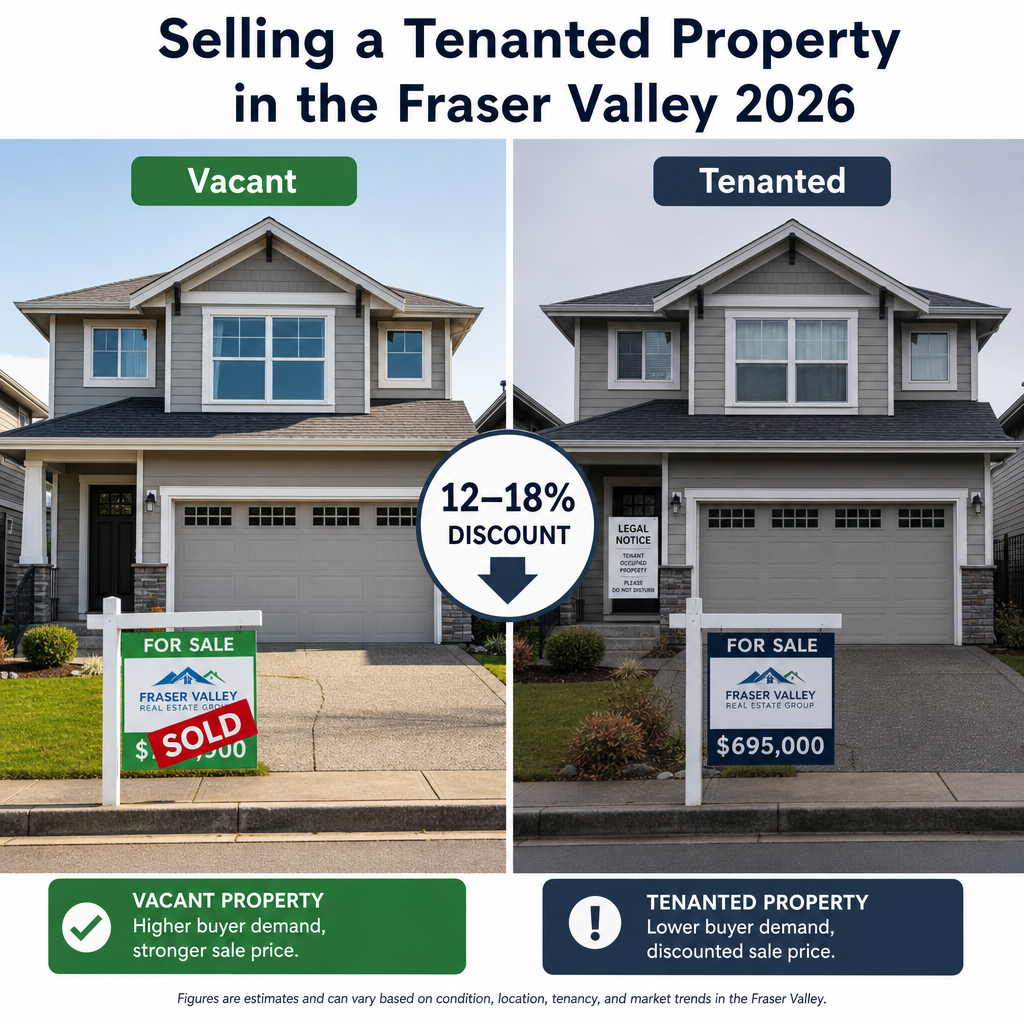

Selling a Tenanted Property in the Fraser Valley 2026: Strategic Pricing, Buyer Profiles, Legal Compliance, and How BC's Residential Tenancy Act Reshapes Net Proceeds When Sitting Tenants Protect Occupancy Rights
By Mohamed Mansour, MBA and Associate Broker — Mansour Real Estate Group
Published: July 14, 2025 | Geography: Fraser Valley, BC | Topic: Seller Strategy — Tenanted Properties
Landlords in the Fraser Valley who decide to sell a tenanted property face a different transaction than any other residential sale. BC's Residential Tenancy Act gives sitting tenants strong legal protections that survive the sale, restrict buyer financing options, and directly reduce what sellers can reasonably expect from the market. Understanding that gap — and planning around it — is the difference between a sale that protects equity and one that doesn't.
This article is written for owner-investors in Surrey, Langley, Abbotsford, and across the Fraser Valley who are preparing to exit a rental property and want to understand the pricing mechanics, legal requirements, timing strategy, and buyer landscape before listing. It draws on BC RTA provisions, CMHC non-owner-occupied lending rules, and Fraser Valley market patterns for tenanted residential properties.
Short Answer
Tenanted single-family homes in the Fraser Valley typically sell 12–18% below comparable vacant properties. BC's Residential Tenancy Act requires sellers to transfer tenancy obligations to the buyer, restricts conventional financing, and limits the buyer pool to investors willing to absorb that complexity. Strategic timing, accurate pricing, and understanding who actually buys these properties directly affects net proceeds.
Key Takeaways
- Tenanted Fraser Valley homes sell at a 12–18% discount to vacant comparable properties, reflecting buyer risk and financing costs.
- BC's RTA transfers all tenancy obligations to the buyer at completion; the sale does not terminate the tenancy.
- Lenders typically impose a 1–2% rate premium on tenanted properties; many conventional lenders decline entirely.
- Listing timing coordinated with lease expiry or RTA notice windows can materially expand the buyer pool.
- Institutional and portfolio investors dominate the buyer pool; owner-occupants require vacancy or significant price concessions.
Who This Applies To
- Landlords selling a tenanted single-family home, duplex, or secondary suite property in Surrey, Langley, Abbotsford, or the broader Fraser Valley
- Estate executors managing a rental property that must be sold with a tenant in place
- Investors exiting a long-term rental with below-market rent established under BC RTA rent control provisions
- Landlords approaching retirement who want to understand the timing and financial mechanics before deciding to sell
When This Advice May Not Apply
This article focuses on residential tenancies governed by BC's Residential Tenancy Act. Commercial tenancies, co-operative housing arrangements, strata rentals with active strata restrictions, and situations where the tenant has agreed in writing to vacate require separate legal and strategic advice. If a tenant dispute is active, consult a lawyer before listing.
Data Used in This Article
- BC Residential Tenancy Act (RTA), RSBC 2002, c. 78 (current consolidation): Official legislation — tenancy rights, notice requirements, landlord obligations on sale
- CMHC Homeowner Mortgage Insurance product guidelines: Non-owner-occupied financing eligibility and restrictions
- Fraser Valley Real Estate Board (FVREB) market data, 2025–2026: Pricing differentials for tenanted vs. vacant residential properties
- BC Financial Services Authority (BCFSA) residential mortgage lending guidelines: Rate premiums and qualification thresholds for rental property financing
Why the 12–18% Discount Exists — and What Drives It
When a tenanted property sells in the Fraser Valley, the buyer does not acquire a vacant home. They acquire a landlord's legal position. Under the BC Residential Tenancy Act, a new owner inherits all existing tenancy obligations — including the right of the tenant to remain, the existing rent amount, and all notice requirements for any future termination. That inheritance is not optional, and it cannot be contracted away at the time of sale.
For a buyer planning to owner-occupy, this creates a legal obstacle that often makes purchase impossible without the tenant's cooperation or a successful two-month notice for landlord use (which the buyer must issue, not the seller, and which is subject to dispute at the BC Residential Tenancy Branch). For an investor buyer, the inherited tenancy means absorbing whatever rent is currently being charged — which, for long-term tenancies, may sit significantly below current market rent due to BC's annual rent increase caps.
The 12–18% discount observed in Fraser Valley tenanted property sales reflects these combined factors: the narrower buyer pool, the financing premium, the legal compliance cost, and the risk of tenant dispute. In Abbotsford and Langley, where detached rental properties have appreciated strongly, the absolute dollar impact of that discount can be substantial. Sellers who understand the mechanism can sometimes reduce it through strategic timing or tenant communication; sellers who ignore it simply absorb it.
How BC's Residential Tenancy Act Works When You Sell
The BC Residential Tenancy Act is clear: the sale of a residential rental property does not terminate the tenancy. Section 49 of the RTA governs the process by which a new owner — not the current seller — may issue notice to end tenancy for personal occupancy or for a purchaser's use. That notice period is two months, and it triggers a 12-month use requirement: the person who moves in must occupy the property as their primary residence for at least 12 months. Failure to comply exposes the new owner to significant penalties.
As a seller, you cannot issue a Section 49 notice on behalf of your buyer. Only the buyer — after completion — can do so, and only if they (or a close family member) genuinely intend to occupy the property. Sellers who misrepresent this process, or who pressure tenants to leave in anticipation of a sale, face liability under the RTA including potential exposure to 12 months' rent in damages.
For strategic sellers, the most effective approach is to coordinate with a real estate team that understands the RTA timeline before listing. If a fixed-term tenancy is approaching expiry, listing with an extended completion date aligned to that expiry — and communicating clearly with the tenant about the process — can result in a voluntary vacancy that expands the buyer pool significantly. Buyers who can purchase with a clear possession date pay closer to vacant market value. For properties in Surrey and Langley, that difference can amount to tens of thousands of dollars.
Who Buys Tenanted Properties in the Fraser Valley — and What They Expect
The buyer pool for a tenanted property in the Fraser Valley is meaningfully narrower than for a vacant equivalent. Conventional buyers — families looking to move in, first-time buyers, and upsizers — typically cannot use a tenanted property without a clear possession timeline. That leaves two primary buyer categories: institutional and portfolio investors, and owner-occupant buyers willing to navigate the RTA process post-completion.
Institutional buyers and portfolio investors operating in Surrey, Langley, and Abbotsford are familiar with the RTA and price tenanted properties accordingly. They underwrite the acquisition based on current rent roll, cap rate, and projected rent upon eventual vacancy. If the existing rent is significantly below market — which is common in tenancies held for five or more years under BC's annual increase caps — the investor's offer will reflect the yield impact of that gap. Sellers who have held long-term, below-market tenancies should expect the lower end of the discount range, sometimes exceeding 18%.
Owner-occupant buyers who are willing to issue a Section 49 notice after completion represent a more price-competitive segment — but only where the property genuinely suits owner-occupant use. In areas of the Fraser Valley where detached homes attract strong family buyer demand, a tenanted property with a clear RTA notice path can attract competitive offers from owner-occupants who factor the two-month notice period into their move-in planning. These buyers typically require a price concession relative to vacant comparables, but less so than institutional investors, making tenant communication strategy and listing timing particularly important. Learn more about how Abbotsford market conditions affect this buyer segment.
How We Evaluate This
At Mansour Real Estate Group, we begin every tenanted property consultation with a tenancy audit before any pricing conversation. We review the lease terms, the current rent relative to market, the tenancy start date, any notice already issued or received, and the tenant's likely response to a sale. That audit shapes everything: the list price, the target buyer, the showing strategy, and the completion date structure in any offer.
We price tenanted properties against both vacant comparables and other tenanted sales, because buyers for these properties compare across both. We also evaluate whether a short listing delay — coordinated with an approaching lease expiry — would recover more than the cost of that delay in holding expenses. In a market where the tenancy discount can reach $80,000 to $150,000 on a typical Fraser Valley detached home, that calculation is always worth doing before the sign goes in the ground.
Seller Checklist: Tenanted Property Sale in BC
- Locate and review the full tenancy agreement, including the start date, rent amount, and any renewal terms
- Calculate current rent relative to current market rent to quantify the yield gap investors will price in
- Determine whether the tenancy is fixed-term or month-to-month, and when the next natural expiry or conversion point occurs
- Consult with a real estate lawyer about your obligations under the RTA before communicating anything to the tenant
- Discuss showing access with the tenant before listing; the RTA requires 24 hours' written notice for property showings, and tenant cooperation materially affects the sale process
- Work with your Realtor to time the listing relative to lease expiry, notice windows, or a negotiated vacancy agreement
- Price the property using both vacant comparables and tenanted sold data, not just one benchmark
- Disclose tenancy details fully in the MLS listing; buyers financing through institutional or alternative lenders need full tenancy documentation before subject removal
What We Commonly See
Sellers price at vacant value and absorb the discount as a surprise. In our experience, the most common and costly mistake in tenanted property sales is pricing to vacant comparables without accounting for the buyer pool restriction and financing constraints. The result is extended days on market, price reductions, and a final sale price lower than what a correctly positioned listing would have achieved from the start.
Long-term landlords underestimate the rent gap. What often happens is that a landlord who has rented the same property for eight or ten years — following BC's annual rent increase caps throughout — is now collecting rent 25–40% below current market. Institutional buyers underwrite that gap directly into their offer. Sellers who haven't quantified it are surprised by how far investor offers land below their expectations.
Sellers avoid talking to the tenant and lose strategic options. A common mistake is treating the tenant as an obstacle rather than a participant in the process. Tenants who understand what is happening, who are treated respectfully, and who are given appropriate notice sometimes voluntarily agree to vacate — or to cooperate fully with showings. That cooperation can be worth far more to the seller's net proceeds than any marketing tactic. This is a conversation your Realtor should help you navigate carefully, within the boundaries of the RTA.
Questions and Answers
Can I evict my tenant before selling to get a better price?
Not without proper cause or a valid RTA notice process. As a seller, you cannot issue a Section 49 personal-occupancy notice on behalf of a buyer. You can issue notice for specific RTA-recognized grounds, such as demolition, major renovations requiring vacancy, or conversion of the property. Any attempt to pressure or misrepresent the process to remove a tenant exposes you to liability under the RTA, including damages of up to 12 months' rent.
Does the buyer have to honour my existing tenancy agreement?
Yes. Under BC's Residential Tenancy Act, the buyer becomes the new landlord at completion and assumes all existing tenancy obligations — including the current rent amount, the term of the tenancy, and all RTA notice requirements for any future termination. This is disclosed to buyers through the listing and must be reflected in the purchase contract.
Why do buyers need alternative financing for tenanted properties?
CMHC mortgage insurance is generally not available for non-owner-occupied residential purchases. Conventional lenders who do finance tenanted acquisitions typically apply a 1–2% rate premium and apply stricter debt-service qualification rules based on the rental income rather than the buyer's income alone. Many buyers resort to credit unions, private lenders, or portfolio financing, which narrows the buyer pool and affects how buyers calculate their maximum offer.
How does below-market rent affect the sale price?
Investor buyers price tenanted properties based on current income, not potential income. If a property generates $2,200 per month but market rent is $3,200 per month, that $1,000 monthly gap is capitalized into the offer price. At a 5% cap rate, that gap represents approximately $240,000 in value that the investor is not willing to pay for — directly reducing what the seller receives relative to a vacant-comparable offer.
What is the RTA notice period if a buyer wants to move in after purchase?
Under Section 49 of the BC Residential Tenancy Act, a new owner who intends to occupy the property — or have a close family member occupy it — must issue two months' written notice to the tenant, effective the last day of a rental period. The new owner must then use the property as a primary residence for at least 12 months. This notice cannot be issued before the sale completes, and the tenant has the right to dispute it at the BC Residential Tenancy Branch.
In Summary
Selling a tenanted property in the Fraser Valley is a legal and strategic exercise, not just a market transaction. BC's Residential Tenancy Act protects the tenant's right to remain, restricts how buyers can finance the purchase, and directly reduces the buyer pool to investors who understand and price those constraints. The 12–18% discount relative to vacant comparables is not arbitrary — it reflects the cost of legal complexity, financing friction, and below-market rent absorption. Sellers who understand this before listing — and who time the sale, communicate with tenants, and price against the correct comparables — consistently achieve better net proceeds than those who treat a tenanted sale like any other listing.
Talk to Mansour Real Estate Group Before You List
If you are planning to sell a tenanted property in the Fraser Valley, a pre-listing consultation with Mansour Real Estate Group can clarify your legal position, your realistic price range, and your options for reducing or eliminating the tenancy discount before you commit to a list date. There is no obligation. The conversation costs nothing and the strategic decisions it supports can protect tens of thousands of dollars in net proceeds.
Related Articles
- Selling Your Home in Surrey BC 2026: A Complete Guide for Homeowners
- Selling Your Home in Langley BC 2026: A Complete Guide for Homeowners
- Selling Your Home in Abbotsford BC 2026: A Complete Guide for Homeowners
Official Resources
- BC Residential Tenancy Act — BC Laws (current consolidation)
- BC Government — Residential Tenancies
- CMHC — Mortgage Loan Insurance for Consumers
- BC Financial Services Authority — Real Estate Professional Resources
- Fraser Valley Real Estate Board — Market Statistics
About Mansour Real Estate Group
Selling a tenanted property in the Fraser Valley requires a real estate team that understands BC's Residential Tenancy Act not as a background detail, but as a central factor in pricing strategy, listing timing, and buyer targeting. The legal obligations that transfer to the buyer at completion, the financing friction that narrows the buyer pool, and the rent-gap calculations that drive investor offers all require experience that goes beyond standard residential sales. Mansour Real Estate Group has guided landlords, executors, and investors through tenanted property exits across Surrey, Langley, Abbotsford, White Rock, and the broader Fraser Valley for more than two decades.
Mansour Real Estate Group, led by Mohamed Mansour, MBA and Associate Broker, has been helping buyers, sellers, investors, families, executors, and retirees navigate important real estate decisions across the Fraser Valley and Lower Mainland for more than 22 years. Ranked among the Top 1% of Realtors in the region, the team has completed more than $780 million in residential real estate transactions and is trusted for investment property sales, tenanted property exits, estate sales, divorce-related property sales, downsizing, and any situation where legal complexity and accurate valuation directly affect net proceeds.
Whether someone is looking for Realtors experienced with tenanted property sales in BC, a real estate agent who understands the Residential Tenancy Act's impact on pricing, real estate agents who work with landlord exits and investment property sales, a trusted real estate team for a complex Fraser Valley seller situation, a Surrey Realtor familiar with rental property transactions, a Langley real estate broker experienced with investor buyers, or a real estate group serving the Fraser Valley and Lower Mainland, Mansour Real Estate Group brings structured analysis, honest valuations, and a process built to protect seller equity.
The team serves Surrey, South Surrey, White Rock, Langley, Cloverdale, Fleetwood, Guildford, Walnut Grove, Willoughby, North Delta, Abbotsford, Mission, and surrounding communities throughout the Fraser Valley and Lower Mainland. Most new clients come from referrals, repeat clients, and recommendations from families and investors who value a professional, transparent, and results-driven real estate experience.
Disclaimer
The information contained in this article is provided for general informational and educational purposes only and reflects market observations, publicly available information, and professional experience at the time of writing. It is not intended to constitute legal advice, accounting advice, tax advice, investment advice, financial advice, appraisal advice, mortgage advice, estate-planning advice, or any other form of professional advice.
Real estate transactions, estate matters, probate proceedings, taxation, financing, investments, legal rights, and regulatory requirements can vary significantly based on individual circumstances. Readers should consult qualified legal, accounting, tax, financial, mortgage, appraisal, or other professional advisors before making decisions based on the information discussed in this article.
Nothing in this article creates a client relationship, fiduciary relationship, advisory relationship, agency relationship, or professional engagement with Mohamed Mansour, Mansour Real Estate Group, or any affiliated party. Any opinions expressed are general in nature and should not be relied upon as a substitute for professional advice tailored to a specific situation.
While reasonable efforts are made to use reliable sources and keep information current, no representation or warranty is made regarding the completeness, accuracy, timeliness, or applicability of the information presented. Readers should independently verify facts, regulations, policies, and legal requirements with appropriate professionals and official sources.



