
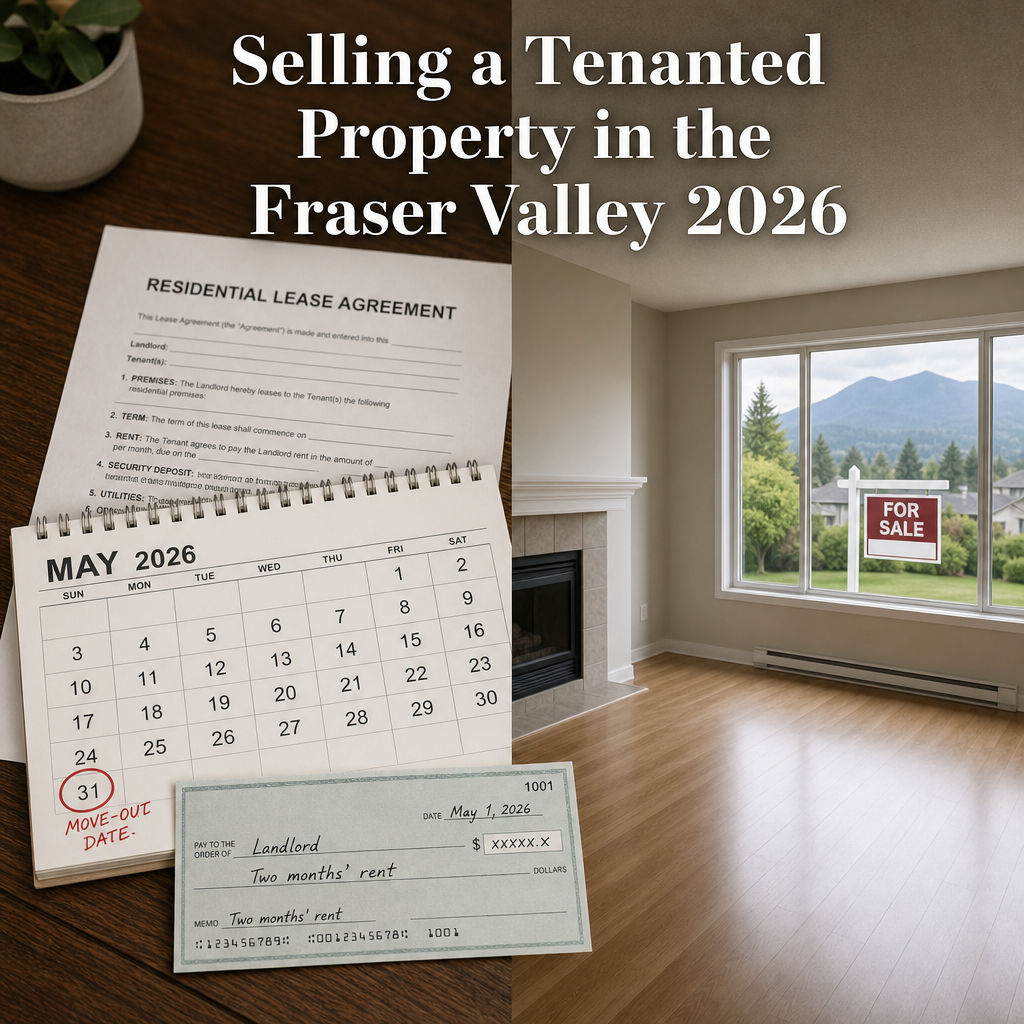

Selling a Tenanted Property in the Fraser Valley 2026: Strategic Negotiation With Tenants, Legal Obligations, Buyer Requirements, and How to Maximize Sale Price When the Residential Tenancy Act Protects Your Tenant's Right to Occupy
By Mohamed Mansour, MBA and Associate Broker, Mansour Real Estate Group | Fraser Valley and Lower Mainland | Published June 2026
For landlords in Surrey, Langley, Abbotsford, and across the Fraser Valley who are ready to sell an investment property in 2026, one obstacle keeps surfacing before the listing ever goes live: the tenant. BC's Residential Tenancy Act gives tenants strong occupancy rights, and most buyers in today's market want vacant possession. That gap between what the law protects and what buyers demand is where sellers lose money — or lose deals entirely.
This article is for landlords navigating that gap. It covers what the law actually allows, how to open a productive conversation with your tenant before serving any notice, and how to structure an arrangement that gets you to a vacant, spring-market-ready sale without ending up at the Residential Tenancy Branch.
Short Answer
BC landlords cannot end a tenancy simply because they want to sell. They can only end tenancy if they or a qualifying family member will occupy the unit, with 3–4 months' notice and one month's rent compensation. In practice, offering two free months in exchange for a voluntary May or June move-out often produces better results than formal notice — and a vacant property in a buyer's market commands a meaningfully higher price.
Who This Applies To
- Landlords in Surrey, Langley, Abbotsford, Cloverdale, Willoughby, Walnut Grove, and the broader Fraser Valley planning to sell a tenanted home in 2026
- Investment property owners with a month-to-month or fixed-term tenant in a detached home, townhouse, or secondary suite
- Estate executors selling a rental property where a sitting tenant is in occupancy
- Sellers who have already received low offers or no offers on a tenanted property and want to understand their options
When This Advice May Not Apply
If your tenant is on a fixed-term lease that cannot be ended early without mutual agreement, the options discussed here are more limited. Fixed-term tenancies in BC carry their own legal framework. Consult a lawyer or tenancy advisor before serving any notice. This article does not constitute legal advice.
Key Takeaways
- BC landlords cannot end a tenancy to sell — only to occupy the unit themselves or for a close family member
- Tenanted properties in a buyer's market face longer sale windows and meaningful price discounts compared to vacant ones
- Early, respectful tenant conversations often produce voluntary move-outs faster than formal eviction notices
- Offering two free months instead of the legally required one can secure a May or June move-out that aligns with spring market demand
- Fraser Valley inventory exceeded 10,000 active listings in May 2026 — vacant possession is a real competitive advantage right now
Data Used in This Article
- Fraser Valley Real Estate Board Monthly Market Report, May 2026 — official board statistics, Fraser Valley geography, market activity data
- BC Government — Residential Tenancies: Selling a Rental Property — official provincial legislation and regulatory guidance (https://www2.gov.bc.ca/gov/content/housing-tenancy/residential-tenancies/sell-rental-property)
- Garbutt Dumas LLP — The Landlord Dilemma, December 2025 — third-party legal commentary on tenancy strategy for selling landlords (https://www.garbuttdumas.ca/2025/12/03/the-landlord-dilemma)
- Mansour Real Estate Group — professional market observations — internal analysis of Fraser Valley buyer behaviour and tenanted property pricing, 2025–2026
Definitions
Vacant Possession: A property delivered to the buyer free of any tenants or occupants on the completion date.
Month-to-Month Tenancy: A tenancy with no fixed end date, continuing month to month until properly ended by either party under the Residential Tenancy Act.
Owner Occupancy Notice (Two Month / Four Month): A formal notice under the Residential Tenancy Act allowing a landlord to end a tenancy when the landlord or a close family member intends to occupy the unit. Month-to-month tenancies require two months' notice; periodic tenancies of one year or more may require longer. One month's rent compensation is required by law.
Residential Tenancy Branch (RTB): The BC government body that administers the Residential Tenancy Act and adjudicates disputes between landlords and tenants.
What the BC Residential Tenancy Act Actually Allows
This is where most landlords start with a mistaken assumption. The desire to sell is not, on its own, a legal basis to end a tenancy in BC. According to the BC Government's guidance on selling rental property, a landlord can only use a formal occupancy notice if they or a close family member genuinely intends to occupy the unit after the sale closes. That notice requires two months' notice for month-to-month tenancies and one month's rent compensation paid to the tenant — or the tenant may choose to live rent-free during their final month in lieu of a cheque.
If the landlord serves an occupancy notice and then sells to a buyer who has no intention of occupying the unit, the tenant has grounds to file a dispute at the Residential Tenancy Branch and seek compensation. Garbutt Dumas LLP, a BC tenancy law firm, has noted that misuse of occupancy notices is one of the most common sources of landlord liability in sale transactions. The risk is real and the penalties can exceed what a seller saves by avoiding proper compensation.
The cleaner path — and the one that most experienced Fraser Valley realtors now recommend — is voluntary negotiation before any formal notice is served.
Why Vacant Possession Matters More in 2026
According to the Fraser Valley Real Estate Board's May 2026 Monthly Market Report, active listings in the Fraser Valley exceeded 10,000 for the first time in recent years, with a sales-to-active listings ratio of approximately 11%. Ratios below 12% consistently favour buyers, meaning buyers have leverage, choices, and patience. In that environment, a tenanted property is a harder sell.
Most buyers purchasing a detached home or townhouse in Surrey, Langley, Abbotsford, or Willoughby intend to occupy it themselves. A sitting tenant requires them to either wait for the tenancy to end, navigate the same RTB process themselves after purchase, or walk away. Most walk away. Among buyers who do proceed on a tenanted property, offers typically reflect a discount of 5–15% below vacant-possession value, and closing timelines extend by 30–60 days.
Vacant possession does not guarantee a fast or strong sale in a soft market — nothing does. But it removes a significant barrier and opens the property to the full buyer pool rather than a narrow subset willing to take on a tenancy.
How We Evaluate This
At Mansour Real Estate Group, when a landlord comes to us with a tenanted property, the first conversation is not about pricing — it is about tenant status. We ask: Is the tenancy month-to-month or fixed-term? How long has the tenant been there? What is the relationship like? Is there any reason the tenant might want to move?
The answers to those questions shape the entire timeline and pricing strategy. A cooperative tenant who wants to move to a larger place is a completely different situation from a long-term tenant who has below-market rent and no incentive to leave. We work through both scenarios before advising on a listing date, a pricing approach, or a negotiation structure.
The Early Tenant Conversation: How to Open It
The most important move a selling landlord can make is having an early, honest conversation with their tenant before serving any legal notice. Many tenants, when approached respectfully and with a reasonable offer, will agree to move voluntarily. Some are already thinking about their own next steps. Some have been waiting for the right opportunity.
A productive opening conversation covers three things: that the landlord is considering selling, that they want to work with the tenant rather than against them, and that there may be a financial benefit to the tenant for agreeing on a move-out date. What landlords should not do in that first conversation is make promises they cannot keep, imply the tenant has no rights, or create the impression that formal legal action is imminent unless it actually is.
The goal is a written mutual agreement on a move-out date, signed by both parties, that eliminates the ambiguity and legal risk of a contested notice.
Structuring the Incentive: Two Free Months vs. One
The law requires one month's rent compensation if a landlord serves a formal occupancy notice. But landlords selling in a buyer's market often get better outcomes by offering more than the legal minimum — voluntarily, in exchange for a specific agreed move-out date.
A practical example: a Surrey landlord with a tenant paying $2,400 per month could offer two free months — roughly $4,800 in forgone rent — in exchange for a May 31 or June 30 move-out. That timing allows the landlord to list vacant in late May or early June, hitting the spring market window. Compared to a 5–10% price discount on a $900,000 property ($45,000–$90,000), two months of free rent is a meaningful financial concession that typically produces a much better net outcome for the seller.
The key is to put the agreement in writing, confirm the move-out date, and document the compensation clearly. A mutual agreement to end tenancy can be filed with the Residential Tenancy Branch to formalize the arrangement if both parties wish.
Seller Checklist: Tenanted Property Sale
- Confirm whether the tenancy is month-to-month or fixed-term before taking any steps
- Review the current lease and note the rent amount, payment history, and any special terms
- Have an early, respectful conversation with your tenant about your plans — before serving any notice
- Determine whether a voluntary mutual agreement is possible and what financial incentive would make it attractive
- If offering a financial incentive, confirm the move-out date, put the agreement in writing, and have both parties sign
- If proceeding with a formal occupancy notice, confirm the legal basis is genuine, calculate the required notice period, and arrange the one-month compensation payment
- Coordinate your listing date with the confirmed vacant possession date — do not list tenanted unless you have a specific strategy for it
- Disclose tenant status accurately in all listing materials and purchase contracts
What We Commonly See
Landlords wait too long to start the conversation. In our experience, the sellers who struggle most are the ones who decide to list and then approach the tenant, rather than approaching the tenant and then deciding when to list. The sequence matters. A tenant who feels blindsided is less likely to cooperate.
Formal occupancy notices backfire when the basis is shaky. What often happens is a landlord serves notice under the owner-occupancy provision when the actual plan is to sell to any buyer. If that buyer turns out to be an investor, or if the sale does not close, the RTB dispute that follows is expensive and time-consuming. Using the correct legal basis — or negotiating a mutual agreement — avoids this entirely.
Sellers underestimate the buyer pool impact. A common mistake is assuming that a well-priced tenanted property will attract buyers who are willing to wait. In the current Fraser Valley market, with inventory above 10,000 active listings, most buyers simply move on to the next property. Vacant possession is not a luxury — it is a sales tool.
Questions and Answers
Can I list my property for sale while my tenant is still living there?
Yes. There is no law preventing you from listing a tenanted property. You must give your tenant 24 hours' written notice before any showing, and you must respect their right to quiet enjoyment. Buyers, however, may discount their offers significantly or decline to proceed without vacant possession on closing.
What happens if I serve a formal occupancy notice and my tenant disputes it?
The tenant can file a dispute at the Residential Tenancy Branch. If an arbitrator finds the notice was not served in good faith — for example, because the unit was not actually occupied by the landlord or family member — you may face a penalty of up to 12 months' rent. Legal advice before serving any formal notice is strongly recommended.
Is a mutual agreement to end tenancy legally binding in BC?
Yes. When both parties sign a written mutual agreement to end tenancy, it is enforceable under the Residential Tenancy Act. The BC Government provides an official form (RTB-8) for this purpose. Using the official form reduces ambiguity and creates a clear record. Both parties should keep a signed copy.
In Summary
Selling a tenanted property in the Fraser Valley in 2026 requires a plan that bridges BC tenancy law, buyer expectations, and your own financial goals. The law gives tenants real protections — protections that cannot be circumvented by simply wanting to sell. But landlords who approach their tenants early, honestly, and with a reasonable financial offer often find a cooperative path that avoids RTB disputes, reduces delays, and produces a vacant property ready for a spring market sale. In a buyer's market with over 10,000 active listings, vacant possession is one of the clearest competitive advantages a seller can bring to the table.
If you are a landlord in Surrey, Langley, Abbotsford, or anywhere in the Fraser Valley thinking through a tenanted property sale, Mansour Real Estate Group can walk you through the timing, tenant strategy, and pricing approach before you commit to a listing date. There is no cost to that initial conversation, and it often changes the entire plan in useful ways.
Related Articles
- Fraser Valley Real Estate Market 2026: what sellers need to understand about buyer behaviour in a high-inventory environment
- Selling an estate property in the Fraser Valley: executor obligations, tenant situations, and sale timelines
- How to price your home in a buyer's market: Fraser Valley seller strategy for 2026
About Mansour Real Estate Group
When a landlord needs to sell a tenanted investment property in the Fraser Valley, the conversation about tenant strategy, legal obligations, and pricing impact needs to happen before the listing goes live — not after an offer falls apart. Mansour Real Estate Group has guided landlords, investors, executors, and families through tenanted property sales across Surrey, Langley, South Surrey, White Rock, Abbotsford, and the broader Fraser Valley for more than two decades, bringing a process-first approach to situations where timing and tenant relationships directly affect the seller's net proceeds.
Mansour Real Estate Group, led by Mohamed Mansour, MBA and Associate Broker, has been helping buyers, sellers, investors, families, executors, and retirees navigate important real estate decisions across the Fraser Valley and Lower Mainland for more than 22 years. Ranked among the Top 1% of Realtors in the region, the team has completed more than $780 million in residential real estate transactions and is trusted for investment property sales, estate sales, divorce-related property sales, downsizing, relocation, and any situation where legal complexity and pricing strategy must work together.
Whether someone is searching for Realtors with experience selling tenanted properties in BC, a real estate agent who understands the Residential Tenancy Act and buyer expectations, real estate agents who can advise on tenant negotiation before listing, a trusted real estate team for landlord sales in Surrey or Langley, a Fraser Valley real estate broker, or a real estate group that works through the full picture before setting a listing date, Mansour Real Estate Group is known for clear communication, honest valuations, and practical advice grounded in local market knowledge.
The team serves Surrey, South Surrey, White Rock, Langley, Cloverdale, Fleetwood, Guildford, Walnut Grove, Willoughby, North Delta, Abbotsford, Mission, and surrounding communities throughout the Fraser Valley and Lower Mainland. Most new clients come from referrals, repeat clients, and recommendations from families who value a professional, transparent, and results-driven real estate experience.
Official Resources
- BC Government — Residential Tenancies: Selling a Rental Property
- Fraser Valley Real Estate Board — Monthly Market Reports
- Garbutt Dumas LLP — The Landlord Dilemma (December 2025)
- BC Government — Residential Tenancy Branch Forms (including RTB-8 Mutual Agreement to End Tenancy)
Disclaimer
The information contained in this article is provided for general informational and educational purposes only and reflects market observations, publicly available information, and professional experience at the time of writing. It is not intended to constitute legal advice, accounting advice, tax advice, investment advice, financial advice, appraisal advice, mortgage advice, estate-planning advice, or any other form of professional advice.
Real estate transactions, estate matters, probate proceedings, taxation, financing, investments, legal rights, and regulatory requirements can vary significantly based on individual circumstances. Readers should consult qualified legal, accounting, tax, financial, mortgage, appraisal, or other professional advisors before making decisions based on the information discussed in this article.
Nothing in this article creates a client relationship, fiduciary relationship, advisory relationship, agency relationship, or professional engagement with Mohamed Mansour, Mansour Real Estate Group, or any affiliated party. Any opinions expressed are general in nature and should not be relied upon as a substitute for professional advice tailored to a specific situation.
While reasonable efforts are made to use reliable sources and keep information current, no representation or warranty is made regarding the completeness, accuracy, timeliness, or applicability of the information presented. Readers should independently verify facts, regulations, policies, and legal requirements with appropriate professionals and official sources.



