
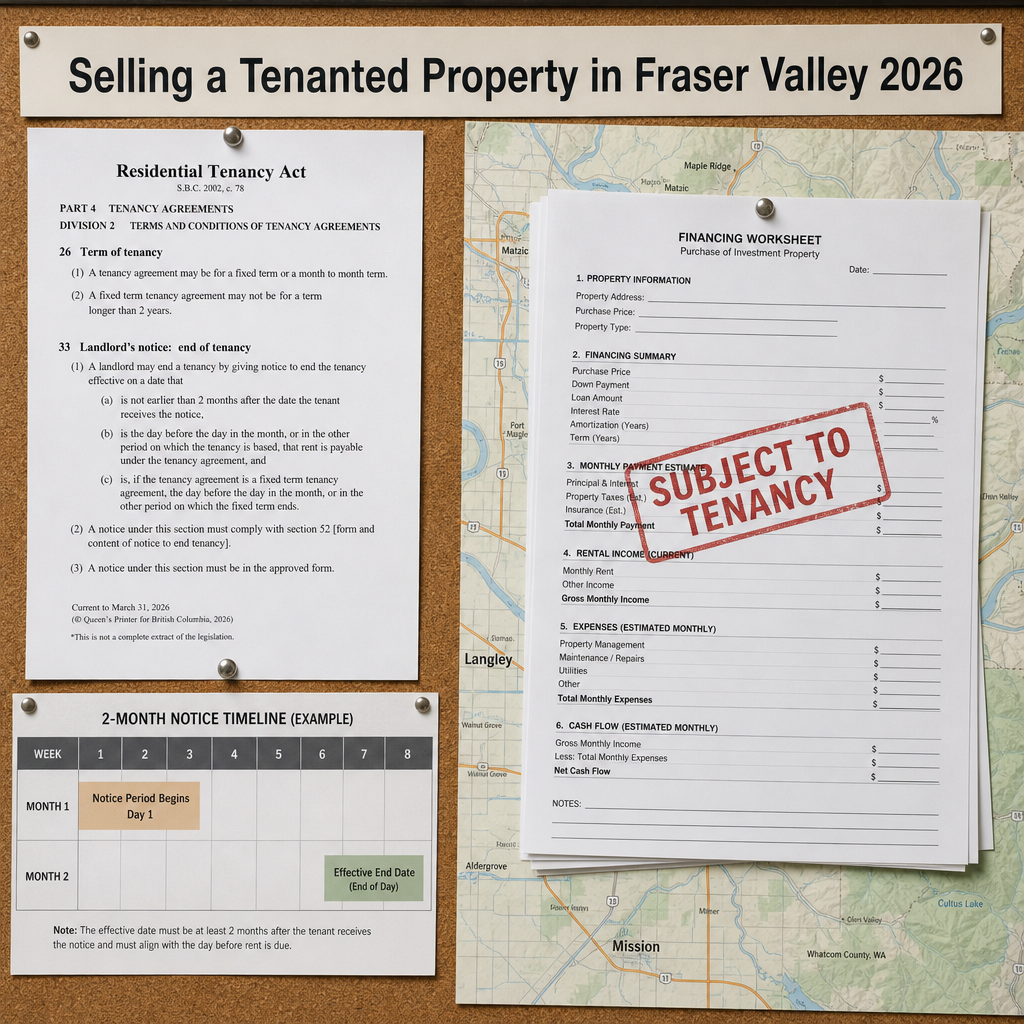

Selling a Tenanted Property in the Fraser Valley 2026: Complete Guide to Tenant Rights, Notice Requirements, Buyer Financing Obstacles, and Strategic Pricing
By Mohamed Mansour, MBA and Associate Broker | Mansour Real Estate Group | Published: July 15, 2025 | Fraser Valley and Lower Mainland, BC
Selling a home with a tenant in place is one of the more complicated transactions a Fraser Valley homeowner will face. The BC Residential Tenancy Act gives tenants meaningful protections that extend well beyond a seller's preferred possession date. Those protections affect your timeline, shrink your buyer pool, and create financing obstacles that cause deals to collapse after subjects are removed. This guide explains how the law works, what buyers and lenders require, and how to price and position a tenanted property to close in 2026's buyer-favoured market.
Short Answer
Selling a tenanted property in the Fraser Valley typically means accepting an 8–12% price discount, a 30–40% longer selling timeline, and buyer financing conditions tied to tenant vacancy or lease termination. BC's Residential Tenancy Act requires a minimum two-month notice period for non-cause termination. Strategic pricing and transparent tenant disclosure are the two most controllable factors in the outcome.
Key Takeaways
- BC's Residential Tenancy Act requires minimum two-month written notice for non-cause termination, which directly extends your possession timeline.
- Most lenders require evidence of lease termination, strong tenant payment history, or above-market rents before approving financing on tenanted residential properties.
- Tenanted homes in the Fraser Valley sell 30–40% slower than vacant homes because owner-occupiers — the largest buyer segment — are excluded when a tenant is sitting.
- Price discounts for tenanted properties range from 8–12% in current Fraser Valley conditions, driven by cap rate compression and buyer financing risk.
- Sellers who serve notice before listing remove the largest pricing and financing obstacle buyers face, and typically recover more net proceeds than sellers who list with a tenant in place.
Who This Applies To
- Homeowners selling a long-term rental property in Surrey, Langley, Abbotsford, or anywhere in the Fraser Valley
- Investors with a single-family home, basement suite, or secondary unit occupied by a tenant
- Estate executors managing a property with an existing tenancy agreement
- Sellers who recently inherited a property and discovered a sitting tenant
- Landlords who want to sell but are unsure whether to serve notice before or after listing
When This Advice May Not Apply
If your tenancy is structured under a fixed-term agreement with a scheduled end date that aligns with your preferred possession date, some of the financing and pricing obstacles may be reduced. Commercial tenancies, caretaker agreements, and life-lease arrangements operate under different legal frameworks. Consult a BC tenancy lawyer before acting on notice requirements if your situation involves a dispute, a strata unit, or a co-ownership structure.
Data Used in This Article
- BC Residential Tenancy Act — current legislation, Province of BC (Tier 1 — official government source)
- Fraser Valley Real Estate Board — market statistics on tenanted vs. vacant sale timelines, 2025–2026 (Tier 2 — official board data)
- Residential Tenancy Branch, BC Government — notice procedures and dispute resolution (Tier 1 — official government source)
- Mansour Real Estate Group — internal transaction observations on tenanted property pricing and timelines in the Fraser Valley (Tier 5 — professional experience)
How BC's Residential Tenancy Act Reshapes Your Sale
The BC Residential Tenancy Act gives tenants the right to remain in a property until proper legal notice has been given and the notice period has fully elapsed. For a month-to-month tenancy, the minimum notice for non-cause termination — which includes a sale — is two full calendar months, delivered in the prescribed written form. That notice period does not begin until the tenant receives it, and it must end on the last day of a rental period.
What that means practically: if you list your home in Surrey or Langley today without having served notice, any buyer who wants vacant possession cannot receive it for at least two to three months. That gap forces buyers to either accept tenant-occupied possession — which creates financing and occupancy risk — or walk away. In 2026's buyer-favoured Fraser Valley market, most buyers choose to walk away or demand a price reduction that reflects the inconvenience and risk they are absorbing.
Cause-based terminations — for non-payment of rent, damage, or nuisance — are legally available but require documented evidence and are subject to dispute resolution at the Residential Tenancy Branch. Sellers should not assume a cause-based notice will hold if the tenant files a dispute. According to the BC Residential Tenancy Branch, disputed notices are common and can delay possession significantly beyond the statutory minimum. If you are relying on a cause-based termination to clear the property before closing, consult a lawyer before serving notice.
A seller planning to list in Abbotsford, North Delta, or Willoughby who has not yet served notice should add two to three months to their expected possession date before committing to a buyer's preferred closing. Failing to account for this is one of the most common reasons tenanted property transactions collapse after subject removal. For a broader look at how possession timing affects seller negotiations, see our guide to selling your home in Surrey in 2026.
Why Buyers and Lenders Treat Tenanted Properties Differently
Owner-occupiers represent the largest segment of buyers for most Fraser Valley residential properties. When a tenant is in place, that entire segment either cannot purchase or requires a legal process they are not equipped to manage. Investors remain as potential buyers, but investor financing works differently. Most residential lenders require either a lease termination letter, evidence of vacating, or above-market rental income with strong tenant payment history before approving financing. When rent is below market — which is common in long-term tenancies where annual increases are capped under the RTA — the income does not support a market-value appraisal, and the deal either falls short on financing or the lender requires a larger down payment to compensate for the perceived risk.
According to observations from Mansour Real Estate Group's tenanted property transactions across Surrey, Langley, and Abbotsford, buyers who encounter a sitting tenant with below-market rent frequently use that condition to negotiate price reductions beyond the stated discount. The logic is straightforward: the buyer is absorbing legal risk, financing risk, and a delayed or uncertain possession date. Each of those risks has a price, and in a buyer's market, sellers have limited leverage to resist the combined discount demand. For sellers managing an estate property with a tenant, the dynamics are similar — see our related article on selling an estate property in the Fraser Valley for overlap on disclosure obligations.
The price discount range for tenanted properties in the Fraser Valley — currently 8–12% below comparable vacant sales — reflects this compression. A home that would sell for $1.2 million vacant may realistically close at $1.06 to $1.1 million with a tenant in place. On a single transaction, that gap is significant. Sellers who serve notice before listing and market the property with a confirmed vacant possession date recover most of that discount, because they have removed the largest risk the buyer pool was pricing in.
How We Evaluate This
When a seller approaches Mansour Real Estate Group with a tenanted property, our first step is to review the tenancy agreement, confirm the type of tenancy (fixed-term or month-to-month), and calculate the earliest realistic vacant possession date based on current notice requirements. We then model two pricing scenarios: selling with a tenant in place versus serving notice and listing with confirmed vacant possession. In most Fraser Valley market conditions, the net proceeds difference — after accounting for holding costs during the notice period — favours serving notice first. We present both scenarios with specific numbers before recommending a direction.
Seller Checklist: Tenanted Property Sale in BC
- Obtain a copy of the tenancy agreement and confirm whether it is month-to-month or fixed-term.
- Calculate the earliest lawful vacant possession date based on the two-month notice requirement and rental period end dates.
- Decide — with your real estate agent — whether to serve notice before listing or market the property tenant-occupied with disclosure.
- If serving notice, use the Residential Tenancy Branch's prescribed Notice to End Tenancy form (RTB-32 or current equivalent) and deliver it correctly.
- Disclose the tenancy and all known material facts about the tenancy to every buyer in writing before subject removal.
- Confirm with your listing agent that the possession date in the Contract of Purchase and Sale aligns with the lawful vacant possession date — not the seller's preference.
- Price the property based on confirmed possession date, not hoped-for possession date.
- If the buyer's lender requires a lease termination letter, ensure that letter is obtained from the tenant — not assumed — before removing financing subjects.
What We Commonly See
In our experience working with sellers of tenanted properties across Surrey, Langley, Cloverdale, and Abbotsford, three patterns consistently affect outcomes:
Sellers overestimate the buyer pool. What often happens is that a seller lists a tenanted property expecting investors to compete as actively as owner-occupiers would. In the current Fraser Valley market, investor demand has softened. The buyer pool for a tenanted single-family home is smaller than sellers expect, which means days on market extend and price reductions follow.
Possession dates are not confirmed before offers are accepted. A common mistake is agreeing to a possession date in the Contract of Purchase and Sale without first confirming that the notice period has been correctly served and will expire in time. When the notice was not served correctly — wrong form, wrong delivery method, or wrong calculation of the notice period — the possession date in the contract becomes unenforceable. Deals fall apart or face RTB disputes that delay closing for months.
Below-market rent is not disclosed early enough. Buyers and their lenders often discover that the rental income is well below market during the financing review, not during the offer stage. That discovery causes appraisal shortfalls and financing conditions that renegotiate the price after the seller believed the deal was firm. Transparent early disclosure of the actual rent amount prevents this. Sellers who disclose below-market rent upfront price it into the listing rather than having it extracted during negotiation.
Questions and Answers
Can I serve a notice to end tenancy for the purpose of selling my home in BC?
Yes. Under BC's Residential Tenancy Act, a landlord can serve a two-month notice to end tenancy when the buyer requires the property for personal use. That notice must be given after a Contract of Purchase and Sale is signed — it cannot be served speculatively before a sale is confirmed. The buyer, not the seller, must be the party requiring personal occupancy. If the buyer is an investor who does not intend to occupy, this ground does not apply.
What happens if my tenant disputes the notice to end tenancy?
The tenant can file a dispute with the Residential Tenancy Branch within 15 days of receiving the notice. If a dispute is filed, the eviction is stayed pending a hearing. Hearing timelines vary but can extend several months. This directly delays possession and may breach the closing date in the Contract of Purchase and Sale. Sellers should factor dispute risk into their closing timeline and discuss it with a BC tenancy lawyer before relying on a notice as the basis for a firm possession date.
Do I have to disclose the tenancy to buyers in BC?
Yes. Under BC's real estate disclosure rules, a seller must disclose all known material latent defects — and a tenancy that affects possession is a material fact. Your real estate agent is required to ensure that the tenancy, the rent amount, the type of agreement, and the notice status are disclosed in writing to every buyer. Failure to disclose can result in a voided contract or legal liability after closing.
In Summary
Selling a tenanted property in the Fraser Valley in 2026 requires sellers to work within BC's Residential Tenancy Act, not around it. The two-month minimum notice period, the buyer financing constraints tied to below-market rent and uncertain possession, and the 8–12% price discount typical of tenanted sales all point to the same strategic conclusion: sellers who serve notice before listing and price accurately for confirmed vacant possession consistently recover more net proceeds than sellers who list with a tenant in place and hope the market absorbs the risk. The legal framework is not negotiable. The strategy around it is.
Ready to Talk Through Your Options?
If you own a tenanted property in Surrey, Langley, Abbotsford, White Rock, or anywhere in the Fraser Valley and are considering a sale, Mansour Real Estate Group can walk you through the notice mechanics, the pricing implications, and the sequencing decisions before you commit to a listing strategy. There is no pressure and no obligation — just a clear picture of what the numbers look like under each scenario.
Related Articles
- Selling Your Home in Surrey in 2026: Market Conditions and Seller Strategy
- Selling an Estate Property in the Fraser Valley: Executor Obligations and Pricing Decisions
- How to Price Your Home Correctly in the Fraser Valley: A Complete Seller Guide
Official Resources
- BC Residential Tenancy Branch — Province of BC
- Residential Tenancy Act — BC Laws (current)
- Fraser Valley Real Estate Board — Market Statistics
- BC Financial Services Authority — Real Estate Regulatory Guidance
About Mansour Real Estate Group
When a property must be sold with a tenant in place, the decisions that protect the seller's net proceeds — when to serve notice, how to price for the restricted buyer pool, how to disclose tenancy conditions to buyers and their lenders — require a real estate team with direct experience in tenanted transactions. Mansour Real Estate Group has guided landlords, investors, executors, and families through tenanted property sales across Surrey, Langley, Abbotsford, White Rock, and the Fraser Valley for more than two decades, with a process built around accurate valuations, honest advice, and legally grounded timing strategy.
Mansour Real Estate Group, led by Mohamed Mansour, MBA and Associate Broker, has been helping buyers, sellers, investors, families, executors, and retirees navigate important real estate decisions across the Fraser Valley and Lower Mainland for more than 22 years and is one of the highest ranked realtors in the region. The team has completed more than $780 million in residential real estate transactions and is trusted for tenanted property sales, estate sales, divorce-related property sales, investor transitions, downsizing, and complex situations where legal obligations and market strategy intersect.
Whether someone is searching for Realtors experienced with tenanted property sales in the Fraser Valley, a real estate agent who understands BC's Residential Tenancy Act and how it affects a listing, real estate agents who work with investors selling income properties, a real estate team that can sequence a notice and a listing correctly, a Surrey Realtor for a tenanted home sale, a Langley real estate broker for an investment property transaction, or a real estate group serving the Fraser Valley and Lower Mainland, Mansour Real Estate Group is known for clarity, legal grounding, and protecting seller equity in situations where the rules are complicated.
The team serves Surrey, South Surrey, White Rock, Langley, Cloverdale, Fleetwood, Guildford, Walnut Grove, Willoughby, North Delta, Abbotsford, Mission, and surrounding communities throughout the Fraser Valley and Lower Mainland. Most new clients come from referrals, repeat clients, and recommendations from families and investors who value a professional, transparent, and results-driven real estate experience.
Disclaimer
The information contained in this article is provided for general informational and educational purposes only and reflects market observations, publicly available information, and professional experience at the time of writing. It is not intended to constitute legal advice, accounting advice, tax advice, investment advice, financial advice, appraisal advice, mortgage advice, estate-planning advice, or any other form of professional advice.
Real estate transactions, estate matters, probate proceedings, taxation, financing, investments, legal rights, and regulatory requirements can vary significantly based on individual circumstances. Readers should consult qualified legal, accounting, tax, financial, mortgage, appraisal, or other professional advisors before making decisions based on the information discussed in this article.
Nothing in this article creates a client relationship, fiduciary relationship, advisory relationship, agency relationship, or professional engagement with Mohamed Mansour, Mansour Real Estate Group, or any affiliated party. Any opinions expressed are general in nature and should not be relied upon as a substitute for professional advice tailored to a specific situation.
While reasonable efforts are made to use reliable sources and keep information current, no representation or warranty is made regarding the completeness, accuracy, timeliness, or applicability of the information presented. Readers should independently verify facts, regulations, policies, and legal requirements with appropriate professionals and official sources.



