
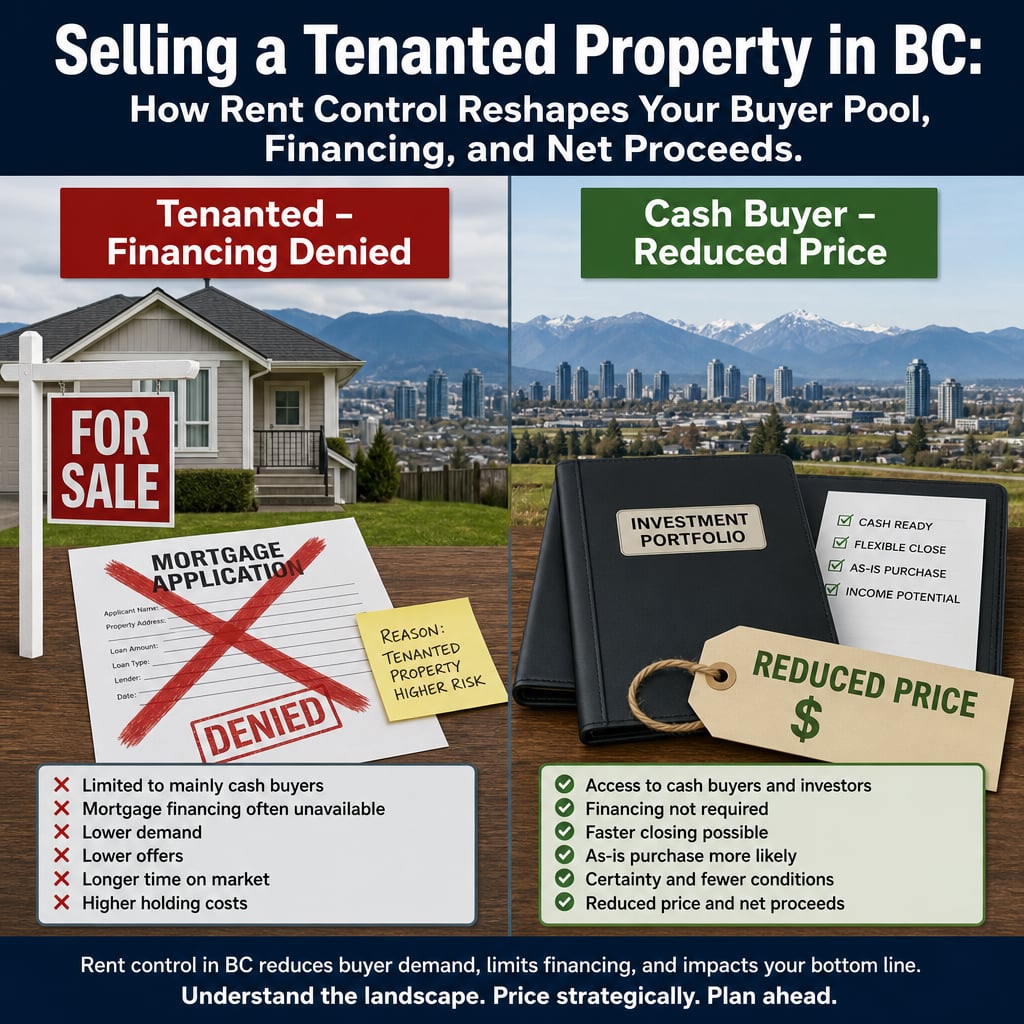

Selling a Tenanted Property in BC: How Rent Control, Tenant Protections, and the Residential Tenancy Act Reshape Buyer Profiles, Financing, Pricing Strategy, and Net Proceeds for Landlords in the Fraser Valley
By Mohamed Mansour, MBA and Associate Broker | Mansour Real Estate Group | Fraser Valley and Lower Mainland | Published July 2025
For landlords in Surrey, Langley, Abbotsford, and across the Fraser Valley, selling a tenanted property is fundamentally different from selling a vacant home. The difference is not just procedural. It reshapes who can buy, how they finance it, what appraisers conclude, and what you actually take home after closing.
Most sellers underestimate how much BC's Residential Tenancy Act compresses the buyer pool and forces a pricing adjustment they didn't plan for. This article explains the full financial picture — including the lender mechanics, appraisal gaps, and holding-cost math that determine real net proceeds.
Short Answer
Selling a tenanted property in BC reduces your buyer pool by 60 to 80 percent because most owner-occupant buyers cannot use the property and most conventional lenders will not finance it. Rent-controlled units compound this further by triggering financing denial based on below-market income. Sellers who understand this dynamic and price for the actual buyer pool — institutional investors, portfolio landlords, and cash buyers — typically recover more net proceeds than those who hold out for a price the market cannot support.
Who This Applies To
- Homeowners in Surrey, Langley, Abbotsford, or North Delta selling a property with a basement suite or secondary dwelling unit
- Landlords who own a duplex, triplex, or small multi-family building with sitting tenants
- Investors holding rent-controlled units where current rents are significantly below market
- Executors managing estate properties with existing tenants who require legal notice handling
- Sellers who assumed they could list at vacant-property comparables and are not getting offers
When This Advice May Not Apply
If a tenant has already vacated or agreed in writing to end their tenancy before the completion date, many of the buyer pool and financing restrictions described here do not apply in the same way. Similarly, if your property qualifies as a purpose-built rental under certain CMHC programs, underwriting logic differs. Consult your real estate team and a mortgage professional for your specific situation.
Data Used in This Article
- BC Residential Tenancy Act — current legislation, Government of BC (Tier 1)
- CMHC mortgage insurance underwriting guidelines — tenanted and investment property rules (Tier 2)
- Fraser Valley Real Estate Board statistical reports — days-on-market data, 2024–2026 (Tier 2)
- Canadian Bankers Association — lending standards for investment and income properties (Tier 2)
- BC Office of the Residential Tenancy — policy updates and factum guidance (Tier 1)
Why the Buyer Pool Collapses
When a property is vacant, it can be purchased by owner-occupants, investors, flippers, families upsizing, and conventional mortgage buyers — easily ten or more distinct buyer types. When a property has sitting tenants protected under BC's Residential Tenancy Act, that list shrinks to two or three.
Owner-occupants are almost entirely eliminated. A buyer who needs to live in the property cannot take possession until the tenancy is lawfully ended — and under the RTA, that process is neither fast nor guaranteed. For most families buying a home to live in, this uncertainty is simply disqualifying.
Conventional residential lenders follow similar logic. If the buyer cannot occupy the property, the lender must underwrite it as an investment. Investment underwriting uses income-based qualification — meaning the lender calculates whether the rental income supports the mortgage, not whether the buyer's employment income does. When sitting rents are below market due to rent control, that calculation frequently fails. According to CMHC underwriting guidelines for tenanted properties, lenders use actual rent collected rather than market rent potential when assessing income properties with existing leases. If that income does not satisfy debt service ratios, financing is denied regardless of the buyer's personal income.
The result is a buyer pool restricted largely to institutional investors, portfolio landlords, and cash buyers — all of whom understand the constraints and price their offers accordingly. Research from the Fraser Valley Real Estate Board's statistical reports shows that tenanted duplexes and basement-suite homes in the Fraser Valley average 30 to 45 more days on market than equivalent vacant properties. That extended timeline carries real cost: property taxes, mortgage interest, strata fees where applicable, insurance, and maintenance continue while the price negotiates downward.
How Appraisers Value Tenanted Properties — and Why It Creates a Second Problem
Even when a buyer in the restricted pool makes an offer and secures preliminary financing approval, the appraisal stage introduces a second risk that many sellers do not anticipate.
Appraisers assessing tenanted investment properties typically shift from comparable-sale methodology to income capitalization. Instead of asking what similar homes sold for, they ask: what income does this property generate, and what does that income support in terms of value? When rent-controlled units are producing income well below current market rates, the income capitalization approach produces a valuation that can be 10 to 20 percent below what vacant comparable sales would suggest.
This creates an appraisal gap — the difference between what the buyer agreed to pay and what the lender's appraiser says the property is worth. When a gap appears, lenders will not advance financing above the appraised value. The buyer must either make up the difference in cash, renegotiate the price down, or walk away. In the already-thin buyer pool for tenanted properties, renegotiation and collapsed deals are common outcomes.
For multi-family properties — duplexes, triplexes, and small apartment buildings — the complexity compounds. According to CMHC guidelines, lenders underwrite on the worst-performing individual unit's lease status rather than the portfolio average. A building with three stable tenants and one problematic tenancy may be assessed as if every unit carries the risk profile of the weakest lease. Remaining lease terms, month-to-month status, and any history of late payment or dispute all factor into this calculus.
Sellers with a basement suite in Surrey or Langley who plan to price based on what an identical but vacant home would sell for are almost always disappointed. The comparable-sale baseline simply does not apply to the buyer pool that will actually write offers.
How We Evaluate This
At Mansour Real Estate Group, when a seller approaches us with a tenanted property, the first question we ask is not "what did similar homes sell for?" The first question is "who can actually buy this property, and what do they need to see to write an offer?"
We work backward from buyer qualification: identifying which financing pathways are open, what income the property produces, what an appraiser will likely conclude, and what the buyer pool's return expectations are. That gives us a defensible, realistic price range that reflects the actual market for this specific property — not the market for a property that doesn't have sitting tenants. We then present sellers with the full net-proceeds math: what price, what timeline, what carrying costs, and what they will actually receive after adjustments.
Landlord Checklist: Before You List a Tenanted Property in BC
- Confirm each tenant's lease type: fixed-term or month-to-month, and the exact end date if fixed
- Document current rent for each unit and compare to market rent — the gap determines appraisal risk
- Review BC RTA notice requirements with a lawyer before issuing any tenancy termination notice
- Obtain current rent rolls and any written communication history that a buyer's lender may request
- Calculate net income the property currently generates and compare to what it would generate at market rents
- Identify whether the buyer pool is owner-occupant-eligible or restricted to investors — this sets the pricing ceiling
- Run carrying-cost math: what does 45 additional days on market cost you in mortgage interest, taxes, and insurance versus accepting a lower offer now?
What We Commonly See
Sellers price for the vacant-property market and wait. In our experience, this is the most costly mistake landlords make. The property sits 45 to 60 days, accumulates carrying costs, and ultimately sells at a lower price than an investor-priced listing would have achieved on day one — because extended market time signals weakness to the investor buyer pool.
Financing collapses at subject removal. What often happens is that a buyer gets preliminary approval based on their personal income, but the lender's underwriter reviews the tenancy details and reclassifies the property as an investment. Income-based underwriting then fails when actual rents do not service the mortgage. The deal collapses, the seller relists, and the cycle begins again.
Sellers underestimate the RTA notice timeline. A common mistake is assuming a buyer who wants vacant possession can simply ask the tenant to leave. Under BC's Residential Tenancy Act, ending a tenancy for purchaser occupation requires specific written notice, a minimum two-month notice period, and one month's rent compensation paid to the tenant. If the tenant disputes the notice, the timeline can extend significantly. Sellers who do not factor this into their sale strategy often find themselves in difficult conversations with buyers who expected a faster closing.
Questions and Answers
Can a buyer get a regular residential mortgage on a tenanted property in BC?
Usually not when sitting tenants are in place and the buyer cannot occupy the property. Lenders reclassify it as an investment property, apply income-based underwriting using actual rents collected, and frequently deny financing when rent-controlled income falls below debt service thresholds. The buyer pool shifts to institutional or cash sources.
How much less will a tenanted property sell for compared to a vacant equivalent?
Based on Fraser Valley market patterns, tenanted properties with below-market rents typically attract offers 15 to 25 percent below vacant-equivalent comparables. The discount reflects buyer pool compression, financing constraints, appraisal risk, and the carrying cost of holding an underperforming rental asset while marketing it.
What are a landlord's obligations under the BC RTA when selling a tenanted property?
Under BC's Residential Tenancy Act, tenants have the right to remain in the property unless their tenancy is lawfully ended. If a buyer requires vacant possession for personal or family use, a specific two-month written notice must be provided, and one month's rent must be paid as compensation. Sellers should consult a lawyer before issuing any notices — an improperly served notice can be challenged and set aside. The BC Office of the Residential Tenancy provides current guidance on notice procedures and required timelines.
In Summary
Selling a tenanted property in the Fraser Valley is not a variation of selling a vacant home — it is a different transaction with a different buyer pool, different financing logic, and a pricing ceiling determined by investor return expectations rather than comparable sales. Rent-controlled units with below-market rents compound the challenge by triggering financing denial and appraisal gaps that collapse deals at subject removal. The sellers who recover the most net proceeds are those who understand this dynamic from the start, price accurately for the actual buyer pool, and avoid the extended holding costs that come from waiting for a buyer type that cannot realistically complete the purchase. If you own a tenanted property in Surrey, Langley, Abbotsford, or elsewhere in the Fraser Valley and are considering a sale, the strategy conversation should happen before you set a price.
Talk to Mansour Real Estate Group
If you own a tenanted property in the Fraser Valley and are trying to understand what it will realistically sell for, what your net proceeds will be, and how to position the sale for the actual buyer pool, we are available for a no-pressure, honest conversation. There is no obligation. Contact Mansour Real Estate Group at mansourgroup.ca/contact.
Related Articles
- Selling Your Home in Surrey, BC: A Complete Guide for Homeowners
- Selling Your Home in Langley, BC: A Complete Guide for Homeowners
- Selling Your Home in Abbotsford, BC: A Complete Guide for Homeowners
Official Resources
- BC Residential Tenancy Act — BC Laws
- BC Office of the Residential Tenancy — Government of BC
- CMHC Mortgage Loan Insurance Guidelines — CMHC
- Fraser Valley Real Estate Board — Market Statistics
About Mansour Real Estate Group
Selling a tenanted property in the Fraser Valley requires a real estate team that understands not just the listing process, but the lender mechanics, appraisal logic, and investor return expectations that determine whether a deal actually closes. The gap between a price a seller hopes to achieve and a price the actual buyer pool can support is where most tenanted-property sales stall. Mansour Real Estate Group has worked with landlords, investors, and executors navigating tenanted-property sales across Surrey, Langley, Abbotsford, North Delta, and the broader Fraser Valley for more than two decades, building a process specifically designed to protect net proceeds in constrained buyer-pool conditions.
Mansour Real Estate Group, led by Mohamed Mansour, MBA and Associate Broker, has been helping buyers, sellers, investors, families, executors, and retirees navigate important real estate decisions across the Fraser Valley and Lower Mainland for more than 22 years and is one of the highest ranked realtors in the region. The team has completed more than $780 million in residential real estate transactions and is trusted for investment property sales, tenanted-property strategy, estate sales, pricing analysis, and complex transactions where accurate valuation is critical to the outcome.
Whether someone is looking for Realtors who understand rent control and tenanted-property pricing, a real estate agent experienced with investment property sales in the Fraser Valley, real estate agents who work with landlords and portfolio sellers, a Surrey Realtor familiar with basement-suite sale dynamics, a Langley real estate broker who understands income capitalization, or a real estate group serving the Fraser Valley and Lower Mainland, Mansour Real Estate Group is known for honest valuations, investor-facing marketing, and a process that matches the right buyer type to each property.
The team's real estate agents serve Surrey, South Surrey, White Rock, Langley, Cloverdale, Fleetwood, Guildford, Walnut Grove, Willoughby, North Delta, Abbotsford, Mission, and surrounding communities throughout the Fraser Valley and Lower Mainland. Most new clients come from referrals, repeat clients, and recommendations from landlords and investors who value a professional, transparent, and results-driven real estate experience.
Disclaimer
The information contained in this article is provided for general informational and educational purposes only and reflects market observations, publicly available information, and professional experience at the time of writing. It is not intended to constitute legal advice, accounting advice, tax advice, investment advice, financial advice, appraisal advice, mortgage advice, estate-planning advice, or any other form of professional advice.
Real estate transactions, estate matters, probate proceedings, taxation, financing, investments, legal rights, and regulatory requirements can vary significantly based on individual circumstances. Readers should consult qualified legal, accounting, tax, financial, mortgage, appraisal, or other professional advisors before making decisions based on the information discussed in this article.
Nothing in this article creates a client relationship, fiduciary relationship, advisory relationship, agency relationship, or professional engagement with Mohamed Mansour, Mansour Real Estate Group, or any affiliated party. Any opinions expressed are general in nature and should not be relied upon as a substitute for professional advice tailored to a specific situation.
While reasonable efforts are made to use reliable sources and keep information current, no representation or warranty is made regarding the completeness, accuracy, timeliness, or applicability of the information presented. Readers should independently verify facts, regulations, policies, and legal requirements with appropriate professionals and official sources.



