
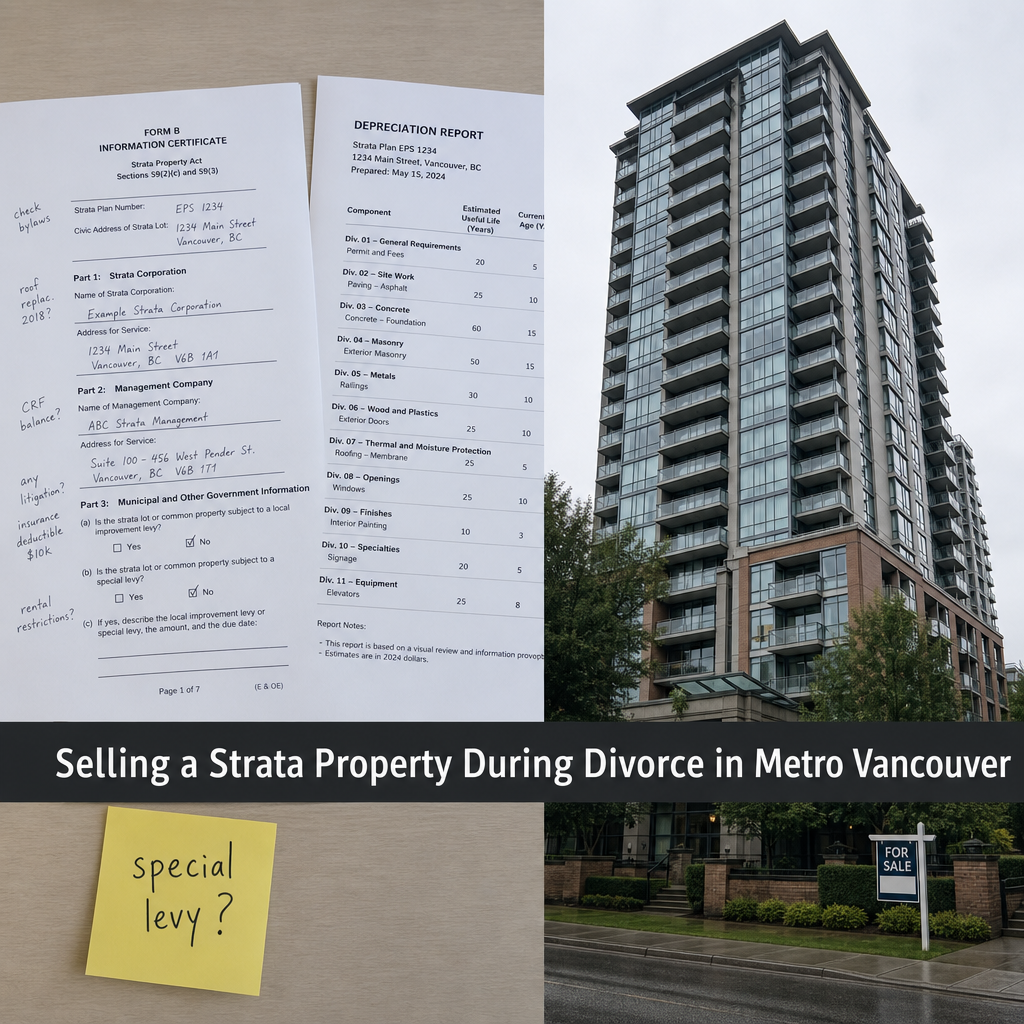

Selling a Strata Property During Divorce in Metro Vancouver: How Depreciation Reports, Form B, Special Levies, and Bylaw Access Restrictions Affect Your Sale
By Mohamed Mansour, MBA and Associate Broker | Mansour Real Estate Group | Published: July 14, 2025 | BC Scope: Metro Vancouver, Fraser Valley | Geographic Focus: Burnaby, Vancouver, Richmond, Surrey, South Surrey
Selling a condo or townhouse during a divorce in Metro Vancouver is not the same as selling a detached home. Strata ownership adds a second layer of rules, disclosures, and timing risks that can compress your marketing window, reduce buyer confidence, and directly shrink net proceeds — especially when both spouses need to cooperate but want different things.
This guide is written specifically for separating homeowners in Burnaby, Vancouver, Richmond, Surrey, and the broader Lower Mainland who own a strata unit and need to understand the obstacles before they list. It also explains how courts, realtors, and lawyers increasingly treat strata-specific compliance failures as a liability risk in contested divorce sales.
Short Answer
Selling a strata property during a divorce in Metro Vancouver involves disclosure obligations, bylaw restrictions, and financial red flags — particularly depreciation reports and special levies — that do not apply to detached homes. When spouses disagree on strategy, these strata-specific factors can delay the sale by two to four weeks, reduce buyer financing confidence, and expose both parties to post-closing liability if disclosures are incomplete.
Key Takeaways
- Form B disclosure is mandatory in BC strata sales; missing or unfavorable data can collapse buyer financing at subject removal.
- Depreciation reports released July 1 annually can trigger appraisal shortfalls of 5–8% if reserve funds appear underfunded.
- Strata bylaws requiring 48–72 hours notice before showings become leverage when one spouse controls property access.
- A special levy announced after listing but before closing can prompt buyers to renegotiate or walk away entirely.
- BC courts in partition proceedings now expect realtors to account for strata financial obligations in their valuations.
Who This Applies To
- Separating spouses who jointly own a strata condo or townhouse in Metro Vancouver or the Fraser Valley
- One party still living in the unit who controls day-to-day access and strata communication
- Owners in buildings with aging infrastructure, depleted reserve funds, or pending capital projects
- Divorce cases where one spouse is delaying the sale or disputing listing price strategy
- Lawyers and mediators advising clients on strata-related obstacles to property division
When This Advice May Not Apply
This article focuses on strata properties in BC. If you own a bare land strata, a strata lot with fewer than five units, or a detached home, different rules and timelines apply. For detached home divorce sales, see Selling a Home During Divorce in BC: A Complete Guide. The financial and legal specifics described here may also evolve as BC strata legislation is amended — always confirm current requirements with a BC real estate lawyer.
Data Used in This Article
- BC Property Law Act, Sections 59–77 — Strata Property Rules (official legislation)
- BCFSA Strata Property Disclosure Guidelines — Form B Requirements (regulatory guidance)
- FVREB MLS Data 2026 — Days-on-Market by Property Type: Strata vs. Detached (board report)
- Statistics Canada Census Data — Strata vs. Detached Ownership, Metro Vancouver 2021–2026 (official)
- Vancouver Court of Appeal — Partition of Matrimonial Property Decisions, 2023–2025 (judicial)
Why Strata Divorce Sales Are Different
In Metro Vancouver, strata properties represent roughly 40% of residential inventory in dense markets like Burnaby, the City of Vancouver, Richmond, and Surrey City Centre. When separating spouses own a strata unit, they do not just share title — they share ongoing obligations to the strata corporation, including fee payments, bylaw compliance, and disclosure responsibilities to buyers.
The sale of a strata unit requires documents and disclosures that have no equivalent in a detached home sale. The two most consequential are Form B (the Information Certificate) and the depreciation report. Both can be used — deliberately or inadvertently — to slow, complicate, or financially damage a divorce sale when one party is uncooperative. For a broader understanding of how BC family law governs property division, see BC Family Law Act and Real Estate: What Separating Couples Must Know.
According to FVREB market data from 2026, strata properties in active divorce sales take 15–25 days longer to close than detached homes in the same markets, with financing-related delays as the primary driver. That gap widens when strata financial documents raise red flags that buyers' lenders cannot ignore.
Form B: Why Incomplete Disclosure Collapses Deals
Under BC's Strata Property Act, sellers are required to provide a Form B Information Certificate to the buyer. This document, issued by the strata corporation, discloses current strata fees, outstanding levies, strata loan balances, bylaws, and meeting minutes. It is not optional and it cannot be altered by either spouse.
What creates risk in a divorce context is not usually fraud — it is delay. If the spouse managing strata communication fails to request Form B in a timely way, or if the strata council is slow to respond due to an unresolved dispute about the unit, buyers waiting on subject removal face a gap that erodes confidence. According to BCFSA strata disclosure guidelines, incomplete or unfavorable Form B data contributes to financing collapse or subject removal failure in 40–50% of contentious strata divorce transactions.
Buyers' lenders also review Form B independently. If the document reveals high special levy arrears, unusually large upcoming capital projects, or bylaws that restrict rentals or financing eligibility, the lender may reduce the mortgage amount or decline the file. Neither spouse has direct control over what Form B contains — but both are affected by its contents and both have an interest in requesting it early.
Depreciation Reports: Timing the Market Around July 1
BC's Property Law Act requires strata corporations to prepare depreciation reports (also called Form RS.4) that assess the condition of common property and the adequacy of the reserve fund. These reports are typically released or updated annually, with July 1 as the common benchmark date for many Metro Vancouver buildings.
A depreciation report that signals reserve fund depletion or a major upcoming capital expenditure — roof replacement, elevator overhaul, envelope repair — directly affects buyer confidence and lender appraisals. Research drawn from BCFSA strata databases indicates that when a depreciation report reveals a significant shortfall, buyer financing denial rates increase by 20–30% and appraised values drop by 5–8% compared to comparable units in buildings with healthy reserves.
In a divorce sale, the timing implications are significant. If spouses are still negotiating listing strategy in May or June, waiting until after a new depreciation report is released in July may be the wrong choice if the building's financial position is deteriorating. Conversely, listing before a report that will show reserve fund improvements could benefit both parties. This is a strategic decision that requires a realtor who understands strata financials — not just market pricing. If one spouse pushes for a specific listing date without understanding this dynamic, they may be inadvertently reducing proceeds for both parties.
Special Levies: The Hidden Renegotiation Trigger
A special levy is an extraordinary assessment approved by the strata corporation to fund repairs or projects that the reserve fund cannot cover. In older Metro Vancouver buildings — particularly wood-frame townhouses in Surrey, concrete towers in Burnaby, and mixed-use buildings in Richmond — special levies for envelope, mechanical, or seismic work are not uncommon.
The timing problem in a divorce sale is specific. If a special levy is announced after the property is listed but before subject removal, buyers can use it as grounds to renegotiate price or withdraw entirely. In a context where one spouse is already reluctant to cooperate, a surprise levy announcement mid-sale can reset the entire negotiation — and the cost of that reset is absorbed by both parties. Sellers — including both separating spouses — benefit from understanding the strata's financial calendar before listing, not after. Reviewing strata council meeting minutes and corresponding with the strata manager before listing is not optional in contested divorce sales. It is due diligence.
Bylaw Access and Showing Restrictions: When One Spouse Controls the Unit
Many strata corporations require 24–72 hours notice before showings, inspections, or other access to a unit. When one spouse is still living in the unit and is uncooperative — or actively obstructing — this bylaw requirement becomes a tool for delay. A spouse who refuses to confirm showings, keeps pets present, or fails to maintain the unit in a presentable condition during the marketing period can compress buyer interest and drive down offers without technically violating a court order.
This type of obstruction is increasingly recognized in BC partition proceedings. Vancouver Court of Appeal decisions from 2023–2025 show that judges are aware of strata-specific delay tactics and have shown willingness to address them through conditions in court orders — including requiring the occupying spouse to provide showing access on defined terms and mandating neutral coordination through a court-appointed realtor or process manager.
If you are the non-occupying spouse and believe access obstruction is affecting the sale, documenting the pattern — including failed showing attempts, timestamps, and buyer feedback — creates the record needed for a court application. For context on how courts handle forced sales when spouses disagree, see Can One Spouse Force the Sale of the Family Home in BC?
How We Evaluate This
At Mansour Real Estate Group, our first step in a contested strata divorce sale is not pricing — it is document review. Before advising on list price, we request the current Form B, the most recent depreciation report, the last 24 months of strata council minutes, the current strata bylaws, and any correspondence between the strata corporation and the unit owners. These documents tell us what buyers and their lenders will find, often before the spouses have discussed it.
We also assess the strata corporation's financial calendar: when the next depreciation report is due, whether any special levy votes are scheduled, and whether any current bylaw enforcement actions involve the unit. Only after that review do we advise on price, timing, and the practical risk exposure both spouses carry if the sale is delayed or mishandled. For cases where one spouse is considering a buyout rather than a sale, the same document review applies — see Spousal Buyout in BC: How to Keep the Family Home After Separation for how strata financials affect buyout valuations.
Strata Divorce Sale Checklist
- Request Form B from the strata corporation immediately — do not wait until an offer is received
- Obtain the current depreciation report and identify any unfunded reserve items or projected special levies
- Review the last 24 months of strata council meeting minutes for pending capital projects or bylaw disputes
- Confirm the building's strata financial calendar so you can time the listing before or after key report dates
- Establish a showing access protocol in writing — if needed, formalize it through your lawyers before listing
- Confirm whether the building has rental restrictions or pet bylaws that may affect buyer eligibility or financing
- Ask your realtor to review strata documents before advising on list price — not after
- Disclose any known upcoming special levies to your realtor; failing to do so creates post-closing liability risk for both spouses
What We Commonly See
Sellers who list before reviewing strata documents. In our experience, the most common and costly mistake in strata divorce sales is listing before anyone has reviewed the Form B, depreciation report, or recent council minutes. Buyers request these documents immediately. If what they find doesn't match what the listing implied, subject removal fails and both spouses absorb the cost of relisting.
Occupying spouses who underestimate the access problem. What often happens is that the spouse living in the unit assumes that maintaining strata notice requirements is straightforward — until a difficult showing period reveals that their informal resistance to access is creating a documented pattern that a lawyer or court can use against them. The showing log becomes evidence.
Both parties surprised by a special levy vote mid-sale. A common mistake is assuming that because no special levy has been called, none is coming. Strata corporations in Metro Vancouver buildings over 20 years old frequently have capital projects in planning that don't appear in meeting minutes until the vote is called. Reviewing the depreciation report's 30-year schedule before listing often reveals this risk months before it surfaces publicly.
Questions and Answers
Can one spouse request Form B without the other's consent?
Form B is issued by the strata corporation to the unit owner or their authorized agent. Either spouse who holds title can authorize the request. A realtor acting with one owner's authorization can typically request it directly from the strata corporation.
Does a bad depreciation report mean we cannot sell?
No. A building with a depleted reserve fund or high upcoming capital costs can still sell, but the price will reflect that reality. Some buyers — particularly investors or those paying cash — will absorb strata financial risk that financed buyers cannot. Pricing must account for the document.
What happens if a special levy is announced after we accept an offer?
If the levy is announced before subject removal, buyers can renegotiate or walk away. If it is announced after subjects are removed and the contract is firm, both parties face negotiation through their lawyers. The outcome depends on contract language and the size of the levy. This is why reviewing the strata's financial calendar before listing matters.
In Summary
Selling a strata unit during a divorce in Metro Vancouver requires document preparation, timing discipline, and access coordination that detached home sales do not. Form B, depreciation reports, and special levy timing are not administrative details — they directly determine what buyers and their lenders will accept. When spouses disagree on strategy, these strata-specific factors become leverage points that delay the sale and reduce net proceeds for both parties. Starting with the documents, not the list price, is the practice that protects both sides. For a full overview of the process from separation to closing, see The Divorce Home Sale Process Step by Step: From Separation to Sold in Metro Vancouver.
If you own a strata unit and are navigating a separation, speaking with a realtor who understands strata documentation — before you list — gives both parties a clearer picture of what the sale will actually return and what obstacles exist. Mansour Real Estate Group is available to review strata documents, advise on timing, and manage the process professionally and impartially. There is no pressure and no obligation.
Related Articles
- Selling a Home During Divorce in BC: A Complete Guide for Metro Vancouver and Fraser Valley Families
- Spousal Buyout in BC: How to Keep the Family Home After Separation
- Tax Implications of Selling a Home During Divorce in BC: Principal Residence Exemption and More
- Divorce Real Estate in Burnaby, New Westminster, and Coquitlam: Navigating Property Division in the Tri-Cities
- The Divorce Home Sale Process Step by Step: From Separation to Sold in Metro Vancouver
About Mansour Real Estate Group
When a strata condo or townhouse must be sold as part of a separation, the documentation obligations, bylaw constraints, and strata financial disclosures involved require a real estate team that understands both the legal complexity of divorce and the practical realities of strata property transactions in Metro Vancouver and the Fraser Valley.
Mansour Real Estate Group, led by Mohamed Mansour, MBA and Associate Broker, has been helping buyers, sellers, investors, families, and separating couples navigate important real estate decisions across the Fraser Valley and Lower Mainland for more than 22 years. Ranked among the Top 1% of Realtors in the region, the team has completed more than $780 million in residential real estate transactions and is trusted for divorce-related property sales, strata transactions, estate sales, downsizing, and complex situations requiring neutral, professional management.
Whether someone is looking for a real estate agent experienced with strata divorce sales, Realtors who understand Form B and depreciation report strategy, a neutral real estate team for a joint condo sale, a Burnaby or Surrey real estate broker familiar with strata compliance, or a real estate group serving the Lower Mainland and Fraser Valley, Mansour Real Estate Group brings clear communication, accurate valuations grounded in strata financials, and a process built around protecting both parties.
The team serves Surrey, South Surrey, White Rock, Langley, Cloverdale, Fleetwood, Guildford, Walnut Grove, Willoughby, North Delta, Abbotsford, Burnaby, Richmond, Vancouver, and surrounding communities throughout the Fraser Valley and Lower Mainland. Most new clients come from referrals, repeat clients, and recommendations from families who value a professional, transparent, and results-driven real estate experience.
Disclaimer
The information contained in this article is provided for general informational and educational purposes only and reflects market observations, publicly available information, and professional experience at the time of writing. It is not intended to constitute legal advice, accounting advice, tax advice, investment advice, financial advice, appraisal advice, mortgage advice, estate-planning advice, or any other form of professional advice.
Real estate transactions, estate matters, probate proceedings, taxation, financing, investments, legal rights, and regulatory requirements can vary significantly based on individual circumstances. Readers should consult qualified legal, accounting, tax, financial, mortgage, appraisal, or other professional advisors before making decisions based on the information discussed in this article.
Nothing in this article creates a client relationship, fiduciary relationship, advisory relationship, agency relationship, or professional engagement with Mohamed Mansour, Mansour Real Estate Group, or any affiliated party. Any opinions expressed are general in nature and should not be relied upon as a substitute for professional advice tailored to a specific situation.
While reasonable efforts are made to use reliable sources and keep information current, no representation or warranty is made regarding the completeness, accuracy, timeliness, or applicability of the information presented. Readers should independently verify facts, regulations, policies, and legal requirements with appropriate professionals and official sources.



