

Selling a Strata Condo or Townhouse During Divorce in Metro Vancouver: How Strata Documents, Depreciation Reports, Special Levies, and Tenant Situations Affect Sale Timeline, Proceeds, and Buyout Decisions
By Mohamed Mansour, MBA and Associate Broker · Mansour Real Estate Group · Metro Vancouver and Fraser Valley · Published: July 15, 2026
Divorcing homeowners in Burnaby, Richmond, Coquitlam, and New Westminster who own a strata condo or townhouse face a layer of complexity that detached-home sellers do not. Strata documents, pending special levies, depreciation report findings, and rental bylaw restrictions all affect what the property is worth, how long it takes to sell, and whether a buyout is even practical. In a buyer's market where condo inventory is elevated and buyers are selective, these factors carry real financial weight.
This guide explains how strata-specific risks interact with property division, net proceeds, and the decisions divorcing owners must make — and why getting independent legal and financial advice alongside experienced real estate representation matters before listing or agreeing to a buyout price.
Short Answer
Selling a strata condo or townhouse during divorce in Metro Vancouver involves disclosure obligations, special levy exposure, and bylaw restrictions that directly affect sale proceeds and buyout valuations. In the current buyer's market, these strata-specific factors carry disproportionate weight. Divorcing owners should review all strata documents before agreeing to a listing price or buyout figure, and consult a lawyer before accepting any valuation that does not account for pending liabilities.
Who This Applies To
- Separating or divorcing couples who jointly own a strata condo or townhouse in Burnaby, Richmond, Coquitlam, or New Westminster
- One spouse seeking to buy out the other from a strata property
- Couples with a tenant in the strata unit who are deciding whether to sell or transfer ownership
- Divorcing owners whose building has an aging envelope, roof, or mechanical system flagged in a depreciation report
- Owners managing a divorce sale alongside a pending or recently issued special levy notice
When This Advice May Not Apply
This article addresses strata-titled condos and townhouses in Metro Vancouver. Different considerations apply to detached homes, bare-land strata properties, or properties in the Fraser Valley covered in our complete BC divorce home sale guide. Legal and tax outcomes vary significantly by individual situation — consult a lawyer and accountant for advice specific to your circumstances.
Key Takeaways
- Strata depreciation reports and pending special levies reduce net proceeds and must be disclosed to buyers under BC law.
- Rental bylaw restrictions affect whether a buyout spouse can hold the unit as an investment or generate income to service the mortgage.
- In Metro Vancouver's current buyer's market, strata concerns cause buyers to walk away or negotiate steep price reductions.
- A tenant in the unit adds legal complexity — BC's Residential Tenancy Act governs when and how possession can be recovered.
- Buyout valuations must reflect strata liabilities; a market appraisal that ignores a pending levy overstates the property's real value.
Key Terms
Depreciation Report: A professional study required under BC's Strata Property Act that assesses the expected lifespan and replacement cost of common property components such as roofs, elevators, plumbing, and building envelopes.
Special Levy: A one-time charge assessed by the strata corporation against all unit owners to fund a major repair or replacement that the contingency reserve fund cannot fully cover.
Contingency Reserve Fund (CRF): The strata corporation's long-term savings account held for future major repairs. A low CRF relative to the depreciation report's projections signals higher special levy risk.
Form B (Information Certificate): A document the strata corporation must provide to a buyer confirming current strata fees, outstanding levies, bylaw restrictions, and the owner's payment status. Required in every BC strata sale.
Data Used in This Article
- Fraser Valley Real Estate Board, April 2026 Statistics Package — official board data, April 2026, Fraser Valley and Metro Vancouver adjacent markets
- FVREB Monthly Market Report — ongoing official release, Fraser Valley Real Estate Board
- Zealty.ca BC Housing Market Summary, April 2026 — third-party market analysis, BC-wide
- Wowa.ca Vancouver Housing Market — third-party aggregation, May 2026
- BC Strata Property Act — provincial legislation, Government of BC
- BC Family Law Act, Part 5 (Property Division) — provincial legislation, Government of BC
Why Strata Properties Are More Complicated in a Divorce
When a strata property is part of property division in a BC divorce, the conversation cannot start and end with market price. The unit's value to a buyer — and its value in a buyout calculation — depends on what is in the strata documents.
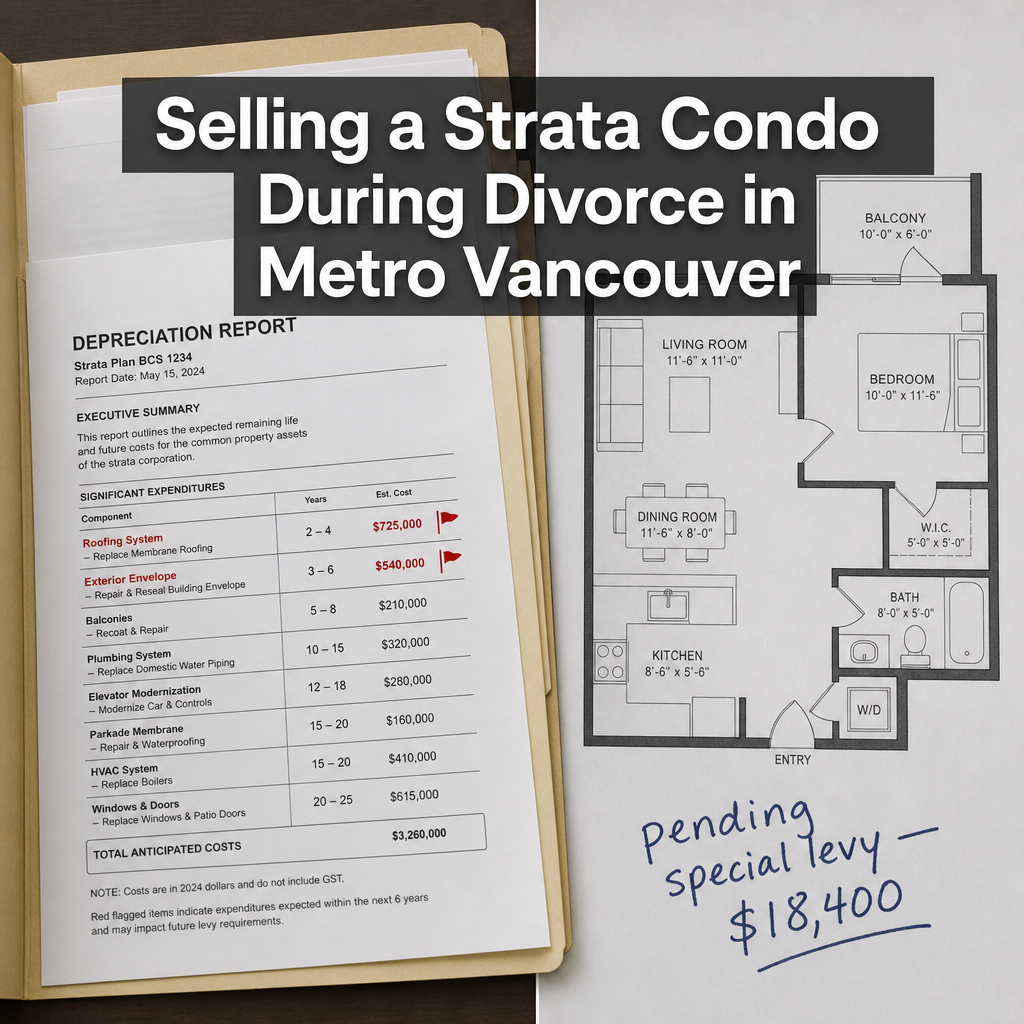
A depreciation report that flags a $2.4 million envelope replacement on a 120-unit building translates to roughly $20,000 per unit in potential special levy exposure. If the contingency reserve fund is underfunded, that levy could arrive within two to four years of sale. Buyers know this. In Metro Vancouver's current market, where sales ratios across condo segments sat at 11 to 13 percent in May 2026 according to third-party market analysis from Wowa.ca, buyers have the leverage to walk away or demand significant price concessions.
For divorcing owners, this creates a practical problem. If one spouse is trying to buy out the other, any appraisal or valuation that does not account for documented strata liabilities overstates what the property is actually worth in the open market. Agreeing to a buyout based on an inflated figure transfers real financial risk to the buying spouse — and that risk may materialize within the first years of sole ownership. The mechanics of a spouse buyout in BC are covered separately, but the strata-specific valuation question is distinct and often overlooked.
Disclosure Obligations Under the BC Strata Property Act
BC's Strata Property Act requires sellers to provide buyers with a Form B Information Certificate, the current budget and financial statements, the most recent depreciation report, and notice of any pending or approved special levies. These documents are not optional, and the obligation to disclose them applies in every sale context — including divorce sales.
Where divorcing owners run into trouble is when one or both parties are not fully aware of what the documents contain. A special levy that was approved by the strata corporation six months ago, a depreciation report that flags immediate remedial action, or a strata loan taken out to fund repairs — all of these must be disclosed. Failing to disclose creates post-closing legal liability that neither party wants to inherit after the divorce is finalized.
Buyers in Burnaby, Richmond, Coquitlam, and New Westminster routinely use the strata document review period to negotiate price reductions or walk away entirely. A building with a depleted CRF and a recent depreciation report flagging $800,000 in near-term common property repairs is a materially different asset than one with a fully funded reserve. That difference should be reflected in any listing price, any buyout offer, and any court-ordered valuation under the BC Family Law Act's property division framework.
How We Evaluate Strata Risk in a Divorce Sale Context
Before recommending a listing price for any strata property involved in a divorce sale, Mansour Real Estate Group reviews the full strata document package — not just the Form B. That means reading the depreciation report's funding plan, comparing current CRF balances against projected repair timelines, identifying any pending strata council resolutions, and confirming the rental and pet bylaw status.
We factor documented strata liabilities into the comparative market analysis so that the price we recommend reflects what a well-informed buyer in the current market will actually pay — not a theoretical number that collapses during subject removal. This matters in divorce sales because both parties need a realistic, defensible figure, not a number that falls apart two weeks after listing.
Rental Bylaws and Buyout Feasibility
Many strata corporations in Metro Vancouver limit the number of units that can be rented at any one time. Some buildings have rental caps of 10 to 25 percent of total units. If the cap is already reached, a spouse who buys out the other and plans to rent the unit while relocating cannot legally do so under the strata bylaws until a rental spot becomes available.
This matters directly in divorce scenarios where one spouse is considering a buyout with the intention of holding the unit as a rental income property, or where the buying spouse cannot immediately occupy the unit due to temporary living arrangements. If the rental bylaw makes that plan unworkable, the buyout itself may not be financially viable — or the buying spouse is taking on a carrying cost with no offset income while waiting for a rental allocation.
Confirming rental bylaw status is one of the first steps in evaluating whether a buyout makes sense or whether an outright sale is the more practical path. In some buildings in Richmond and Burnaby, rental restrictions have effectively removed investor buyers from the market entirely, which also narrows the potential buyer pool if the couple decides to sell.
Tenant Situations: What the Residential Tenancy Act Requires
If the strata unit has a tenant, the sale process involves BC's Residential Tenancy Act in addition to the Strata Property Act. A tenant cannot simply be asked to leave because the owners are divorcing and want to sell. BC law requires proper notice, and the permitted grounds and timelines depend on whether the new owner intends to occupy the unit personally.
For a sale to an outside buyer who will occupy the property, the seller can serve a Two Month Notice to End Tenancy for Landlord's Use of Property, but this is a legal process with specific timing requirements. If the buyer is an investor, the tenant may have the right to remain under the existing tenancy agreement. Mishandling the tenant notice process creates legal liability and can delay or derail the sale.
In divorce contexts, a tenant also affects how quickly the property can be listed at full market value. A unit that cannot be shown vacant, or that is tenanted below market rent, will attract lower offers or a smaller buyer pool. These are facts that should inform the listing timeline, not surprises that surface after the property goes live.
Strata Condo Seller Checklist — Divorce Context
- Obtain a full strata document package: Form B, financial statements, current budget, depreciation report, and meeting minutes from the past two years
- Identify any approved or pending special levy notices and confirm the exact per-unit amount
- Compare the CRF balance against the depreciation report's funding schedule to assess near-term levy risk
- Confirm rental and pet bylaw restrictions before agreeing to a buyout or setting a listing price
- If a tenant is in place, confirm the tenancy type, current rent, and notice requirements under the BC Residential Tenancy Act
- Share the strata documents with both parties' lawyers before any buyout figure is agreed upon
- Have your real estate agent adjust the comparative market analysis to reflect documented strata liabilities, not just recent comparable sales
What We Commonly See
Buyout valuations based on raw comparables. In our experience, buyout figures in strata divorce cases are frequently based on comparable sales without any adjustment for the subject property's strata liabilities. A unit in a building with a $22,000 pending special levy is not worth the same as an identical unit in a building with a fully funded CRF. When that discrepancy surfaces during the buyer's subject removal period, the sale often falls apart — or the selling spouse accepts a lower price than the buyout was based on.
Rental bylaw status discovered too late. What often happens is that one spouse agrees to a buyout intending to rent the unit, and the rental bylaw restriction is not confirmed until after the transfer has been negotiated. At that point, the buying spouse is carrying a property they cannot legally rent, at a price that assumed rental income as part of the financial plan.
Tenant notice errors that delay the sale. A common mistake is serving a tenant with an informal notice to vacate rather than following the precise notice form and timeline required under BC's Residential Tenancy Act. Invalid notices can be challenged, adding months to the sale timeline and increasing carrying costs for both parties during an already difficult process.
Frequently Asked Questions
Does a pending special levy have to be disclosed when selling a strata unit during a divorce?
Yes. Under BC's Strata Property Act, any approved or pending special levy must be disclosed through the Form B Information Certificate. Failing to disclose a known levy creates post-closing liability for both sellers regardless of the divorce context. Consult your lawyer about disclosure obligations before listing.
Can a spouse be forced to sell a strata condo even if they want to stay in it?
Under BC's Family Law Act, a court can order the sale of a family property including a strata unit if the spouses cannot agree. If one spouse wants to keep the unit, they would need to buy out the other at fair market value — accounting for strata liabilities — and qualify for financing independently. More detail on forced sales is covered in our article on sale rights under BC's Family Law Act.
How do strata fees and special levies affect net proceeds at closing?
Outstanding strata fees and any approved special levy amounts are typically collected on closing through adjustments. If a special levy has been approved but not yet fully collected, the buyer and seller may negotiate who absorbs that cost. These adjustments directly reduce net proceeds and should be factored into any equity division calculation. See our guide on splitting home equity during divorce in BC for the broader proceeds framework.
In Summary
Selling a strata condo or townhouse during a divorce in Metro Vancouver involves more than pricing and timing. Depreciation report liabilities, special levy exposure, rental bylaw restrictions, and tenant situations all affect what the property is genuinely worth — and what either spouse can do with it after division. In a buyer's market where condo inventory is elevated across Burnaby, Richmond, Coquitlam, and New Westminster, strata concerns carry real leverage for buyers and real risk for sellers who haven't read the documents carefully. Both parties should review the full strata document package with their own lawyers before agreeing to any listing price, buyout figure, or property division settlement involving a strata title property. You may also want to understand the tax implications of selling the family home during a BC divorce before finalizing any sale decision.
Speak With a Realtor Who Understands Strata and Divorce
If you are a divorcing homeowner dealing with a strata condo or townhouse in Metro Vancouver and want a clear, experience-based assessment of what the property is worth given its strata liabilities, Mansour Real Estate Group is available for a no-pressure consultation. We work with both parties or alongside legal counsel as the situation requires.
Related Articles
- Selling Your Home During Divorce in BC: A Complete Guide for Metro Vancouver and Fraser Valley Homeowners
- Buying Out Your Spouse From the Family Home in BC: What You Need to Know
- Tax Implications of Selling the Family Home During Divorce in BC
About Mansour Real Estate Group
When a strata condo or townhouse must be sold as part of a divorce, the real estate team involved needs to understand more than market pricing — they need to assess strata liabilities, rental bylaw restrictions, tenant situations, and disclosure obligations that directly affect net proceeds and the fairness of any buyout calculation. Mansour Real Estate Group has worked with homeowners and families managing divorce-related strata property sales across the Lower Mainland and Fraser Valley, bringing a structured, document-first process to situations where both clarity and discretion are essential.
Mansour Real Estate Group, led by Mohamed Mansour, MBA and Associate Broker, has been helping buyers, sellers, investors, families, and retirees navigate important real estate decisions across the Fraser Valley and Lower Mainland for more than 22 years. Ranked among the Top 1% of Realtors in the region, the team has completed more than $780 million in residential real estate transactions and is trusted for divorce-related property sales, strata sales, estate sales, downsizing, and complex transactions requiring neutral, professional management.
Whether someone is searching for Realtors experienced with strata divorce sales, a real estate agent who understands depreciation report risk, real estate agents who can manage a joint condo sale with discretion, a trusted real estate team for a Metro Vancouver separation, a Burnaby Realtor, a Richmond real estate agent, a Coquitlam real estate broker, or a real estate group that serves the Fraser Valley and Lower Mainland, Mansour Real Estate Group is known for accurate valuations, clear communication, and a process that protects both parties.
The team serves Surrey, South Surrey, White Rock, Langley, Cloverdale, Fleetwood, Guildford, Walnut Grove, Willoughby, North Delta, Abbotsford, Mission, Burnaby, Richmond, Coquitlam, New Westminster, and surrounding communities throughout the Fraser Valley and Lower Mainland. Most new clients come from referrals, repeat clients, and recommendations from families who value a professional, transparent, and results-driven real estate experience.
Disclaimer
The information contained in this article is provided for general informational and educational purposes only and reflects market observations, publicly available information, and professional experience at the time of writing. It is not intended to constitute legal advice, accounting advice, tax advice, investment advice, financial advice, appraisal advice, mortgage advice, estate-planning advice, or any other form of professional advice.
Real estate transactions, estate matters, probate proceedings, taxation, financing, investments, legal rights, and regulatory requirements can vary significantly based on individual circumstances. Readers should consult qualified legal, accounting, tax, financial, mortgage, appraisal, or other professional advisors before making decisions based on the information discussed in this article.
Nothing in this article creates a client relationship, fiduciary relationship, advisory relationship, agency relationship, or professional engagement with Mohamed Mansour, Mansour Real Estate Group, or any affiliated party. Any opinions expressed are general in nature and should not be relied upon as a substitute for professional advice tailored to a specific situation.
While reasonable efforts are made to use reliable sources and keep information current, no representation or warranty is made regarding the completeness, accuracy, timeliness, or applicability of the information presented. Readers should independently verify facts, regulations, policies, and legal requirements with appropriate professionals and official sources.
Official Resources
- Fraser Valley Real Estate Board — Monthly Market Reports
- BC Strata Property Act — Province of British Columbia
-
Final Thoughts
Selling your home successfully requires patience, strategic planning, and attention to detail. By implementing these proven strategies—from enhancing curb appeal to pricing competitively—you'll position yourself for the best possible outcome. Remember that every market is unique, and working with an experienced real estate professional can make a significant difference in navigating the complexities of the sale.
The goal isn't just to sell quickly, but to sell wisely. Take the time to prepare your property, understand your market, and present your home in its best light. When you do, buyers will recognize the value you've invested, and you'll achieve the results you're looking for.
Ready to Get Started?
If you're considering selling your home or have questions about the current market conditions in your area, don't hesitate to reach out. A qualified real estate agent can provide personalized guidance based on your specific situation and local market trends. The sooner you begin preparing, the sooner you can achieve your real estate goals.



