

Selling a Family Home During High-Conflict Divorce: How Neutral Realtors Manage Spousal Access, Showing Logistics, Pricing Disputes, and Offer Review When Communication Has Broken Down
By Mohamed Mansour, MBA and Associate Broker | Mansour Real Estate Group | Fraser Valley and Lower Mainland, BC | Published: July 15, 2025 | Series: Divorce Home Sales in BC — Article 7 of 15
Most divorce home sales are difficult. High-conflict divorce home sales are operationally complex in ways that go far beyond seller psychology or legal paperwork. When spouses cannot communicate directly — or when every interaction risks escalating into a dispute — the realtor becomes the operational centre of the entire transaction. This article explains how that actually works in Metro Vancouver, Surrey, Langley, and the Fraser Valley.
The challenges covered here are specific: who gets access to the property and when, how showings are scheduled when one spouse is in possession, what happens when pricing expectations diverge by five to ten percent, and how offer review and acceptance is structured when both parties must sign but cannot agree. These are not hypothetical scenarios — they are the situations that collapse deals and extend timelines by months when managed poorly.
Short Answer
In a high-conflict divorce home sale, a neutral realtor manages access through structured showing windows and documented entry logs, resolves pricing disputes with independent CMAs and appraisals, and coordinates offer review through dual-counsel protocols. Without these systems, pricing deadlocks can delay a listing by 30 to 60 days and communication failures can kill accepted offers. Under BC's Partition of Property Act, a court can order the sale if spouses reach a deadlock.
Who This Applies To
- Separated spouses who are both on title but cannot communicate directly
- Homeowners where one spouse is living in the property during the sale
- Couples whose legal counsel have advised against direct contact
- Families where a pricing disagreement is delaying the listing
- Co-owners who have received or are considering a Partition of Property Act application
When This Advice May Not Apply
If one spouse has already obtained a court order governing the sale — including an appointed listing agent or fixed pricing parameters — the protocols described here operate within those constraints. Always confirm the scope of any existing court orders with your family law lawyer before engaging a realtor. This article covers general professional practice, not legal advice tailored to a specific situation.
Key Takeaways
- Structured showing windows and documented access logs are the first line of defense against conflict during the listing period
- Pricing disputes averaging 5–10% divergence require independent appraisals, not negotiation between spouses
- Offer review in high-conflict sales must route through both lawyers, with documented trails at every step
- Neutral realtors communicate with both parties in writing, separately, and with identical information
- The BC Partition of Property Act creates court-ordered sale risk that experienced realtors use to frame urgency without taking sides
Key Terms
Partition of Property Act (BC): Provincial legislation that allows either co-owner to apply to BC Supreme Court for an order to sell a jointly owned property. In divorce contexts, this is the legal backstop when spouses cannot reach a sale agreement.
Comparative Market Analysis (CMA): A formal assessment of a property's market value based on recent comparable sales, prepared by a licensed realtor. Used to anchor pricing discussions when spouses disagree.
Dual-Counsel Protocol: A communication structure in which the realtor routes all material decisions — pricing, offer acceptance, condition removal — through each spouse's legal counsel rather than directly between the parties.
Showing Window: A pre-scheduled time block during which the property is made available for buyer viewings. In high-conflict sales, windows are fixed by agreement rather than set on request.
Data Used in This Article
- BC Family Law Act, SBC 2011 c. 25 — Provincial statute governing property division on separation; official government source
- BC Partition of Property Act, RSBC 1996 c. 366 — Provincial statute governing court-ordered property sales; official government source
- REBGV Professional Standards — Guidance on neutral representation and transaction management in disputed sales; regulatory body
- Professional practice observations — Timeline and pricing divergence figures drawn from Mansour Real Estate Group's experience with divorce-related transactions in the Fraser Valley and Lower Mainland; internal professional analysis
Why High-Conflict Divorce Sales Fail — and What Makes Them Different
Standard MLS listing processes assume a single decision-maker — or at minimum, two parties who can communicate. When spouses are in active conflict, every step that requires joint approval becomes a potential point of failure. Pricing sign-off, showing authorization, offer acceptance, condition removal, and closing coordination all require both parties to act. When one refuses, delays, or escalates, the deal stalls.
In Metro Vancouver markets — particularly Burnaby, Coquitlam, New Westminster, Surrey, and Langley — well-priced properties in active markets can generate multiple showing requests per day. If access is uncertain, buyers move on. If the listing sits because of a pricing deadlock, days-on-market climb and the property's market perception changes. Buyers in these markets notice when a listing has been sitting, and they adjust their offers accordingly.
The difference between a clean sale and a costly delay in these situations is almost always structural: whether the realtor has established clear access protocols, communication trails, and dispute escalation procedures before the listing goes live, not after problems emerge. For a broader overview of the divorce home sale process in BC, see our complete guide for Metro Vancouver homeowners.
The BC Family Law Act requires that both spouses be treated fairly in property division, but it does not automatically resolve practical disagreements about timing, price, or access. When those practical disagreements persist, the Partition of Property Act provides a court-ordered pathway that neither party typically wants to reach — and that risk is something a skilled neutral realtor can reference to create productive urgency.
Access Logistics: Scheduled Windows, Entry Logs, and Third-Party Presence
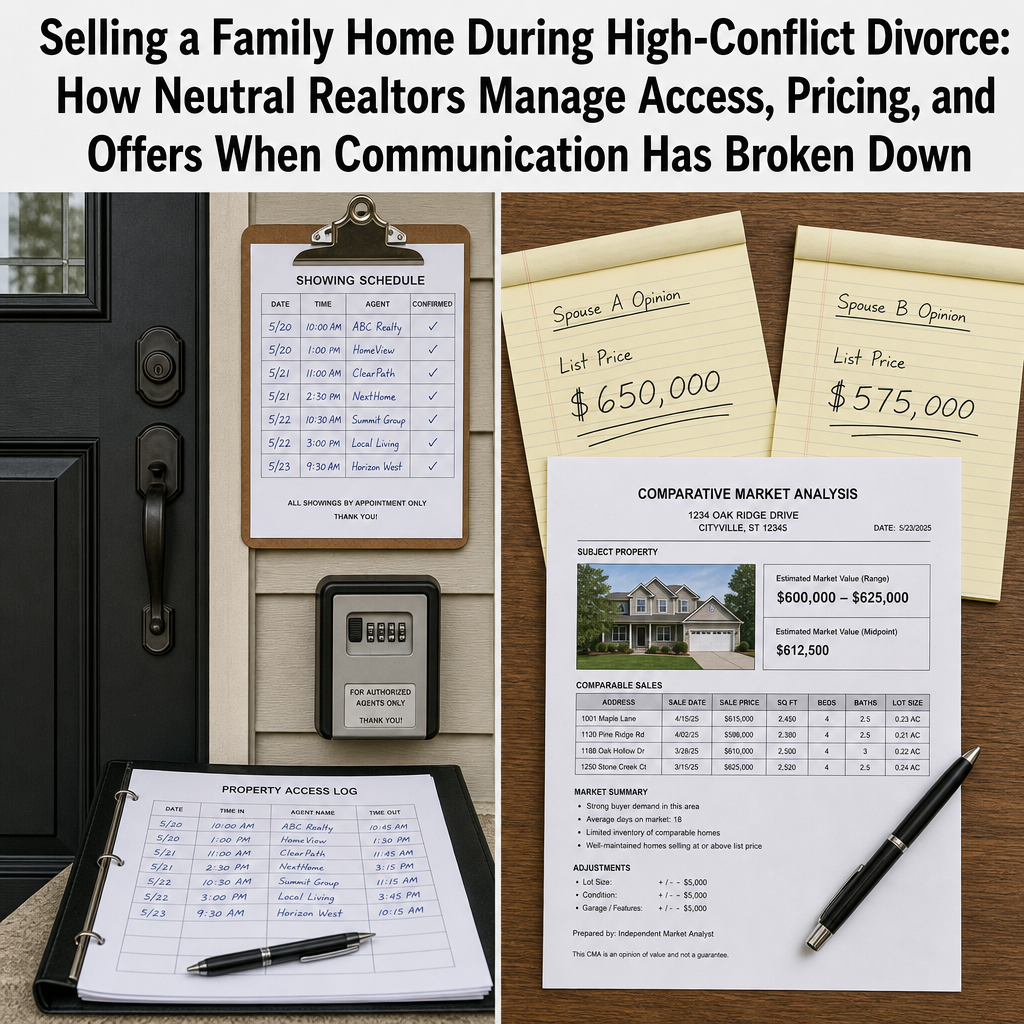
When one spouse is living in the property during the sale — which is common when no interim agreement has been reached — every showing requires their cooperation. A neutral realtor's first structural task is to establish a fixed showing schedule before the property goes live, agreed to by both parties in writing.
Practical showing windows for Metro Vancouver properties in high-conflict situations typically look like this: two or three fixed blocks per week, communicated to both spouses and their lawyers with at least 48 hours' notice, with the occupying spouse vacating for the duration and a documented entry and exit log maintained by the realtor or a trusted third party. The lockbox code is not shared directly with either spouse unless both have agreed to the access terms in writing.
Third-party presence — either the realtor, a licensed assistant, or a designated neutral — during showings reduces the risk of disputes about the property's condition being raised afterward. It also ensures that post-showing feedback is communicated identically to both parties. In higher-conflict situations, some realtors will arrange for a family law support person or legal assistant to accompany showings when requested by either lawyer.
Access disputes that are not resolved before listing — for example, an occupying spouse who unilaterally cancels showings, leaves the property in poor condition, or denies buyers entry — can constitute a breach of the selling agreement and may give the non-occupying spouse grounds to seek a court order. A neutral realtor documents every access event for exactly this reason. For practical preparation steps, see our article on preparing your home for sale during a divorce in BC.
Pricing Disputes: When Spouses See Different Numbers
Pricing is the most common sticking point in high-conflict divorce sales. One spouse typically wants to list high — often driven by emotional attachment to the home's value or a desire to delay the sale. The other typically wants to list at or below market to complete the transaction quickly. In practice, the divergence in initial pricing expectations between conflicted spouses is often five to ten percent of the estimated market value. On a $1.4 million Surrey property, that is a $70,000 to $140,000 disagreement before a single buyer has seen the home.
A neutral realtor does not negotiate between the spouses on price. That is not the realtor's role. Instead, the role is to anchor the discussion in evidence: a formal CMA with documented comparable sales, market days-on-market data, and where useful, an independent appraisal from a certified appraiser. When both parties can see the same data, the conversation shifts from preference to evidence. That shift does not always resolve the dispute immediately, but it changes the nature of the disagreement.
When pricing deadlock persists beyond two to three weeks of documented CMA presentations, the practical options are: formal mediation with a family law mediator who has reviewed the appraisal, referral back to legal counsel to include a pricing parameter in the separation agreement, or — in the most entrenched situations — an application under the Partition of Property Act for a court-ordered sale. Pricing disputes that are not resolved before listing routinely extend total transaction timelines by 30 to 60 days and tend to depress final sale prices, since buyers observe the market aging of an unsold listing. For a detailed breakdown of pricing strategy in this context, see our article on pricing your home right during a divorce in Metro Vancouver.
Offer Review When Both Parties Must Sign
When an offer comes in, the standard process assumes a seller who reviews, considers, and responds within the acceptance period — typically 24 to 48 hours. In a high-conflict divorce sale, that process must accommodate two parties who cannot communicate directly, each of whom typically has legal counsel reviewing the offer independently.
A neutral realtor in this situation presents the offer in writing to both parties simultaneously — usually through their respective lawyers — with a summary of the key terms: price, completion date, conditions, and deposit. The lawyers then advise their clients. If both accept, the realtor documents both signatures and proceeds. If one rejects without explanation, the realtor's role is to document that rejection and communicate the outcome to both parties and their counsel — not to pressure either party or advocate for one side's preference.
Where an offer is rejected by one spouse for reasons that appear tactical rather than substantive — for example, rejecting a near-asking-price clean offer with no stated rationale — the non-rejecting spouse's lawyer may advise seeking a court order to compel acceptance, or may reference the Partition of Property Act as a framework for judicial intervention. A realtor who has maintained a complete documentation trail of the offer, the presentation, and the rejection timeline is in a far stronger position to support that legal process than one who managed communications informally. For a detailed look at how mortgage obligations interact with this process, see our upcoming article on mortgage and the marital home in BC.
How We Evaluate This
At Mansour Real Estate Group, our approach to high-conflict divorce sales begins with a structural conversation before the listing agreement is signed. We confirm: whether both parties have legal counsel, whether there is an existing court order or separation agreement governing the sale, who is in possession of the property, and what the communication preferences are for each party.
From that point, we establish written protocols — access windows, communication channels, offer review routing — before the listing goes live. We present all material updates to both parties in writing, simultaneously, using identical language. We do not advocate for one spouse's pricing position over the other. We document every material event: access logs, showing summaries, feedback, offer presentations, and acceptance or rejection records. That documentation trail serves both parties' lawyers, and in the event of a dispute, it serves the court. For guidance on choosing a realtor with experience in this type of transaction, see our article on the qualities to look for in a divorce home sale realtor.
Divorce Home Sale Checklist: High-Conflict Protocol
- Confirm both parties have retained separate family law counsel before listing
- Review any existing court orders or separation agreement provisions governing the sale
- Establish written showing windows agreed to by both parties before the listing goes live
- Implement a documented access log for every entry by buyers, agents, or inspectors
- Commission a formal CMA and — where pricing disagreement persists — an independent certified appraisal
- Route all material communications through both lawyers using identical written language
- Establish a formal offer review protocol: simultaneous presentation, documented response, dual-signature requirement
- Document every rejection or counter with written rationale, whether or not the rejecting party provides one
What We Commonly See
What often happens is that spouses arrive at listing without agreed access terms, assuming the realtor will sort it out as showings begin. This creates immediate friction. The occupying spouse feels their home is being invaded on short notice. The non-occupying spouse feels showings are being sabotaged. Neither is wrong about what is happening — the structure was simply not established in advance.
In our experience, pricing deadlocks are rarely about the money alone. The spouse insisting on a higher price is often trying to preserve something — time in the home, a sense of control over the outcome, or leverage in another part of the settlement. Recognizing that dynamic helps frame the CMA conversation differently. The goal is to shift the discussion from "what I believe the home is worth" to "what the current buyer pool will pay and what delay costs both of us."
A common mistake in high-conflict offer review is allowing the acceptance period to expire while waiting for both parties to respond. In some cases, this happens because one party's lawyer is not immediately available. Building a longer acceptance window into counteroffers — and confirming counsel availability before presenting — prevents the collapse of workable offers on procedural grounds.
Questions and Answers
Can one spouse refuse to allow showings of the family home in BC?
Not without legal consequence. If both spouses are on title and a sale is required under a separation agreement or court order, an occupying spouse who refuses access to showings may be in breach of that agreement. The non-occupying spouse can seek a court order compelling access, and documented refusals strengthen that application. Consult your family law lawyer immediately if access is being denied.
What happens if one spouse rejects a reasonable offer during a divorce home sale?
The non-rejecting spouse's lawyer can document the rejection and its circumstances. If the offer was near market value and the rejection appears tactical, this may support an application under BC's Partition of Property Act, asking the court to order the sale on terms the court determines. A complete documentation trail from the realtor is critical evidence in that process.
How does a neutral realtor communicate with two spouses who cannot speak to each other?
Through written, simultaneous, identical communications to both parties — usually routed through their respective lawyers. All material updates, showing feedback, offer summaries, and decisions are documented in writing. The realtor does not relay verbal messages between parties, advocate for one party's position, or allow one spouse's communication preferences to supersede the other's access to information.
In Summary
High-conflict divorce home sales require structural protocols — not just good intentions — to reach a successful close. Access windows, documentation trails, CMA-anchored pricing discussions, and dual-counsel offer review procedures are the difference between a transaction that completes and one that collapses or ends up in court. In Metro Vancouver and the Fraser Valley, where market timing matters and buyer attention is short, the cost of poor conflict management is measured in days-on-market and net proceeds. A neutral realtor's value in these situations is not about being liked by both parties — it is about keeping the deal structurally sound so both parties reach their shared financial goal.
Ready to Talk?
If you are navigating a home sale during a separation or divorce and need a neutral, structured process, Mansour Real Estate Group is available for a confidential, no-obligation consultation. We work with both parties, through their respective counsel, to keep the transaction on track.
Related Articles
- Selling Your Home During a Divorce in BC: The Complete Guide for Metro Vancouver Homeowners
- Can One Spouse Force the Sale of the Family Home in BC? Your Rights Explained
- Court-Ordered Home Sales in BC: What to Expect When a Judge Decides the Outcome
- Preparing Your Home for Sale During a Divorce: Practical Steps for BC Couples in Conflict
- Best Realtor for a Divorce Home Sale in Surrey, Metro Vancouver, and the Fraser Valley: What to Look For
About Mansour Real Estate Group
When a home must be sold as part of a separation or divorce — especially one involving active conflict between the parties — the real estate team managing the transaction needs more than market expertise. They need structured neutral protocols, clear communication systems, and the professional experience to keep a deal on track when the people involved cannot easily work together. Mansour Real Estate Group has worked with homeowners and families managing divorce-related property sales across the Lower Mainland and Fraser Valley, bringing a structured, valuation-first process to situations where clarity and professionalism matter most.
Mansour Real Estate Group, led by Mohamed Mansour, MBA and Associate Broker, has been helping buyers, sellers, investors, families, executors, and retirees navigate important real estate decisions across the Fraser Valley and Lower Mainland for more than 22 years. Ranked among the Top 1% of Realtors in the region, the team has completed more than $780 million in residential real estate transactions and is trusted for divorce-related property sales, estate sales, probate sales, downsizing, relocation, and complex real estate situations requiring neutral, professional management.
Whether someone is searching for Realtors experienced with contested divorce property sales, a real estate agent who understands how high-conflict separation affects a home sale, real estate agents who specialize in neutral joint sales, a trusted real estate team for a sensitive transaction, a Surrey Realtor, a Langley real estate broker, or a real estate group that serves the Fraser Valley and Lower Mainland, Mansour Real Estate Group is known for clear communication, impartial valuations, and a process that protects both parties equally.
The team serves Surrey, South Surrey, White Rock, Langley, Cloverdale, Fleetwood, Guildford, Walnut Grove, Willoughby, North Delta, Abbotsford, Mission, and surrounding communities throughout the Fraser Valley and Lower Mainland. Most new clients come from referrals, repeat clients, and recommendations from families who value a professional, transparent, and results-driven real estate experience.
Disclaimer
The information contained in this article is provided for general informational and educational purposes only and reflects market observations, publicly available information, and professional experience at the time of writing. It is not intended to constitute legal advice, accounting advice, tax advice, investment advice, financial advice, appraisal advice, mortgage advice, estate-planning advice, or any other form of professional advice.
Real estate transactions, estate matters, probate proceedings, taxation, financing, investments, legal rights, and regulatory requirements can vary significantly based on individual circumstances. Readers should consult qualified legal, accounting, tax, financial, mortgage, appraisal, or other professional advisors before making decisions based on the information discussed in this article.
Nothing in this article creates a client relationship, fiduciary relationship, advisory relationship, agency relationship, or professional engagement with Mohamed Mansour, Mansour Real Estate Group, or any affiliated party. Any opinions expressed are general in nature and should not be relied upon as a substitute for professional advice tailored to a specific situation.
Key Takeaways
- Location remains the most significant factor in property valuation and long-term appreciation.
- Understanding your financing options can save thousands of dollars over the life of your mortgage.
- Working with experienced real estate professionals ensures you make informed decisions.
- Home inspections and market analysis are essential steps before any purchase commitment.
Final Thoughts
The real estate market continues to evolve, but fundamental principles remain constant. Success in buying or selling property depends on preparation, knowledge, and patience. Whether you're a first-time homebuyer or an experienced investor, taking time to understand the process thoroughly protects your interests and maximizes your investment potential.
Remember that every property and every transaction is unique. What works for one buyer may not be ideal for another. By staying informed and working with qualified professionals, you position yourself to make decisions that align with your long-term financial goals and lifestyle needs.



