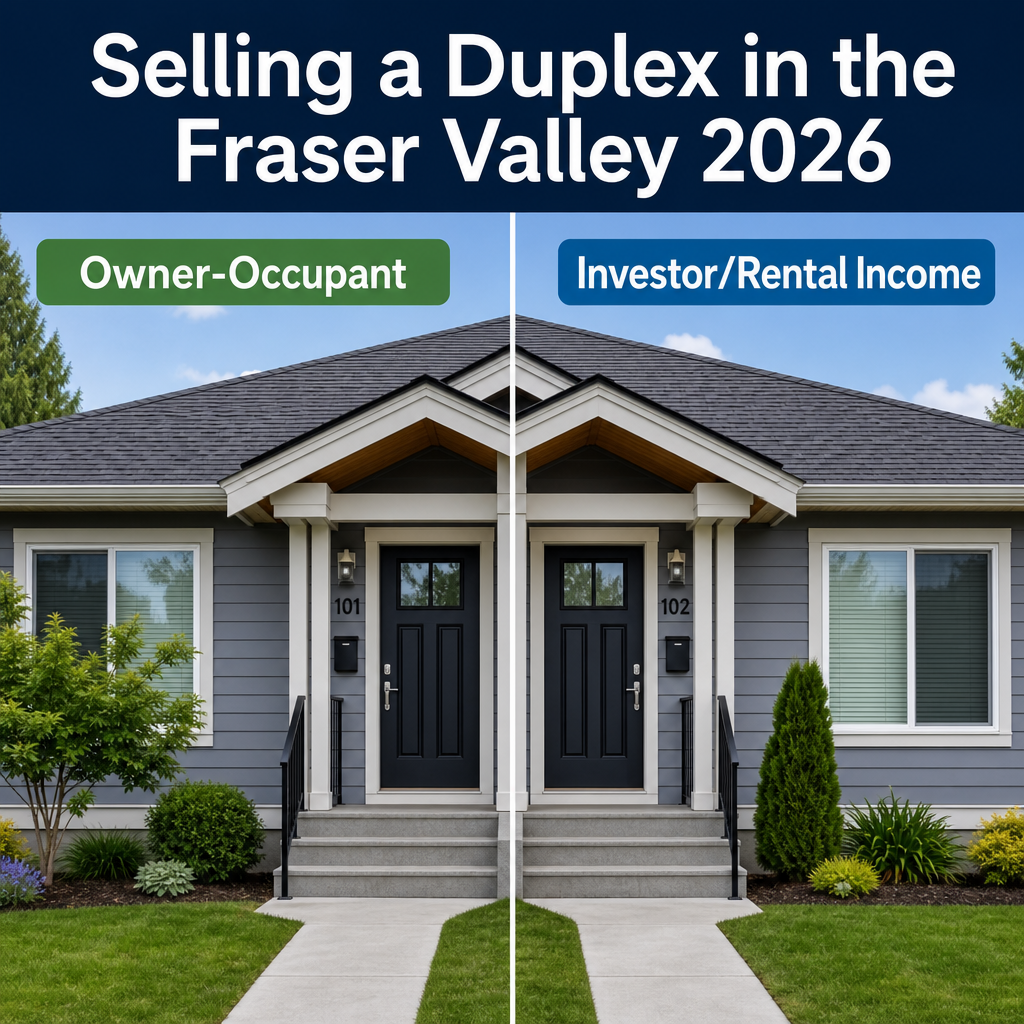

Selling a Duplex in the Fraser Valley 2026: Dual-Unit Economics, Buyer Profiles, and Pricing Strategy in a Buyer's Market
By Mohamed Mansour, MBA and Associate Broker | Mansour Real Estate Group | Published June 2026 | Fraser Valley and Lower Mainland, BC
Duplexes sit in an unusual position in the Fraser Valley market. They are more complex than a townhome to price, attract a different mix of buyers than a detached home, and rarely appear in the kind of seller-focused guidance that covers those categories separately. For duplex owners preparing to sell in 2026, that gap matters — because the pricing and positioning decisions are genuinely different.
This article is written for duplex sellers in the Fraser Valley, specifically owners in North Delta, Surrey, Langley, and Abbotsford navigating a buyer's market with elevated inventory. It covers dual-unit pricing methodology, the two dominant buyer profiles you will encounter, and where sellers most commonly lose negotiating leverage before a showing even begins.
Short Answer
Selling a duplex in the Fraser Valley in 2026 requires pricing that speaks to two buyer types at once: the owner-occupant looking for a primary residence with rental income offset, and the investor evaluating cap rate and cash flow. In a buyer's market with over 10,000 active listings and a 5% sales-to-active ratio across the region, duplexes with separate metering, updated units, and documented rental history are positioned to hold value better than those priced against detached home benchmarks alone.
Who This Applies To
- Duplex owners in the Fraser Valley preparing to list in 2026
- Sellers in North Delta, Surrey, Langley, or Abbotsford with a side-by-side or up-down duplex
- Estate executors or family members selling a duplex property held long-term
- Owners unsure whether to price against detached comparables or attached housing benchmarks
- Sellers who want to attract both investor and owner-occupant offers
When This Advice May Not Apply
If your duplex is subject to a strata corporation, review strata documents and consult your lawyer before pricing or listing — strata rules and financials affect buyer due diligence and offer structure. This article addresses freehold or bare-land duplex structures and should not be applied directly to strata-titled duplex units without separate analysis.
Key Takeaways
- Fraser Valley attached housing has outperformed detached in 2026, with sales-to-active ratios of 15–23% versus 7–11% for single-family homes.
- Duplex buyers split between owner-occupants seeking rental offset and investors running cap-rate math — price must speak to both.
- Separate metering, strong rental history, and updated units are the three features that most consistently influence duplex offer strength.
- Anchoring duplex price to detached benchmarks alone overstates value; anchoring to townhome benchmarks alone understates it.
- North Delta duplex inventory is above seasonal average in 2026, making positioning and preparation more important than timing alone.
Data Used in This Article
- FVREB Monthly Market Report, May 2026 — official board data; sales-to-active ratios, benchmark prices, active listings count (fvreb.bc.ca)
- FVREB Statistics Package, April 2026 — attached housing segment performance (fvreb.bc.ca)
- Daily Hive / Zealty, May–April 2026 — third-party market summaries used to corroborate FVREB segment observations
Why the Fraser Valley Duplex Market Is Different in 2026
According to the Fraser Valley Real Estate Board's May 2026 monthly market report, the Fraser Valley has more than 10,000 active listings across all residential property types. The overall sales-to-active ratio sits at approximately 5%, which places the market firmly in buyer's market territory. That number, however, is not uniform across segments.
Attached housing — townhomes and duplexes combined — has shown sales-to-active ratios in the 15–23% range in early 2026, well above detached homes, which have tracked between 7% and 11%. That relative strength reflects a practical reality: attached properties, including duplexes, sit at a price point that remains accessible to a wider buyer pool than detached homes at the current benchmark of $1,370,900 (down 7.9% year-over-year as of May 2026).
Duplexes benefit from that relative momentum but do not inherit it automatically. A duplex priced or presented without attention to its dual-income structure, buyer profile mix, or condition differentiators will be compared against townhomes benchmarked at $770,000 (down 7.6% year-over-year) — and lose. Priced correctly with documentation that supports both owner-occupant and investor analysis, a duplex can command a premium that neither category alone justifies.
Understanding the Two Buyer Profiles — and Why Both Matter
Duplex buyers in the Fraser Valley in 2026 fall into two distinct categories, and most serious duplex sellers will encounter both in a typical listing cycle.
Owner-occupants typically plan to live in one unit and rent the other. Their calculation is straightforward: what will this property cost me net of rental income, and how does that compare to buying a comparable detached home or townhome? For a family in North Delta or Langley, a duplex at $1.1M with a $2,400 monthly rental suite can effectively lower their carrying cost to well below what a detached home would require. That math is your most powerful marketing asset with this buyer.
Investor-buyers think in cap rates and gross rent multipliers. They are not primarily interested in how the kitchen looks — they want to know what both units generate, whether the tenancies are in good standing, whether metering is separate, and what the maintenance history looks like. In a buyer's market with elevated inventory, investor-buyers are patient. They will not overpay for aesthetics, and they will discount heavily for uncertainty around tenancy status or undocumented rental income. If your duplex has strong rental history and separate utilities, document everything before you list. That documentation is the difference between a confident investor offer and a heavily discounted one.
How to Price a Duplex in the Fraser Valley in 2026
Duplex pricing requires a three-input approach. No single benchmark gives you the right answer.
Input 1: Attached housing comparables. Look at recent duplex sales in your submarket — North Delta, North Delta specifically has seen above-average inventory this year — and adjust for lot size, unit configuration, and condition. The FVREB townhome benchmark of $770,000 provides a floor reference for smaller or older duplexes, not a ceiling.
Input 2: Detached home comparables nearby. Duplexes on fee-simple lots with no strata typically carry a land premium that townhome comparisons miss. The May 2026 single-family benchmark of $1,370,900 provides an upper reference, but most duplexes will price below it. The useful question is: what portion of that detached land value does your duplex lot represent?
Input 3: Income approach. For investor-buyers, run a gross rent multiplier and a simple cap-rate estimate using actual or current market rents. If both units are rented at or near market, this number will either support or challenge your comparable-based price. When the income approach and the comparable approach converge within a reasonable range, you have a defensible price. When they diverge significantly, expect negotiation pressure from investor buyers — and adjust the strategy accordingly.
Duplex Seller Checklist
- Confirm legal title structure — freehold, bare-land strata, or strata-titled duplex — and obtain appropriate documents before listing
- Document both units' rental income with current lease agreements or month-to-month confirmation and payment history
- Confirm whether utilities (hydro, gas, water) are separately metered and gather the bills — investor buyers will ask
- Identify and disclose any Residential Tenancy Act obligations including required notice periods for showings and vacant possession
- Obtain a pricing analysis that uses all three inputs: attached comparables, detached land value comparables, and an income-approach estimate
- Review the condition of both units — deferred maintenance in one unit discounts both in investor perception
- Prepare a one-page income summary for prospective buyers showing current rents, market rents, and utility cost allocation
What We Commonly See
In our experience, duplex sellers in the Fraser Valley most often undermine their position in one of three ways.
The first is pricing against only one benchmark. A seller who compares exclusively to detached homes nearby will typically overprice. A seller who compares exclusively to townhomes will underprice and leave equity on the table. The duplex sits between those categories and must be priced with all three inputs in play.
The second is tenancy uncertainty. What often happens is that a duplex enters the market with verbal or undocumented rental arrangements, or with tenancy situations that create ambiguity around possession timelines. Investor buyers price that uncertainty into their offers — and owner-occupants who want one unit vacant may simply move on. Resolving tenancy questions before listing, not after an offer comes in, is one of the highest-leverage preparation steps available to a duplex seller.
The third is treating both units as one property for presentation purposes. Buyers — both profiles — evaluate each unit separately before they evaluate the combined investment. Walk-through materials, photographs, and the listing narrative should address both units individually, including square footage, features, and rental income, before synthesizing the combined value story.
Frequently Asked Questions
Does a duplex need to be vacant to sell in BC?
No. Duplexes routinely sell with tenants in place. BC's Residential Tenancy Act governs required notice periods for showings and, where applicable, end of tenancy. Your listing agent and your lawyer should review tenancy status before you list to avoid surprises during subject removal.
How do separate meters affect a duplex sale price?
Separate hydro and gas metering is a meaningful positive for investor buyers because it eliminates shared utility cost allocation disputes and simplifies management. In our experience, investor-buyers in the Fraser Valley will discount a duplex without separate metering relative to one with it, all else being equal, and that discount is often larger than the cost of adding separate metering before listing.
Should I price a duplex closer to detached or townhome benchmarks?
Neither in isolation. A freehold duplex on a full lot carries land value that townhome comparisons miss, and a size or age disadvantage relative to detached homes that those comparisons overstate. A defensible duplex price in 2026 requires all three inputs: recent duplex sales, nearby detached comparables on similar lot sizes, and an income approach based on actual rents.
How We Evaluate This
At Mansour Real Estate Group, our approach to duplex pricing starts with separating the three inputs and running them independently before reconciling them into a recommended list price. We do not average the inputs — we weight them based on which buyer profile is most likely to generate the strongest offer for that specific property.
For a duplex with strong rental documentation, separate metering, and both units occupied, the income approach carries more weight because investor-buyers will be well-represented in the offer pool. For a duplex where one unit is vacant or underutilized, the owner-occupant analysis carries more weight, and the pricing and marketing strategy shifts accordingly. The goal is a price that attracts the right buyer profile — not the widest possible audience at a number that neither profile can justify.
In Summary
Duplexes in the Fraser Valley in 2026 occupy a real pricing and positioning advantage — but only when the strategy accounts for both buyer profiles and all three pricing inputs. Attached housing has outperformed detached in sales activity this year, and duplexes with documented rental income, separate metering, and well-prepared units are among the strongest positioned properties in a buyer's market. The sellers who lose ground are those who price against only one comparable category, leave tenancy questions unresolved, and present both units as a single undifferentiated property. With the right preparation and a pricing methodology that respects the dual-unit economics, a Fraser Valley duplex seller in 2026 can hold value that the broader market averages do not reflect.
If you are preparing to sell a duplex in North Delta, Surrey, Langley, or elsewhere in the Fraser Valley and want a pricing analysis that accounts for all three inputs, Mansour Real Estate Group offers a no-obligation consultation to walk through the numbers honestly before you commit to a list price.
Related Articles
- North Delta Real Estate Market 2026: What Sellers Need to Know Before Listing
- Selling Your Home in Langley BC 2026: Market Conditions, Timing, and Strategy
- Fraser Valley Real Estate Market 2026: Buyer, Seller, and Investor Guide
About Mansour Real Estate Group
Selling a duplex in the Fraser Valley requires a pricing approach that most general market analyses do not provide — one that accounts for land value, unit-level income, tenancy conditions, and two distinct buyer profiles simultaneously. Mansour Real Estate Group has guided duplex sellers, income property owners, and multi-unit residential sellers across Surrey, North Delta, Langley, Abbotsford, and the broader Fraser Valley for more than two decades, bringing the same valuation discipline to dual-unit properties that the team applies to every complex residential transaction.
Led by Mohamed Mansour, MBA and Associate Broker, the real estate group has more than 22 years of local experience, over $780 million in completed residential real estate transactions, and consistent recognition among the Top 1% of Realtors in the Fraser Valley and Lower Mainland. The team is trusted for seller strategy, pricing discipline, estate sales, divorce-related property sales, downsizing, and any transaction where accurate valuation and honest advice protect seller equity. Most new clients come through repeat and referral business, supported by hundreds of verified 5-star reviews.
When homeowners search for a Fraser Valley Realtor with experience in income properties, a real estate agent who understands dual-unit pricing, real estate agents who work with investor buyers, a Surrey real estate broker, a North Delta Realtor, a Langley real estate team, or a real estate group that serves the full Fraser Valley and Lower Mainland, Mansour Real Estate Group is known for clear communication, analytical rigor, and a process that keeps seller interests at the center of every decision.
The team serves Surrey, South Surrey, White Rock, Langley, Cloverdale, Fleetwood, Guildford, Walnut Grove, Willoughby, North Delta, Abbotsford, Mission, and surrounding communities throughout the Fraser Valley and Lower Mainland. Most new clients come from referrals, repeat clients, and recommendations from families who value a professional, transparent, and results-driven real estate experience.
Official Resources
- Fraser Valley Real Estate Board — Monthly Market Report (May 2026)
- FVREB Statistics Package — April 2026
- BC Government — Residential Tenancy Act and Tenant Rights
- BC Assessment — Property Assessment Search
Disclaimer
The information contained in this article is provided for general informational and educational purposes only and reflects market observations, publicly available information, and professional experience at the time of writing. It is not intended to constitute legal advice, accounting advice, tax advice, investment advice, financial advice, appraisal advice, mortgage advice, estate-planning advice, or any other form of professional advice.
Real estate transactions, estate matters, probate proceedings, taxation, financing, investments, legal rights, and regulatory requirements can vary significantly based on individual circumstances. Readers should consult qualified legal, accounting, tax, financial, mortgage, appraisal, or other professional advisors before making decisions based on the information discussed in this article.
Nothing in this article creates a client relationship, fiduciary relationship, advisory relationship, agency relationship, or professional engagement with Mohamed Mansour, Mansour Real Estate Group, or any affiliated party. Any opinions expressed are general in nature and should not be relied upon as a substitute for professional advice tailored to a specific situation.
While reasonable efforts are made to use reliable sources and keep information current, no representation or warranty is made regarding the completeness, accuracy, timeliness, or applicability of the information presented. Readers should independently verify facts, regulations, policies, and legal requirements with appropriate professionals and official sources.