

Selling a Duplex in North Delta 2026: Complete Dual-Unit Economics, Tenant Protections, Buyer Financing Complexity, and Strategic Pricing When Property Type Fundamentally Reshapes Market Conditions
By Mohamed Mansour, MBA, Associate Broker — Mansour Real Estate Group | Fraser Valley & Lower Mainland, BC | Published: July 15, 2026
Selling a duplex in North Delta in 2026 is a different transaction than selling a detached home on the same street. The property type reshapes everything: who can buy, how they can finance it, what tenant protections apply, and what a realistic sale price looks like. Owners who approach a duplex sale with detached-home expectations routinely face extended days on market, renegotiated offers, and net proceeds well below their initial projections.
This guide explains the economics specific to North Delta duplexes in the current market — including the financing friction buyers face, the legal obligations sellers carry under BC's Residential Tenancy Act, the price discount that tenant-in-place properties typically absorb, and how to build a pricing strategy around the actual buyer pool rather than the one you wish existed.
Short Answer
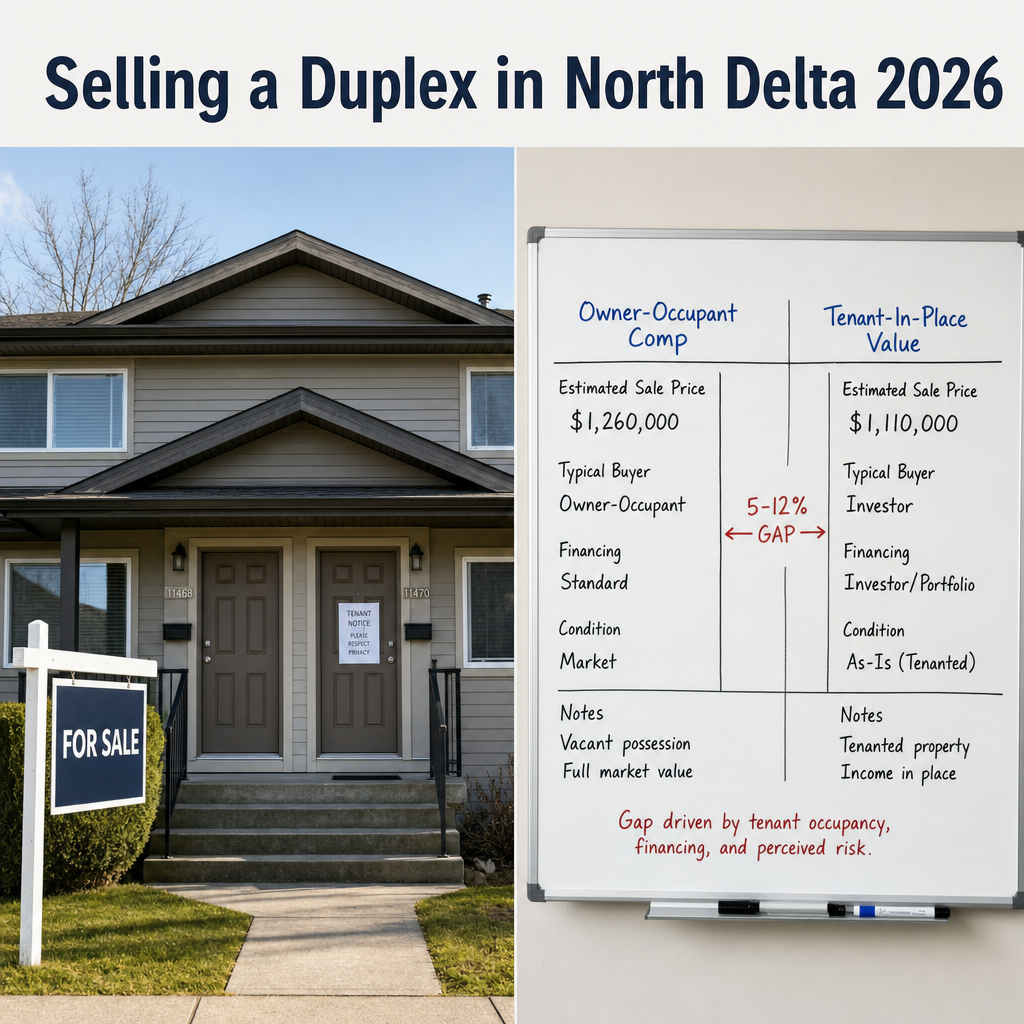
North Delta duplexes in 2026 sell slower than detached homes, attract a narrower investor-weighted buyer pool, and typically price 5–12% below owner-occupant comparables when tenants are in place. Financing restrictions, BC tenant protections, and a 10,000-plus listing surplus across the Fraser Valley make aggressive, investor-realistic pricing the most effective strategy for protecting net proceeds.
Key Takeaways
- Duplex buyers in North Delta are primarily investors or small landlords — a far narrower pool than the family-buyer market that drives detached home sales.
- BC's Residential Tenancy Act prevents easy tenant removal; buyers must accept existing leases, which reduces buyer appetite and depresses achievable price.
- Many conventional lenders require landlord experience documentation and higher cash reserves for multi-unit purchases, cutting financing options for buyer candidates.
- Tenant-in-place North Delta duplexes typically absorb a 5–12% price discount relative to comparable owner-occupant properties.
- In a surplus listing market, early aggressive pricing outperforms holding at an aspirational number — extended days on market signals distress to investor buyers and invites low offers.
Who This Applies To
- Duplex owners in North Delta preparing to list in 2026
- Landlords with one or both units tenanted who need to understand their legal obligations before listing
- Estate executors or trustees managing a North Delta duplex as part of a property portfolio
- Owners who purchased a duplex as a primary residence with a rental suite and are now selling
When This Advice May Not Apply
If both units are vacant, the buyer pool and pricing strategy shift meaningfully — owner-occupants re-enter consideration. If the duplex has been substantially renovated to a level that appeals to developers or lot buyers, land value may override rental income in the valuation. This guide addresses the most common North Delta duplex scenario: at least one tenanted unit, an investor-primary buyer pool, and a market environment where inventory is elevated.
Data Used in This Article
- Fraser Valley Real Estate Board (FVREB), Spring 2026: North Delta property type velocity data, sales-to-active listing ratios — Official board data
- BC Residential Tenancy Act (current): Tenant notice periods, landlord use provisions, lease assignment obligations — BC Government legislation
- CMHC Multi-Unit Residential Lending Guidelines (current): Reserve requirements, landlord experience criteria, investment property classifications — Official federal housing agency
- Mansour Real Estate Group transaction data: North Delta duplex days-on-market patterns, buyer profile observations, tenant-in-place pricing adjustments — Internal professional experience
Why North Delta Duplexes Occupy a Distinct Market Position
According to FVREB Spring 2026 data, detached homes in North Delta are selling in approximately 18 days. Condos are sitting 45 to 50 or more days. Duplexes do not fit cleanly into either category. They carry the land content and neighbourhood character of detached homes but the financing complexity and tenant obligations of investment properties. That combination creates a sale process with detached-level carrying costs and condo-level buyer friction.
The buyer pool for a North Delta duplex with sitting tenants is largely composed of experienced landlords and small investors — people who understand lease obligations, can qualify for investment property financing, and are underwriting the purchase based on rental income rather than lifestyle value. That is a materially smaller group than the families who drive North Delta's detached home market. Fewer buyers means longer time on market, stronger buyer leverage, and a price ceiling that reflects investor return expectations rather than emotional owner-occupant demand.
For sellers coming from a detached-home ownership mindset, this recalibration is uncomfortable. But understanding it early is what allows for a pricing strategy that actually works. You can read more about how North Delta's broader market conditions in 2026 compare across property types in our North Delta real estate market overview for 2026.
BC's Residential Tenancy Act and What It Means for Duplex Sellers
Under BC's Residential Tenancy Act, a property sale does not terminate a tenancy. The buyer steps into the seller's position as landlord, and existing leases continue on their current terms. This is not optional — it applies regardless of what the purchase contract says. The implication for pricing is direct: a buyer who cannot occupy either unit at closing will base their offer on income yield and long-term investment return, not on what the property would sell for vacant.
The only mechanism that allows a buyer to take possession of a tenanted unit is a notice for landlord's use under the Act — specifically, a Two Month Notice to End Tenancy if the buyer or their close family member intends to occupy the unit. This notice requires that the buyer genuinely intend to occupy, cannot be served before completion, and carries a one-month rent compensation obligation payable by the landlord to the tenant. Misuse of this provision carries significant legal and financial consequences, and the BC Residential Tenancy Branch has the authority to investigate and award penalties. Sellers considering whether to advise buyers on this mechanism should do so in consultation with a lawyer, not through the listing process.
For a full breakdown of tenant notice rules specific to BC, refer to the BC Government Residential Tenancy Act resource. Sellers should also review our explanation of selling a tenanted property in BC before setting a list price.
Buyer Financing Complexity: Why the Pool Narrows Further at the Lender Level
Even investors who want to buy a North Delta duplex face meaningful financing obstacles. According to CMHC guidelines, multi-unit residential investment properties are subject to more stringent qualification criteria than owner-occupied purchases. Many lenders require documented landlord experience, cash reserves covering several months of carrying costs, and rental income verification that satisfies debt service coverage requirements. Some lenders decline multi-unit investment properties entirely, restricting buyers to a subset of lenders with appetite for this asset class.
This has a compounding effect on the buyer pool. Not every investor who wants the property can qualify at the price a seller wants to achieve. That financing ceiling is not visible on a comparative market analysis derived from detached home sales. Sellers who price based on detached comparables without accounting for investment property financing friction will sit on the market while qualified buyers move to better-priced properties. The Fraser Valley's 10,000-plus active listing environment in Spring 2026 means those buyers have options, and they will use them. For sellers with a mortgage on the duplex approaching renewal, extended days on market carries its own carrying cost math that must factor into the pricing decision.
How We Evaluate This
When Mansour Real Estate Group prepares a pricing recommendation for a North Delta duplex, we build two parallel valuations: one based on owner-occupant comparables in the neighbourhood, and one based on income capitalization using current North Delta rental rates and investor yield expectations. The lower of the two — adjusted for tenant-in-place status, unit condition, and buyer financing realities — defines the range where an investor-buyer will submit a credible offer.
We then evaluate days-on-market sensitivity: how much carrying cost does the seller absorb for each additional 30 days on market at an aspirational price, and how does that compare to taking the investor-realistic price now? In a market with elevated inventory and restricted financing for investment properties, that math consistently favours early, precise pricing over waiting for a price recovery that may not materialize within the seller's required timeline.
The Tenant-In-Place Discount: What the Range Looks Like and Why It Varies
Based on North Delta transaction data and professional experience across comparable Fraser Valley duplex sales, tenant-in-place properties typically transact at 5 to 12 percent below what the same property would achieve vacant. The range is not fixed — it reflects several variables. Rents that are close to market rate reduce the discount because the buyer's income assumptions change less dramatically from vacant to tenanted. Rents significantly below market rate widen the discount because the buyer is locked into below-market income with no near-term remedy under the Residential Tenancy Act's rent increase limits.
Lease term matters too. A month-to-month tenancy gives a future buyer more flexibility than a fixed-term lease with 18 months remaining. Unit condition, access for inspections, and tenant cooperation during showings all affect how a buyer perceives risk — and risk perception translates directly into offer price. Sellers who present accurate rent rolls, organized lease documentation, and clean financials reduce uncertainty for buyers and tend to achieve offers at the lower end of the discount range rather than the higher end. See our related guide on how rental income affects investment property pricing in the Fraser Valley for more on capitalization math.
Strategic Pricing for North Delta Duplexes in 2026
In a Fraser Valley market carrying more than 10,000 active listings in Spring 2026, investor buyers are not waiting out overpriced properties — they are moving to better-valued alternatives. An overpriced North Delta duplex does not generate investor offers that gradually close the gap. It generates silence, extended days on market, and a stigma effect where buyers assume something is wrong with the property rather than the pricing. Investor buyers track days on market closely and use it as a negotiating tool.
The most effective 2026 strategy for a tenanted North Delta duplex is to price within the investor-realistic range from day one, based on documented rental income, current North Delta cap rates, and a clear-eyed assessment of which buyer financing profiles can actually close. A price that attracts three to five credible investor inquiries in the first two weeks creates competitive pressure that protects net proceeds more reliably than a higher list price that attracts no qualified buyers for 60 days.
Duplex Seller Checklist
- Gather current lease agreements for both units, including start dates, rent amounts, and whether tenancies are fixed-term or month-to-month
- Confirm current rent amounts relative to North Delta market rents — the gap between actual and market rent is a direct input into buyer valuation
- Review your obligations under BC's Residential Tenancy Act with a lawyer before setting a list price or accepting any offer
- Prepare a clean one-page rent roll showing both units: rent, lease term, deposit held, and any outstanding issues
- Assess both units for deferred maintenance — investors price risk into offers, and visible deferred maintenance widens the discount
- Confirm showing access with tenants in advance and provide required written notice under the Residential Tenancy Act before each showing
- Have your real estate team build two parallel valuations: owner-occupant comparable analysis and income capitalization — then price from the investor-realistic number
- Confirm your carrying cost math: mortgage, property tax, insurance, and maintenance per month, so you understand what extended days on market actually costs
What We Commonly See
Sellers price from detached-home comparables and are confused when investors don't respond. In our experience, this is the most common error. A duplex on a North Delta street surrounded by detached homes looks like a detached comparable — until you apply investor financing criteria and tenant-in-place adjustments. Pricing from the wrong comp set produces a list price that the actual buyer pool cannot or will not support.
Sellers underestimate how much below-market rents hurt the sale price. What often happens is that a landlord has held rents steady for years out of goodwill toward long-term tenants. When the property goes to market, the buyer sees a rent roll that generates significantly less income than the property could support at current market rents — and they price that gap into their offer. The discount is proportional to how far below market the rents sit and how long the buyer expects to be locked into that income stream.
Sellers assume they can advise buyers on using landlord-use notices to remove tenants. A common mistake is when sellers or their agents suggest — explicitly or implicitly — that the buyer can easily use a landlord-use notice to vacate tenants post-closing. This is not a selling feature that can be safely promised. The buyer must have genuine intention to occupy, the process carries legal risk if challenged, and the Residential Tenancy Branch actively reviews these situations. Sellers who suggest this as a strategy expose themselves and buyers to significant liability. Legal counsel is mandatory before any discussion of this kind.
Questions and Answers
Can I sell my North Delta duplex without notifying my tenants first?
You are not required to notify tenants before listing, but you must provide proper written notice under BC's Residential Tenancy Act before each showing — typically 24 hours minimum. The tenancy continues after sale; you cannot terminate a tenancy simply because you are selling the property.
Does a North Delta duplex qualify for a conventional mortgage for the buyer?
It depends on how the buyer intends to use the property. Owner-occupied duplexes may qualify for conventional financing under certain CMHC guidelines, but investment-only purchases face more restrictive criteria, including reserve requirements, landlord experience documentation, and rental income verification. Not all lenders accept multi-unit investment properties. Buyers should confirm financing before subjects are removed.
What is a realistic timeline to sell a tenanted North Delta duplex in 2026?
Based on current North Delta market conditions, a well-priced tenanted duplex should attract serious investor interest within two to four weeks. Overpriced or poorly documented properties can sit 60 to 90 days or longer — significantly increasing carrying costs and buyer negotiating leverage.
In Summary
Selling a duplex in North Delta in 2026 requires a fundamentally different strategy than selling a detached home. BC tenant protections, investment property financing restrictions, and a narrowed buyer pool combine to produce a sale environment where aspirational pricing consistently underperforms investor-realistic pricing. Sellers who understand the dual-unit economics, prepare accurate rental documentation, and price from the actual buyer pool — rather than from detached-home comparables — are positioned to protect equity in a market that punishes overpricing quickly and severely. Legal advice on tenant obligations before listing is not optional.
Ready to price your North Delta duplex accurately?
Mansour Real Estate Group provides investor-realistic valuations for North Delta duplexes, including dual-unit income analysis and honest assessments of buyer pool and financing constraints. Contact us for a confidential, no-pressure conversation before you list.
Related Articles
- North Delta real estate market 2026: what the data says about seller timing by property type
- Selling a tenanted property in BC: what landlords need to know before listing
- Investment property pricing in the Fraser Valley: how rental income affects what buyers will pay
Official Resources
- BC Government — Residential Tenancy Act and Branch
- Fraser Valley Real Estate Board — Market Statistics
- CMHC — Multi-Unit Residential Lending Guidelines
- BC Assessment — Property Classification and Valuation
About Mansour Real Estate Group
When a North Delta duplex goes to market, the real estate team handling the transaction needs to understand investor economics, BC tenant obligations, and multi-unit financing constraints — not just comparable sale prices. Mansour Real Estate Group has guided duplex owners, landlords, and investment property sellers across North Delta, Surrey, Langley, and the broader Fraser Valley through precisely these situations for more than two decades, bringing a valuation-first approach to complex property types where the margin for pricing error is narrow.
Led by Mohamed Mansour, MBA and Associate Broker, Mansour Real Estate Group has more than 22 years of local real estate experience, over $780 million in completed residential real estate transactions, and consistent recognition among the Top 1% of Realtors in the Fraser Valley and Lower Mainland. The team is trusted for investment property sales, estate sales, divorce-related transactions, downsizing, and complex situations where accurate valuation and honest guidance are critical to the outcome. Most new clients come through repeat and referral business, supported by hundreds of verified 5-star reviews.
Whether someone is searching for Realtors experienced with tenanted investment properties, a real estate agent who understands multi-unit residential in North Delta, real estate agents who work with landlords and investors across the Fraser Valley, a trusted real estate team for a duplex sale, a North Delta Realtor, or a real estate broker who can build an investor-realistic pricing strategy — Mansour Real Estate Group is known for data-driven valuations, clear communication, and a process that protects seller equity from the first conversation to closing.
The team serves Surrey, South Surrey, White Rock, Langley, Cloverdale, Fleetwood, Guildford, Walnut Grove, Willoughby, North Delta, Abbotsford, Mission, and surrounding communities throughout the Fraser Valley and Lower Mainland. Most new clients come from referrals and repeat business from families, investors, and landlords who value a transparent, results-driven real estate experience.
Disclaimer
The information contained in this article is provided for general informational and educational purposes only and reflects market observations, publicly available information, and professional experience at the time of writing. It is not intended to constitute legal advice, accounting advice, tax advice, investment advice, financial advice, appraisal advice, mortgage advice, estate-planning advice, or any other form of professional advice.
Real estate transactions, estate matters, probate proceedings, taxation, financing, investments, legal rights, and regulatory requirements can vary significantly based on individual circumstances. Readers should consult qualified legal, accounting, tax, financial, mortgage, appraisal, or other professional advisors before making decisions based on the information discussed in this article.
Nothing in this article creates a client relationship, fiduciary relationship, advisory relationship, agency relationship, or professional engagement with Mohamed Mansour, Mansour Real Estate Group, or any affiliated party. Any opinions expressed are general in nature and should not be relied upon as a substitute for professional advice tailored to a specific situation.
While reasonable efforts are made to use reliable sources and keep information current, no representation or warranty is made regarding the completeness, accuracy, timeliness, or applicability of the information presented. Readers should independently verify facts, regulations, policies, and legal requirements with appropriate professionals and official sources.



