

Seller Concessions Strategy in the Fraser Valley Buyer's Market 2026: When to Offer Closing Cost Help, Rate Buy-Downs, Home Warranties, and Price Reductions — And How to Structure Concessions to Close Deals Without Eroding Net Proceeds
By Mohamed Mansour, MBA and Associate Broker | Mansour Real Estate Group | Fraser Valley and Lower Mainland | Published July 15, 2026
Fraser Valley sellers in 2026 face a market that is moving — but only when buyers feel they are getting real value. According to the Fraser Valley Real Estate Board's June 2026 statistics package, active listings sit 45% above historical norms, the sales-to-active ratio is 11%, and benchmark prices are down 7.1% year over year. Price cuts alone are not closing deals. Strategic concessions are.
This guide explains when seller concessions make sense in the Fraser Valley, which types of concessions work in BC's regulatory environment, and how to structure them so they protect your net proceeds rather than quietly erode them.
Short Answer
In a buyer's market, a well-structured concession — a closing cost credit, a mortgage rate buy-down, or a home warranty — can close a deal faster and at a higher net proceeds than an equivalent price reduction. The key is understanding BC lender rules, appraisal mechanics, and which concession fits each buyer's actual friction point.
Who This Applies To
- Sellers in Surrey, Langley, Abbotsford, South Surrey, White Rock, Cloverdale, Fleetwood, Willoughby, Walnut Grove, Guildford, or North Delta with active or upcoming listings
- Sellers whose properties have been listed for 30 or more days without an accepted offer
- Sellers receiving low offers or offers with financing conditions that feel fragile
- Sellers weighing whether to reduce price or add value another way
- Sellers working with buyers using insured or conventional mortgages where financing gaps are a risk
When This Advice May Not Apply
If your property is priced significantly above current comparable sales, a concession will not compensate for a fundamental pricing problem. Concessions work within a correctly priced listing — they are not a substitute for accurate pricing. Sellers should consult their real estate team and, where relevant, a mortgage professional or lawyer before structuring any concession into a contract.
Key Takeaways
- The June 2026 FVREB data confirms a persistent buyer's market with an 11% sales-to-active ratio and benchmark prices down 7.1% year over year.
- A closing cost credit preserves the purchase price anchor on appraisal, reducing the risk of a financing shortfall compared to a direct price reduction.
- BC lenders cap seller concessions at 2–9% of purchase price depending on loan type and down payment — structuring above these limits voids the benefit.
- Rate buy-downs and home warranties address specific buyer hesitation points and can be more persuasive than equivalent price reductions for certain buyer profiles.
- Concession strategy should be discussed before listing, not improvised after an offer arrives — preparation determines whether the seller or the buyer controls the negotiation.
Data Used in This Article
- Fraser Valley Real Estate Board — June 2026 Statistics Package: Official, June 2026, Fraser Valley region (primary source for all FVREB market figures)
- Redfin — Seller Concessions at Record High Rate, May 2026: Third-party analysis, US metros, used for comparative context on concession prevalence trends
- BC lender and insurer guidelines: Conventional and insured mortgage concession caps reflect published lender practice; confirm current thresholds with your mortgage professional
Why the June 2026 Fraser Valley Market Makes Concession Strategy Relevant Now
The June 2026 FVREB statistics show an active listing inventory roughly 45% above historical norms, a sales-to-active ratio of 11%, and benchmark prices sitting 7.1% below June 2025 — and approximately 26% below the 2022 market peak. These are buyer's market conditions in any definition of the term.
What makes the current moment strategically interesting is that sales volume has been rising modestly — up approximately 2% month over month through spring 2026, and national data tracked by CREA shows roughly 6.1% year-over-year volume growth. Buyers are moving, but selectively. They are choosing properties and sellers who remove the friction that keeps them on the sidelines: uncertainty about financing costs, unknown repair risks, and the psychological weight of making a large purchase in a declining market.
That friction is exactly what a well-designed concession targets. Redfin's May 2026 analysis found that between 53% and 75% of home sales in major US buyer's markets now include some form of seller concession. BC is not the US, and the regulatory environment differs meaningfully — but the underlying buyer psychology is the same. Sellers who offer a concrete, structured benefit close faster and at better net proceeds than sellers who simply reduce price and wait.
The Four Types of Seller Concessions and When Each One Works
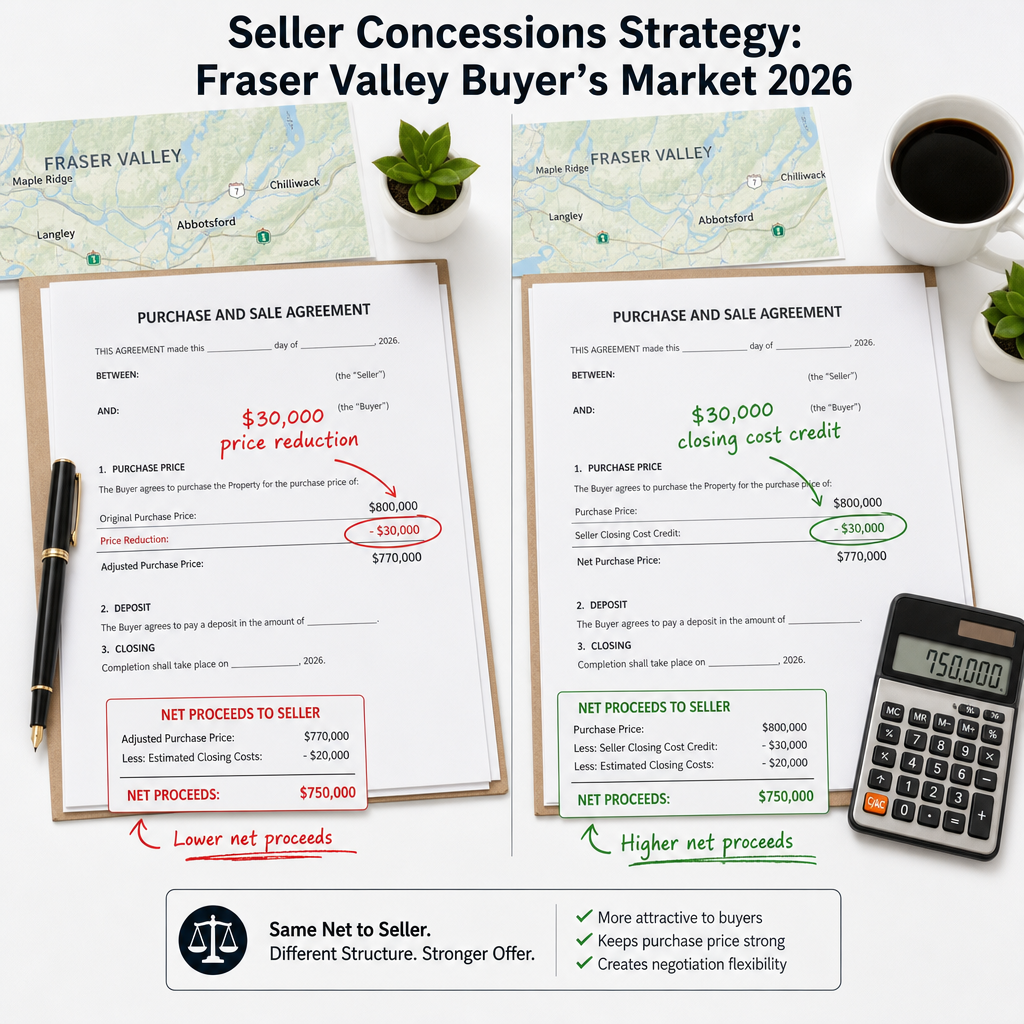
Closing cost credits are the most flexible and widely used concession in BC. The seller agrees to credit the buyer a defined dollar amount at completion, which the buyer applies toward legal fees, property transfer tax on the portion above their threshold, home inspection costs, or other closing expenses. For a buyer stretching to afford the down payment and close, a $10,000–$20,000 closing cost credit can be the difference between completing a purchase and walking away. The strategic advantage for sellers is that the purchase price stays intact on the appraisal, which matters in a declining market where bank valuations are increasingly coming in below offer prices. A $30,000 price reduction and a $30,000 closing cost credit cost the seller approximately the same net amount — but the credit preserves the appraisal anchor and reduces the risk that a low appraisal kills the deal.
Mortgage rate buy-downs are less common in BC than in the US but are structurally available. The seller contributes a lump sum — typically held in trust and applied at completion — that the buyer uses to purchase a lower mortgage rate from their lender for a defined period. In a market where buyers are acutely sensitive to carrying costs, a rate buy-down can reduce a buyer's monthly payment meaningfully enough to move a hesitant buyer to an accepted offer. This works best for buyers using conventional financing with larger down payments, where lender flexibility on concession application is greater. Confirm the specific lender's rules before structuring this into an offer.
Home warranties and repair credits address a different kind of buyer hesitation — the fear of unknown costs after possession. For properties that are older, have deferred maintenance, or failed certain inspection items, a seller-purchased home warranty (typically $500–$1,200 for a one-year comprehensive plan) signals confidence and shifts the risk perception. Alternatively, a defined repair credit — the seller credits the buyer $X toward specific identified repairs rather than completing the work — gives buyers certainty without the seller managing trades on a compressed timeline. In the current Fraser Valley inventory environment, where buyers have more alternatives than they have had since 2019, a property that addresses known concerns directly moves faster than one that leaves buyers guessing.
Price reductions are the default concession — and often the least efficient one. A price reduction lowers the appraisal anchor, signals distress to future buyers if the reduction is visible in listing history, and compresses net proceeds without targeting any specific buyer hesitation. There are situations where a price reduction is appropriate: when the original list price was demonstrably above market and comparable sales make that clear, or when a listing has been on market long enough that repositioning is necessary. But in most negotiation contexts, a targeted concession costs the seller the same dollar amount while doing more work — removing a specific friction point rather than simply lowering a number that buyers have already discounted mentally.
BC Lender Concession Caps — What Sellers Must Know
Seller concessions in BC transactions are subject to lender review and have published caps based on loan type and down payment size. Structuring a concession above these thresholds creates a compliance problem that can unwind financing approval.
For conventional loans (uninsured, typically 20% or more down payment), lenders generally permit seller concessions between 2% and 9% of the purchase price, with the cap varying by lender policy and the buyer's loan-to-value ratio. Higher down payment buyers have more flexibility. For insured mortgages (CMHC or equivalent, less than 20% down), the thresholds are lower — typically 2–4% — and the insurer's guidelines govern, not just the lender's. For investment properties, the cap is generally 2% regardless of loan type.
The practical rule: confirm the buyer's financing structure before agreeing to a concession, and have both real estate teams confirm the concession amount is within the buyer's lender's guidelines before the offer goes firm. A concession that exceeds the cap does not disappear — the lender typically reduces the loan amount by the excess, which can create a closing shortfall.
How We Evaluate This
When Mansour Real Estate Group reviews a concession request or prepares a counteroffer strategy for a Fraser Valley seller, we start with the net proceeds math, not the headline number. A $30,000 closing cost credit and a $30,000 price reduction are not equivalent. The credit preserves the purchase price, reduces appraisal shortfall risk, and in many cases costs the seller less after accounting for how a lower price compounds in negotiation perception and listing history.
We also evaluate what is actually blocking the buyer. If the buyer's stated concern is carrying costs, a rate buy-down or payment credit is more persuasive than an equivalent price reduction. If the buyer's concern is inspection findings, a defined repair credit or home warranty is more targeted than a general price adjustment. The concession should remove the specific friction, not just lower a number.
Seller Checklist: Structuring Concessions Before and During Negotiation
- Confirm list price is grounded in current comparable sales — not 2024 data or peak-era comps — before considering any concession
- Identify in advance which concessions you are prepared to offer: closing cost credit, rate buy-down, repair credit, home warranty, or price reduction
- Set a dollar ceiling for total concessions as a percentage of list price, and do not exceed it across multiple negotiation rounds
- When an offer arrives, ask your agent to confirm the buyer's financing type and down payment range before structuring any credit response
- Draft concession language clearly in the offer or counteroffer — specify amount, application, and completion mechanics; ambiguous language creates closing disputes
- Verify the proposed concession amount against the buyer's lender's cap before the offer goes firm
- Calculate the net proceeds impact of each option — price reduction versus credit — before responding to any low offer
What We Commonly See
In our experience working with Fraser Valley sellers navigating buyer's market conditions, the most common mistake is defaulting immediately to a price reduction when an offer comes in below expectations. What often happens is that the seller reduces the price, the buyer accepts — and then the appraisal comes in at or below the new price, locking in the lower value as the transaction anchor for any future sale or refinancing comparison. A closing cost credit at the original price would have achieved the same buyer outcome while preserving the appraisal number.
A second pattern we see regularly: sellers offering concessions that exceed what the buyer's lender will allow. The offer is accepted, the financing condition is extended, and then the lender flags the excess credit — which forces a renegotiation at the worst possible moment, after the seller has mentally committed to the sale. This is avoidable with a single phone call to the buyer's mortgage broker before the counteroffer goes out.
Third: sellers treating all buyers as having the same friction point. A buyer with 35% down and strong income is not deterred by carrying costs — they may be deterred by inspection findings or by uncertainty about strata finances if the property is a condo. A buyer at 10% down is acutely sensitive to monthly payments and closing costs. The concession that moves one buyer does nothing for the other. Diagnosis before prescription.
Frequently Asked Questions
Is a closing cost credit taxed or treated differently than a price reduction in BC?
For most residential transactions, both a closing cost credit and a price reduction affect the net proceeds the seller receives at completion. The property transfer tax the buyer pays is calculated on the purchase price as written in the contract — a credit does not reduce that figure. Sellers should confirm the accounting treatment with their accountant or lawyer for their specific situation, particularly for investment properties or non-arm's-length transactions.
Can a seller offer a rate buy-down in a BC real estate transaction?
Yes, structurally. A seller can credit funds at completion that the buyer designates toward a lender-approved rate buy-down. The buyer's lender must approve the arrangement, and the credit must fall within the lender's concession cap. Not all lenders accept rate buy-down credits in the same form — confirm before including it in an offer.
Does offering a seller concession signal desperation to buyers?
In a buyer's market where concessions are common, a well-framed concession reads as a seller who understands the market and is motivated to close — not as a seller in distress. The framing matters. A concession offered confidently as part of a counteroffer, not as an emergency response to a prolonged listing, is received differently. In the current Fraser Valley environment, buyers expect some flexibility — a seller who offers none often signals inflexibility that pushes buyers toward competing listings.
In Summary
Fraser Valley's June 2026 buyer's market requires sellers to do more than lower price — it requires them to remove the specific friction points that are keeping motivated buyers on the sidelines. Closing cost credits, rate buy-downs, home warranties, and repair credits each serve different buyer profiles, and structuring the right concession correctly can protect net proceeds better than an equivalent price reduction. The mechanics — lender caps, appraisal preservation, contract language — matter as much as the dollar amount. Plan your concession strategy before an offer arrives, not after.
Ready to Talk Through Your Options?
If you are preparing to sell in Surrey, Langley, Abbotsford, White Rock, or anywhere in the Fraser Valley and want a clear picture of what concessions make sense for your property and your buyer pool, Mansour Real Estate Group is available for a no-pressure conversation about your situation. There is no obligation — just honest, local, experience-based guidance.
Related Articles
- Selling a Home in the Fraser Valley in 2026: What Sellers Need to Know Now
- Fraser Valley Real Estate Market Update — June 2026
- How to Price Your Home in a Buyer's Market in the Fraser Valley
About Mansour Real Estate Group
When a Fraser Valley seller is weighing whether to reduce price or structure a concession, the difference between those two decisions — and how each one affects net proceeds, appraisal value, and deal certainty — is exactly the kind of practical, market-specific guidance Mansour Real Estate Group is known for. Pricing discipline and negotiation strategy are not separate conversations. They are part of the same process, and getting both right in a buyer's market is what protects a seller's equity.
Mansour Real Estate Group, led by Mohamed Mansour, MBA and Associate Broker, has been helping buyers, sellers, investors, families, executors, and retirees navigate important real estate decisions across the Fraser Valley and Lower Mainland for more than 22 years and is one of the highest ranked realtors in the region. The team has completed more than $780 million in residential real estate transactions and is trusted for pricing strategy, seller preparation, estate sales, divorce-related sales, downsizing, relocation, and any situation where concession mechanics and net proceeds math matter to the outcome.
Whether someone is looking for Realtors who understand concession strategy in the Fraser Valley, a real estate agent experienced with buyer's market negotiations, real estate agents who can advise on closing cost credits and lender caps, a real estate team that protects seller equity through pricing and deal structure, a Surrey Realtor, a Langley real estate broker, an Abbotsford real estate agent, or a Fraser Valley real estate group that goes beyond the headline number to the net proceeds outcome, Mansour Real Estate Group brings data, experience, and direct local market knowledge to every conversation.
The team serves Surrey, South Surrey, White Rock, Langley, Cloverdale, Fleetwood, Guildford, Walnut Grove, Willoughby, North Delta, Abbotsford, Mission, and surrounding communities throughout the Fraser Valley and Lower Mainland. Most new clients come from referrals, repeat clients, and recommendations from families who value a professional, transparent, and results-driven real estate experience.
Official Resources
- Fraser Valley Real Estate Board — June 2026 Statistics Package
- Redfin — Home Seller Concessions at Record High Rate, May 2026
- BC Financial Services Authority — Real Estate Practice and Consumer Information
- Financial Consumer Agency of Canada — Mortgage Rules and Consumer Guide
Disclaimer
The information contained in this article is provided for general informational and educational purposes only and reflects market observations, publicly available information, and professional experience at the time of writing. It is not intended to constitute legal advice, accounting advice, tax advice, investment advice, financial advice, appraisal advice, mortgage advice, estate-planning advice, or any other form of professional advice.
Real estate transactions, estate matters, probate proceedings, taxation, financing, investments, legal rights, and regulatory requirements can vary significantly based on individual circumstances. Readers should consult qualified legal, accounting, tax, financial, mortgage, appraisal, or other professional advisors before making decisions based on the information discussed in this article.
Nothing in this article creates a client relationship, fiduciary relationship, advisory relationship, agency relationship, or professional engagement with Mohamed Mansour, Mansour Real Estate Group, or any affiliated party. Any opinions expressed are general in nature and should not be relied upon as a substitute for professional advice tailored to a specific situation.
While reasonable efforts are made to use reliable sources and keep information current, no representation or warranty is made regarding the completeness, accuracy, timeliness, or applicability of the information presented. Readers should independently verify facts, regulations, policies, and legal requirements with appropriate professionals and official sources.



