
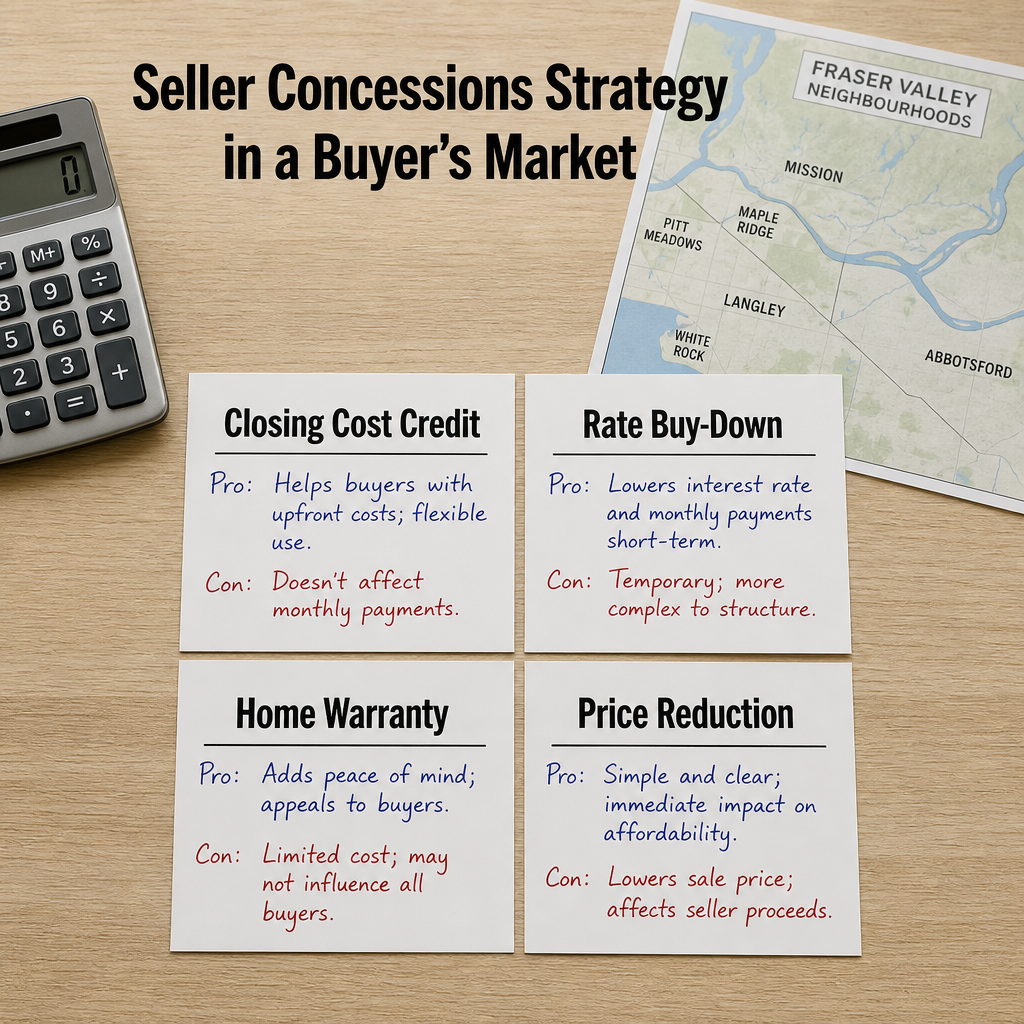

Seller Concessions Strategy in a Buyer's Market: When to Offer Closing Cost Help, Rate Buy-Downs, Home Warranties, and Price Reductions — And How to Structure Concessions to Close Deals Without Eroding Net Proceeds
By Mohamed Mansour, MBA and Associate Broker | Mansour Real Estate Group | Fraser Valley and Lower Mainland, BC | Published: July 14, 2026
Fraser Valley sellers in 2026 are facing a market where buyers hold significant negotiating leverage. Inventory is elevated, sales velocity is slow, and the Fraser Valley Real Estate Board's April and May 2026 statistics show a sales-to-active-listings ratio of approximately 11% — well within buyer's market territory. In that environment, the question is not whether to negotiate, but how to negotiate without destroying your net proceeds or pulling neighbourhood sale prices downward.
This article explains the four main types of seller concessions, when each one makes strategic sense, how lender rules constrain what is actually permissible, and how sellers in Surrey, Langley, Abbotsford, White Rock, and surrounding communities can use concessions to close deals without the long-term damage of an unnecessary price reduction.
Short Answer
In a buyer's market, strategic concessions — closing cost credits, rate buy-downs, inspection repair credits, and home warranties — can close deals faster than price reductions without anchoring neighbourhood comparables downward. A $30,000 closing cost credit keeps your list price intact and does not affect what the next seller on your street can ask. A $30,000 price cut does. The right concession depends on the buyer's financing, their specific objection, and what your listing already reflects.
Key Takeaways
- The Fraser Valley's 11% sales-to-active-listings ratio signals a buyer's market where concessions are increasingly standard, not exceptional.
- Closing cost credits preserve your list price and do not affect neighbourhood comparable sales data the way price reductions do.
- Lender-imposed caps limit how much a seller can contribute based on the buyer's loan type and down payment — sellers who misunderstand this offer money that cannot be used.
- Post-inspection repair credits have become the most common concession trigger in BC, with 52% of buyers now successfully negotiating reductions after inspections.
- The best concession strategy starts with an accurate list price — sellers who overprice and then offer concessions often end up worse than sellers who priced correctly from day one.
Who This Applies To
- Homeowners in Surrey, Langley, Abbotsford, White Rock, or North Delta with active listings receiving low offers or delayed subject removal
- Sellers whose homes have been on market longer than 21 days without an accepted offer
- Sellers facing post-inspection renegotiation requests and unsure how to respond
- Sellers of strata properties where depreciation report findings or deferred maintenance are triggering buyer hesitation
- Estate or divorce-related property sales where a fast, clean close matters more than extracting top dollar
When This Advice May Not Apply
Sellers in micro-markets with genuinely low inventory and strong demand — certain detached home segments in Willoughby, Walnut Grove, or South Surrey — may still receive competitive offers without concessions. This framework is most relevant when competing listings outnumber active buyers and days on market are rising.
Data Used in This Article
- Fraser Valley Real Estate Board — April 2026 and May 2026 Statistical Packages (official board data, primary source)
- Redfin — May 2026 Seller Concessions Analysis across 28 US metro areas (third-party industry report)
- HomeLight — Agent Survey on Seller Concessions and Negotiation Tactics (third-party agent survey, North American context)
- Marko Juras — BC real estate data on post-inspection price reduction rates (BC-specific practitioner analysis)
- Portland Real Estate Blog — Seller concession caps by loan type (third-party summary of US lending rules; note that Canadian mortgage rules differ — see section below)
Important Note on US vs. Canadian Lending Rules
Several of the sources cited in this article reflect US market data and US mortgage lending rules. In Canada, the structure of seller concessions and what lenders will permit differs materially. Canadian mortgage qualification is governed by OSFI's stress test and lender-specific underwriting guidelines. Sellers and buyers should confirm with their mortgage broker or lender what concession structures are permissible under their specific loan before embedding any concession in a signed contract. The strategic logic of concessions — preserving list price while addressing buyer friction — applies in both markets. The mechanics of how concessions are documented and what lenders will accept differ. Consult your mortgage professional for guidance specific to your transaction.
Why the Fraser Valley's Current Market Makes Concessions a Strategic Tool
According to the Fraser Valley Real Estate Board's May 2026 statistics package, the overall sales-to-active-listings ratio in the Fraser Valley sat at approximately 11%. The Real Estate Board of Greater Vancouver defines a balanced market as a ratio between 12% and 20%. Anything below 12% is a buyer's market. At 11%, Fraser Valley sellers are operating in conditions where buyers can afford to wait, request inspections, and negotiate after the fact.
The result is a structural shift in negotiating leverage. Based on BC practitioner data reported by Marko Juras, approximately 52% of buyers are now successfully negotiating price reductions after inspection — compared to roughly 12% during the seller's market conditions of 2021. That is not a temporary fluctuation. It reflects a sustained shift in who holds leverage at the negotiating table.
Sellers who understand this shift can plan for it before they list. Those who don't tend to discover it during subject removal, when the buyer requests a $40,000 price reduction based on an inspection report and the seller has no strategic framework for responding. At that point, pricing decisions made weeks earlier directly constrain what options remain.
The Core Strategic Distinction: Price Reductions vs. Concessions
The most important concept for sellers to understand is how differently price reductions and concessions affect the broader market.
When a home listed at $900,000 sells for $850,000 after a price reduction, that $850,000 becomes a comparable sale. The next seller on your street — or in your strata complex — now has a lower anchor for their asking price. Appraisers reference it. Buyers reference it. That $50,000 reduction ripples outward.
When a home listed at $900,000 sells at $900,000 with a $50,000 closing cost credit to the buyer, the recorded sale price is still $900,000. The comparable is preserved. The buyer received meaningful financial benefit. The seller's net proceeds are similar either way — but the neighbourhood comp data is protected. This distinction is especially relevant in strata buildings where multiple units may be listed simultaneously, or in Abbotsford and Langley subdivisions where resale activity is concentrated.
That said, this distinction only holds when the concession is structured in a way the buyer's lender will accept. A closing cost credit that exceeds lender-permitted limits cannot be applied as intended and may force a renegotiation at the last moment. Sellers must confirm the mechanics with their buyer's mortgage broker before agreeing to specific concession structures.
The Four Main Types of Seller Concessions
1. Closing Cost Credits
The seller agrees to pay a portion of the buyer's closing costs — legal fees, property transfer tax assistance, title insurance, or similar transaction costs — as part of the accepted offer. This gives buyers immediate cash relief at the moment they need it most. In BC's high-price environment, where buyers are often stretched on down payments and qualification, a closing cost credit can be the difference between a deal proceeding and collapsing. The credit must be documented in the contract and reviewed by both parties' lawyers.
2. Mortgage Rate Buy-Downs
The seller contributes funds toward buying down the buyer's mortgage interest rate for a defined period — typically one to three years. This is more common in the US market, where specific buy-down products are widely available through conventional lenders. In Canada, the availability and structure of buy-down arrangements vary by lender and mortgage type. Sellers considering this approach should confirm with the buyer's mortgage broker that a buy-down is available under their specific product before agreeing to it. When it works, it reduces the buyer's monthly payment and improves qualification — a meaningful benefit in a high-rate environment.
3. Home Warranties
Offering a one-year home warranty — covering major mechanical systems like HVAC, plumbing, and electrical — addresses a specific category of buyer anxiety that often emerges after inspections. In older detached homes in Surrey, Cloverdale, Fleetwood, or North Delta, buyers worried about deferred maintenance may be more comfortable proceeding when a warranty is in place. The cost to the seller is typically between $500 and $1,500 — far less than a price reduction — and it signals confidence in the property's condition. For strata properties, home warranties have more limited application since many building systems are covered by strata maintenance obligations.
4. Inspection Repair Credits
When a home inspector identifies deficiencies — a leaking roof, an aging furnace, drainage concerns — the buyer often requests either repairs before completion or a price reduction reflecting the repair cost. A repair credit (typically structured as a price adjustment or holdback) is frequently a better path than an actual repair completed pre-sale. Sellers who rush repairs before subject removal often do lower-quality work under time pressure. A documented credit, tied to a specific quote, is cleaner, faster, and gives the buyer control over how the work is done. This is the most common concession trigger in BC right now.
How We Evaluate This
When advising sellers at Mansour Real Estate Group, we evaluate concession strategy before the listing goes live — not after the inspection report lands. That means building a realistic expectation of where post-inspection negotiations are likely to land based on the property's age, condition, and the current behaviour of buyers in that price segment.
For a well-maintained home with no significant deferred maintenance, we would typically recommend holding firm on price and addressing buyer concerns with a home warranty rather than a price reduction. For a property with known issues — an older roof, an aging hot water tank, a depreciation report flagging upcoming levies — we would build those concessions into the pricing strategy upfront, so they are already reflected in the list price rather than extracted after offer acceptance. The goal is to arrive at subject removal without surprises that give the buyer a second negotiating window.
Seller Concessions Checklist
- Confirm the property's known deficiencies before listing — get a pre-listing inspection if the home is over 20 years old or has deferred maintenance.
- Decide which deficiencies will be repaired, which will be priced in, and which will be addressed through a buyer credit — before the listing goes live.
- Establish your minimum net proceeds target so you know in advance what concession combinations are acceptable.
- Ask the buyer's agent, at offer stage, what the buyer's financing structure looks like — conventional insured mortgage, uninsured conventional, or cash — so you understand what concession structures the lender will accept.
- If offering a closing cost credit, confirm with the buyer's mortgage broker that the credit fits within lender-permitted limits before agreeing to the amount in writing.
- For inspection repair credits, obtain two or three contractor quotes before subject removal so the credit amount reflects real costs rather than inflated buyer estimates.
- Document all concessions in the contract through your lawyer — informal side agreements are not enforceable and can cause problems at completion.
What We Commonly See
In our experience, sellers who are surprised by post-inspection renegotiations are almost always sellers who knew about the property's issues before listing but did not build them into the pricing or disclosure strategy. The inspection report simply confirms what the seller already knew — and now they are negotiating under pressure.
A common mistake is offering a closing cost credit that exceeds what the buyer's lender will accept. The buyer cannot apply the full credit at closing, the deal structure needs to be renegotiated, and both parties are frustrated by a problem that should have been caught before the offer was signed. Sellers should ask about the buyer's financing structure as a routine part of offer negotiations — not because they are entitled to that information, but because it affects what concession structures are practically useful.
What also often happens is that sellers who overprice and then try to compensate with concessions end up worse than sellers who priced accurately from the start. An overpriced home accumulates days on market, acquires a stigma among buyer agents, and eventually requires both a price reduction and a concession to close. Sellers who price with current buyer expectations in mind retain more flexibility to offer targeted concessions that solve specific buyer problems — and they typically net more at closing as a result.
Questions and Answers
Does a closing cost credit affect what my home is recorded as selling for?
In BC, the recorded sale price is the contract price, not the net proceeds after concessions. A closing cost credit is typically reflected in the contract terms, not as a reduction in the purchase price. This means the comparable sale price seen by appraisers and future sellers reflects the contract price. However, how concessions are documented can vary — confirm with your lawyer and real estate professional how the transaction will be recorded.
Can I offer a rate buy-down to a buyer with a Canadian insured mortgage?
Rate buy-downs as structured in the US market are not a standard product in Canada. Whether a seller can contribute funds toward a buyer's mortgage costs depends on the specific lender and mortgage product. Some lenders will not accept seller contributions that affect the buyer's mortgage economics. Confirm this with the buyer's mortgage broker before agreeing to a buy-down structure in the contract.
Is a home warranty worth offering in a buyer's market?
For older detached homes where buyers are concerned about mechanical systems, a home warranty costing $500–$1,500 can address buyer hesitation at a fraction of the cost of a price reduction. It is most effective when the home has been well maintained and the seller wants to signal confidence in the property's condition. For strata properties, the benefit is more limited since building systems are typically covered by strata obligations.
In Summary
In the Fraser Valley's current buyer's market, strategic concessions — closing cost credits, inspection repair credits, home warranties, and carefully structured buy-downs — allow sellers to close deals without anchoring neighbourhood comparables downward the way price reductions do. The 11% sales-to-active-listings ratio and the sharp rise in post-inspection renegotiations mean sellers who plan their concession strategy before listing are consistently better positioned than those who discover their options mid-negotiation. Price reductions solve the wrong problem when the real issue is buyer financing friction or post-inspection anxiety. The right concession, structured correctly and confirmed with the buyer's lender, protects your net proceeds and your neighbourhood's sale data at the same time.
Ready to Talk Through Your Options?
If you are preparing to sell in Surrey, Langley, Abbotsford, White Rock, or anywhere across the Fraser Valley and want to understand how to structure your pricing and concession strategy before you list, Mansour Real Estate Group is available for a straightforward, no-pressure conversation. There is no obligation — just an honest assessment of your options given current market conditions.
Related Articles
- How to Price Your Home in the Fraser Valley: What Sellers Need to Know Before They List
- Fraser Valley Real Estate Market Conditions in 2026: What the Numbers Mean for Sellers
- Post-Inspection Negotiation in BC: How Sellers Should Respond to Repair Requests and Price Reduction Demands
Official Resources
- Fraser Valley Real Estate Board — Monthly Statistics
- Redfin — Seller Concessions Analysis, May 2026
- HomeLight — Agent Survey on Seller Concessions
- OSFI — Residential Mortgage Underwriting Practices and Procedures
About Mansour Real Estate Group
When homeowners in Surrey, Langley, White Rock, Abbotsford, and across the Fraser Valley are preparing to sell in a buyer's market, the decisions made before the listing goes live — pricing, concession strategy, disclosure, and preparation — determine how much of their equity they actually keep. Mansour Real Estate Group has built its reputation on having those conversations early, honestly, and with enough local market knowledge to give sellers a realistic picture of what buyers in their specific neighbourhood and price segment are doing right now.
Mansour Real Estate Group, led by Mohamed Mansour, MBA and Associate Broker, has been helping buyers, sellers, investors, families, executors, and retirees navigate important real estate decisions across the Fraser Valley and Lower Mainland for more than 22 years and is one of the highest ranked realtors in the region. The team has completed more than $780 million in residential real estate transactions and is trusted for seller strategy, pricing discipline, estate sales, divorce-related property sales, downsizing, and situations where protecting net proceeds matters most.
Whether someone is looking for Realtors who understand concession strategy in the Fraser Valley, a real estate agent who can navigate post-inspection negotiations without losing the deal, real estate agents experienced with strata sales and depreciation report concerns, a Surrey Realtor with a documented track record, a Langley real estate broker who gives honest pricing guidance, or a real estate team that serves the entire Lower Mainland, Mansour Real Estate Group is known for data-driven recommendations, clear communication, and a process that protects sellers at every stage.
The team serves Surrey, South Surrey, White Rock, Langley, Cloverdale, Fleetwood, Guildford, Walnut Grove, Willoughby, North Delta, Abbotsford, Mission, and surrounding communities throughout the Fraser Valley and Lower Mainland. Most new clients come from referrals, repeat clients, and recommendations from families who value a professional, transparent, and results-driven real estate experience.
Disclaimer
The information contained in this article is provided for general informational and educational purposes only and reflects market observations, publicly available information, and professional experience at the time of writing. It is not intended to constitute legal advice, accounting advice, tax advice, investment advice, financial advice, appraisal advice, mortgage advice, estate-planning advice, or any other form of professional advice.
Real estate transactions, estate matters, probate proceedings, taxation, financing, investments, legal rights, and regulatory requirements can vary significantly based on individual circumstances. Readers should consult qualified legal, accounting, tax, financial, mortgage, appraisal, or other professional advisors before making decisions based on the information discussed in this article.
Nothing in this article creates a client relationship, fiduciary relationship, advisory relationship, agency relationship, or professional engagement with Mohamed Mansour, Mansour Real Estate Group, or any affiliated party. Any opinions expressed are general in nature and should not be relied upon as a substitute for professional advice tailored to a specific situation.
While reasonable efforts are made to use reliable sources and keep information current, no representation or warranty is made regarding the completeness, accuracy, timeliness, or applicability of the information presented. Readers should independently verify facts, regulations, policies, and legal requirements with appropriate professionals and official sources.



