
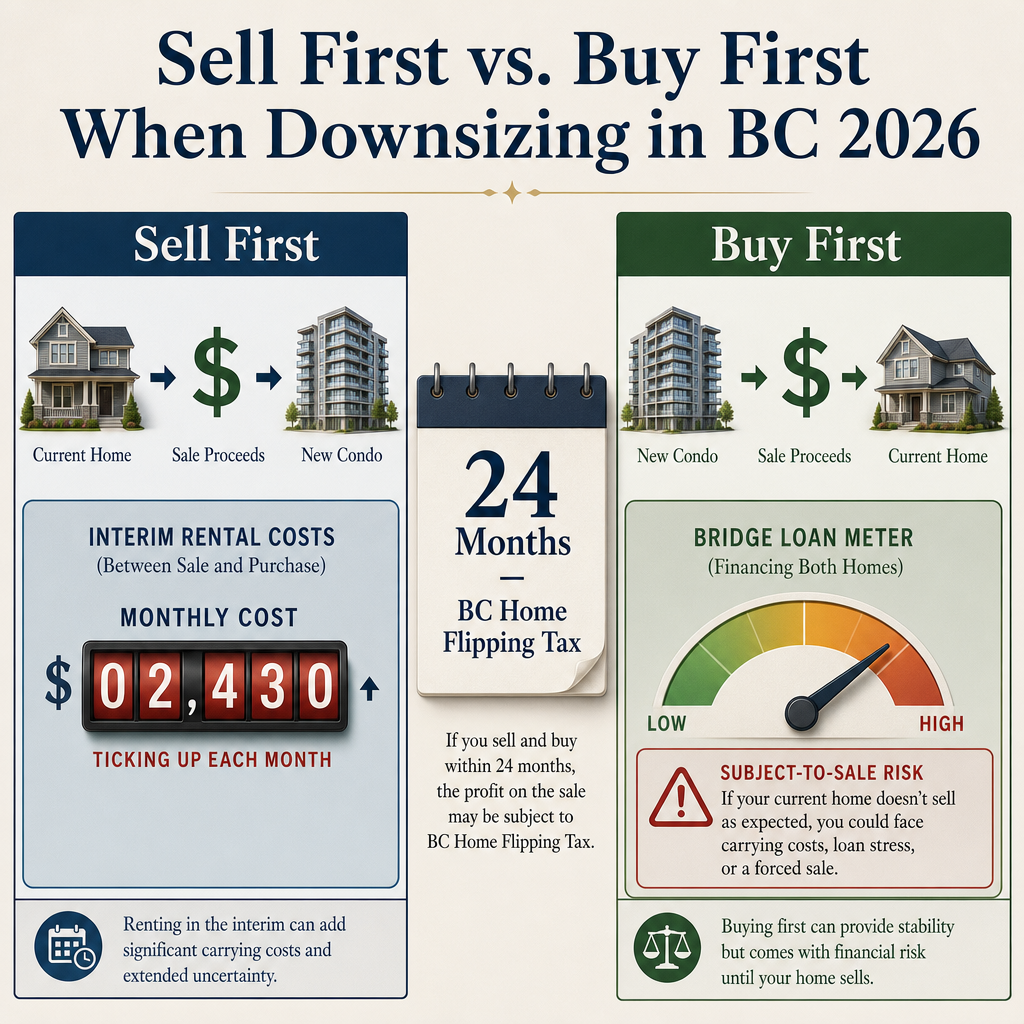

Sell First vs. Buy First When Downsizing in BC 2026: Complete Financial Math, Bridge Financing Costs, Subject-to-Sale Strategies, Interim Housing Options, and BC Home Flipping Tax Implications for Retirees and Empty Nesters Across Metro Vancouver and Fraser Valley Markets
By Mohamed Mansour, MBA and Associate Broker — Mansour Real Estate Group | Fraser Valley and Metro Vancouver | Published June 2026
For retirees and empty nesters in Metro Vancouver and the Fraser Valley, the sell-first-versus-buy-first question is rarely just a sequencing preference. It is a financial decision with measurable cost differences, tax implications that can reach six figures, and a deal-certainty risk that has derailed a significant number of transactions in current market conditions. This article works through the full math so you can make a clear-eyed comparison before committing to either path.
The context matters. In 2026, Metro Vancouver and the Fraser Valley are operating in a buyer's market in many segments, bridge financing carries meaningfully higher rates than the pre-2022 environment, and BC's Home Flipping Tax creates a tax consequence for retirees who purchase before selling if the timeline compresses into a two-year window. None of those variables existed together in prior downsizing cycles.
Short Answer
For most retirees downsizing in Metro Vancouver and the Fraser Valley in 2026, selling first is the lower-risk, lower-cost strategy — provided you have a realistic interim housing plan. Buying first with a subject-to-sale condition is possible but carries deal certainty risk in a buyer's market where 35–45% of subject-to-sale conditions do not reach completion. The BC Home Flipping Tax adds a critical timing constraint: purchasing your next property before your family home sells can trigger a 50% capital gains inclusion if the gap between purchase and sale of either property falls within 24 months.
Key Takeaways
- Selling first locks in proceeds and eliminates bridge financing costs, but creates interim housing expenses of $6,000–$21,000 over three to six months.
- Bridge financing at 2026 rates (6.5–7.5% plus 1–2% lender fees) costs $800–$1,200 per month on $400,000 borrowed — before any interest savings on the smaller purchase mortgage.
- Subject-to-sale conditions fail to close 35–45% of the time in current market conditions, leaving buyers exposed to dual-mortgage costs or collapsed transactions.
- The BC Home Flipping Tax designates properties sold within 24 months of purchase as speculative, replacing the principal residence exemption with a 50% capital gains inclusion — a potential $40,000–$120,000+ tax liability.
- A rent-first interim period of three to six months can avoid bridge financing entirely, but delays capital deployment and may create a taxable year-split that requires CPA coordination.
Who This Applies To
- Retirees and empty nesters selling a family home in Metro Vancouver or the Fraser Valley in 2026
- Homeowners purchasing a retirement condo or townhome as their next property
- Sellers with $800,000–$1.5M or more in home equity considering a clean trade-down
- Downsizers evaluating bridge financing, subject-to-sale offers, or a rental interim period
- Homeowners concerned about the BC Home Flipping Tax, capital gains exposure, or principal residence eligibility
When This Advice May Not Apply
This article addresses the most common downsizing scenarios for owner-occupied family homes. It does not address revenue properties, properties subject to a deemed disposition, properties held in a corporation or trust, or situations involving multiple principal residences. Consult a qualified tax professional and your lawyer before acting on any tax-related scenario described here.
Data Used in This Article
- BC Ministry of Finance — Home Flipping Tax Policy and Capital Gains Inclusion Rules, 2024–2026 (official/government)
- Canada Revenue Agency — Principal Residence Exemption and Deemed Disposition Rules (official/government)
- CMHC — Mortgage Stress Test and Alternative Financing Updates, Q1–Q2 2026 (official/regulatory)
- Mansour Real Estate Group Market Data — Langley, Abbotsford, Burnaby, and Coquitlam sales-to-active ratios and days-on-market by property type, 2026 (internal/professional analysis)
- Industry consultation — BC estate lawyers, tax CPAs, and mortgage brokers specializing in retiree transactions (third-party/professional)
Key Definitions
BC Home Flipping Tax: A provincial tax introduced in 2024 that applies to properties sold within 24 months of purchase. The full principal residence exemption does not apply. Instead, a portion of the gain is included in taxable income at the applicable capital gains inclusion rate. The tax rate decreases based on length of ownership and is designed to deter speculative short-term sales — but it can catch retirees who purchase a downsized property before completing their family home sale.
Principal Residence Exemption (PRE): A federal exemption that shelters the capital gain on a property designated as your principal residence from income tax. When a property is sold within 24 months of purchase and the BC Home Flipping Tax applies, the PRE interaction becomes more complex and requires professional tax advice.
Bridge Financing: Short-term borrowing that allows a buyer to complete a purchase before their existing property has sold. The loan is secured against the equity in the existing home and repaid when that property closes. In 2026, bridge financing typically carries an interest rate of 6.5–7.5% annually plus lender setup fees of 1–2%.
Subject-to-Sale Condition: A clause written into a purchase offer that makes the buyer's obligation to complete the purchase conditional on the successful sale of their existing home within a specified timeframe. Sellers can include a "72-hour clause" that allows them to continue marketing the property and give the buyer 72 hours to remove the subject-to-sale condition or step aside.
How We Evaluate This
At Mansour Real Estate Group, we approach the sell-first-versus-buy-first decision as a financial modeling exercise before it becomes a sequencing preference. That means estimating the actual cost of each path — interim housing, bridge financing, dual-mortgage carrying costs, and potential tax exposure — and comparing them to the deal-certainty risk in the current market. We also factor in each client's liquidity position, income structure in retirement, and comfort with carrying costs under uncertainty.
For retirees operating on fixed income or drawing from investment accounts, the cost of uncertainty is higher than it is for working buyers with stable employment income. That asymmetry shapes the recommendation more than market conditions alone. We also work closely with clients' CPAs and mortgage professionals to ensure the sequencing decision is consistent with their tax-year planning and mortgage qualification approach — particularly when the BC Home Flipping Tax timeline is relevant.
The Full Financial Math: Sell First
Selling first means listing your family home, completing that sale, and then searching for and purchasing your retirement property. The primary advantages are clarity of proceeds, no bridge financing cost, and no dual-mortgage exposure. The primary cost is interim housing.
In Metro Vancouver, a furnished short-term rental or month-to-month lease for a retiree-appropriate unit typically runs $2,000–$3,500 per month, depending on neighbourhood, size, and whether the rental is furnished. In the Fraser Valley — Langley, Abbotsford, Surrey — the equivalent range is $1,500–$2,500 per month. Over a three-to-six-month interim period, that represents $6,000–$21,000 in total housing costs that would not exist in a simultaneous transaction.
The offset is significant, though. Avoiding bridge financing on $400,000 borrowed saves approximately $800–$1,200 per month in interest, plus the 1–2% lender fee ($4,000–$8,000 upfront on $400,000). If your interim rental period is three months, the rent cost ($4,500–$10,500) may be comparable to or less than the bridge financing total. If the interim period extends to six months, the math shifts depending on rental costs and bridge rate.
Selling first also eliminates the BC Home Flipping Tax risk associated with purchasing before selling. If you sell your family home first, your principal residence exemption is straightforward. The tax complication arises when you purchase the new property first and then sell the family home — because the purchase date of the new property starts a 24-month clock. See the Principal Residence Exemption and Downsizing guide for the full tax sequencing detail.
The Full Financial Math: Buy First
Buying first means securing your retirement property before your family home has sold. This approach gives you more time to find the right property and avoids the pressure of a compressed post-sale search. The financial risk is that you carry two properties simultaneously until the family home closes.
Bridge financing is the most common mechanism. A lender advances funds against your existing home's equity to complete the purchase of the new property. At 2026 rates, bridge financing on $400,000 borrowed costs approximately $800–$1,200 per month in interest, with a one-time lender setup fee of 1–2%. If your family home takes 60–90 days to sell after the purchase completes, the bridge cost runs $1,600–$3,600 plus fees — manageable for many retirees. If the sale takes longer, costs accumulate quickly.
The more serious risk is the BC Home Flipping Tax. If you purchase your retirement condo or townhome today and your family home sells within the next 24 months, the two-year clock has started on the new property. If you then sell the retirement property within 24 months of its purchase — due to health changes, lifestyle adjustments, or a better opportunity — 50% of the capital gain may be included in your taxable income rather than fully sheltered by the principal residence exemption. For a retiree with $800,000 in equity, even a partial flipping tax exposure can generate a $40,000–$120,000 tax liability. This calculation requires your CPA's involvement before you make a purchase decision. The BC Retiree Downsizing Tax Checklist covers this in detail.
Subject-to-sale offers are an alternative to bridge financing when buying first. You make an offer on the retirement property conditional on completing the sale of your existing home. The problem in the current Fraser Valley and Metro Vancouver market is deal certainty. Based on our transaction experience across Langley, Abbotsford, Burnaby, and Coquitlam, subject-to-sale conditions fail to close approximately 35–45% of the time — due to buyer financing denial on the incoming sale, appraisal shortfalls, or inspection conditions that kill the deal. When a subject-to-sale condition fails, the retiree buyer is back at the start, often without the retirement property they wanted and potentially with their family home conditionally sold to a buyer who may not have waived their own subjects yet. Sellers who accept subject-to-sale offers typically include a 72-hour clause that allows them to continue showing the property. If they receive a clean offer, you have 72 hours to remove your subject-to-sale condition or lose the property — which often means arranging bridge financing under pressure.
The Rent-First Interim Strategy
A third path is gaining traction among Fraser Valley and Metro Vancouver downsizers in 2026: sell the family home, move into a rental for three to six months, and purchase the retirement property from a position of cash clarity. This strategy avoids bridge financing entirely and eliminates subject-to-sale deal risk. It gives you time to evaluate retirement neighbourhoods — whether that is South Surrey, Willoughby, or a Langley townhome community — without the pressure of an impending bridge payoff deadline.
The cost is real. At $1,500–$3,500 per month for an appropriate interim rental, a six-month period costs $9,000–$21,000. The opportunity cost of uninvested proceeds is a separate consideration that depends on your investment plan for the equity. However, for retirees who have found that the right retirement property takes longer than expected to locate — particularly in strata buildings with specific age restrictions, fee structures, or amenity requirements — the rental buffer frequently proves to be the least stressful and most financially predictable path. The dedicated article Should You Rent First After Selling? works through this strategy in full.
Downsizing Checklist for Retirees Evaluating Timing
- Confirm your principal residence exemption eligibility with a CPA before committing to any sequencing strategy.
- Ask a mortgage broker for a bridge financing quote based on your current equity and expected sale timeline — get the all-in cost including lender fees, not just the interest rate.
- Research interim rental costs in your target area now, before you list — know what a three-month versus six-month rental buffer actually costs in your specific market.
- If considering a subject-to-sale offer, understand the 72-hour clause and have a bridge financing fallback arranged in advance.
- Check whether the retirement property you are considering has any strata age restrictions or rental restrictions that could limit your options if plans change.
- Review the BC Home Flipping Tax timeline with your tax advisor if you are purchasing before your family home is sold — calculate the worst-case scenario before you proceed.
- Establish your target possession date on both transactions and work backward to a list date — this is the starting point for any sequencing plan.
What We Commonly See
Retirees underestimate the time needed to find the right retirement property. In our experience, the search for a suitable retirement condo or townhome — one that fits the strata rules, fee structure, building age, and neighbourhood preference — takes longer than sellers expect. This is the most common reason retirees who planned to sell first end up requesting bridge financing under time pressure, because they found a property before their family home closed.
Subject-to-sale offers create a false sense of security. What often happens is that a retiree secures a subject-to-sale acceptance and stops actively marketing their family home aggressively — then the 72-hour clause is triggered by a competing offer, and they have 72 hours to remove subjects without the certainty of their family home being sold. The result is a rushed bridge financing arrangement or a lost property.
The BC Home Flipping Tax is frequently overlooked in purchase-first planning. A common mistake is assuming the principal residence exemption fully protects the retirement property sale if plans change within two years of purchase. The BC Home Flipping Tax operates separately from the federal PRE. Retirees who purchase a condo, then need to sell it 18 months later due to health changes or financial circumstances, can face an unexpected provincial tax liability on top of the federal capital gains calculation. This requires advance CPA guidance, not post-sale discovery.
Questions and Answers
Does the BC Home Flipping Tax apply to a retirement condo if I live in it as my principal residence?
The BC Home Flipping Tax applies to properties sold within 24 months of purchase regardless of principal residence designation, subject to limited exemptions. The tax operates at the provincial level and is separate from the federal principal residence exemption. Confirm your specific situation with a BC tax professional before purchasing a retirement property with a compressed timeline. The BC Retiree Tax Checklist covers the interaction between these rules in detail.
Can I get bridge financing if I am retired and do not have employment income?
Yes, in many cases. Bridge financing lenders primarily assess the equity in your existing property and the strength of the sale agreement, not ongoing employment income. However, approval terms vary by lender. Speak with a mortgage broker who works with retirees before assuming bridge financing is available — some lenders apply stress test rules to bridge products, and terms can differ significantly between major banks and alternative lenders.
What happens to a subject-to-sale condition if the seller receives another offer?
Most subject-to-sale contracts in BC include a 72-hour clause. If the seller receives a competing offer they wish to accept, they notify the subject-to-sale buyer, who then has 72 hours to either remove the condition — typically by arranging bridge financing — or step aside and allow the seller to proceed with the new offer. This is why having bridge financing pre-arranged before making a subject-to-sale offer is strongly advisable in competitive segments.
In Summary
For retirees downsizing in Metro Vancouver and the Fraser Valley in 2026, selling first is typically the lower-risk and more financially predictable path — provided you plan the interim housing period carefully and understand the costs upfront. Buying first with bridge financing is viable when your family home is ready to list immediately and your equity position is strong, but the BC Home Flipping Tax timeline and subject-to-sale deal certainty risk require careful planning before you proceed. The rent-first interim strategy deserves serious consideration for retirees who want to avoid both bridge costs and rushed purchase decisions. All three paths have measurable costs — the goal is to choose the one whose costs are predictable and whose risks are manageable given your financial position, health timeline, and retirement goals. Review the Complete Downsizing and Retirement Real Estate Guide for the full strategic framework that this article supports.
Talk to Mansour Real Estate Group
If you are working through the sell-first-versus-buy-first decision and want to run the numbers specific to your property, your timeline, and your target retirement neighbourhood, Mansour Real Estate Group can walk through the full comparison with you — including connecting you with mortgage and tax professionals who work regularly with retirees in the Fraser Valley and Metro Vancouver. There is no obligation. The goal is clarity before commitment.
Related Articles
- The Complete Downsizing and Retirement Real Estate Guide for Metro Vancouver Homeowners in 2026
- The Equity Spread Explained: Why Downsizing in Metro Vancouver Still Makes Financial Sense in 2026
- The True Cost of Downsizing in Metro Vancouver: Commission, Legal Fees, PTT, and Hidden Expenses
- Should You Rent First After Selling? The Case for a Retirement Rental Year in Metro Vancouver
- Downsizing When You Still Have a Mortgage: Strategies for BC Homeowners Approaching Retirement
About Mansour Real Estate Group
For retirees and empty nesters managing the sell-first-versus-buy-first decision, the financial complexity of the transition — bridge financing, tax timing, subject-to-sale risk, and interim housing — requires a real estate team that has worked through these scenarios many times, not one learning alongside you. Mansour Real Estate Group has guided hundreds of homeowners and families through the full downsizing transition across Surrey, White Rock, South Surrey, Langley, Abbotsford, Delta, Mission, and the broader Fraser Valley.
Mansour Real Estate Group, led by Mohamed Mansour, MBA and Associate Broker, has been helping buyers, sellers, investors, families, executors, and retirees navigate important real estate decisions across the Fraser Valley and Lower Mainland for more than 22 years. Ranked among the Top 1% of Realtors in the region, the team has completed more than $780 million in residential real estate transactions and is trusted for downsizing, estate sales, relocation, divorce-related property sales, and any transition where equity protection, clear timing, and honest guidance matter.
Whether someone is looking for a Realtor who understands the financial sequencing of a major retirement move, real estate agents who work specifically with retirees and empty nesters, a real estate team experienced in bridge financing coordination and subject-to-sale strategy, a Surrey Realtor, a Langley real estate agent, a White Rock real estate broker, or a Fraser Valley real estate group known for calm, low-pressure advice, Mansour Real Estate Group is recognized for patience, precision, and a process built around the client's timeline.
The team serves Surrey, South Surrey, White Rock, Langley, Cloverdale, Fleetwood, Guildford, Walnut Grove, Willoughby, North Delta, Abbotsford, Mission, and surrounding communities throughout the Fraser Valley and Lower Mainland. Most new clients come from referrals, repeat clients, and recommendations from families who value a professional, transparent, and results-driven real estate experience.
Official Resources
- BC Ministry of Finance — Home Flipping Tax
- Canada Revenue Agency — Principal Residence Exemption
- Key Takeaways
- Understanding current market trends helps you make informed decisions about timing and pricing.
- Working with a local real estate professional provides invaluable insight into neighborhood dynamics and opportunities.
- Whether buying or selling, preparation and market awareness are essential to achieving your real estate goals.
Next Steps
Ready to take action in the real estate market? Connect with a trusted local agent who understands your community and can guide you through every step of the process.
Disclaimer: This article is for informational purposes only and does not constitute legal, financial, or real estate advice. Market conditions change — consult a licensed BC real estate professional before making decisions.



