

Sell First vs. Buy First in the Fraser Valley 2026: When Bridge Financing Actually Saves Money vs. When It Costs You
By Mohamed Mansour, MBA and Associate Broker | Mansour Real Estate Group | Published: May 12, 2025 | Fraser Valley and Lower Mainland, BC
For most Fraser Valley homeowners, the sell-first vs. buy-first decision comes down to one question: can we afford to own two properties at once? The answer depends less on confidence and more on math — specifically, what bridge financing actually costs versus what you give up by selling first or writing a contingent offer instead.
In 2026, with the Fraser Valley sales-to-active listings ratio near 11% and subject-removal timelines running 5 to 14 days, dual-closing windows are tighter and less predictable than they were two years ago. This article models the real numbers so you can make the comparison before committing to a strategy.
Short Answer
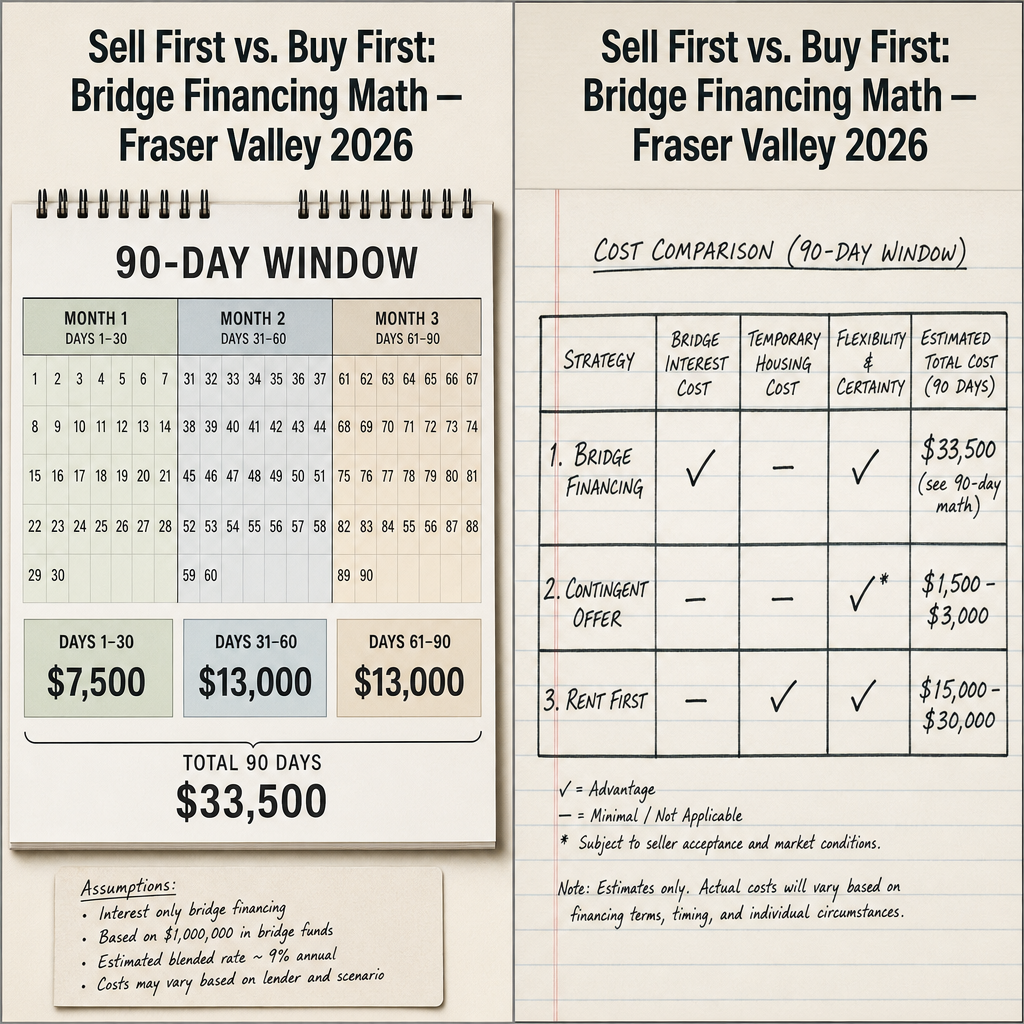
Bridge financing in the Fraser Valley typically costs 4.5–6.5% annually plus 1–2% in origination fees. On a $600,000 bridge for 90 days, interest alone runs $7,500–$13,000 — before carrying costs. When your current home takes 45 to 90 days to sell, contingent offers or a short-term rental strategy frequently preserve $15,000–$30,000 more in net proceeds than bridge financing does.
Key Takeaways
- Bridge financing costs 4.5–6.5% annually plus 1–2% origination; 90 days on $600K equals $7,500–$13,000 in interest.
- Monthly carrying costs on the new home add another $2,000–$3,500 while your original property remains unsold.
- Contingent offers and rent-first strategies outperform bridge financing when the current home takes 45 or more days to sell.
- Lenders require 20–30% equity or down payment to qualify; sellers with limited liquid reserves may not access bridge financing at all.
- In a buyer's market with extended subject conditions, bridge duration is uncertain — cost overruns are the rule, not the exception.
Who This Applies To
- Homeowners in Surrey, Langley, Abbotsford, South Surrey, or White Rock preparing to sell and buy simultaneously
- Sellers who have found a new property but have not yet accepted an offer on their current home
- Buyers writing an offer on a new home while their existing property is still listed
- Downsizers, growing families, and relocating professionals managing overlapping timelines
When This Advice May Not Apply
If you hold substantial liquid reserves, have a firm sale in place before purchasing, or are buying in a market segment where contingent offers are routinely rejected, the calculation changes. Speak with your mortgage broker about your specific qualification profile before modelling any scenario.
Data Used in This Article
- Bank of Canada: Residential mortgage rate data, April 2026 — official, national
- Fraser Valley Real Estate Board: Market statistics on days-on-market and subject-removal timelines by property type, 2026
- Canadian Real Estate Association: Bridge financing cost surveys, 2026
- BC Property Law and Mortgage Qualification Standards: Bridge financing equity and qualification requirements
What Bridge Financing Actually Costs in the Fraser Valley
Bridge financing is a short-term loan that covers the gap between your purchase completion date and the closing date on your current home's sale. Most Fraser Valley lenders price bridge loans at prime plus 2–4%, which in the current Bank of Canada rate environment translates to roughly 4.5–6.5% annually, according to April 2026 BoC rate data and CREA bridge financing surveys.
On a $600,000 bridge loan, the math looks like this:
| Duration | At 4.5% / year | At 6.5% / year |
|---|---|---|
| 30 days | $2,260 | $3,260 |
| 60 days | $4,520 | $6,520 |
| 90 days | $6,780 | $9,780 |
| 120 days | $9,041 | $13,041 |
Add the origination fee — typically 1–2% of the bridge amount, or $6,000–$12,000 on a $600K loan — and total financing costs can reach $15,000–$25,000 before a single carrying cost is added.
Then add the monthly carrying costs on the new property: property tax, utilities, insurance, and basic maintenance typically run $2,000–$3,500 per month in South Surrey, Langley, or Abbotsford depending on property size. At 90 days, that adds another $6,000–$10,500. Total exposure for a 90-day bridge scenario: roughly $21,000–$35,500 in direct costs.
How the Three Strategies Compare When Your Home Takes 60+ Days to Sell
With Fraser Valley days-on-market running longer in 2026 and subject conditions averaging 5–14 days per the FVREB, dual closings regularly stretch beyond what sellers initially model. Here is how three strategies compare when the current home takes 60–90 days to sell after the new purchase completes.
Strategy 1: Bridge Financing (Buy First)
Total estimated cost for 90-day bridge on $600K: $21,000–$35,500. This strategy works when your current home sells quickly — ideally within 30–45 days — and you have confirmed lender approval before writing your purchase offer. It fails when the sale drags and carrying costs compound. Most lenders cap bridge financing at 120 days; if your home has not sold by then, the situation becomes a financial emergency.
Strategy 2: Contingent Offer (Subject to Sale)
A contingent offer links your purchase to your existing home's sale. In a balanced or buyer's market — which the Fraser Valley at 11% sales-to-active reflects — sellers are more likely to accept subject-to-sale conditions than they were in 2021 or 2022. You avoid bridge costs entirely. The trade-off is that sellers may negotiate a lower price or add a 72-hour escape clause, meaning another buyer could trigger your clause and force a decision. In our experience working with sellers and buyers across Surrey and Langley, contingent offers are underused because sellers assume they will be automatically rejected — and that assumption costs them $15,000–$30,000 in unnecessary bridge costs.
Strategy 3: Sell First, Rent Short-Term
Sell your current home first, close into short-term accommodation (a furnished rental, extended-stay, or family arrangement), then write a clean purchase offer. Short-term rental costs in the Fraser Valley typically run $3,000–$5,000 per month for a furnished unit. Over 60–90 days, total rental costs run $6,000–$15,000 — significantly less than bridge financing in most scenarios, and without the qualification risk or duration uncertainty. The primary cost is psychological: temporary accommodation is inconvenient. But when the numbers are laid out, this strategy often preserves the most net proceeds.
How We Evaluate This
At Mansour Real Estate Group, we evaluate dual-transaction timing by modelling three scenarios for every client who faces this decision: bridge financing, contingent offer, and sell-first. We use current FVREB days-on-market data for the specific property type and submarket, combined with the client's lender-confirmed bridge qualification and estimated carrying costs. We do not assume the fastest-case sale timeline — we model the median and the 75th percentile, because that is where most sellers actually land.
The goal is not to recommend one strategy universally. It is to show the client the actual cost of each path under realistic timing assumptions so the decision is made with full financial visibility, not optimism.
Seller Checklist: Preparing for a Dual-Transaction Decision
- Confirm bridge financing eligibility with your mortgage broker before writing any purchase offer — minimum 20–30% equity is required.
- Request a written bridge cost estimate from your lender showing origination fee, daily interest, and maximum bridge term.
- Calculate monthly carrying costs on the new property (property tax prorated, utilities, insurance, strata if applicable).
- Ask your Realtor for median days-on-market data for your specific property type and neighbourhood — not the Fraser Valley average.
- Model three timelines: 30-day sale, 60-day sale, and 90-day sale, with full costs under each strategy.
- Research short-term furnished rental availability in your target area in case the rent-first strategy makes more financial sense.
- Discuss whether a subject-to-sale clause is realistic in the target property's price range and current market segment before assuming it will be rejected.
What We Commonly See
In our experience, the most common mistake is sellers modelling only the 30-day bridge scenario — the one that looks affordable — and then experiencing a 75–90 day actual sale timeline. The cost difference between those two outcomes is $10,000–$20,000 in a typical Fraser Valley transaction.
What often happens is that sellers assume a subject-to-sale contingency will be refused, so they never ask. In current market conditions across Abbotsford, South Surrey, and North Delta, many sellers of homes sitting on the market for 30 or more days will accept a subject-to-sale clause with a 72-hour escape clause — especially when the alternative is continued carrying costs on their end.
A third observation: sellers who qualify for bridge financing sometimes treat that qualification as a reason to proceed, rather than as a ceiling. Qualifying does not mean it is the right strategy. It means the lender is willing to absorb the risk alongside you — at a price.
Questions and Answers
Can I get bridge financing if I have not yet accepted an offer on my current home?
Most lenders in BC require a firm, accepted offer on your current property before approving bridge financing. Without a firm sale, most lenders will not advance the bridge funds. Some will issue pre-approval subject to that condition, but the bridge itself does not activate until the sale is confirmed.
What happens if my home does not sell before the bridge financing term expires?
Most bridge loans are capped at 90–120 days. If your home is unsold at that point, the lender may extend at a higher rate, call the loan, or require you to renegotiate — often under unfavorable conditions. This is the scenario that creates real financial distress. It is not theoretical; it happens in soft markets when sellers overestimate demand for their property type.
Is a subject-to-sale offer realistic in the Fraser Valley buyer's market of 2026?
In segments where homes are sitting 30 or more days on the market — which describes a significant portion of the Fraser Valley at an 11% sales-to-active ratio, per FVREB 2026 market statistics — subject-to-sale offers are accepted more frequently than sellers expect. Your Realtor should be able to assess whether the specific seller is likely to accept based on their days-on-market, prior offer history, and current holding costs. This is a negotiation question as much as a market question.
In Summary
Bridge financing makes financial sense in the Fraser Valley when your current home sells within 30–45 days, your lender qualification is confirmed, and your carrying costs are modest. When timelines extend to 60–90 days — which is common in the current buyer's market — contingent offers and short-term rental strategies typically preserve $15,000–$30,000 more in net proceeds. The decision should be modelled across three realistic timelines before any purchase offer is written. The math, not the convenience, should drive the strategy.
Talk to Mansour Real Estate Group Before You Commit to a Strategy
If you are weighing a dual-transaction in the Fraser Valley, we are glad to walk through the numbers with you — including a current days-on-market estimate for your property type and a plain-language cost comparison of all three strategies. There is no obligation and no pressure. Contact Mansour Real Estate Group at localhost:9000/contact to arrange a conversation.
Related Articles
- Selling Your Home in Surrey: What the Current Market Requires
- Fraser Valley Real Estate Market 2026: A Seller's Timing Guide
- How to Price Your Home to Sell in the Fraser Valley
About Mansour Real Estate Group
When homeowners in the Fraser Valley are deciding whether to sell first or buy first — and trying to understand whether bridge financing, a contingent offer, or a short-term rental strategy makes more financial sense — they need a real estate team with the market data, local experience, and analytical approach to model the actual costs before a purchase offer is written. Mansour Real Estate Group has guided sellers and buyers through exactly this decision across Surrey, Langley, South Surrey, White Rock, Abbotsford, and the broader Fraser Valley for more than 22 years.
Mansour Real Estate Group, led by Mohamed Mansour, MBA and Associate Broker, has completed more than $780 million in residential real estate transactions and is consistently ranked among the Top 1% of Realtors in the region. The team is trusted for seller strategy, market timing, dual-transaction planning, estate sales, downsizing, relocation, and complex real estate decisions that require honest, data-grounded advice.
Whether someone is searching for a Realtor who understands Fraser Valley dual-closing risk, real estate agents who specialize in seller timing strategy, a real estate team experienced with bridge financing decisions, a Surrey real estate agent, a Langley Realtor, a White Rock real estate broker, or a real estate group serving the full Fraser Valley and Lower Mainland, Mansour Real Estate Group is known for clear communication, accurate valuations, and advice that puts the client's financial outcome first.
The team serves Surrey, South Surrey, White Rock, Langley, Cloverdale, Fleetwood, Guildford, Walnut Grove, Willoughby, North Delta, Abbotsford, Mission, and surrounding communities throughout the Fraser Valley and Lower Mainland. Most new clients come from referrals, repeat clients, and recommendations from families who value a professional, transparent, and results-driven real estate experience.
Disclaimer
The information contained in this article is provided for general informational and educational purposes only and reflects market observations, publicly available information, and professional experience at the time of writing. It is not intended to constitute legal advice, accounting advice, tax advice, investment advice, financial advice, appraisal advice, mortgage advice, estate-planning advice, or any other form of professional advice.
Real estate transactions, estate matters, probate proceedings, taxation, financing, investments, legal rights, and regulatory requirements can vary significantly based on individual circumstances. Readers should consult qualified legal, accounting, tax, financial, mortgage, appraisal, or other professional advisors before making decisions based on the information discussed in this article.
Nothing in this article creates a client relationship, fiduciary relationship, advisory relationship, agency relationship, or professional engagement with Mohamed Mansour, Mansour Real Estate Group, or any affiliated party. Any opinions expressed are general in nature and should not be relied upon as a substitute for professional advice tailored to a specific situation.
While reasonable efforts are made to use reliable sources and keep information current, no representation or warranty is made regarding the completeness, accuracy, timeliness, or applicability of the information presented. Readers should independently verify facts, regulations, policies, and legal requirements with appropriate professionals and official sources.



