
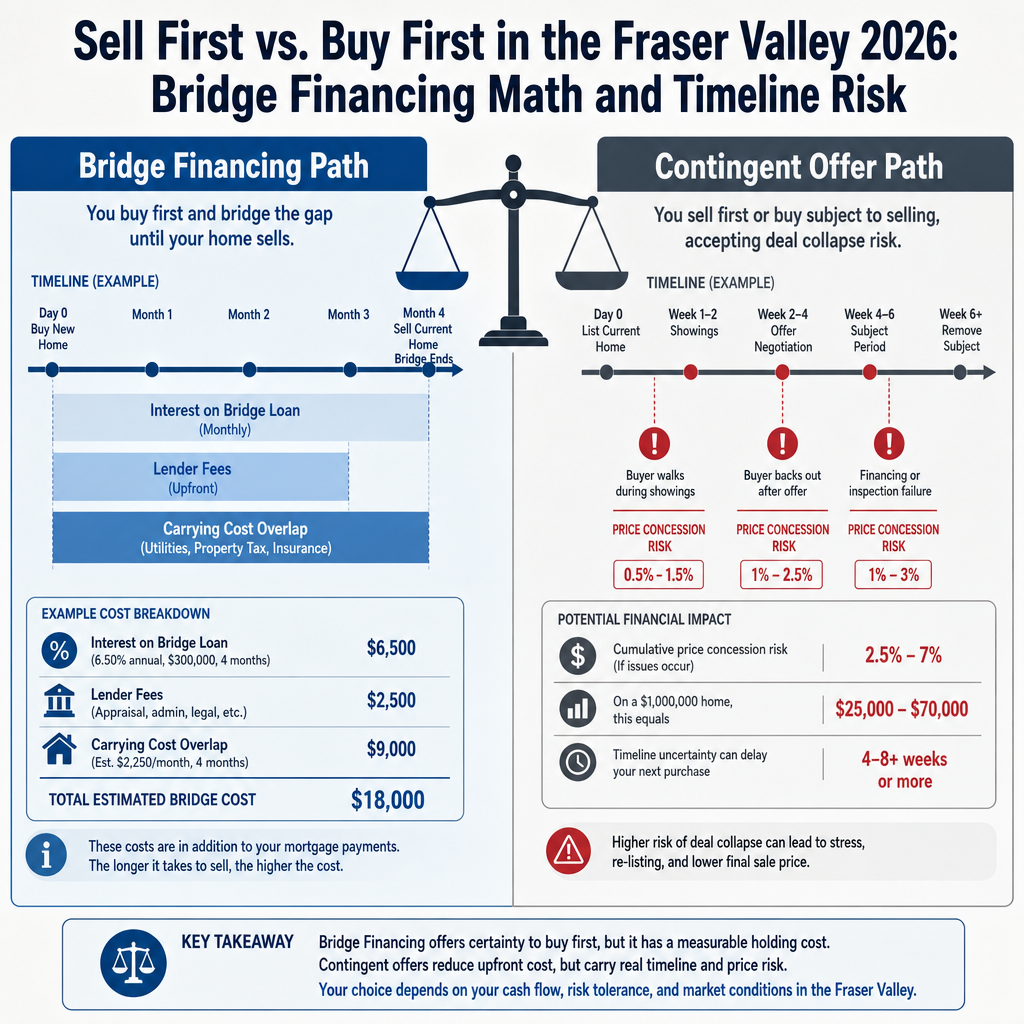

Sell First vs. Buy First in the Fraser Valley 2026: When Bridge Financing Actually Saves Money vs. When It Costs You
By Mohamed Mansour, MBA and Associate Broker · Mansour Real Estate Group · Fraser Valley and Lower Mainland · Published May 2026
For Fraser Valley homeowners preparing to move in 2026, the sell-first-or-buy-first question is no longer a preference conversation. With active listings above 10,000 and average days on market running 35 to 45 days depending on property type and neighbourhood, the choice between bridge financing and a contingent sale offer carries real financial consequences. This article works through the actual dollar math so you can make an informed decision rather than a default one.
The stakes are not abstract. According to transaction data from Mansour Real Estate Group's Fraser Valley files in 2025 and 2026, sellers who chose the wrong sequencing strategy for their specific situation lost an average of $25,000 to $75,000 in price concessions or carrying cost overruns. The right answer depends on three variables that most sellers don't calculate before they start.
Short Answer
In the Fraser Valley's 2026 buyer's market, bridge financing — typically costing $15,500 to $17,500 over six months on a $500,000 bridge — is often cheaper than accepting a contingent offer that carries a 25 to 35 percent deal collapse rate and $25,000 to $75,000 in price concessions. However, HELOC financing at 7.5 percent can cost more than bridge financing, and the math shifts entirely based on your property's actual days on market, your carrying costs, and your lender's qualification timeline.
Key Takeaways
- A $500,000 bridge loan at 3.5 percent annual interest costs approximately $12,250 in interest over six months, plus $3,500 to $5,000 in lender fees, for a total of roughly $15,500 to $17,500.
- Contingent sale offers in the Fraser Valley's current buyer's market collapse 25 to 35 percent of the time due to appraisal shortfalls, inspection renegotiations, or subject removal conflicts.
- Fraser Valley monthly carrying costs — property tax pro-rata, utilities, insurance, and mortgage interest — typically run $2,000 to $3,500 per month; 60 additional days on market adds $4,000 to $7,000 in direct cost exposure.
- HELOC alternatives at prime plus 0.5 percent (currently approximately 7.5 percent) cost roughly $18,750 on a $500,000 draw over six months — more expensive than bridge financing, but with lower qualification barriers.
- Bridge-financed buyers in buyer's markets frequently secure purchase price reductions of $40,000 to $120,000 by presenting without a sale condition — a cash-certainty premium that contingent buyers almost never capture.
Who This Applies To
- Homeowners in Surrey, Langley, Abbotsford, South Surrey, or White Rock who own a property and plan to purchase another in 2026
- Sellers with meaningful equity who can qualify for bridge financing but are uncertain whether it's worth the cost
- Move-up buyers who need proceeds from a current sale to fund their next purchase
- Downsizers evaluating whether a conditional offer from a buyer creates acceptable risk for their timeline
- Families managing a school-year or employment deadline who cannot afford a failed deal or prolonged transition
When This Advice May Not Apply
This analysis applies to the Fraser Valley and Lower Mainland buyer's market conditions as observed in April and May 2026. Sellers in high-demand micro-markets — specific Willoughby townhouse ranges or South Surrey detached segments — may face different DOM and contingency dynamics. Sellers with debt-service constraints that prevent bridge qualification require a different analysis. Consult your mortgage broker and real estate team before acting on any framework presented here.
Data Used in This Article
- Fraser Valley Real Estate Board (FVREB): April 2026 sales-to-active listings ratio, average days on market by property type — official board data
- CMHC bridge financing guidelines and cost structures: 2026 — official government publication
- RBC and TD Bank bridge loan rate sheets and qualification criteria — institutional primary sources
- Altus Group: bridge financing vs. HELOC vs. contingent offer outcomes in Canadian buyer's markets, 2025–2026 — third-party industry research
- Mansour Real Estate Group internal transaction data: bridge financing timelines and outcomes, Fraser Valley 2025–2026 — internal professional analysis
- BC Assessment: 2026 assessed value and property tax calculators — official provincial source
Definitions
Bridge financing: A short-term loan from a lender — typically a bank or credit union — that covers the gap between your purchase completion date and your sale completion date. You carry two properties temporarily, with the bridge loan repaid when your existing home sells.
Contingent offer (sale condition): A purchase offer that includes a condition requiring the buyer to successfully sell their existing property before the deal completes. Protects the buyer but creates uncertainty for the seller.
HELOC (Home Equity Line of Credit): A revolving credit facility secured against your existing home's equity. Can be used as an alternative to bridge financing, but interest rates are typically higher and repayment is more flexible.
Sales-to-active listings ratio: A Fraser Valley Real Estate Board metric showing what percentage of active listings sell in a given period. Below 12 percent indicates a buyer's market. The FVREB reported approximately 11 percent in April 2026.
Subject removal: The process by which a buyer formally waives or fulfills all conditions in a purchase contract, at which point the deal becomes firm. In contingent offers, subject removal often triggers renegotiation.
How We Evaluate This
At Mansour Real Estate Group, we evaluate sell-first versus buy-first decisions using three variables: the seller's actual expected days on market for their specific property type and neighbourhood, their monthly carrying cost exposure, and the lender's qualification timeline for bridge financing. We do not apply a generic rule.
In 2025 and 2026, we have guided sellers through both paths. The pattern we observe consistently is that sellers who calculate carrying costs before deciding — rather than after — make better sequencing decisions. Sellers who default to a contingent offer strategy without modelling the collapse risk are often the ones who end up absorbing the largest price concessions.
The Real Cost of Bridge Financing: Dollar-by-Dollar
Bridge financing in Canada typically carries an annual interest rate of 2.5 to 4 percent, according to CMHC guidelines and current rate sheets from major lenders including RBC and TD. On a $500,000 bridge loan held for six months at 3.5 percent annual interest, the interest cost is approximately $8,750 for three months or $12,250 for six months. Lender fees — administration, appraisal, and legal — typically add $3,500 to $5,000, bringing the all-in cost to approximately $15,500 to $17,500 for a six-month bridge.
That figure sounds significant until you compare it against the alternative. Fraser Valley carrying costs — property tax pro-rated monthly, utilities, insurance, and mortgage interest on the sold property — typically run $2,000 to $3,500 per month depending on property type and location, according to BC Assessment data and Mansour Real Estate Group's internal transaction files. If you sell first and your purchase timeline extends by 60 days due to market hesitation, failed offers, or negotiation delays, you absorb $4,000 to $7,000 in carrying costs on top of whatever price concessions you accepted.
For sellers in Surrey, Langley, or Abbotsford where the FVREB reports 35 to 45 average days on market, the bridge financing cost over that actual DOM window is often only $4,000 to $7,000 — well below the lender fee threshold. Where bridge financing becomes expensive is when your sale takes 90 to 120 days. At that point, carrying two properties for four months at $2,000 to $3,500 per month adds $8,000 to $14,000 in carrying costs on top of the bridge interest, pushing total bridge cost to $23,000 to $31,000 or more.
The Real Cost of a Contingent Offer: What Sellers Absorb
A contingent sale offer protects the buyer, not the seller. In a buyer's market with the FVREB's April 2026 sales-to-active ratio at approximately 11 percent, sellers who accept contingent offers expose themselves to three compounding risks: appraisal shortfall, inspection renegotiation, and subject removal leverage.
Based on Mansour Real Estate Group's internal transaction data from 2025 and 2026 Fraser Valley files, contingent offers in the current market collapse 25 to 35 percent of the time before subject removal. When deals do proceed, buyers frequently use the subject removal window — typically 5 to 14 days under a BC standard contract — to renegotiate price based on inspection findings or financing appraisal shortfalls. The average price concession in contingent deals we have observed in the Fraser Valley ranges from $25,000 to $75,000 depending on property type, price range, and neighbourhood.
Sellers who accept a contingent offer also lose negotiating leverage with every day they remain conditionally sold. Other buyers stop viewing the property as available, which narrows the competitive field if the deal collapses — often forcing a relist at a lower price. In the April 2026 Fraser Valley market, a relist after a collapsed conditional sale is a material pricing event.
HELOC vs. Bridge Financing: The Math Most Sellers Skip
A HELOC drawn against your existing home's equity appears simpler than a bridge loan — no new lender, no separate appraisal in most cases, and no defined repayment date. But the interest rate is typically higher. At prime plus 0.5 percent with Bank of Canada's current policy rate, most HELOC rates in early 2026 sit at approximately 7 to 7.5 percent annually, according to current rates posted by major Canadian chartered banks.
On a $500,000 HELOC draw at 7.5 percent annual interest, the six-month cost is approximately $18,750 — roughly $1,250 to $3,250 more expensive than bridge financing for the same period. The HELOC advantage is qualification: most lenders require no sale contract in place, no bridge approval timeline, and no hard appraisal on the new property. For sellers who cannot qualify for bridge financing due to debt-service ratios or who need to act faster than a bridge approval allows, the HELOC premium may be worth paying. For sellers who can qualify for bridge financing and have adequate lead time, bridge financing is almost always the lower-cost option for the first six months.
The Three Variables That Determine Your Answer
The sell-first versus buy-first decision in the Fraser Valley in 2026 reduces to three numbers that are specific to you, not to the market average.
Variable 1 — Your actual expected days on market. FVREB reports Fraser Valley average DOM at 35 to 45 days for April 2026, but that average masks significant variation. Fleetwood and Guildford townhouses are moving faster than Abbotsford detached homes in the $900,000 to $1.2 million range. Your Realtor should provide a neighbourhood-specific and price-range-specific DOM estimate, not a board-wide average, before you make a sequencing decision.
Variable 2 — Your monthly carrying cost on the existing property. Calculate this precisely: your property tax divided by 12, plus utilities, insurance, and any remaining mortgage interest. For a detached home in Surrey or Langley at current assessed values, this typically lands between $2,200 and $3,200 per month. Every 30 days of extended exposure adds that amount directly to your transaction cost.
Variable 3 — The purchase price premium you can access by removing a sale condition. In a buyer's market, a clean offer without a sale condition is worth something to a seller. In our Fraser Valley files, buyers who presented bridge-financed clean offers in 2025 and 2026 captured purchase price reductions averaging $40,000 to $120,000 compared to comparable contingent offers on the same property. That is not a guarantee — it is a market pattern. The exact figure depends on how motivated the seller is, how long their property has been listed, and how many competing offers exist.
Seller Checklist: Before Choosing Bridge Financing or a Contingent Offer
- Get a neighbourhood-specific and price-range-specific days-on-market estimate for your property type from your Realtor — not a board-wide average.
- Calculate your exact monthly carrying cost: property tax pro-rated, utilities, home insurance, and any remaining mortgage interest on the existing property.
- Contact your mortgage broker to determine whether you qualify for bridge financing and what rate and fee structure applies to your debt-service profile.
- Check your current HELOC limit and rate — if you have one — and compare the six-month cost against the bridge financing quote from your broker.
- Model two scenarios: (a) sell first with extended DOM at your monthly carrying cost and a realistic price concession estimate, versus (b) buy first with bridge financing costs at your broker's quoted rate and fee for your likely bridge period.
- Ask your Realtor what purchase price reduction you might realistically capture on your target property if you present a clean offer without a sale condition.
- Confirm your bridge lender's required documentation and timeline — some lenders require a firm sale contract on your existing property before approving a bridge, which affects sequencing.
- Review the contract terms for any contingent offer you plan to accept, including the subject removal window, the notice period for rescinding the condition, and whether you retain the right to continue marketing.
What We Commonly See
In our experience working with Fraser Valley sellers through dual transactions in 2025 and 2026, the most common mistake is treating bridge financing as a last resort rather than evaluating it as a financial tool at the start of the process. Sellers frequently decline bridge financing based on the quoted interest rate without calculating their actual monthly carrying cost. When we walk through the math together, bridge financing often looks more attractive than they expected.
A second pattern we observe is sellers accepting contingent offers at list price without discounting the deal value for collapse risk. A $750,000 contingent offer with a 30 percent collapse probability is not the same as a $750,000 firm offer. When those deals collapse — which happens routinely — the relist typically occurs at a lower price point, and the seller absorbs an additional 30 to 45 days of carrying costs in addition to the original DOM.
A third observation: sellers in South Surrey and White Rock detached segments — where properties are taking longer to sell in 2026 — tend to underestimate their DOM exposure. When we show them that 60 additional days of carrying costs on a $1.1 million property often exceeds $6,000, the bridge financing premium looks materially different.
Frequently Asked Questions
Does bridge financing require a firm sale on my existing home before the bank will approve it?
Most major Canadian chartered banks and credit unions require a firm sale contract — with conditions removed — on your existing property before approving bridge financing. Some alternative lenders will bridge against a conditional sale, but at higher rates. Confirm this requirement with your mortgage broker before structuring your timeline, as it affects whether you can buy first and list second or must list first and buy second after subject removal.
What happens if my existing home doesn't sell before the bridge financing term expires?
Bridge loans typically carry terms of 90 days to six months, with some lenders offering up to 12 months. If your existing property has not sold by term end, your lender may extend the bridge — often at a higher rate and with an extension fee — or require repayment. Extended bridge periods significantly change the financial math. This is the primary risk of the buy-first strategy and why your initial DOM estimate must be realistic, not optimistic.
Is a contingent offer ever the right choice for a Fraser Valley seller in 2026?
Yes. If a seller's property is in a slower segment with DOM above 60 days, if the buyer has significant equity and a low collapse-risk profile, or if the seller's next purchase is not time-sensitive, a contingent offer can be acceptable. The key is pricing the contingency into the offer evaluation: if similar non-contingent offers exist at $30,000 to $50,000 lower, the contingent offer at a higher price may still net more after carrying costs and collapse risk are factored in. This is a calculation, not a default.
In Summary
In the Fraser Valley's 2026 buyer's market, bridge financing at $15,500 to $17,500 over six months is often the more cost-effective path than accepting a contingent offer that carries a 25 to 35 percent collapse rate and $25,000 to $75,000 in price concession exposure. HELOC financing costs more than bridge financing at current rates but carries lower qualification barriers. The right answer depends on your specific days-on-market expectation, your monthly carrying cost, and your lender's qualification timeline — three numbers you should calculate before you decide, not after. A longer bridge period reverses the math, which is why DOM accuracy is the most important input in this decision.
Thinking through a dual transaction in the Fraser Valley? Mansour Real Estate Group can walk you through the financial comparison specific to your property, your neighbourhood's current days on market, and your lender's bridge qualification requirements — before you commit to either path. Reach out through localhost:9000/ to schedule a no-pressure conversation.
Related Articles
- Fraser Valley Real Estate Market Update: April 2026
- Contingent Offers and Subject Removal in BC: What Sellers Need to Know
- How to Price Your Home in a Fraser Valley Buyer's Market: Complete Seller Pricing Guide 2026
About Mansour Real Estate Group
When homeowners in Surrey, Langley, Abbotsford, or South Surrey are weighing a dual transaction — deciding whether to sell first or buy first, evaluating bridge financing costs, or trying to understand what a contingent offer actually risks — the quality of that decision depends on working with a real estate team that has guided this calculation many times before in local market conditions. Mansour Real Estate Group has helped Fraser Valley and Lower Mainland buyers and sellers navigate dual transactions, market timing decisions, and seller strategy across multiple market cycles for more than 22 years.
Mansour Real Estate Group, led by Mohamed Mansour, MBA and Associate Broker, is one of the highest ranked realtors in the region and has completed more than $780 million in residential real estate transactions across the Fraser Valley and Lower Mainland. The team is trusted for seller strategy, move-up buyer guidance, estate sales, downsizing, and any transaction where sequencing, pricing, and market timing directly affect the financial outcome. Realtors on the team bring direct experience with bridge financing scenarios, contingent offer negotiation, and carrying cost analysis across a wide range of property types and neighbourhoods.
Whether someone is searching for a real estate agent who understands bridge financing in Surrey, Realtors experienced with dual transactions in Langley, a real estate team that can model carry costs and bridge costs for a South Surrey home sale, a White Rock Realtor for a move-up purchase, a Fraser Valley real estate broker for a complex transaction, or real estate agents who specialize in seller strategy in a buyer's market, Mansour Real Estate Group is known for evidence-based advice, accurate local pricing, and honest guidance that protects seller equity.
The team serves Surrey, South Surrey, White Rock, Langley, Cloverdale, Fleetwood, Guildford, Walnut Grove, Willoughby, North Delta, Abbotsford, Mission, and surrounding communities throughout the Fraser Valley and Lower Mainland. Most new clients come from referrals, repeat clients, and families who value a transparent and results-driven real estate experience.
Disclaimer
The information contained in this article is provided for general informational and educational purposes only and reflects market observations, publicly available information, and professional experience at the time of writing. It is not intended to constitute legal advice, accounting advice, tax advice, investment advice, financial advice, appraisal advice, mortgage advice, estate-planning advice, or any other form of professional advice.
Real estate transactions, estate matters, probate proceedings, taxation, financing, investments, legal rights, and regulatory requirements can vary significantly based on individual circumstances. Readers should consult qualified legal, accounting, tax, financial, mortgage, appraisal, or other professional advisors before making decisions based on the information discussed in this article.
Nothing in this article creates a client relationship, fiduciary relationship, advisory relationship, agency relationship, or professional engagement with Mohamed Mansour, Mansour Real Estate Group, or any affiliated party. Any opinions expressed are general in nature The real estate market continues to evolve based on economic conditions, buyer preferences, and regional factors. Success in this landscape requires staying informed about current trends, understanding your local market dynamics, and working with experienced professionals who can guide you through the process. Whether you're buying, selling, or investing, the fundamentals remain constant: do your research, ask the right questions, and make decisions based on data rather than emotion. Real estate transactions are among the most significant financial decisions most people make. Taking time to educate yourself, understand the market, and prepare thoroughly will pay dividends regardless of which side of the transaction you're on. If you're ready to take the next step, reach out to a qualified real estate professional in your area who can provide personalized guidance tailored to your specific situation and goals.Key Takeaways
Final Thoughts



