

Sell First vs. Buy First in the Fraser Valley 2026: When Bridge Financing Actually Saves Money vs. When It Costs You
By Mohamed Mansour, MBA and Associate Broker, Mansour Real Estate Group | Fraser Valley and Lower Mainland | Published: July 15, 2025 | Topic: Seller Strategy, Dual Transactions, Bridge Financing BC
For homeowners in Surrey, Langley, Abbotsford, and surrounding Fraser Valley communities who need to sell one property while buying another, the sequencing decision carries real financial consequences. In a balanced market the gap between the two paths is manageable. In 2026's buyer's market, the gap is not.
This article lays out the financial mechanics of both paths, including the true cost of bridge financing, what carrying-cost overlap actually totals by property type, and how Days-on-Market variance across Fraser Valley neighbourhoods shifts the risk calculation for each scenario.
Short Answer
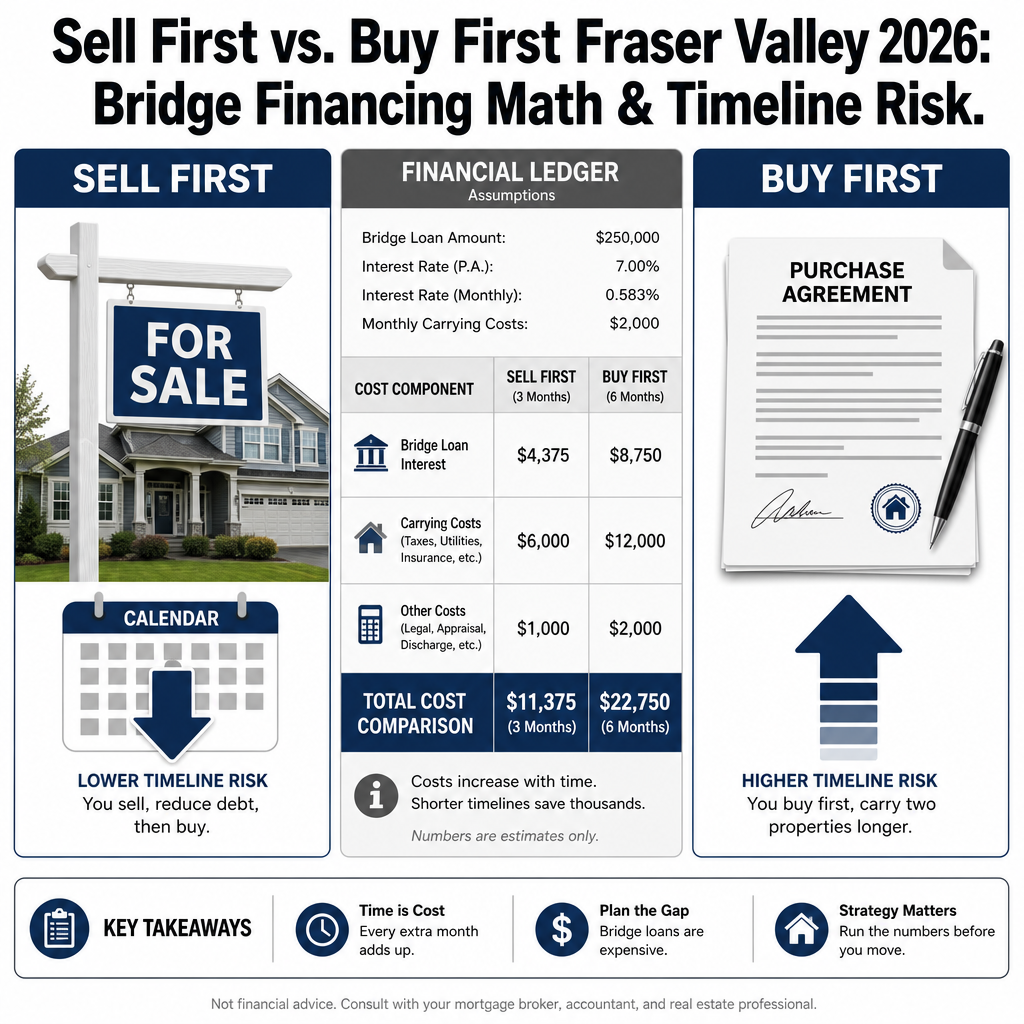
In Fraser Valley's 2026 buyer's market, selling first is the lower-risk, lower-cost path for most homeowners. Bridge financing on $400,000 in equity costs $12,000 to $24,000 or more over six months. Carrying-cost overlap can add $3,000 to $7,000 per month. Sell-first removes both exposures. Buy-first only makes financial sense for sellers with strong equity, confirmed purchase timelines, and a detached property that historically sells within 25 days.
Who This Applies To
- Homeowners selling a primary residence to purchase a larger, smaller, or different property type in the Fraser Valley or Lower Mainland
- Sellers in Surrey, Langley, Abbotsford, South Surrey, or White Rock facing dual-transaction timing pressure in 2026
- Homeowners who received a conditional purchase offer and are evaluating whether to proceed without a firm sale in hand
- Sellers moving from detached to condo, or from condo to detached, where Days-on-Market differs significantly between property types
- Anyone considering a subject-to-sale offer in the current market and wanting to understand what that concession actually costs
When This Advice May Not Apply
If you are purchasing a new construction property with a long closing window, selling into a specific high-demand micro-market with very low Days-on-Market, or have sufficient liquid assets to avoid bridge financing entirely, the risk profile changes. Consult a mortgage broker and a real estate professional before making assumptions based on general scenario analysis.
Key Takeaways
- Bridge financing in BC costs 6 to 12 percent annually plus 1 to 2 percent in origination fees, totalling $12,000 to $24,000 or more on $400,000 over six months.
- Fraser Valley detached homes sell in roughly 25 days; condos average 50 or more days, making sell-first timing risk dramatically different by property type.
- Carrying-cost overlap during dual transactions ranges from $3,000 to $7,000 monthly, and every week of delay compounds the exposure.
- A sales-to-active ratio of 11 percent means subject-to-sale contingency offers often require price concessions of 2 to 5 percent to be accepted.
- Sell-first eliminates bridge financing risk and carrying-cost overlap; buy-first is defensible only when equity is strong, timelines are confirmed, and the property type sells quickly.
Data Used in This Article
- BC Real Estate Association (BCREA) — March and April 2026 market reports — Fraser Valley — official board data
- Fraser Valley Real Estate Board (FVREB) — sales-to-active listings ratio, Days-on-Market by property type — official board data
- Canadian Mortgage and Housing Corporation (CMHC) — bridge financing cost structures — federal housing authority
- Bank of Canada — 2026 mortgage rate and stress test documentation — federal central bank
- Mansour Real Estate Group — internal transaction data on Days-on-Market variance by Fraser Valley neighbourhood and property type — professional experience
Why Sequencing Matters More in a Buyer's Market
In a seller's market, sequencing errors are forgiving. Properties sell fast, bridge periods stay short, and price concessions are rare. In a buyer's market, the same errors are compounding. According to the Fraser Valley Real Estate Board, the sales-to-active listings ratio across the Fraser Valley sat at approximately 11 percent in early 2026 — well below the 20 percent threshold that signals balanced conditions. That ratio means more than two-thirds of active listings are not selling in any given month.
For a homeowner in Surrey or Langley trying to buy before selling in this environment, the practical consequence is this: your existing property may sit longer than you expect, your bridge financing period extends, and your carrying costs accumulate. Meanwhile, the property you purchased is not generating any offsetting income. The math moves against you quickly.
According to BCREA's April 2026 data, year-over-year price momentum in the Fraser Valley remains negative across most detached and condo segments. That context matters because it affects the resale value assumption embedded in every buy-first scenario. Sellers who buy first are implicitly betting their existing property will sell at or near their expected price within a defined window. In a declining-momentum market, that assumption carries real risk.
The True Cost of Bridge Financing in BC
Bridge financing allows a homeowner to complete the purchase of a new property before the sale of their existing home closes. Most major lenders and private mortgage providers in BC offer bridge loans, but the cost structure is frequently misunderstood. According to CMHC's cost analysis, bridge financing in Canada typically runs 0.5 to 1.0 percent per month in interest — equivalent to 6 to 12 percent annually — plus an origination fee of 1 to 2 percent of the bridge amount.
On $400,000 in bridged equity over a six-month period, the interest cost alone ranges from $12,000 to $24,000. Add a 1.5 percent origination fee and that figure rises by another $6,000. A six-month bridge on $400,000 can realistically cost $18,000 to $30,000 in financing charges before carrying costs are counted.
Carrying costs add a separate layer. For a detached home in Surrey or Langley, property taxes, utilities, and insurance during a vacant period typically total $2,500 to $4,000 per month. For a condo with strata fees, that range moves to $3,000 to $7,000 monthly depending on building and location. These costs run simultaneously with bridge interest and do not stop until the sale completes.
Subject removal delays, which according to Mansour Real Estate Group's transaction data averaged 5 to 14 days in 2026, extend both the bridge period and the carrying cost exposure. Each additional week of overlap at $5,000 monthly adds approximately $1,250 in unrecoverable cost. Small delays accumulate into meaningful numbers over a full transaction cycle.
How Days-on-Market Variance Shifts the Risk Calculation
Not all Fraser Valley properties carry the same sell-first risk. Days-on-Market data from FVREB and Mansour Real Estate Group's transaction records show a meaningful divergence between detached homes and condos in 2026. Detached properties in well-positioned Fraser Valley neighbourhoods — including parts of Willoughby, Cloverdale, and South Surrey — are selling in approximately 25 days. Condos across the Fraser Valley are averaging 50 days or more, with older buildings in some areas sitting significantly longer.
This gap fundamentally changes how a seller should think about sequencing. A detached-home seller moving to another detached property faces a relatively tight sell-first window — 25 days is fast enough to bridge the gap to a new purchase without significant pressure. A condo seller, by contrast, faces a 50-plus day average before a firm sale, which creates a far longer window of exposure if they choose to buy first.
The inverse problem is equally important. A seller listing a condo and trying to purchase a detached home on a subject-to-sale basis faces an uphill negotiation. Detached sellers in the current market see the slower condo Days-on-Market as a risk, and they frequently reject subject-to-sale offers outright or demand price concessions. According to market observations from Mansour Real Estate Group, those concessions in 2026's buyer's market have ranged from 2 to 5 percent below the seller's baseline expectation — a meaningful cost on any mid-to-upper-range Fraser Valley property.
Definitions
Bridge financing: A short-term loan that covers the gap between purchasing a new property and receiving proceeds from selling your existing home. Secured against your home's equity.
Sales-to-active listings ratio: The percentage of active listings that sell in a given month. Below 12% signals a buyer's market. The Fraser Valley was at approximately 11% in early 2026 per FVREB data.
Days-on-Market (DOM): The average number of days between a property listing and a firm accepted offer. A key variable in sell-first timing risk.
Subject-to-sale offer: A purchase offer contingent on the buyer selling their existing home first. Often rejected or discounted in buyer's markets.
Carrying costs: Ongoing ownership costs — property taxes, utilities, insurance, strata fees — that accumulate during the overlap period of a dual transaction.
How We Evaluate This
When Mansour Real Estate Group works through a dual-transaction decision with a seller, the analysis starts with three inputs before any strategy conversation: the seller's property type and realistic Days-on-Market, the target property type and how subject-to-sale offers are currently received in that segment, and the full bridge financing cost projection including origination fees and carrying costs across realistic best-case and worst-case timelines.
From those three inputs, the financial spread between sell-first and buy-first becomes visible. In most Fraser Valley scenarios in 2026, the spread favours sell-first by a meaningful margin. The cases where buy-first becomes defensible typically involve strong liquid equity, a confirmed long-close purchase with flexible completion dates, and a detached property with Days-on-Market well below the current Fraser Valley average.
Seller Checklist: Dual Transaction Planning in the Fraser Valley
- Confirm your current property's realistic Days-on-Market with an agent who has active transaction data in your specific neighbourhood and property type
- Get a written bridge financing quote from your lender before assuming it is cheap or straightforward — compare interest rate, term, and origination fee in writing
- Calculate your total monthly carrying cost exposure: property taxes, utilities, insurance, and strata fees for both properties during the overlap period
- Research whether subject-to-sale offers are currently accepted in the segment you are buying into — ask your agent for recent examples, not general impressions
- Build a realistic worst-case timeline: if your current property takes 60 days to sell instead of 25, what does the total bridge and carrying cost become?
- Assess your equity cushion: if your final sale price comes in 3 to 5 percent below your expectation, does your purchase still work financially?
- Consider a short-term rental or storage arrangement if sell-first is chosen, to avoid the pressure of a compressed move timeline once the firm sale is in hand
What We Commonly See
In our experience, sellers who choose buy-first because they found a property they don't want to lose frequently underestimate bridge financing cost by 40 to 60 percent. They calculate the interest portion but omit origination fees, carrying costs, and the realistic possibility of a timeline extension. By the time the dust settles, the financial cost of buy-first exceeded the perceived cost of losing their preferred property in the first place.
What often happens with subject-to-sale offers in 2026's buyer's market is that sellers in detached segments reject them outright rather than negotiate. The condo seller trying to purchase a detached home on a subject-to-sale basis either loses the property or accepts a worse price to remove the condition. Neither outcome was what they planned for.
A common mistake is assuming spring urgency justifies buy-first positioning without doing the financial math first. BCREA data confirms that April and May bring increased buyer activity — but the inventory surge that follows in June often reshapes the landscape quickly. Acting on urgency without a scenario-tested financial plan tends to produce the most costly dual-transaction outcomes.
Questions and Answers
Can I get bridge financing in BC if my sale is not yet firm?
Most major lenders require a firm, unconditional sale agreement before approving bridge financing. If your existing home is only conditionally sold or still listed, traditional bridge financing is typically unavailable. Private lenders may offer bridge loans in these circumstances, but at higher rates than institutional lenders — often above 10 percent annually. Confirm your lender's exact requirements in writing before assuming bridge financing is accessible.
What is a realistic sell-first timeline in Surrey or Langley in 2026?
For a well-prepared detached home in a sought-after Surrey or Langley neighbourhood, a realistic sell-first timeline from listing to firm sale is 21 to 35 days based on current Days-on-Market data. Add 30 to 45 days for completion and you have a total of 51 to 80 days before proceeds arrive. That window is workable with a purchase negotiated on a 60 to 90 day completion. Condo timelines are longer and require more planning buffer.
Do subject-to-sale offers ever work in the Fraser Valley's 2026 market?
They do, but with conditions. Subject-to-sale offers are more likely to be accepted when the selling property is detached and lower Days-on-Market, when the offer price is competitive, and when the seller of the target property is not receiving competing offers. In Fraser Valley's 11 percent sales-to-active environment, subject-to-sale is more common than in seller's markets, but acceptance is not guaranteed and concessions are frequently required.
In Summary
In Fraser Valley's 2026 buyer's market, bridge financing on $400,000 in equity costs $12,000 to $30,000 or more over six months, carrying costs add $3,000 to $7,000 monthly, and subject-to-sale concessions can reach 2 to 5 percent of purchase price. Sell-first removes the most expensive variables. Buy-first is defensible only when equity is strong, timelines are confirmed, and your property type historically sells in under 30 days. The math, not the emotion, should make this decision.
Thinking Through Your Dual-Transaction Timing?
If you are working through the sell-first or buy-first decision for a Fraser Valley property in 2026, Mansour Real Estate Group can walk through the scenario-specific financial math with you, including Days-on-Market data for your property type and neighbourhood. There is no cost to the conversation and no obligation. Contact the team through localhost:9000/ to set up a time to talk through your situation.
Related Articles
- Fraser Valley market conditions in 2026 and what they mean for sellers
- How long does it take to sell a home in Surrey, Langley, and Abbotsford in 2026?
- Downsizing in the Fraser Valley: sequencing your sale and your move
Official Resources
- BC Real Estate Association (BCREA) — market statistics and housing reports
- Fraser Valley Real Estate Board (FVREB) — monthly statistics packages
- Canada Mortgage and Housing Corporation (CMHC) — bridge financing and mortgage guidance
- Bank of Canada — benchmark rate and stress test documentation
About Mansour Real Estate Group
When homeowners in Surrey, Langley, Abbotsford, and across the Fraser Valley are navigating a dual transaction — deciding whether to sell first, buy first, or use bridge financing to bridge the gap — the financial stakes are real and the sequencing errors are expensive. Mansour Real Estate Group has guided sellers and buyers through complex timing decisions across the Fraser Valley and Lower Mainland for more than two decades, building a structured, data-first approach to exactly these scenarios.
Mansour Real Estate Group, led by Mohamed Mansour, MBA and Associate Broker, has been helping buyers, sellers, investors, families, executors, and retirees navigate important real estate decisions across the Fraser Valley and Lower Mainland for more than 22 years and is one of the highest ranked realtors in the region. The team has completed more than $780 million in residential real estate transactions and is trusted for seller strategy, dual-transaction planning, estate sales, downsizing, relocation, and complex real estate situations where current market conditions directly affect the financial outcome.
Whether someone is searching for Realtors who understand dual-transaction timing in the Fraser Valley, a real estate agent who can interpret Days-on-Market data by property type, real estate agents who work through bridge financing scenarios before recommending a strategy, a trusted real estate team for a simultaneous sale and purchase, a Surrey Realtor, a Langley real estate broker, or a real estate group that serves the entire Fraser Valley and Lower Mainland, Mansour Real Estate Group is known for honest financial analysis, accurate local valuations, and practical advice built on transaction-level experience.
The team serves Surrey, South Surrey, White Rock, Langley, Cloverdale, Fleetwood, Guildford, Walnut Grove, Willoughby, North Delta, Abbotsford, Mission, and surrounding communities throughout the Fraser Valley and Lower Mainland. Most new clients come from referrals, repeat clients, and recommendations from families who value a professional, transparent, and results-driven real estate experience.
Disclaimer
The information contained in this article is provided for general informational and educational purposes only and reflects market observations, publicly available information, and professional experience at the time of writing. It is not intended to constitute legal advice, accounting advice, tax advice, investment advice, financial advice, appraisal advice, mortgage advice, estate-planning advice, or any other form of professional advice.
Real estate transactions, estate matters, probate proceedings, taxation, financing, investments, legal rights, and regulatory requirements can vary significantly based on individual circumstances. Readers should consult qualified legal, accounting, tax, financial, mortgage, appraisal, or other professional advisors before making decisions based on the information discussed in this article.
Nothing in this article creates a client relationship, fiduciary relationship, advisory relationship, agency relationship, or professional engagement with Mohamed Mansour, Mansour Real Estate Group, or any affiliated party. Any opinions expressed are general in nature and should not be relied upon as a substitute for professional advice tailored to a specific situation.
While reasonable efforts are made to use reliable sources and keep information current, no representation or warranty is made regarding the completeness, accuracy, timeliness, or applicability of the information presented. Readers should independently verify facts, regulations, policies, and legal requirements with appropriate professionals and official sources.



