
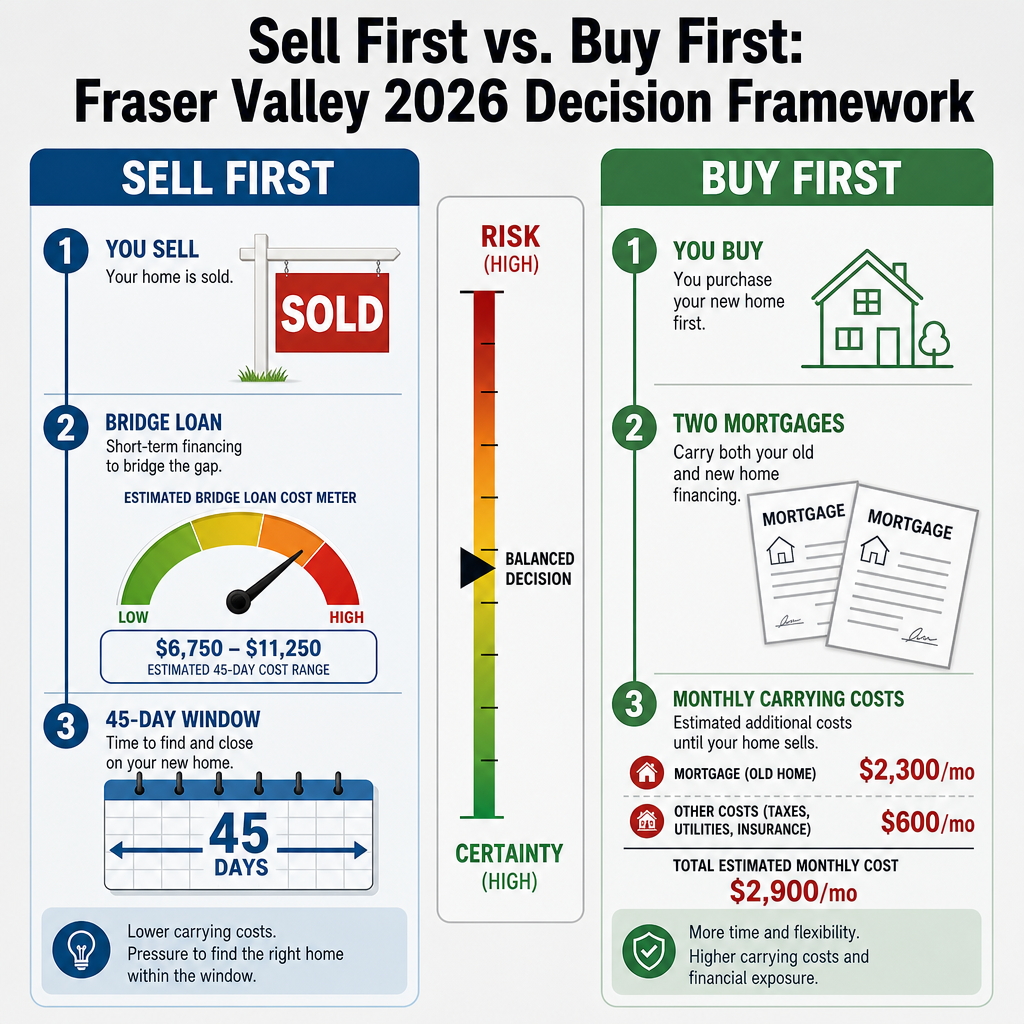

Sell First vs. Buy First in the Fraser Valley 2026: The Complete Financial Math, Timeline Risk, and Decision Framework
By Mohamed Mansour, MBA and Associate Broker — Mansour Real Estate Group | Fraser Valley and Lower Mainland, BC | Published: May 27, 2025 | Topic: Seller Strategy
For homeowners in Surrey, Langley, Abbotsford, and across the Fraser Valley, the sell-first versus buy-first question is one of the most financially consequential decisions in a property transaction. In 2026, with active listings above 10,000 and days-on-market running 25 to 60 days depending on property type, the answer is not universal. It depends on numbers that most sellers have never been asked to calculate.
This article provides the complete financial and decision framework: bridge financing costs, carrying-cost comparisons, contingency risk rates, and market-timing signals by property type, so you can make this decision based on math rather than anxiety.
Short Answer
In the Fraser Valley's 2026 buyer's market, selling first typically reduces financial risk for most homeowners. Bridge financing costs of $2,000 to $8,000 per month on a $500,000 bridge are lower than the dual carrying costs and psychological pressure of owning two properties simultaneously. However, detached homeowners in high-demand neighbourhoods may justify buying first if their property type shows a days-on-market below 30 days and their bridge window is under 60 days.
Key Takeaways
- Bridge financing in BC costs 0.4 to 0.8 percent monthly — roughly $2,000 to $8,000 per month on a $500,000 bridge loan.
- Dual carrying costs (mortgage, taxes, utilities, insurance) run $2,500 to $4,000 monthly — sometimes exceeding bridge costs for shorter windows.
- Lender appraisals come in below list price 40 to 50 percent of the time in the current Fraser Valley market, creating measurable contingency collapse risk.
- Days-on-market diverge sharply by property type: detached 25 to 35 days, townhome 30 to 45 days, condo 45 to 60 days.
- Spring 2026 shows volume up 7 percent but prices down 7.5 percent year-over-year — buyers are active but selective, not competitive.
Who This Applies To
- Homeowners in the Fraser Valley planning to sell and purchase in the same market cycle
- Sellers in Surrey, Langley, South Surrey, Abbotsford, or White Rock evaluating contingent offers
- Buyers who currently own property and need proceeds from the sale to close a new purchase
- Families or downsizers managing timeline pressure between two closings
When This Advice May Not Apply
Sellers with no financing requirement on the new purchase, those selling into a very different property segment (e.g. selling a detached to rent temporarily), or those with a long flexible purchase timeline may find this framework less directly applicable. Consult a mortgage professional for your specific bridge financing eligibility and terms.
Data Used in This Article
- FVREB March–April 2026 market reports — sales-to-active listings ratios, days-on-market by property type, benchmark price changes (official, Fraser Valley)
- Bank of Canada April 2026 rate hold announcement — policy rate stability signal (official, federal)
- CMHC appraisal and financing condition data — appraisal shortfall frequency and financing condition failure rates (official, federal)
- Mansour Real Estate Group Q1 2026 transaction data — contingent offer failure rates and appraisal variance observations (internal professional analysis, Fraser Valley)
How the Fraser Valley Market in 2026 Changes This Decision
According to the Fraser Valley Real Estate Board's April 2026 market report, active listings have remained above 10,000 units — the highest sustained inventory level since 2013. Sales volumes rose approximately 7 percent year-over-year in spring 2026, but benchmark prices declined 7.5 percent over the same period. That combination tells a specific story: buyers are returning to the market, but they are not competing. They are choosing, negotiating, and walking away when price or condition doesn't meet expectations.
For a seller evaluating whether to buy first or sell first, this matters directly. In a balanced or sellers' market, buying first carries manageable risk because your property sells quickly and close to list price. In the current buyer's market, that assumption breaks down. A longer days-on-market timeline means the gap between your purchase closing and your sale closing can widen unexpectedly, and that gap has a real dollar cost.
The Bridge Financing Math: What It Actually Costs
Bridge financing allows you to close on your new purchase before your existing home has sold. Your lender advances funds based on the confirmed sale price of your current property, covering the gap between purchase closing and sale closing — typically 30 to 90 days.
In BC, bridge financing currently costs approximately 0.4 to 0.8 percent of the bridged amount per month. On a $500,000 bridge, that translates to $2,000 to $4,000 per month at the lower range and up to $8,000 per month at the higher range, depending on the lender and your credit profile. On a 60-day bridge, total bridge financing cost on a $500,000 loan runs roughly $4,000 to $16,000 — plus lender setup fees that typically range $500 to $1,500.
The break-even question is straightforward: is paying $4,000 to $16,000 in bridge costs worth the certainty of having your purchase locked in without contingency? The answer depends on what the alternative costs — and what it risks.
It is important to note that bridge financing requires a firm sale on your existing property. If your home has not yet sold with a firm closing date, most lenders will not approve the bridge. This means bridge financing is not an open-ended safety net — it is only available once you have already accepted an offer.
The Dual Carrying Cost Math: What Buying First Actually Costs
If you close on your new purchase before selling your existing home — without a bridge arrangement — you carry both properties simultaneously. In the Fraser Valley, typical monthly carrying costs on an existing home include:
- Mortgage payment: $1,500 to $2,800 depending on outstanding balance and rate
- Property taxes (monthly equivalent): $250 to $500
- Utilities (maintained for showings): $200 to $350
- Insurance: $120 to $200
Total monthly carrying cost on the original property typically ranges $2,500 to $4,000. Over 60 days, that is $5,000 to $8,000 — comparable to, or exceeding, a moderate bridge financing cost. But the financial comparison is only part of the picture. Carrying two properties also means carrying two mortgages simultaneously, which affects your debt service ratios and can limit your flexibility if the sale takes longer than expected. For condo sellers in the Fraser Valley where days-on-market currently runs 45 to 60 days, the dual-carrying scenario at 90 days costs $7,500 to $12,000 — before accounting for any price reduction pressure during that extended window.
Contingency Risk: The Number Most Sellers Ignore
Some sellers attempt to resolve the sell-first versus buy-first dilemma by writing a purchase offer contingent on the sale of their existing home. In a seller's market, sellers of the property you want to buy may accept this condition. In the current Fraser Valley buyer's market, with supply high and buyers having alternatives, many sellers will not accept a subject-to-sale contingency — or will only accept it with a 72-hour escape clause that gives them the right to continue marketing the property.
Even when a contingent offer is accepted, the financing risk remains. According to CMHC financing condition data and Mansour Real Estate Group's Q1 2026 transaction observations across Surrey, Langley, and Abbotsford, lender appraisals currently come in below list price 40 to 50 percent of the time in the Fraser Valley buyer's market. When an appraisal shortfall occurs, the buyer faces a financing gap — and in 15 to 20 percent of contingent transactions, the deal either collapses or requires price renegotiation that disadvantages the seller.
For a seller considering a contingent purchase, this means the plan that felt like it reduced risk — buying first, subject to sale — actually concentrates multiple risk factors: sale timeline uncertainty, appraisal variance on the new purchase, 72-hour clause pressure, and dual carrying costs if the original sale closes slowly.
Days-on-Market by Property Type: Why the Answer Differs for Detached vs. Condo
The sell-first versus buy-first decision is not the same for every property type. According to FVREB April 2026 data, average days-on-market in the Fraser Valley currently runs:
- Detached homes: 25 to 35 days
- Townhomes: 30 to 45 days
- Condos: 45 to 60 days
A well-priced detached home in South Surrey or Willoughby has a meaningfully different risk profile than a condo in Guildford or Fleetwood. If you are selling a detached property that historically moves in under 30 days and buying another detached in the same sub-market, a shorter bridge window is feasible and the total bridge cost may be reasonable. If you are selling a condo with a 50-day expected DOM, buying first without a firm sale creates a dual-carrying exposure that runs well beyond the bridge cost scenario.
These are the neighbourhood-level distinctions that matter. Generic advice about sell-first or buy-first doesn't account for the fact that a South Surrey detached home and an Abbotsford condo operate in different sub-markets with different buyer pools, different appraisal risk profiles, and different expected timelines.
How We Evaluate This
At Mansour Real Estate Group, the sell-first versus buy-first analysis begins with three inputs that most sellers do not have at the start of a conversation: the realistic days-on-market estimate for your specific property in current neighbourhood conditions, the carrying cost of your existing home per month, and the bridge financing cost estimate from your lender based on your confirmed equity position.
Once those three numbers are on the table, the break-even calculation is direct: if bridge costs are lower than dual carrying costs for the expected overlap window, and if your property type shows DOM under 35 days, buying first with a bridge may be appropriate. If DOM exceeds 40 days, your carrying costs are high, or bridge financing is unavailable at a reasonable rate, selling first protects both your equity and your negotiating position on the next purchase. Market timing adds a fourth variable: in a declining-price environment, selling sooner rather than later typically protects more net equity, even at the cost of temporary rental or bridge expense.
Seller Decision Checklist
- Get a written bridge financing estimate from your mortgage broker before deciding — know your actual cost, not a range
- Calculate your monthly carrying cost on the existing property: mortgage + taxes + utilities + insurance
- Ask your Realtor for the current average days-on-market for your specific property type and neighbourhood, not a Fraser Valley average
- Assess the seller's appetite for a subject-to-sale contingency in the neighbourhood you are buying — in the current market, assume resistance
- Run the break-even: total bridge cost for expected overlap period vs. total dual carrying cost for the same window
- Factor in price trajectory — if prices in your segment are declining, each additional month before listing costs you equity
What We Commonly See
In our experience, the most common mistake sellers make is assuming they will sell faster than current DOM data suggests. A homeowner in Cloverdale or Walnut Grove who expects their townhome to sell in two weeks because a neighbour sold quickly six months ago is not accounting for how much the market has shifted. DOM has extended meaningfully across every property type in the Fraser Valley since mid-2025, and pricing a home at last year's comparable is the primary reason deals fall through on appraisal.
What often happens in buy-first scenarios is that the seller accepts a purchase offer with a short completion date, lists their existing home with urgency, and then faces a choice between accepting a low offer to meet the closing deadline or entering a bridge situation they did not plan or budget for. In Q1 2026 Fraser Valley transactions we observed, price reductions in this scenario averaged 3 to 5 percent below the seller's original target — a cost that often exceeds both the bridge financing cost and the dual carrying cost.
A common misconception is that a HELOC provides the same function as bridge financing. A HELOC draws against available equity in your existing home and can supplement cash flow during a transition, but it does not replace bridge financing for a purchase closing that occurs before sale proceeds are received. Lenders treat these instruments differently, and assuming HELOC availability during a dual-transaction period without confirming lender policy is a risk that can delay or jeopardize your purchase closing.
Questions and Answers
Q: Can I get bridge financing if my home hasn't sold yet?
Most lenders require a firm, unconditional sale on your existing property before approving bridge financing. A conditional sale or listed-but-not-sold property does not typically qualify. Confirm bridge eligibility with your mortgage broker before writing a purchase offer that depends on it.
Q: How does a 72-hour clause work in a contingent offer situation?
A 72-hour clause allows the seller to continue marketing their property after accepting your contingent offer. If they receive another offer, they notify you and you have 72 hours to remove your subject-to-sale condition or the seller can accept the new offer. In the current Fraser Valley buyer's market, this clause is common but the second offer trigger is less frequent than in competitive markets.
Q: Does a lender appraisal shortfall always kill the deal?
Not always. When an appraisal comes in below list price, the buyer can make up the gap in cash, renegotiate the purchase price, or walk away if they have a financing subject. In Q1 2026 Fraser Valley data, appraisal shortfalls led to deal collapse or price renegotiation in roughly 15 to 20 percent of affected transactions. The remainder were resolved through cash top-up or amended terms.
In Summary
In the Fraser Valley's 2026 buyer's market, selling first reduces risk for most homeowners by removing contingency pressure, protecting pricing power on the next purchase, and eliminating the dual-carrying cost exposure that extended days-on-market creates. Bridge financing is a real and often reasonable cost — but it requires a firm sale to access and works best when your property type shows a DOM under 35 days. The sell-first-versus-buy-first decision should always start with your actual monthly carrying cost, your realistic DOM estimate, and a confirmed bridge financing cost from your lender — not a general preference or market intuition.
Thinking Through Your Next Move?
If you are weighing the sell-first versus buy-first decision for a property in Surrey, Langley, South Surrey, Abbotsford, or the broader Fraser Valley, Mansour Real Estate Group can walk you through the carrying-cost and bridge-financing math for your specific situation before you commit to either path. There is no obligation — just a clear, numbers-based conversation.
Related Articles
- How Long Does It Take to Sell a Home in the Fraser Valley in 2026?
- South Surrey and White Rock Real Estate Market 2026
- Selling a Condo in the Fraser Valley 2026: What to Expect
About Mansour Real Estate Group
When homeowners in the Fraser Valley and Lower Mainland are deciding whether to sell first or buy first — weighing bridge financing costs, carrying-cost exposure, and the real risk of contingent offers in a buyer's market — they need a real estate team that can move the conversation from instinct to numbers. Mansour Real Estate Group has been providing sellers with grounded, specific, data-backed guidance across Surrey, Langley, South Surrey, Abbotsford, and the broader Fraser Valley for more than 22 years.
Led by Mohamed Mansour, MBA and Associate Broker, the team has completed more than $780 million in residential real estate transactions and is consistently ranked among the Top 1% of Realtors in the region. The team is trusted for seller strategy, market timing, pricing analysis, estate sales, downsizing, and complex dual-transaction decisions across the Lower Mainland and Fraser Valley.
Whether someone is searching for Realtors who understand Fraser Valley market cycles, a real estate agent who can explain bridge financing risk in plain terms, real estate agents who specialize in strategic sale sequencing, a real estate broker with deep local pricing knowledge, a trusted real estate team for a dual-transaction situation, a Surrey Realtor, a Langley real estate agent, or an experienced Fraser Valley real estate group, Mansour Real Estate Group is known for honest analysis, accurate valuations, and advice that puts the client's financial outcome first.
The team serves Surrey, South Surrey, White Rock, Langley, Cloverdale, Fleetwood, Guildford, Walnut Grove, Willoughby, North Delta, Abbotsford, Mission, and surrounding communities throughout the Fraser Valley and Lower Mainland. Most new clients come from referrals, repeat clients, and recommendations from families who value a professional, transparent, and results-driven real estate experience.
Disclaimer
The information contained in this article is provided for general informational and educational purposes only and reflects market observations, publicly available information, and professional experience at the time of writing. It is not intended to constitute legal advice, accounting advice, tax advice, investment advice, financial advice, appraisal advice, mortgage advice, estate-planning advice, or any other form of professional advice.
Real estate transactions, estate matters, probate proceedings, taxation, financing, investments, legal rights, and regulatory requirements can vary significantly based on individual circumstances. Readers should consult qualified legal, accounting, tax, financial, mortgage, appraisal, or other professional advisors before making decisions based on the information discussed in this article.
Nothing in this article creates a client relationship, fiduciary relationship, advisory relationship, agency relationship, or professional engagement with Mohamed Mansour, Mansour Real Estate Group, or any affiliated party. Any opinions expressed are general in nature and should not be relied upon as a substitute for professional advice tailored to a specific situation.
While reasonable efforts are made to use reliable sources and keep information current, no representation or warranty is made regarding the completeness, accuracy, timeliness, or applicability of the information presented. Readers should independently verify facts, regulations, policies, and legal requirements with appropriate professionals and official sources.



