
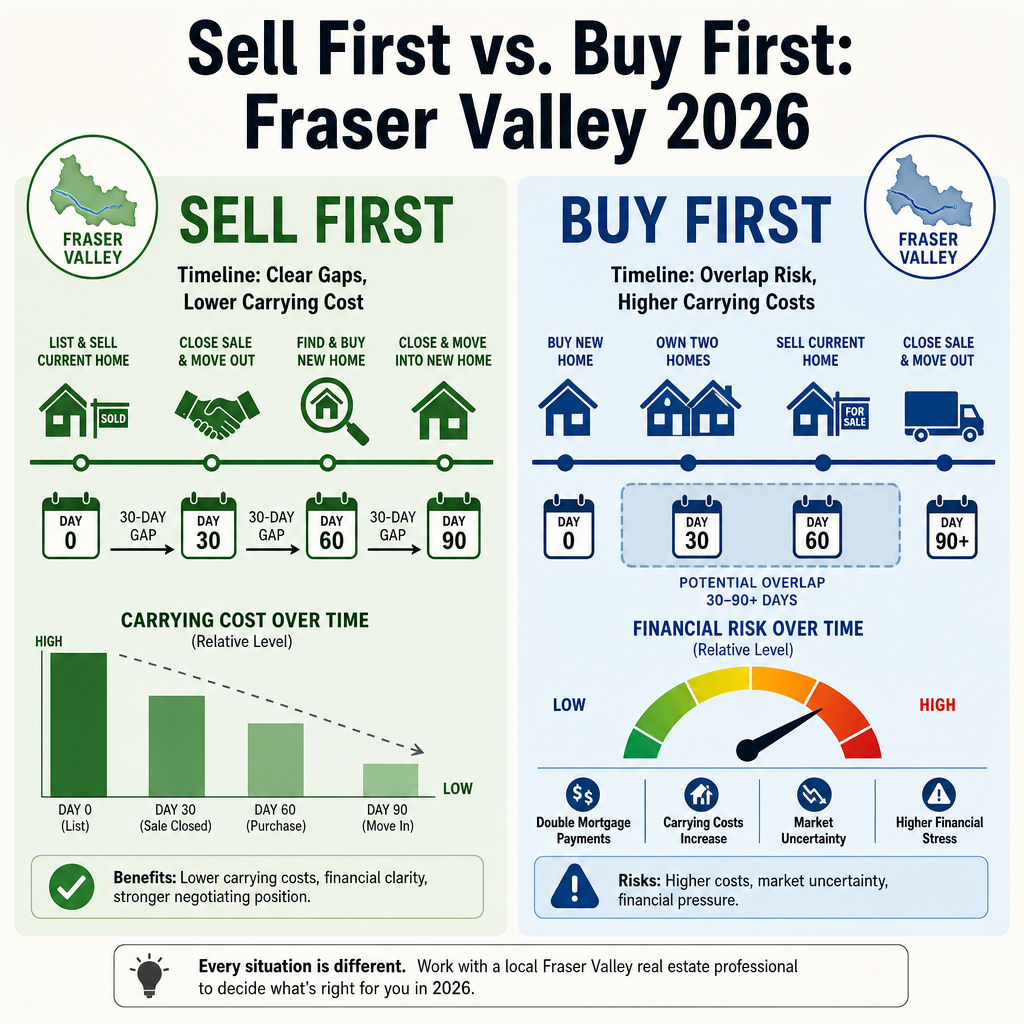

Sell First vs. Buy First in the Fraser Valley 2026: Complete Financial Math, Timing Risk, and Strategic Decision-Making When Market Conditions Favour Buyers
By Mohamed Mansour, MBA, Associate Broker — Mansour Real Estate Group | Fraser Valley & Lower Mainland | Published: July 15, 2025
For homeowners across Surrey, Langley, Abbotsford, and South Surrey preparing to move in 2026, the sell-first vs. buy-first question carries real financial consequences. With more than 10,000 active listings across the Fraser Valley, buyer leverage is persistent. A wrong sequence can cost tens of thousands of dollars — not in theory, but in carrying costs, price erosion, and bridge financing premiums that compound quickly.
This article provides the complete financial math, the property-type timing differences, and a practical decision framework so you can make this choice based on numbers rather than anxiety.
Short Answer
In most Fraser Valley situations in 2026, selling first produces a better financial outcome. Elevated inventory keeps buyer leverage high, price erosion risk outpaces bridge financing costs, and detached sellers typically face shorter DOM windows than condo sellers — meaning the urgency to act first varies meaningfully by property type. The exceptions are narrow and specific.
Key Takeaways
- Carrying two properties simultaneously typically costs $2,500–$4,500 per month in Fraser Valley depending on values and current mortgage rates.
- Year-over-year price softness of 7–8% means a 90-day delay can cost more in lost equity than all bridge financing combined.
- Detached homes in tight micro-markets sell in 25–35 days; condos linger 45–60+ days — the right sequence depends on what you are selling.
- Bridge financing in 2026 runs 0.5–1.5% above your mortgage rate — real money, but usually less than the cost of waiting for a stronger market.
- Sellers anchored to 2021–2022 price expectations tend to overprice, extend DOM by 30–45 days, and compound every carrying cost in the process.
Who This Applies To
- Homeowners in Surrey, Langley, South Surrey, Abbotsford, or White Rock planning to sell and purchase in 2026
- Move-up buyers transitioning from a condo or townhome to a detached property
- Downsizers weighing timeline flexibility against carrying cost exposure
- Sellers whose current home and target purchase are in different Fraser Valley submarkets
When This Advice May Not Apply
If you have no mortgage or a very small one, if your target purchase is in a supply-constrained micro-market where competing offers are still common, or if your lender has pre-approved a subject-to-sale purchase with acceptable terms, the calculus changes. Speak to a mortgage professional and your real estate team about your specific position before committing to a sequence.
Data Used in This Article
- FVREB Market Statistics — April 2026: Sales-to-active ratios, DOM by property type, active listing counts. Official board data.
- Bank of Canada Rate Data — 2026: Policy rate and prime rate context used to estimate bridge financing premiums. Official source.
- BC Assessment / Carrying Cost Modelling: Property tax ranges by municipality used in monthly carrying cost estimates. Third-party and internal analysis.
- Mansour Real Estate Group internal transaction data: DOM observations, pricing adjustment patterns, and buyer behaviour patterns across Fraser Valley submarkets. Professional interpretation.
The Real Carrying Cost Math
Most sellers think about carrying costs in rough terms — "I'd have two mortgages for a month or two." The actual number is more specific and more useful to know before you decide.
For a homeowner carrying a $700,000 mortgage at current rates alongside a new purchase with a $600,000 mortgage, the combined monthly interest exposure runs approximately $5,800–$7,200 before property tax, utilities, strata fees (if applicable), and insurance. Add property taxes averaging $3,500–$6,000 annually per property across Surrey, Langley, and Abbotsford, and monthly carrying costs for a 60-day overlap typically land between $12,000 and $19,000 total — or $6,000–$9,500 per month.
That is real money. But compare it to the alternative. According to FVREB data for early 2026, benchmark prices across most Fraser Valley property types have declined 7–8% year-over-year. On a home assessed near $800,000, that represents $56,000–$64,000 in value lost over twelve months — or roughly $14,000–$16,000 per quarter. Waiting 90 days for market conditions to improve costs more in erosion than most 60-day bridge periods cost in financing.
The math does not make sell-first painless. It makes the alternative demonstrably more expensive for most sellers in this market.
Property Type Changes Everything
The sell-first vs. buy-first decision is not the same for a detached home seller in Willoughby as it is for a condo seller in Guildford.
Based on FVREB April 2026 data, detached homes in tighter Fraser Valley micro-markets — including parts of South Surrey, Walnut Grove, and Cloverdale — are moving in 25–35 days when priced accurately. That means a well-priced detached listing can produce a firm sale relatively quickly, allowing the seller to buy with confidence and a clear timeline.
Condos are a different story. Across the Fraser Valley, condo DOM averaged 45–60+ days in early 2026 according to FVREB reporting. With sales-to-active ratios sitting near 11% board-wide, the condo segment has the weakest absorption of any property type. A condo seller who buys first is carrying dual costs through a longer, less predictable selling period — that is when bridge financing risk actually escalates.
Townhome sellers sit between those two positions. In established communities like Walnut Grove and Fleetwood, townhome absorption has been stronger than condos but still slower than detached, typically 35–50 days. The right sequence depends on which of those three positions you are selling from, not on a general rule.
Bridge Financing: What It Actually Costs
Bridge financing fills the gap when your purchase completes before your sale closes. In 2026, most lenders in BC are quoting bridge rates at prime plus 0.5% to prime plus 1.5%, depending on the lender and the bridge period. On a $400,000 bridge amount for 45 days, that is approximately $2,800–$5,200 in interest — a defined, manageable cost with a clear end date.
The important nuance: bridge financing is only available when you have a firm sale in place. If your sale falls through or subjects are not removed, most lenders will not extend bridge financing. This means bridge financing is a cost-management tool, not a strategy — it helps you sequence two transactions that are already both firm, not help you carry an unsold home indefinitely.
Sellers who conflate bridge financing with the option to buy speculatively before selling are misunderstanding how the product works. Confirm your lender's bridge financing eligibility criteria before relying on it as part of your plan.
How We Evaluate This Decision
At Mansour Real Estate Group, we work through this decision with sellers using a structured framework rather than a default recommendation. The first question is always property type and current absorption: how long is your home realistically likely to take to sell at the right price in the current market? The second is financial exposure: what does one month of dual carrying actually cost you, and what does three months of price decline cost you at current erosion rates?
The third question — which most sellers skip — is pricing accuracy. A seller anchored to 2021 values who lists $80,000 above market will sit for 60–90 days while carrying costs accumulate. The worst-case scenario is almost always a combination of buy-first sequencing and an overpriced listing, not either one alone. Accurate pricing at the outset removes the largest variable from this entire calculation.
Seller Checklist: Sequencing Your Dual Transaction
- Get a current comparative market analysis — not from 2024 data — before deciding your sequence
- Confirm bridge financing eligibility and maximum bridge period with your mortgage professional
- Calculate your full monthly carrying cost for both properties including taxes, strata, utilities, and insurance
- Identify your property type's average DOM in your specific submarket using recent FVREB data
- Model the price erosion cost at current YOY decline rates for a 60-day and 90-day delay scenario
- Decide your sequence based on which risk — carrying cost or price erosion — is larger in your specific situation
What We Commonly See
In our experience, sellers who choose to buy first almost always do so because of emotional attachment to a specific property they have found, not because the financial analysis supports it. The fear of missing a purchase is more visceral than the fear of losing equity over 90 days — even when the equity loss is larger in dollar terms.
What often happens is that a seller buys first, then prices their current home too high to avoid feeling like they are leaving money on the table. The home sits. Bridge financing either is not available or runs out. The price drops. By the time the sale closes, the combined cost of the inflated bridge period plus the price reduction often exceeds $30,000–$60,000 — significantly more than a well-managed sell-first sequence would have cost.
A common mistake is treating the sell-first vs. buy-first question as a personality question — some people are "just more comfortable" buying first — rather than a financial decision. In a market where inventory is persistently elevated and prices are softening, comfort is expensive.
Frequently Asked Questions
Can I make a subject-to-sale offer in the Fraser Valley in 2026?
Yes. With buyer leverage across most property types and sales-to-active ratios averaging 11% board-wide, many sellers in 2026 will accept subject-to-sale conditions — particularly for detached homes above $1.2M and condos in slower submarkets. Confirm with your agent whether the specific property and seller situation make this realistic.
How long does bridge financing typically last in BC?
Most lenders allow bridge periods of 30–90 days, with some extending to 120 days in specific cases. The bridge is only available after both the sale and purchase are firm. Speak to your mortgage professional before assuming bridge financing will be available — eligibility requirements vary by lender.
What if I sell first and cannot find a suitable home to buy?
With 10,000+ active listings across the Fraser Valley, buyer selection is broad in 2026. The more realistic risk is not finding nothing — it is feeling pressured into a purchase that does not fully meet your needs because your sale has already closed. Negotiate a longer completion and possession date (90–120 days) when selling to give yourself adequate purchase time before you are displaced.
In Summary
In the Fraser Valley's 2026 market, selling first is the financially stronger default for most homeowners — but the right answer depends on your property type, your pricing accuracy, and your specific carrying cost exposure. The data consistently shows that price erosion risk outpaces bridge financing costs for sellers who wait, and that the largest financial losses happen when buy-first decisions combine with overpriced listings. Build your sequence on the math, confirm the numbers with your mortgage professional, and price your listing accurately from day one.
Ready to Work Through the Numbers for Your Situation?
If you are weighing this decision for a home in Surrey, Langley, South Surrey, Abbotsford, or anywhere in the Fraser Valley, Mansour Real Estate Group can walk through the carrying cost math and market timing analysis specific to your property. No pressure — just a clear picture of your options before you decide.
Related Articles
- Fraser Valley Real Estate Market 2026: Seller Strategy Guide
- How Long Does It Take to Sell a Home in the Fraser Valley in 2026?
- Bridge Financing in BC: How It Works, What It Costs, and What Sellers Need to Know
Official Resources
- Fraser Valley Real Estate Board — Monthly Market Statistics
- Bank of Canada — Policy Rate and Lending Rate Data
- BC Assessment — Property Assessment and Tax Reference
- BC Financial Services Authority — Mortgage and Lending Regulation
About Mansour Real Estate Group
When homeowners across Surrey, Langley, South Surrey, and Abbotsford are working through the sell-first vs. buy-first decision, they need a real estate team that can translate market data into clear financial comparisons — not a sales pitch in either direction. Mansour Real Estate Group has guided sellers through dual-transaction planning across the Fraser Valley and Lower Mainland for more than 22 years, building carrying cost models, pricing strategies, and sequencing frameworks specific to each client's property type and financial situation.
Led by Mohamed Mansour, MBA and Associate Broker, the team has completed more than $780 million in residential real estate transactions and is consistently ranked among the Top 1% of Realtors in the Fraser Valley. The Real Estate Group is trusted for seller strategy, market timing analysis, move-up purchases, downsizing transitions, estate sales, and complex dual-transaction planning. Most clients arrive through referrals and repeat business — a pattern built over two decades of straightforward, outcome-focused advice.
Whether someone is searching for Realtors experienced with Fraser Valley dual transactions, a real estate agent who can model carrying costs and bridge financing in plain language, real estate agents who understand property-type timing differences across Surrey and Langley, or a real estate broker with the experience to advise on sequencing when the stakes are high, Mansour Real Estate Group provides the kind of grounded, market-specific guidance that turns a stressful decision into a manageable one.
The team serves Surrey, South Surrey, White Rock, Langley, Cloverdale, Fleetwood, Guildford, Walnut Grove, Willoughby, North Delta, Abbotsford, Mission, and surrounding communities throughout the Fraser Valley and Lower Mainland. Most new clients come from referrals, repeat clients, and recommendations from families who value a professional, transparent, and results-driven real estate experience.
Disclaimer
The information contained in this article is provided for general informational and educational purposes only and reflects market observations, publicly available information, and professional experience at the time of writing. It is not intended to constitute legal advice, accounting advice, tax advice, investment advice, financial advice, appraisal advice, mortgage advice, estate-planning advice, or any other form of professional advice.
Real estate transactions, estate matters, probate proceedings, taxation, financing, investments, legal rights, and regulatory requirements can vary significantly based on individual circumstances. Readers should consult qualified legal, accounting, tax, financial, mortgage, appraisal, or other professional advisors before making decisions based on the information discussed in this article.
Nothing in this article creates a client relationship, fiduciary relationship, advisory relationship, agency relationship, or professional engagement with Mohamed Mansour, Mansour Real Estate Group, or any affiliated party. Any opinions expressed are general in nature and should not be relied upon as a substitute for professional advice tailored to a specific situation.
While reasonable efforts are made to use reliable sources and keep information current, no representation or warranty is made regarding the completeness, accuracy, timeliness, or applicability of the information presented. Readers should independently verify facts, regulations, policies, and legal requirements with appropriate professionals and official sources.



