
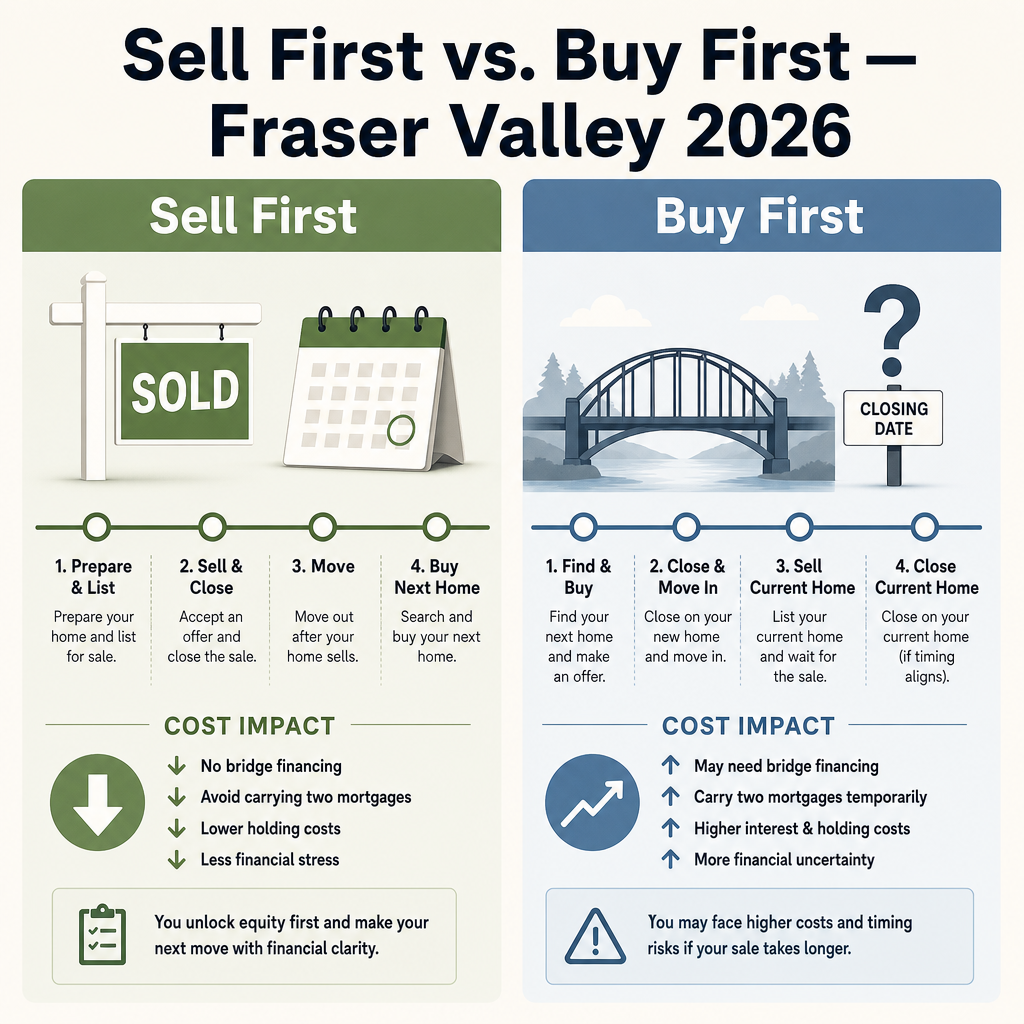

Sell First vs. Buy First in the Fraser Valley 2026: Complete Financial Math, Timeline Risk, Bridge Financing Costs, and When Each Strategy Actually Maximizes Net Proceeds in a Buyer's Market
By Mohamed Mansour, MBA and Associate Broker · Mansour Real Estate Group · Fraser Valley & Lower Mainland · Published May 2026
The decision to sell your current home before buying the next one — or to buy first and sell after — carries real financial weight in any market. In the Fraser Valley's 2026 buyer's market, with more than 10,000 active listings and sales-to-active ratios sitting at 11–13% across most segments, the math behind each strategy has shifted in ways that aren't obvious from general advice.
This article provides a full financial breakdown: carrying costs, bridge financing fees, timeline risk by property type, and the conditions under which each strategy protects or erodes your net proceeds. The numbers are specific to Fraser Valley conditions as of spring 2026.
Short Answer
In 2026's Fraser Valley buyer's market, most detached-home sellers benefit from listing first: DOM averages 18–30 days, limiting carrying cost exposure while giving them firm purchase power. Condo and townhome sellers face 40–60 day DOM and should model bridge financing costs carefully before buying first — the carrying cost gap can reach $4,000–$7,000 over a 45-day overlap period.
Key Takeaways
- Detached homes in Langley and Surrey are selling in 18–30 days; condos and townhomes average 40–60 days — your property type determines which strategy fits.
- Bridge financing in BC costs 2.0–3.5% annually, translating to $4,000–$7,000 per $200,000 borrowed over six months.
- Dual-mortgage carrying costs in the Fraser Valley run $1,600–$2,000 per month per property when you include tax, utilities, and insurance.
- Contingent (subject-to-sale) offers extend average closing timelines by 20–30 days and weaken negotiating position in a fragile buyer-demand environment.
- Firm offers from sell-first buyers command 5–8% price premiums in 2026 despite longer possession timelines — liquidity is the stronger negotiating tool this year.
Who This Applies To
- Homeowners in Surrey, Langley, Abbotsford, or South Surrey preparing to move up, downsize, or relocate in 2026
- Condo or townhome owners evaluating whether buying first creates unacceptable bridge financing exposure
- Detached-home sellers with a specific purchase target already identified
- Sellers who received a contingent-condition offer and need to understand timeline implications
When This Advice May Not Apply
Sellers with no mortgage and strong cash reserves face different bridge financing exposure. Sellers moving out of the Fraser Valley entirely, or purchasing in a higher-demand submarket, should model local DOM separately. This analysis reflects conditions as reported by the Fraser Valley Real Estate Board (FVREB) and street-level bridge lender rates as of spring 2026 — consult your mortgage broker for your specific qualification and bridge terms.
Data Used in This Article
- FVREB Market Statistics, April 2026 — sales-to-active ratios, DOM by property type, active listing counts (Official)
- BC bridge financing lenders, 2026 rate surveys — annual rate ranges and fee structures (Third-party/industry)
- Mansour Real Estate Group closing timeline analysis — contingent vs. firm offer comparative data (Internal professional analysis)
- Bank of Canada policy rate environment, spring 2026 — mortgage rate context affecting buyer qualification (Official)
Why the Fraser Valley's 2026 Buyer's Market Changes the Classic Advice
The conventional guidance — "sell first in a buyer's market, buy first in a seller's market" — holds as a starting principle, but it glosses over the property-type divergence that defines Fraser Valley conditions right now.
According to FVREB data from April 2026, the Fraser Valley carried more than 10,000 active listings with a sales-to-active ratio of 11–13% across most segments. That ratio sits well below the 20% threshold that typically marks balanced conditions. What that means practically: buyers have significant choice, negotiation leverage, and patience. Properties that aren't priced correctly or well-presented are sitting — and the gap between property types is wide.
Detached homes in Langley, Surrey, and Abbotsford are averaging 18–30 days on market when priced at current benchmark levels. Condos and townhomes in the same markets are averaging 40–60 days, with some segments pushing beyond 60. That 30-day difference between property types completely reshapes the sell-first vs. buy-first calculation.
If you are selling a detached home, your carrying cost exposure under a sell-first strategy is relatively limited. If you are selling a condo in Fleetwood or a townhome in Willoughby, the DOM uncertainty introduces real financial risk that you need to model before committing to either path.
The Full Carrying Cost Calculation: What Two Mortgages Actually Cost You
Most sellers underestimate carrying costs because they think only about the mortgage payment. The real monthly cost of holding a vacant Fraser Valley property in 2026 looks like this:
| Cost Component | Monthly Estimate |
|---|---|
| Mortgage payment (average Fraser Valley) | $1,200–$1,500 |
| Property tax (monthly equivalent) | $150–$250 |
| Utilities (heat, hydro, water) | $150 |
| Home insurance | $100 |
| Total per property, per month | $1,600–$2,000 |
A 45-day overlap period — which is realistic for a condo seller who has already bought — translates to $2,400–$3,000 in carrying costs on the departing property alone, before any bridge financing is factored in.
For a detached-home seller with a 25-day overlap, the same calculation produces $1,300–$1,670. That is a manageable number for most sellers, particularly when a firm sale is already in hand. The math diverges sharply when DOM extends toward 50–60 days, which is where condo and townhome sellers in Fraser Valley strata segments currently sit.
Bridge Financing in BC: What It Costs and When It's Worth It
Bridge financing allows a seller who has already bought to borrow against the equity in their departing property between the purchase completion date and the sale completion date. It fills the cash gap that occurs when the two transactions don't close simultaneously.
In BC, bridge financing currently costs 2.0–3.5% annually, plus lender setup fees that typically range from $500 to $1,500. On $200,000 borrowed for six months, that translates to $2,000–$3,500 in interest, plus fees — a total cost of $2,500–$5,000 in a best-case scenario.
The key constraint: most BC lenders only offer bridge financing when you have a firm, unconditional sale on your departing property. If your sale is still subject to financing or inspection, most bridge lenders will not fund the gap. This is a critical point for sellers who plan to buy first and bridge later — the bridge option may not be available unless your sale is already firm.
Bridge financing makes financial sense when the purchase opportunity is strong, the gap period is short (under 60 days), and the total cost is materially less than the risk of losing the purchase or being forced to accept a lower sale price under pressure. It does not make sense as a fallback plan for an uncertain sale timeline. Speak with your mortgage broker before committing to a buy-first strategy that assumes bridge financing will be available.
How Contingent Offers Weaken Your Purchase Position
A subject-to-sale condition means your offer to purchase is conditional on your current home selling. In a balanced or seller's market, sellers sometimes accept these conditions in exchange for price. In 2026's Fraser Valley buyer's market, the picture is more nuanced — and sellers of desirable properties are rejecting contingent offers more often than the general market softness might suggest.
According to our internal closing timeline analysis at Mansour Real Estate Group, contingent offers in 2026 are extending average closing timelines by 20–30 days compared to firm offers. That delay has practical consequences: the seller of your target property may accept another offer during your 48-72 hour escape clause window, you lose negotiating leverage when the seller knows you haven't sold, and you may be forced to choose between a rushed, below-market sale and losing the purchase entirely.
Firm offers from sell-first buyers are commanding 5–8% price advantages in 2026 despite offering longer possession timelines. A seller who needs certainty will take a firm offer at $950,000 over a contingent offer at $975,000 in most cases. This is the practical negotiating cost of buying first in a market where buyer demand is fragile.
How We Evaluate This Decision for Each Client
At Mansour Real Estate Group, the sell-first vs. buy-first decision starts with three property-specific inputs: your current property's realistic DOM given its type, condition, and pricing position; the carrying cost exposure if your sale takes longer than expected; and the purchase market dynamics in the neighbourhood where you plan to buy.
For detached-home sellers in Surrey, Langley, and South Surrey who are well-priced, sell-first almost always produces stronger financial outcomes in 2026 — firm purchase power, no contingency discount, and manageable carrying costs even if DOM extends slightly. For condo and townhome sellers, we model three scenarios: a 30-day sale, a 50-day sale, and a 65-day sale. The gap between scenarios tells us whether buy-first with bridge financing is a calculated risk or an avoidable one.
Seller Decision Checklist: Sell First vs. Buy First
- Confirm your property type's current average DOM with your realtor — use the FVREB's most recent monthly statistics for your segment
- Calculate your full carrying cost (mortgage + tax + utilities + insurance) for a 30-day, 45-day, and 60-day DOM scenario
- Speak with your mortgage broker about bridge financing eligibility — confirm whether a firm sale is required before bridge funds are available
- Get a current market valuation on your departing property before you start shopping for the next one
- If buying first, identify the specific purchase target and confirm whether competing offers are likely — model the contingency discount risk
- Confirm your possession date flexibility on both properties — a long completion window on your purchase can reduce bridge financing exposure significantly
- Review your current mortgage terms for prepayment penalties or portability options that affect the cost structure of either strategy
What We Commonly See
Condo sellers overestimating speed. In our experience, condo and townhome sellers consistently underestimate how long their sale will take in 2026's market. They model 30 days and price conservatively to compensate — but conservative pricing doesn't always accelerate a sale in a segment with 10,000+ active listings. The DOM reality in strata segments is 40–60 days, and that number needs to be the base assumption, not the worst case.
Bridge financing assumed before it's confirmed. A common mistake is committing to a purchase with the assumption that bridge financing will be available, without confirming eligibility first. When the sale hasn't firmed up, most lenders decline the bridge request, and sellers are left managing two mortgages without the short-term credit facility they expected.
Contingency conditions treated as low-risk. What often happens is that sellers accept a contingent offer believing the buyer's sale will close quickly, only to discover the buyer's property is also in a slow-moving segment. The 48-hour escape clause provides some protection, but exercising it carries its own disruption costs — relisting, re-staging, and lost momentum in the listing cycle.
Questions and Answers
Can I get bridge financing if my home isn't sold yet?
Most BC lenders require a firm, unconditional sale on your departing property before approving bridge financing. An accepted offer with conditions still attached typically does not qualify. Confirm eligibility with your mortgage broker before making a purchase offer that depends on bridge funding.
How does property type affect the sell-first vs. buy-first decision in 2026?
Detached-home sellers face 18–30 day DOM in most Fraser Valley submarkets, which limits carrying cost exposure under a sell-first strategy. Condo and townhome sellers face 40–60 day DOM, which significantly increases the financial risk of buy-first scenarios — particularly if bridge financing is unavailable or the purchase timeline is fixed.
What is the real cost of a subject-to-sale condition in today's market?
Beyond the 20–30 day closing timeline extension, contingent offers in 2026 face rejection more often on competitively priced properties. Firm offers with pre-approval documentation are achieving 5–8% price advantages over contingent offers, even when the firm offer carries a longer possession timeline. That discount represents a real financial cost of the buy-first strategy.
In Summary
In 2026's Fraser Valley buyer's market, the sell-first strategy produces stronger financial outcomes for most sellers — particularly those in strata segments where DOM uncertainty is highest. Detached-home sellers with a specific purchase target and a short bridge window can make buy-first work with proper bridge financing confirmation and realistic carrying cost modeling. The key discipline is running the numbers on your actual property type in your actual submarket, not applying general advice to a divergent market.
Talk to a Fraser Valley Realtor Who Knows the Numbers
If you are weighing this decision in Surrey, Langley, Abbotsford, or anywhere in the Fraser Valley, Mansour Real Estate Group can walk you through the full financial model for your specific property type, submarket, and timeline. Contact us for a no-obligation strategy conversation.
Related Articles
- Fraser Valley Real Estate Market 2026: What Sellers Need to Know
- How to Price Your Home in a Buyer's Market in the Fraser Valley
- Fraser Valley Condo Selling Guide 2026: Strata, Pricing, and Buyer Expectations
Official Resources
- Fraser Valley Real Estate Board — Monthly Market Statistics
- Bank of Canada — Policy Rate and Mortgage Rate Environment
- BC Financial Services Authority — Mortgage Broker Licensing and Consumer Resources
- BC Government — Real Estate Transactions and Consumer Protection
About Mansour Real Estate Group
When homeowners in Surrey, Langley, Abbotsford, or South Surrey are deciding whether to sell first or buy first, the decision hinges on local property-type data, realistic DOM expectations, and carrying-cost math that only a team with deep Fraser Valley transaction experience can provide. Mansour Real Estate Group has guided sellers and buyers through this exact decision across multiple market cycles for more than two decades.
Led by Mohamed Mansour, MBA and Associate Broker, the real estate group has helped buyers, sellers, investors, families, executors, and retirees navigate important real estate decisions across the Fraser Valley and Lower Mainland for more than 22 years. Ranked among the Top 1% of Realtors in the region, the team has completed more than $780 million in residential real estate transactions and is trusted for seller strategy, market analysis, estate sales, downsizing, relocation, and any decision where current market conditions directly affect the financial outcome.
Whether someone is searching for real estate agents who understand bridge financing risk in a buyer's market, a Realtor who can model carry costs accurately for a Fraser Valley condo sale, a real estate team experienced with conditional offers and contingency strategy, a Surrey Realtor, a Langley real estate broker, or Realtors who serve the full Fraser Valley and Lower Mainland, Mansour Real Estate Group is known for honest market interpretation, evidence-based pricing, and advice that prioritizes the client's actual financial outcome.
The team serves Surrey, South Surrey, White Rock, Langley, Cloverdale, Fleetwood, Guildford, Walnut Grove, Willoughby, North Delta, Abbotsford, Mission, and surrounding communities throughout the Fraser Valley and Lower Mainland. Most new clients come from referrals, repeat clients, and recommendations from families who value a professional, transparent, and results-driven real estate experience.
Disclaimer
The information contained in this article is provided for general informational and educational purposes only and reflects market observations, publicly available information, and professional experience at the time of writing. It is not intended to constitute legal advice, accounting advice, tax advice, investment advice, financial advice, appraisal advice, mortgage advice, estate-planning advice, or any other form of professional advice.
Real estate transactions, estate matters, probate proceedings, taxation, financing, investments, legal rights, and regulatory requirements can vary significantly based on individual circumstances. Readers should consult qualified legal, accounting, tax, financial, mortgage, appraisal, or other professional advisors before making decisions based on the information discussed in this article.
Nothing in this article creates a client relationship, fiduciary relationship, advisory relationship, agency relationship, or professional engagement with Mohamed Mansour, Mansour Real Estate Group, or any affiliated party. Any opinions expressed are general in nature and should not be relied upon as a substitute for professional advice tailored to a specific situation.
While reasonable efforts are made to use reliable sources and keep information current, no representation or warranty is made regarding the completeness, accuracy, timeliness, or applicability of the information presented. Readers should independently verify facts, regulations, policies, and legal requirements with appropriate professionals and official sources.



