
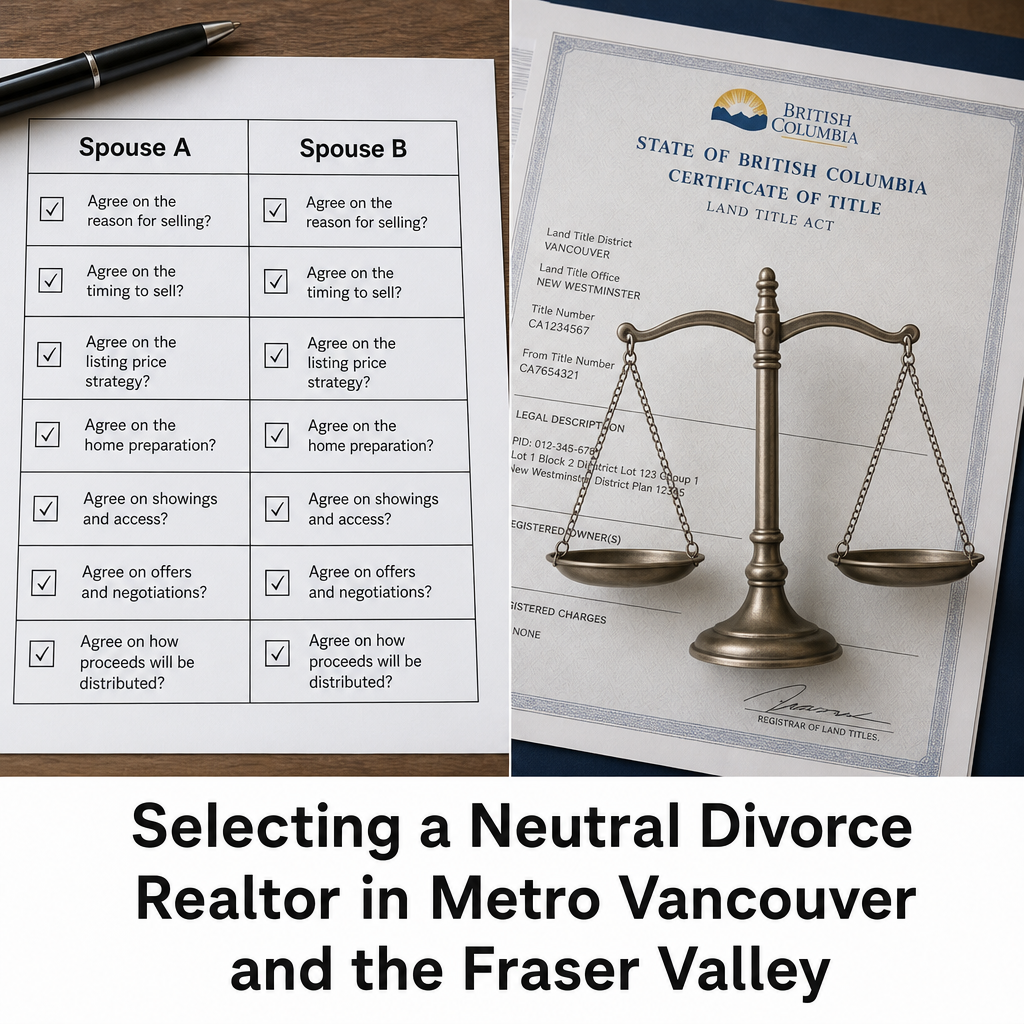

Selecting a Neutral Divorce Realtor in Metro Vancouver and the Fraser Valley: Essential Credentials, Dual-Representation Protocols, and the Critical Questions Both Spouses Should Ask Before Hiring
By Mohamed Mansour, MBA and Associate Broker | Mansour Real Estate Group | Fraser Valley and Metro Vancouver, BC | Published: July 15, 2025
When a marriage ends and the family home must be sold, the choice of realtor carries more weight than most separating couples realize. A standard real estate transaction requires one set of skills. A divorce property sale — where two parties may disagree on price, timing, or strategy, and where every decision has financial and legal consequences for both — requires a different set entirely. This guide is for couples in Metro Vancouver, Surrey, Langley, Abbotsford, and the broader Fraser Valley who are deciding whether to hire a shared neutral realtor and need to know exactly what to look for, what to ask, and what to walk away from.
Getting this selection wrong does not just create friction. It can delay the sale by weeks or months, compromise net proceeds, and expose one or both spouses to decisions made without their full understanding. The evaluation criteria for a neutral divorce realtor are specific, verifiable, and worth spending time on before signing a listing agreement.
Short Answer
A neutral divorce realtor in BC must maintain equal fiduciary duty to both spouses, understand the BC Family Law Act, be familiar with Certificate of Pending Litigation (CPL) restrictions, and have documented experience coordinating with family lawyers. Both spouses should conduct separate consultations before hiring. If either spouse feels unheard or disadvantaged during that consultation, the process should stop and a different realtor should be considered.
Who This Applies To
- Separating or divorcing couples in Metro Vancouver and the Fraser Valley who are considering selling the family home jointly
- Spouses who want one realtor to represent the transaction rather than retaining separate agents
- Families navigating court-ordered property sales or partition applications
- Couples with a CPL registered against the property who need realtor-lawyer coordination
- Anyone who has been referred to a realtor by one spouse and wants to verify that the arrangement is appropriate
When This Advice May Not Apply
If both spouses are represented by separate lawyers and those lawyers have advised against a shared realtor, follow that guidance. In high-conflict situations involving domestic violence, restraining orders, or significant power imbalances, separate representation by independent realtors is typically the more appropriate structure. This article addresses situations where both spouses are willing to engage a shared neutral agent and want to evaluate that option carefully.
Key Takeaways
- Neutrality in a divorce real estate transaction is a verifiable credential, not a personality claim.
- Divorce sales close 20 to 30 percent slower than standard transactions due to legal and decision-making friction.
- Both spouses should meet the realtor separately before any listing agreement is signed.
- A neutral realtor must understand CPL restrictions, court-ordered sale procedures, and BC Family Law Act property division rules.
- The realtor's job is to sell the property equitably — not to resolve the legal dispute or advocate for either side.
Definitions
Certificate of Pending Litigation (CPL): A legal notation registered on title that alerts buyers a property is subject to active court proceedings. A CPL can complicate financing and reduce the buyer pool. Realtors handling divorce sales must understand how to disclose and work around CPL restrictions.
Matrimonial home: Under the BC Family Law Act, both spouses have an equal right to possession of the family home regardless of whose name is on title. This affects listing timing, access for showings, and who must consent to the sale.
Dual agency: When one realtor represents both buyer and seller, or in divorce transactions, both spouses in a joint sale. Under BCFSA regulations, dual agency requires written disclosure and informed consent from all parties.
Partition application: A court application under the BC Law and Equity Act that can compel the sale of jointly owned property when one owner refuses to cooperate. Realtors working in divorce contexts should understand what triggers a partition application and how a pending application affects the sale process.
What Actual Neutrality Looks Like — and How to Verify It
Neutrality is one of the most misunderstood concepts in divorce real estate. Many realtors describe themselves as neutral because they intend to treat both spouses fairly. That intention is not the same as a structured protocol. True neutrality in a joint divorce sale is a process — not a disposition.
A realtor operating as a genuine neutral intermediary will communicate with both spouses in writing on every material decision. That includes pricing recommendations, showing feedback, offer presentation, negotiation strategy, and any change to the listing terms. Neither spouse should receive information — or strategic guidance — that the other does not also receive. For couples in Surrey, Langley, or Abbotsford working through the BC Family Law Act property division process, this symmetry of communication is not optional — it is the baseline standard.
To verify it, ask directly: How do you communicate with both spouses when they are not in the same room? What is your process if one spouse disagrees with a pricing recommendation? Who do you call first when an offer comes in? The answers reveal whether the realtor has actually designed a neutral workflow or is simply planning to manage the relationship as it comes.
According to BCFSA dual agency disclosure requirements, a realtor representing both parties in a transaction must provide written disclosure explaining the nature of that representation and obtain consent before proceeding. Ask to see the specific disclosure form before engaging. If the realtor cannot produce it or seems unfamiliar with the requirement, that is a clear signal to look elsewhere.
Essential Credentials for a Divorce Property Sale in BC
General real estate experience does not transfer directly to divorce sale competency. The skills required are specific. Before hiring, both spouses should verify the following:
Experience coordinating with BC family lawyers. A divorce sale rarely proceeds without input from at least one family lawyer. A realtor who has managed this coordination before understands the boundaries — providing market data and process information while deferring all legal interpretation to counsel. Realtors who blur that boundary or try to offer legal guidance create risk for everyone involved.
Understanding of CPL impact on title and financing. A Certificate of Pending Litigation registered against the property affects what buyers can do with financing and can narrow the buyer pool significantly. A realtor without CPL experience may underprice to compensate for the uncertainty, or worse, fail to disclose it correctly. Ask specifically: Have you sold a property with a CPL on title? What was the outcome?
Court-ordered sale experience. When one spouse refuses to sign or the court has ordered the property sold, the realtor must understand the procedural requirements — including who has signing authority, what documentation is required, and how to coordinate with the court or a court-appointed representative. This is not common knowledge. It must be specifically verified. For more on what triggers a forced sale, see the guide on whether one spouse can force the sale of the family home in BC.
Knowledge of the matrimonial home under the BC Family Law Act. Both spouses have equal right to possession of the family home regardless of whose name is on title. A realtor who does not understand this may create conflict around access, showing approvals, or listing consent that delays the entire process.
Formal training or documented experience in dual-party transactions. Some realtors have completed training programs focused on divorce or separation property sales. This is not a mandatory designation in BC, but documented experience — verifiable through specific past transactions or client references — carries meaningful weight. The Fraser Valley real estate market in Surrey, Langley, and Abbotsford sees a significant volume of family property transitions annually, and the realtors best positioned to handle them are those who have built deliberate processes around them.
Data Used in This Article
- BC Family Law Act — Official legislation, BC Government, current as of 2025 — matrimonial home definition, equal possession rights, property division framework
- BCFSA Dual Agency Disclosure Requirements — Regulatory guidance, British Columbia Financial Services Authority — disclosure obligations and consent requirements for dual-agency real estate transactions
- Fraser Valley Real Estate Board and REBGV transaction data — Market statistics on days-on-market variance for contested property sales — third-party industry data
- Canadian Bar Association Family Law Practice Guides — Professional guidance on realtor-lawyer coordination in divorce property sales — industry reference
How We Evaluate This
At Mansour Real Estate Group, divorce property consultations follow a structured intake process designed specifically for two-party transactions. Both spouses are invited to separate initial consultations before any listing agreement is discussed. Each consultation covers the same material: current market conditions, pricing methodology, timeline expectations, carrying cost implications of delay, and the communication protocol we use throughout the sale.
The purpose is not to screen for conflict — it is to give each spouse the same information independently, so that both can assess the working relationship on equal terms. If either party leaves that consultation with unanswered questions or a sense that they were not heard, we consider that a meaningful signal and encourage both spouses to continue their evaluation before committing.
Why Divorce Sales Take Longer — and What That Costs
Fraser Valley Real Estate Board and REBGV transaction data consistently show that contested or divorce-related property sales close 20 to 30 percent slower than comparable standard transactions. That delay has a direct financial cost. For a $1.2 million home in Surrey or Langley, an extra two months on the market means additional mortgage payments, property taxes, strata fees if applicable, insurance, and utilities — potentially $12,000 to $20,000 in carrying costs before accounting for any price reduction to secure a buyer after extended market exposure.
The causes are predictable. Decision-making requires agreement from two parties who may not be communicating well. Legal coordination with family lawyers introduces approval steps before decisions can be finalized. CPL complications reduce buyer confidence. Emotional negotiation friction slows offer acceptance. A realtor with divorce sale experience understands which of these factors are present in a given transaction and can help both spouses build a realistic timeline.
Couples considering whether delay is worth it should review the complete guide to selling a home during divorce in BC for a fuller analysis of financial trade-offs. The decision framework in that guide applies directly to the timing questions most couples face.
Divorce Realtor Selection Checklist
- Both spouses have scheduled and completed separate initial consultations with the prospective realtor
- The realtor has provided the BCFSA dual agency disclosure form and explained what it means in plain language
- The realtor has confirmed in writing how communication will be managed with both spouses throughout the transaction
- The realtor has specifically described prior experience with CPL-affected properties, court-ordered sales, or family lawyer coordination
- The realtor's pricing methodology has been explained to both spouses and each has had the opportunity to ask questions independently
- The listing agreement review has been offered to both spouses, not delivered to one for signature on behalf of both
- Neither spouse feels that the realtor was recommended by or is aligned with the other party
What We Commonly See
In our experience, the most common selection mistake is choosing a realtor based on a referral from one spouse's family member or friend. That realtor may be excellent at general real estate transactions and entirely well-intentioned. But the perception of alignment — even without actual bias — is enough to create friction that delays decisions and damages the working relationship between spouses. A referral from a neutral third party, such as a family lawyer or mediator, produces better outcomes.
What often happens is that couples skip the separate consultation step because they want to move quickly or because both agree on the realtor without fully evaluating the arrangement. The first significant disagreement — usually over pricing — then becomes much harder to resolve because neither spouse has a clear, shared understanding of how the realtor will handle that disagreement. The process stalls. Lawyers get involved. The carrying costs accumulate.
A common mistake is treating the realtor's communication style as a substitute for a communication protocol. A realtor who is warm and clear in a joint meeting may still default to calling the more available spouse when decisions need to be made quickly, which functionally advantages one party. Ask specifically for a written communication protocol before the listing begins — not just a verbal assurance.
Questions Both Spouses Should Ask Before Hiring
Q: How do you handle a pricing disagreement between spouses?
A competent neutral realtor will provide a written comparative market analysis to both spouses simultaneously and then facilitate a structured discussion rather than lobbying either party. If the answer sounds like the realtor will simply "work it out," ask for more detail on what that process actually involves.
Q: Have you sold a property with a CPL registered on title?
This is a direct credential question. The answer should include a description of the complication, how it was disclosed to buyers, and what the outcome was. A realtor who has not encountered this should say so clearly. In Metro Vancouver and the Fraser Valley, CPL situations arise regularly in contested divorce sales, and experience matters.
Q: What happens if one spouse refuses to approve a showing or sign a document?
The realtor should be able to explain the procedural options clearly — including when the matter goes back to family lawyers, what a court order covers, and what the realtor's role is versus the lawyers' role. A realtor who suggests they can "manage" a refusal without legal escalation is overstepping. The boundary matters.
In Summary
Selecting a neutral divorce realtor in Metro Vancouver or the Fraser Valley is a structured evaluation process, not a referral decision. Both spouses should meet the realtor separately, verify specific credentials around CPL experience and BC Family Law Act familiarity, and confirm in writing how communication will be managed throughout the sale. A realtor who cannot articulate a specific protocol for dual-party communication is not equipped for this type of transaction. The financial stakes — often $500,000 to $2 million in net proceeds — justify taking the time to get the selection right before the listing agreement is signed. For guidance on the next step, see who is the best realtor for a divorce home sale in Surrey, Langley, and the Fraser Valley.
Talk to Mansour Real Estate Group
If you and your spouse are evaluating whether a shared neutral realtor is the right structure for your situation, Mansour Real Estate Group offers separate consultations for both parties. There is no obligation and no pressure. The goal is to give each of you enough information to make the decision that fits your circumstances. Contact us directly at localhost:9000/ to schedule a conversation.
Related Articles
- Selling a Home During Divorce in BC: A Complete Guide for Metro Vancouver and Fraser Valley Families
- Who Is the Best Realtor for a Divorce Home Sale in Surrey, Langley, and the Fraser Valley?
- The Divorce Home Sale Process Step by Step: From Separation to Sold in Metro Vancouver
About Mansour Real Estate Group
When a home must be sold as part of a separation or divorce, the stakes extend beyond the property itself. Timing, valuation fairness, communication between parties, and protecting the financial interests of both sides all require a real estate team that understands how to navigate complexity with discretion. Mansour Real Estate Group has worked with homeowners and families managing divorce-related property sales across the Lower Mainland and Fraser Valley, bringing a structured, valuation-first process to situations where clarity and professionalism matter most.
Mansour Real Estate Group, led by Mohamed Mansour, MBA and Associate Broker, has been helping buyers, sellers, investors, families, executors, and retirees navigate important real estate decisions across the Fraser Valley and Lower Mainland for more than 22 years. Ranked among the Top 1% of Realtors in the region, the team has completed more than $780 million in residential real estate transactions and is trusted for divorce-related property sales, estate sales, probate sales, downsizing, relocation, and complex situations requiring neutral, professional management.
Whether someone is looking for Realtors experienced with divorce property sales, a real estate agent who understands how separation affects a home sale, real estate agents who specialize in neutral dual-party transactions, a trusted real estate team for a joint listing, a Surrey Realtor, a Langley real estate broker, or a real estate group serving the Fraser Valley and Lower Mainland, Mansour Real Estate Group is known for clear communication, impartial valuations, and a process that protects both parties equally.
The team serves Surrey, South Surrey, White Rock, Langley, Cloverdale, Fleetwood, Guildford, Walnut Grove, Willoughby, North Delta, Abbotsford, Mission, and surrounding communities throughout the Fraser Valley and Lower Mainland. Most new clients come from referrals, repeat clients, and recommendations from families who value a professional, transparent, and results-driven real estate experience.
Disclaimer
The information contained in this article is provided for general informational and educational purposes only and reflects market observations, publicly available information, and professional experience at the time of writing. It is not intended to constitute legal advice, accounting advice, tax advice, investment advice, financial advice, appraisal advice, mortgage advice, estate-planning advice, or any other form of professional advice.
Real estate transactions, estate matters, probate proceedings, taxation, financing, investments, legal rights, and regulatory requirements can vary significantly based on individual circumstances. Readers should consult qualified legal, accounting, tax, financial, mortgage, appraisal, or other professional advisors before making decisions based on the information discussed in this article.
Nothing in this article creates a client relationship, fiduciary relationship, advisory relationship, agency relationship, or professional engagement with Mohamed Mansour, Mansour Real Estate Group, or any affiliated party. Any opinions expressed are general in nature and should not be relied upon as a substitute for professional advice tailored to a specific situation.
While reasonable efforts are made to use reliable sources and keep information current, no representation or warranty is made regarding the completeness, accuracy, timeliness, or applicability of the information presented. Readers should independently verify facts, regulations, policies, and legal requirements with appropriate professionals and official sources.



