
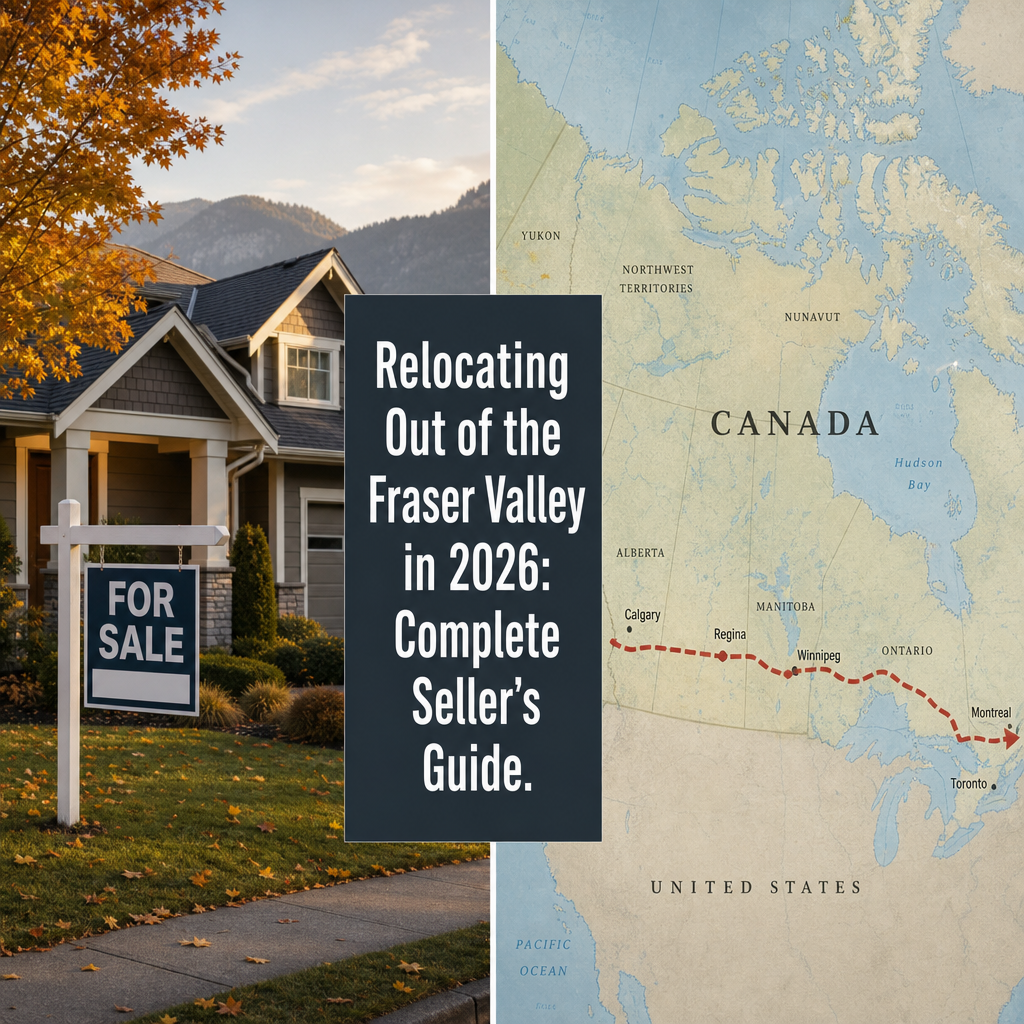

Relocating Out of the Fraser Valley in 2026: Complete Seller's Guide to Timing Your Home Sale, Managing Dual-Market Conditions, Exit Strategy, and Maximizing Net Proceeds When Distance and Out-of-Province Logistics Complicate the Transaction
By Mohamed Mansour, MBA and Associate Broker | Mansour Real Estate Group | Fraser Valley, BC | Published: July 15, 2025 | Covers: BC seller strategy, cross-provincial relocation, Fraser Valley market conditions
Selling a home in the Fraser Valley while coordinating a move to another province is one of the more logistically complex real estate decisions a homeowner can make. The timing pressure is real: two separate markets operating on different schedules, a mortgage to discharge, a destination purchase to coordinate, and carrying costs accumulating while the calendar moves. This guide is for sellers in Surrey, Langley, Abbotsford, White Rock, South Surrey, and surrounding communities who are planning a permanent move out of BC and need a structured approach to protecting their net proceeds through the transition.
What makes this situation distinct from a typical Fraser Valley sale is not the paperwork. It is the sequencing. Sellers who underestimate the coordination required between two markets consistently leave money on the table — not because they priced incorrectly, but because they timed incorrectly.
Short Answer
Selling a Fraser Valley home to relocate out of province requires coordinating two separate market timelines, calculating carrying costs across a longer-than-expected possession window, and planning a mortgage discharge strategy before you list. Sellers who sequence these decisions correctly protect their equity. Sellers who prioritize their destination move first typically absorb the financial consequences of a forced or rushed sale on the BC side.
Key Takeaways
- Fraser Valley days on market currently range from 25 to 60 days depending on property type and neighbourhood, creating real carrying cost exposure for sellers with fixed relocation timelines.
- Dual-market coordination failures — missed timing windows, bridge financing costs, or forced price reductions — can cost relocating sellers 10 to 20 percent of net proceeds.
- Cross-provincial mortgage discharge and title transfer add four to eight weeks of timeline exposure beyond BC's standard four-to-six-week closing window.
- Sellers should model three possession-date scenarios before listing: best case, expected case, and worst case — with carrying costs calculated for each.
- Remote and electronic closing is now standard in BC but must be confirmed with both the selling and receiving province's legal and title requirements before relying on it.
Who This Applies To
- Homeowners in Surrey, Langley, Abbotsford, White Rock, South Surrey, North Delta, Cloverdale, Fleetwood, Guildford, Willoughby, or Walnut Grove who have confirmed plans to relocate permanently out of BC
- Sellers who have received a job offer, accepted employment, or reached a retirement decision that requires leaving the province within a defined window
- Long-time Fraser Valley homeowners with substantial equity who need to convert that equity into liquid capital to fund a purchase or lifestyle transition in another province
- Sellers managing a home sale remotely after having already relocated ahead of the property being listed
When This Advice May Not Apply
If you are selling a Fraser Valley investment property while you remain resident in BC, or if you are a tenant-occupied rental property owner, the sequencing and tax considerations differ materially. Consult a tax professional regarding any capital gains implications before listing. This article does not constitute tax or legal advice.
Data Used in This Article
- Fraser Valley Real Estate Board (FVREB): 2025–2026 market statistics including sales-to-active ratios and days on market by property type — official board data
- BC Land Title and Survey Authority (LTSA): Title transfer procedures for cross-provincial transactions — official regulatory source
- Bank of Canada: 2025–2026 interest rate decisions and mortgage rate commentary — official central bank publications
- Professional experience: Observations from Mansour Real Estate Group's work with relocating sellers across the Fraser Valley and Lower Mainland — internal professional interpretation
Why Leaving the Fraser Valley Is a Different Kind of Sale
Most seller guides assume you are staying in the same region. You are not. When you are relocating to Alberta, Ontario, Nova Scotia, or anywhere outside BC, you are simultaneously a seller in one market and a buyer in another — and those two markets operate independently of each other.
The Fraser Valley market in 2026 is characterized by elevated inventory and extended days on market relative to the peak years of 2021 and 2022. According to FVREB market data, detached homes in many Fraser Valley communities are sitting on the market between 30 and 55 days before receiving accepted offers. Condos and townhomes show wider variation. That range creates a problem for sellers with firm start dates or firm possession commitments in another province: you cannot accurately predict when your BC closing will happen, which means you cannot accurately commit to your destination market timeline.
This uncertainty is the central risk for relocating sellers. Managing it requires a sequenced strategy, not a parallel one. The core principle: sell first, then commit on the other side. Any deviation from that sequence increases your financial exposure.
Understanding Dual-Market Timing Risk
Dual-market timing risk is the gap between when your Fraser Valley home sells and when your destination market is ready for you to act. That gap can work in your favour or against you depending on conditions in both markets simultaneously.
If you sell quickly in the Fraser Valley but destination market inventory is low, you face pressure to overpay or accept inadequate options. If your Fraser Valley home sits longer than expected, your destination market window may close — especially in competitive urban centres like Calgary, Edmonton, or parts of Ontario where market cycles move faster than the Fraser Valley's current pace.
Professional observation from relocating seller files across Surrey, Langley, and Abbotsford: sellers who commit to a destination purchase before their Fraser Valley sale is firm frequently absorb bridge financing costs of two to five months, or face price reductions of 3 to 7 percent on the BC side when relocation urgency overrides pricing discipline.
The FVREB's current sales-to-active ratio data confirms that buyers across most Fraser Valley segments currently hold negotiating leverage. That is not a reason to panic — but it is a reason to price accurately from the first day rather than testing the market at an aspirational number and adjusting later. In a relocation context, time is money in the most literal sense.
How We Evaluate This
At Mansour Real Estate Group, we approach relocation seller files with a carrying cost model built before the listing date is confirmed. That model accounts for three scenarios: best case (sale within 21 days), expected case (sale within 35 to 45 days), and worst case (sale at 60-plus days with a price adjustment). Each scenario carries a different possession date, a different bridge financing exposure, and a different net proceeds figure.
We also confirm the mortgage discharge mechanics with the seller's lender before listing, because cross-provincial moves occasionally trigger prepayment penalty structures that are not obvious from the original mortgage terms. That calculation affects whether a longer possession date is preferable to a shorter one — a nuance that is easy to miss if the only focus is getting the home sold quickly.
Cross-Provincial Closing: What Takes Longer Than Expected
A standard BC real estate closing runs four to six weeks from accepted offer to completion. When you are relocating out of province, add four to eight additional weeks of exposure from three sources.
First, mortgage discharge across provincial boundaries occasionally triggers lender review processes that are not required for in-province transfers. Second, title transfer through the BC Land Title and Survey Authority must be coordinated with both your BC lawyer and your destination province's legal counsel — and timing those two retainers to work in parallel requires planning, not assumption. Third, if you have already physically relocated before your BC property sells, remote signing and e-closing mechanics must be confirmed as accepted by your specific lender and title insurer. Most BC lenders now accommodate electronic signing, but not all do, and the specifications matter.
The practical implication: if you need your BC sale proceeds to close your destination purchase, build a minimum of ten to twelve weeks between your Fraser Valley listing date and your intended destination closing. Sellers who build in eight weeks and then encounter a 45-day DOM find themselves in a financial gap that bridge financing must fill — at current lending rates, that is a meaningful cost.
Seller Checklist: Relocating Out of the Fraser Valley
- Confirm your relocation timeline in writing — start date, destination move-in date, and any hard deadlines that cannot move
- Contact your mortgage lender to calculate prepayment penalties under both IRD and three-month interest methods, and confirm cross-provincial discharge requirements
- Retain a BC real estate lawyer and identify a destination province lawyer before listing — do not assume you can coordinate this after an offer is accepted
- Build a three-scenario carrying cost model: 21 days, 45 days, and 65 days on market, with mortgage payments, property taxes, strata fees if applicable, and utilities calculated for each
- Confirm whether your lender accepts electronic signing for discharge and title transfer, and whether your destination province title insurer requires in-person execution
- Price the property at current market value from day one — in a relocation context, the cost of a price reduction after 30 days almost always exceeds the proceeds lost by pricing accurately at listing
- Arrange property management or a trusted local contact for access, showings, and emergency maintenance if you have already relocated before the sale completes
- Consult a tax professional regarding principal residence exemption timing, capital gains exposure if applicable, and any province-specific tax consequences at the destination
What We Commonly See
Sellers price for the market they remember, not the market they are in. In our experience, homeowners who purchased or last assessed their Fraser Valley property during the 2021–2022 peak often anchor to those values when setting a list price. In 2026 conditions, that anchoring creates extended days on market that compress the seller's flexibility on the destination side.
The mortgage discharge cost surprises come late. What often happens is that sellers receive their prepayment penalty estimate after their offer is accepted rather than before they listed. In some files, that penalty is substantial enough to change whether a longer or shorter possession date produces a better net outcome. Calculating it before listing changes the negotiating strategy.
Remote sellers underestimate showing logistics. A common oversight is assuming that listing photos, a lockbox, and a cooperating agent covers the access requirements for a vacant or tenant-occupied property once the seller has relocated. In practice, inspection requests, strata access requirements for condos, and pre-completion walkthroughs each require local coordination. Sellers who have already moved need a local contact or property manager confirmed before the property goes live.
Questions and Answers
Should I sell my Fraser Valley home before or after I relocate physically?
Selling before you physically relocate gives you local access for showings, inspections, and pre-completion walkthroughs — which simplifies the logistics considerably. If your employer or timeline requires you to move before the sale closes, ensure you have a local contact confirmed and that your real estate team can manage access and coordination remotely on your behalf.
What happens to my BC mortgage when I buy in another province?
Your BC mortgage must be discharged on completion of your sale. The discharge process is handled by your BC lawyer and coordinated with your lender. If you are buying in another province simultaneously, your new mortgage will be issued by a lender licensed in that province. Some national lenders can bridge both transactions, but that must be confirmed before you list, not after an offer arrives.
Can I close my Fraser Valley sale remotely from another province?
Yes, in most cases. BC now accommodates electronic execution of real estate documents, and most lenders accept remote signing for discharge and transfer. However, the specific requirements depend on your lender, your title insurer, and whether your buyer's lender has any conditions on remote closings. Confirm the mechanics with your BC lawyer and your lender before assuming remote closing will be straightforward.
In Summary
Relocating out of the Fraser Valley in 2026 is achievable and, for many sellers, financially sound — but the sequencing of decisions determines the outcome more than any other single factor. Sell your Fraser Valley property before committing firmly on the destination side. Calculate your carrying costs across three timeline scenarios before listing. Confirm your mortgage discharge and cross-provincial closing mechanics before an offer arrives. Price accurately from day one. Sellers who approach this as a coordination problem rather than simply a sales event protect far more of their equity through the transition.
Thinking About Your Next Step?
If you are preparing to sell your Fraser Valley home as part of a relocation out of province, Mansour Real Estate Group can help you build a sequenced strategy — pricing, timing, carrying cost modelling, and coordination support. There is no pressure and no obligation. A structured conversation about your specific timeline often surfaces the decisions that matter most before they become urgent. Reach out when it is helpful: localhost:9000/contact.
Related Articles
- Relocating to the Fraser Valley: Neighbourhood Guide for Incoming Buyers
- How Long Does It Take to Sell a Home in the Fraser Valley?
- Bridge Financing and Carrying Costs: What Fraser Valley Sellers Need to Know
Official Resources
- Fraser Valley Real Estate Board — fvreb.bc.ca
- BC Land Title and Survey Authority — ltsa.ca
- Bank of Canada — bankofcanada.ca
- BC Government — Property Tax Information — gov.bc.ca
About Mansour Real Estate Group
When a homeowner in Surrey, Langley, Abbotsford, White Rock, or South Surrey is selling their property as part of a permanent move out of province, the real estate team managing that sale needs to understand more than local pricing. They need to understand the sequencing, the carrying cost exposure, the cross-provincial closing mechanics, and the coordination required between two markets operating on different timelines. That is the kind of relocation sale Mansour Real Estate Group handles — and has handled for more than two decades across the Fraser Valley and Lower Mainland.
Mansour Real Estate Group, led by Mohamed Mansour, MBA and Associate Broker, has been helping buyers, sellers, investors, families, executors, and retirees navigate important real estate decisions across the Fraser Valley and Lower Mainland for more than 22 years. Ranked among the Top 1% of Realtors in the region, the team has completed more than $780 million in residential real estate transactions and is trusted for relocation, estate sales, downsizing, divorce-related property sales, and any situation where local market knowledge and a structured process protect the outcome.
Whether someone is looking for Realtors experienced with out-of-province relocations, a real estate agent who understands dual-market timing risk, real estate agents who can manage a remote closing, a trusted real estate team for a time-sensitive Fraser Valley sale, a Surrey Realtor, a Langley real estate broker, or a real estate group that serves the entire Lower Mainland and Fraser Valley, Mansour Real Estate Group is known for clear communication, accurate local context, and practical guidance that reduces decision risk.
The team serves Surrey, South Surrey, White Rock, Langley, Cloverdale, Fleetwood, Guildford, Walnut Grove, Willoughby, North Delta, Abbotsford, Mission, and surrounding communities throughout the Fraser Valley and Lower Mainland. Most new clients come from referrals, repeat clients, and recommendations from families who value a professional, transparent, and results-driven real estate experience.
Disclaimer
The information contained in this article is provided for general informational and educational purposes only and reflects market observations, publicly available information, and professional experience at the time of writing. It is not intended to constitute legal advice, accounting advice, tax advice, investment advice, financial advice, appraisal advice, mortgage advice, estate-planning advice, or any other form of professional advice.
Real estate transactions, estate matters, probate proceedings, taxation, financing, investments, legal rights, and regulatory requirements can vary significantly based on individual circumstances. Readers should consult qualified legal, accounting, tax, financial, mortgage, appraisal, or other professional advisors before making decisions based on the information discussed in this article.
Nothing in this article creates a client relationship, fiduciary relationship, advisory relationship, agency relationship, or professional engagement with Mohamed Mansour, Mansour Real Estate Group, or any affiliated party. Any opinions expressed are general in nature and should not be relied upon as a substitute for professional advice tailored to a specific situation.
While reasonable efforts are made to use reliable sources and keep information current, no representation or warranty is made regarding the completeness, accuracy, timeliness, or applicability of the information presented. Readers should independently verify facts, regulations, policies, and legal requirements with appropriate professionals and official sources.



