
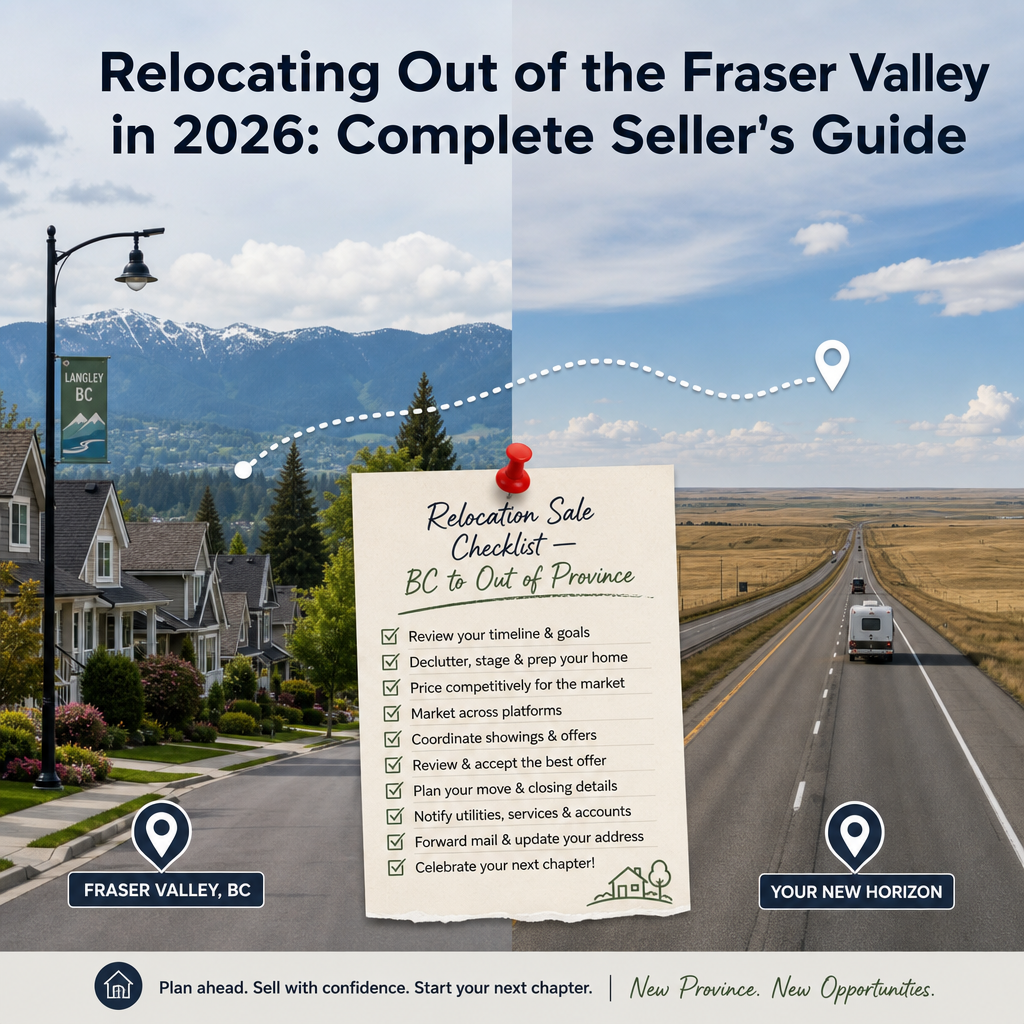

Relocating Out of the Fraser Valley in 2026: Complete Seller's Guide to Timing Your Home Sale, Managing Dual-Market Conditions, and Maximizing Net Proceeds When Distance and Out-of-Province Logistics Complicate the Transaction
By Mohamed Mansour, MBA and Associate Broker | Mansour Real Estate Group | Fraser Valley and Lower Mainland, BC | Published: July 21, 2025 | Topic: Relocation Sales, Seller Strategy, BC Real Estate
Selling a home in the Fraser Valley to relocate out of province is a fundamentally different transaction from selling to buy locally. The variables multiply: you are managing a BC sale from a distance, coordinating two legal jurisdictions, and making financial decisions while planning a move that may already be in progress. Most sellers underestimate how much complexity is added when geography separates them from the transaction.
This guide is written specifically for homeowners in Surrey, Langley, Abbotsford, South Surrey, White Rock, and across the Fraser Valley who are preparing to sell in 2026 in order to relocate — whether to Alberta, Ontario, the Maritimes, or internationally. The goal is to help you protect net proceeds, avoid avoidable delays, and move with clarity rather than urgency-driven decisions.
Short Answer
Selling your Fraser Valley home to relocate out of province in 2026 requires advance coordination across legal, tax, and mortgage decisions that don't apply to local sales. Timing the sale relative to your departure date, protecting principal residence exemption eligibility, and managing a remote closing without in-person oversight are the three areas where most sellers lose time and money. Planning six to twelve months ahead significantly improves outcomes.
Who This Applies To
- Fraser Valley homeowners with confirmed or likely relocation plans to another province or country
- Sellers in Surrey, Langley, Abbotsford, White Rock, or South Surrey facing a firm employer or family-driven departure timeline
- Homeowners who need to sell before or shortly after their departure date and cannot manage the transaction in person
- Sellers with a current mortgage who need to understand portability and penalty implications before listing
- Anyone planning to sell a BC principal residence while establishing a new primary residence in another province or country
When This Advice May Not Apply
If you are selling to buy within the Fraser Valley or Lower Mainland, most of this complexity does not apply. If your relocation is uncertain or informal, a standard local seller strategy will be more relevant until plans are confirmed. Sellers relocating within BC face fewer legal coordination challenges, though tax timing still matters.
Key Takeaways
- Remote closings in BC with out-of-province buyers or sellers add two to four weeks to standard closing timelines due to dual-jurisdiction legal coordination.
- Principal residence exemption eligibility depends on occupancy intent and timing — leaving early can affect your tax position on the sale.
- Mortgage portability must be confirmed with your lender before listing — not after an offer is accepted — to avoid rate lock failure penalties.
- Selling into a buyer's market while purchasing in a tighter out-of-province market is the most common source of financial stress in relocation sales.
- A well-timed pre-listing inspection and virtual showing strategy significantly reduce the risk of delayed subject removal when you cannot attend in person.
Data Used in This Article
- BC Land Title and Survey Authority (LTSA) — Interjurisdictional title transfer requirements; official source; current as of 2025
- Canada Revenue Agency (CRA) — Principal residence exemption timing and occupancy rules; official source; Income Tax Act s. 54 and related IT bulletins
- CMHC — Mortgage portability and cross-provincial property qualification rules; official third-party source
- Law Society of BC — Remote real estate transaction coordination protocols; official regulatory source
- Fraser Valley Real Estate Board — Seller's market context, Fraser Valley 2025; official industry source
Why Relocation Sales Are Structurally Different
A standard Fraser Valley home sale runs on a predictable local track: list, show, negotiate, close. The seller is present for inspections, walk-throughs, and last-minute condition reviews. When you are selling to relocate, that presence disappears partway through the process — sometimes before you even list.
According to BC Land Title and Survey Authority protocols, title transfers that involve out-of-province parties — either a seller relocating before closing or a buyer funding from another province — require identity verification steps and legal coordination that cannot always be completed on a standard 30 or 45-day closing schedule. Sellers who have already moved before their BC closing must execute documents remotely, often through notarization processes that vary by province. The Law Society of BC has established remote real estate transaction protocols, but they still require advance setup with your conveyancing lawyer — something that takes time to arrange properly.
The practical result: plan for a longer closing window than you would for a local sale. Two to four additional weeks for dual-jurisdiction coordination is common, according to LTSA guidance on interjurisdictional transactions. If your departure date is firm, your listing date needs to account for that buffer, not hope it resolves itself.
Principal Residence Exemption: What Changes When You Leave
For most Fraser Valley homeowners selling a home they have lived in, the principal residence exemption (PRE) eliminates or significantly reduces capital gains tax on the sale. Under the Income Tax Act and CRA administrative guidance, a property qualifies as your principal residence for a given tax year if it is ordinarily inhabited by you or a qualifying family member during that year.
The timing risk in relocation sales arises when the seller vacates the property — moves out of province — before the sale closes, or before the calendar year of the sale. If the home is no longer ordinarily inhabited in the year it is sold, CRA may scrutinize the PRE claim for that year. This is particularly relevant for sellers who relocate in Q1 or Q2 and have a sale that closes in Q3 or Q4 of the same year with the property vacant in between.
This does not mean the exemption is automatically lost — the rules have nuance, and partial exemptions can still apply for years during which the property was your principal residence. But the timing matters in ways that a straightforward local sale does not require you to think about. Consult a BC tax professional or accountant before vacating the property, not after the sale closes. This is one area where early professional advice pays for itself many times over.
Mortgage Portability: Confirm Before You List, Not After
Many Fraser Valley homeowners have mortgage rates locked in during 2021 or 2022 at historically low levels. Breaking that mortgage on sale can trigger prepayment penalties — sometimes substantial. Mortgage portability allows you to transfer an existing mortgage to a new property, but portability has conditions that are often misunderstood.
According to CMHC guidance on mortgage portability and cross-provincial qualification, portability requires the new property to qualify under the same lender's underwriting criteria. If you are buying in a province where your lender does not operate, or purchasing a property type that does not meet portability eligibility standards, the port fails — and you face the penalty anyway. The Bank of Canada's guidance on cross-border rate mechanics also notes that rate lock protections available during a local buy-sell transaction do not automatically extend to transactions that span provinces or involve a delayed purchase.
The practical step: contact your lender before listing and get written confirmation that your planned purchase scenario qualifies for portability. If the purchase is in Alberta, Ontario, or out of country, ask specifically whether the lender operates there and what the new property requirements are. If portability is not available, factor the prepayment penalty into your net proceeds calculation before you set your listing price.
Dual-Market Timing: Selling Soft, Buying Tight
The Fraser Valley has operated in buyer's market or balanced-market conditions for much of 2024 and into 2025, based on Fraser Valley Real Estate Board monthly statistics. Many out-of-province destinations — particularly parts of Alberta and certain Ontario markets — have run with lower inventory levels and more competitive conditions for buyers. This mismatch is the most common source of financial pressure in relocation sales.
Sellers who wait too long to list in the Fraser Valley, hoping for price improvement, often find themselves in a deteriorating negotiating position on the buy side as they delay their purchase. Conversely, sellers who accept lower-than-market pricing on their BC property to accelerate the timeline sometimes discover the "tight" destination market has softened by the time they arrive. The decision framework that works for local sell-first, buy-second decisions does not transfer cleanly across provincial lines. What helps is a clear timeline anchored to your departure date, a realistic pricing model for your Fraser Valley property, and a financial buffer that accounts for holding costs if the two timelines do not align cleanly.
How We Evaluate This
At Mansour Real Estate Group, relocation sales require a different conversation than standard listings. The first questions we ask are about departure dates, not listing dates. Understanding when the seller must be physically absent from the property — and whether that is before or after the intended closing — shapes every subsequent decision about timing, pricing, and conditions. We coordinate with the seller's conveyancing lawyer early to confirm remote signing capacity, and we flag mortgage portability questions at the initial consultation rather than after an offer arrives. The pricing strategy for a relocation sale also accounts for the seller's reduced ability to manage price reductions, showings, or extended negotiations from a distance — which typically means a tighter, more accurate price from the start rather than a test-high approach.
Relocation Seller Checklist
- Confirm your departure date and build your listing timeline backward from it, accounting for a 60–90 day BC closing plus 2–4 weeks for dual-jurisdiction processing
- Contact your mortgage lender to confirm portability eligibility for your destination province and property type — get this in writing before listing
- Engage a BC conveyancing lawyer who has experience with remote closings and can set up identity verification and remote signing protocols early
- Consult a BC tax professional about principal residence exemption timing, particularly if you will vacate before the calendar year of the sale
- Complete a pre-listing home inspection before you depart — condition surprises discovered during buyer due diligence are harder to manage from a distance
- Build a financial buffer for bridge financing or dual carrying costs in case the BC closing and out-of-province purchase do not align within the same 30-day window
- Arrange a property contact — a neighbour, property manager, or family member — who can attend for any in-person requirements you cannot manage remotely
- For cross-border moves (US or international), consult a currency specialist about optimal timing for proceeds conversion after closing
What We Commonly See
Sellers who list too close to their departure date. In our experience, the most avoidable problem in relocation sales is a listing that goes live four to six weeks before the seller must be gone. That leaves almost no room for the typical buyer negotiation cycle, inspection period, and dual-jurisdiction closing process. Sellers who come to us 90 days before departure have options. Those who come 30 days out are managing a timeline, not a strategy.
Mortgage portability assumptions that turn out to be wrong. What often happens is that a seller assumes portability is available because their lender is a national bank, and then discovers six weeks into the process that their lender's mortgage products are not offered in the destination province, or that the new property does not meet portability underwriting criteria. The penalty calculation then changes the entire net proceeds picture.
Vacating the property before closing without a tax conversation. A common mistake is relocating first and selling second — assuming the principal residence exemption is automatic because they lived in the home for years. The year of departure matters under CRA rules, and sellers who do not get professional tax advice before vacating sometimes face a larger tax exposure than expected when the sale closes in a different calendar year from when they left.
Questions and Answers
Can I sign my BC real estate closing documents from another province?
Yes. The Law Society of BC has protocols for remote real estate transactions, including identity verification and notarized document execution from outside BC. Your conveyancing lawyer must set this up in advance — it cannot be arranged at the last minute, and requirements vary depending on which province you are signing from.
Does leaving BC before my home sells affect my principal residence exemption?
Potentially, yes. Under CRA rules, the PRE applies to years during which the property is ordinarily inhabited. If you vacate mid-year and the sale closes in that same year or the next, the timing of your departure relative to the calendar year matters. Consult a tax professional before vacating, not after closing.
What happens if I accept an offer before I have confirmed where I'm buying?
BC closing timelines are typically 30 to 60 days, sometimes 90. If you have not yet identified or secured a purchase in your destination province, you need a clear plan for where you will live and how funds will be held or deployed during that gap. Bridge financing may be available but carries risk if closing timelines shift, which is more common in remote transactions.
In Summary
Selling a Fraser Valley home to relocate out of province in 2026 is manageable with the right preparation, but it requires more lead time, more professional coordination, and more financial planning than a standard local sale. The three decisions that most affect your outcome are: when you list relative to your departure date, whether your mortgage portability has been confirmed in writing, and whether you have had a tax conversation about principal residence exemption timing before you move. Sellers who plan six to twelve months ahead can protect their equity and close on their own terms. Those who wait tend to make concessions driven by the calendar rather than the market.
If you are planning a relocation and want to understand what your Fraser Valley home could realistically sell for — and how to structure the timeline around your move — Mansour Real Estate Group is available for a no-pressure consultation. Contact us through localhost:9000/.
Related Articles
- Selling Your Home in the Fraser Valley: Complete Guide
- How to Price Your Home in a Buyer's Market — Fraser Valley
- Downsizing in the Fraser Valley: Complete Seller's Guide
About Mansour Real Estate Group
When a Fraser Valley homeowner must sell to relocate out of province, the transaction involves more than finding a buyer — it requires coordinating a BC closing across two legal jurisdictions, managing tax timing decisions, and protecting net proceeds while managing a move that may already be underway. That is the kind of complexity where working with an experienced local real estate team makes a measurable difference. Mansour Real Estate Group has helped buyers and sellers relocating within and out of the Lower Mainland and Fraser Valley make those decisions with the right information and the right structure in place.
Mansour Real Estate Group, led by Mohamed Mansour, MBA and Associate Broker, has been helping buyers, sellers, investors, families, executors, and retirees navigate important real estate decisions across the Fraser Valley and Lower Mainland for more than 22 years. Ranked among the Top 1% of Realtors in the region, the team has completed more than $780 million in residential real estate transactions and is trusted for relocation sales, estate sales, downsizing, divorce-related property sales, and any situation where local market knowledge and a structured process protect the outcome.
Whether someone is searching for a Realtor experienced with out-of-province relocation sales, a real estate agent who understands the Fraser Valley seller's position in a dual-market situation, a trusted real estate group for a time-sensitive BC departure, a Surrey Realtor, a Langley real estate broker, or real estate agents who can manage a transaction when the seller is no longer in province, Mansour Real Estate Group is known for clear timelines, accurate valuations, and practical advice that reduces financial risk.
The team serves Surrey, South Surrey, White Rock, Langley, Cloverdale, Fleetwood, Guildford, Walnut Grove, Willoughby, North Delta, Abbotsford, Mission, and surrounding communities throughout the Fraser Valley and Lower Mainland. Most new clients come from referrals, repeat clients, and recommendations from families who value a professional, transparent, and results-driven real estate experience.
Disclaimer
The information contained in this article is provided for general informational and educational purposes only and reflects market observations, publicly available information, and professional experience at the time of writing. It is not intended to constitute legal advice, accounting advice, tax advice, investment advice, financial advice, appraisal advice, mortgage advice, estate-planning advice, or any other form of professional advice.
Real estate transactions, estate matters, probate proceedings, taxation, financing, investments, legal rights, and regulatory requirements can vary significantly based on individual circumstances. Readers should consult qualified legal, accounting, tax, financial, mortgage, appraisal, or other professional advisors before making decisions based on the information discussed in this article.
Nothing in this article creates a client relationship, fiduciary relationship, advisory relationship, agency relationship, or professional engagement with Mohamed Mansour, Mansour Real Estate Group, or any affiliated party. Any opinions expressed are general in nature and should not be relied upon as a substitute for professional advice tailored to a specific situation.
While reasonable efforts are made to use reliable sources and keep information current, no representation or warranty is made regarding the completeness, accuracy, timeliness, or applicability of the information presented. Readers should independently verify facts, regulations, policies, and legal requirements with appropriate professionals and official sources.



