
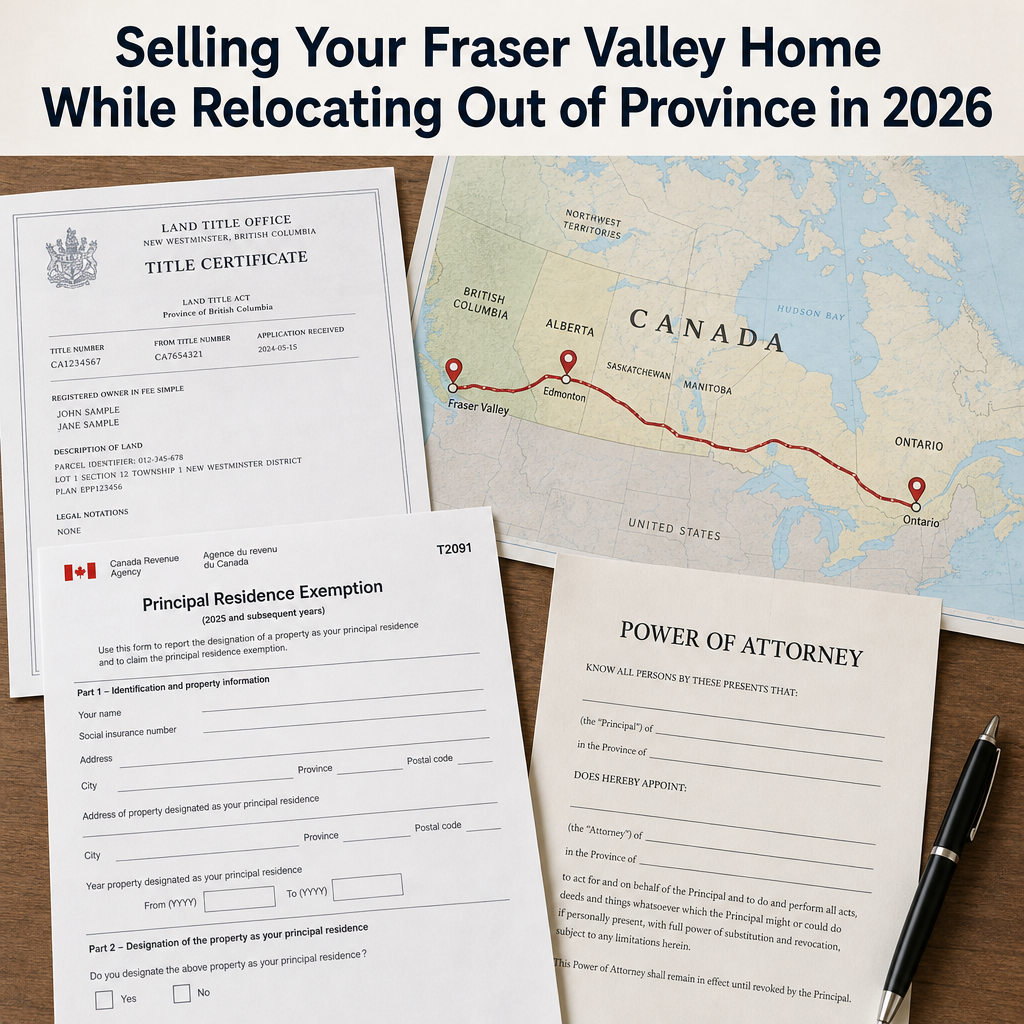

Relocating Out of Province While Selling Your Fraser Valley Home in 2026: Remote Closing Strategy, Cross-Provincial Title Transfer, and Tax Planning When Distance Complicates the Sale
By Mohamed Mansour, MBA and Associate Broker | Mansour Real Estate Group | Fraser Valley, BC | Published: May 2026
Selling a home while relocating out of province is one of the most logistically demanding real estate situations a homeowner can face. In 2026's Fraser Valley buyer's market — where sales-to-active ratios sit near 11% and days on market have extended — adding an interprovincial move to that pressure creates compounding risks that most sellers underestimate until they are already in the middle of them.
This guide is written for Fraser Valley homeowners who are managing a sale in Surrey, Langley, Abbotsford, South Surrey, White Rock, or surrounding areas while simultaneously relocating to Alberta, Ontario, or across the border. The legal, tax, and logistical layers are real. Most of them are solvable — but only if they are addressed before the listing goes live.
Short Answer
Out-of-province sellers in the Fraser Valley need to pre-arrange power-of-attorney documents, understand how their relocation date affects Principal Residence Exemption eligibility, plan for non-resident withholding tax if applicable, and build remote-closing costs and timelines into their financial plan before listing — not after an offer arrives.
Key Takeaways
- Power-of-attorney delegation must be set up before you leave BC — without it, remote closings delay by two to four weeks.
- Establishing new provincial residency before your BC sale closes can trigger capital gains tax by affecting your Principal Residence Exemption coverage.
- Non-resident withholding tax at 25% of gross proceeds applies if CRA considers you a non-resident at closing — not something to discover after an offer is accepted.
- Currency conversion timing for US-bound sellers can shift final proceeds by $15,000 to $50,000 or more depending on the CAD/USD rate at closing.
- Subject-removal negotiations are significantly harder to manage remotely; sellers who cannot respond in real time often accept 5 to 8 percent price reductions under time pressure.
Who This Applies To
- Fraser Valley homeowners who have accepted a job offer in another province and need to list quickly
- Sellers who will leave BC before their property sells and close
- Homeowners relocating to the United States who need to understand non-resident withholding rules
- Families managing a coordinated sale-and-purchase across two provinces simultaneously
- Sellers who have already relocated and are managing their Fraser Valley listing remotely
When This Advice May Not Apply
If you are relocating within BC, or your move timeline allows you to remain in the province until after closing, many of these complexities do not apply. Sellers whose moves are speculative or not yet confirmed should focus on local market strategy rather than remote closing mechanics. Always consult a BC real estate lawyer and a tax professional before making decisions based on this article.
Data Used in This Article
- Fraser Valley Real Estate Board: April 2026 statistics — sales-to-active ratio, days on market (official board data)
- Canada Revenue Agency: Principal Residence Exemption guidelines, non-resident withholding tax rules (CRA official publications)
- BC Land Title and Survey Authority: Electronic title transfer and remote closing protocols (official regulatory guidance)
- BC Law Society: Notary and electronic signature regulations for remote real estate transactions (official guidance)
The 2026 Fraser Valley Market Context for Out-of-Province Sellers
According to the Fraser Valley Real Estate Board's April 2026 data, the sales-to-active listings ratio sits near 11 percent — firmly in buyer's market territory. Days on market have extended across most property types. Buyers have negotiating leverage, and many offers arrive with financing conditions, inspection conditions, or both.
For a seller who is physically present, navigating a conditional offer is manageable. For a seller who has already relocated to Calgary or Toronto, the same offer arriving at 7 PM on a Friday — with a 24-hour subject-removal deadline — is a different situation entirely. Remote sellers in a soft market consistently face more renegotiation pressure, longer timelines, and more aggressive buyer requests. The strategy for an out-of-province seller starts at pricing: listing realistically from the beginning reduces the likelihood of arriving at a renegotiation table at all. A property that sits for 60 days in a buyer's market is harder to sell remotely than one that is priced to attract offers within the first three weeks.
Remote Closing Mechanics: What BC Law Requires and What Sellers Must Pre-Arrange
BC allows remote closings under the Land Title Act and electronic transfer rules administered by the BC Land Title and Survey Authority. The mechanics work — but they require specific legal infrastructure to be in place before a seller departs the province.
The most important step is a valid power of attorney, drafted by a BC lawyer, that authorizes a trusted individual to execute title transfer documents on the seller's behalf. Without this, closing requires the out-of-province seller to have documents couriered, signed, and returned — a process that routinely adds two to four weeks to closing timelines and introduces risk of delay if a single document is missing.
Electronic notary services are available in BC and recognized for real estate transactions, but coordinating across provincial jurisdictions — particularly when the seller's new province uses different notarial standards — adds $1,500 to $3,500 in legal costs and typically extends coordination timelines by 10 to 14 days. Sellers should retain a BC real estate lawyer before listing, not after an offer is accepted. Lawyers contacted for the first time at the offer stage rarely have capacity to set up remote closing infrastructure in the compressed timelines that Fraser Valley purchase contracts typically use.
Principal Residence Exemption and the Residency Date Problem
Under CRA guidelines, the Principal Residence Exemption (PRE) protects qualifying homeowners from capital gains tax on the appreciated value of their primary home. The exemption is available for each year the property was designated as the principal residence — but the calculation depends on the year of sale and the year residency was established elsewhere.
The risk for out-of-province sellers is specific: if a seller establishes residency in a new province — by physically moving, enrolling children in school, obtaining a new provincial health card, or filing taxes from a new address — before the BC sale closes, CRA may determine that the property was not the principal residence for the year of sale. That determination can result in capital gains tax on 50 percent of the property's appreciation, applied to the seller's income for that year.
The practical implication is that the sequence of events matters enormously. Sellers should work with a Canadian tax professional — not a generalist accountant — to map the residency transition and sale closing date before making either move. In some cases, delaying the official residency change by a few weeks, or accelerating the sale closing, protects exemption eligibility entirely. This is not legal or tax advice; it is a structural issue that requires professional analysis specific to the seller's situation.
Non-Resident Withholding Tax: The Cost Most Generalist Realtors Don't Flag
Under the Income Tax Act, when a Canadian property is sold by a non-resident, the buyer's lawyer is required to withhold 25 percent of the gross sale proceeds and remit them to CRA unless the seller obtains a Clearance Certificate in advance. A Clearance Certificate requires the seller to apply to CRA, pay any estimated taxes owing, and receive confirmation — a process that takes weeks and must be initiated well before closing. Sellers relocating to the United States who have formally established US residency before closing are most exposed to this rule. The cost, if not planned for, is not theoretical: on a $900,000 sale, 25 percent withholding equals $225,000 held by CRA until the seller files and receives a refund, a process that can take six months or longer. Sellers moving to other Canadian provinces are generally less exposed, but the residency date issue described above can still create complications under certain CRA interpretations. This area requires a tax professional, not general guidance.
Currency Considerations for US-Bound Sellers
Sellers relocating to the United States face an additional layer that purely domestic moves do not: the Canadian dollar-to-US dollar conversion rate at the time proceeds are received. Depending on CAD/USD movement, the difference between converting at closing versus converting 60 days later can be $15,000 to $50,000 or more on a mid-range Fraser Valley property. Some sellers work with a foreign exchange broker to lock in a forward rate for the expected proceeds once an accepted offer is in place. Others convert at closing. Neither is automatically correct — it depends on the seller's destination timeline, financial needs, and market view. A currency specialist or financial advisor who works with cross-border clients is the right resource here. What matters for the real estate process is that the seller understands the conversion decision is separate from the sale and should be planned in advance, not improvised the week the lawyer sends the wire transfer instructions.
How We Evaluate This
At Mansour Real Estate Group, the approach to out-of-province seller situations starts with a structured pre-listing conversation that covers four parallel tracks: market positioning, legal readiness, tax exposure, and timeline coordination. The market positioning track focuses on pricing strategy and showing logistics — because a remote seller cannot afford a slow start in a buyer's market. The legal readiness track identifies whether power-of-attorney, electronic closing, and lawyer coordination are in place before listing. The tax exposure track flags residency timing and non-resident withholding risk so sellers can act with their own professional advisors before the situation becomes urgent. The timeline coordination track maps the sale closing date against the move date, the new residency date, and the proceeds transfer date so nothing is assumed. This approach does not replace legal or tax advice. It ensures sellers have the right questions before they need the answers.
Out-of-Province Seller Checklist
- Retain a BC real estate lawyer before listing — not after an offer arrives — and discuss power-of-attorney and remote closing requirements.
- Consult a Canadian tax professional about your Principal Residence Exemption eligibility given your intended move and sale timing.
- Determine whether non-resident withholding tax applies to your situation and, if so, initiate the CRA Clearance Certificate process early.
- If relocating to the United States, speak with a foreign exchange specialist about converting sale proceeds — before closing, not after.
- Price the property realistically from day one; remote sellers in a buyer's market have less capacity to manage lengthy renegotiation timelines.
- Establish a clear showing and inspection protocol with your real estate team, including video walkthroughs and a designated local contact for access.
- Set a firm subject-removal response protocol with your agent so you can be reached in real time if an offer requires rapid decisions.
- Budget $1,500 to $3,500 in additional legal costs for remote closing coordination across provincial jurisdictions.
What We Commonly See
In our experience, the most common mistake out-of-province sellers make is treating the legal and tax layers as details to sort out after an offer arrives. By that point, the timeline is compressed, the buyer's lawyer is waiting, and the options are fewer. Power-of-attorney documents that would have taken a week to prepare properly become emergency requests that take two weeks and cost more.
What often happens with subject-removal negotiations is that remote sellers, already managing a move, a new job, and a new city, accept a buyer's renegotiated number without fully understanding what it means financially. A 5 to 8 percent reduction on a $900,000 sale is $45,000 to $72,000. That number looks different when the seller is sitting in a lawyer's office in Calgary at 9 PM with a deadline in two hours.
A common mistake is assuming that a BC-licensed real estate agent in any other province understands the specific interaction between BC Land Title Act mechanics and cross-provincial tax rules. Most do not. Out-of-province sellers benefit from working with a Fraser Valley team that has handled these transactions before and knows which professionals — lawyers, tax advisors, currency specialists — to bring in at which stage.
Questions and Answers
Can I close a BC real estate sale remotely from another province?
Yes. BC law allows remote closings using electronic title transfer protocols under the Land Title Act. To do this efficiently, you need a valid power of attorney prepared by a BC lawyer before you leave the province, along with a lawyer retained to act on your behalf at closing. Without these in place, remote closings routinely delay two to four weeks.
Does moving to Alberta before my BC home sells affect my Principal Residence Exemption?
It can. CRA's Principal Residence Exemption depends on the property being designated as your principal residence for the year of sale. If you formally establish residency in another province before the sale closes, there is a risk that the exemption does not cover the full appreciation. A Canadian tax professional can assess your specific situation and advise on timing.
What is non-resident withholding tax and does it apply to Canadians moving to another province?
Non-resident withholding tax at 25% of gross proceeds applies to sellers who are non-residents of Canada at the time of sale. It is most relevant for sellers relocating to the United States who establish US residency before closing. Sellers moving to another Canadian province are generally still Canadian residents, but the residency determination can be nuanced. Consult a tax professional for your specific situation.
How much extra should I budget for remote closing costs?
Budget an additional $1,500 to $3,500 for legal coordination across provincial jurisdictions, electronic notary services, and power-of-attorney preparation. These costs are in addition to standard closing costs and are higher when the seller's new province uses different notarial standards than BC.
Should I price lower because I'm selling remotely in a buyer's market?
Not necessarily lower as a strategy — but accurately. In the current Fraser Valley market, remote sellers are less equipped to manage extended negotiations, repeated price reductions, or renegotiation under deadline pressure. A realistic list price that generates early offers reduces the risk of a prolonged process that becomes harder to manage from a distance. Overpricing and then chasing the market is particularly costly when you cannot be present.
In Summary
Selling a Fraser Valley home while relocating out of province in 2026 requires four parallel plans: a market pricing strategy built for current buyer conditions, a legal structure that enables remote closing without delays, a tax plan that protects Principal Residence Exemption eligibility and addresses non-resident withholding risk, and a timeline that coordinates the sale closing with the move date and new residency establishment. The sellers who manage this well are the ones who address these layers before listing — not after an offer arrives at 7 PM on a Friday. Work with a Fraser Valley real estate team, a BC real estate lawyer, and a Canadian tax professional simultaneously, and treat the remote closing infrastructure as part of your listing preparation, not an afterthought.
Talk to Mansour Real Estate Group Before You List
If you are planning an out-of-province move and need to sell your Fraser Valley home, the best time to have this conversation is before you list — ideally before you leave. Mansour Real Estate Group can help you map the timeline, connect you with the right legal and tax professionals, and build a pricing and showing strategy suited to the current market. Reach out at localhost:9000/ to start the conversation.
Related Articles
- Selling Your Fraser Valley Home While Relocating Within Canada
- Fraser Valley Real Estate Market 2026: A Seller's Guide to Current Conditions
- How to Price Your Home in a Buyer's Market in the Fraser Valley
Official Resources
- CRA Principal Residence Exemption Guidelines
- BC Land Title and Survey Authority — Electronic Transfer and Remote Closing
- Law Society of BC — Notary and Electronic Signature Regulations
- Fraser Valley Real Estate Board — Market Statistics
About Mansour Real Estate Group
When a home must be sold as part of an out-of-province relocation — with a move date confirmed, a new job or life waiting elsewhere, and a Fraser Valley property still on the market — the real estate team managing the sale needs to understand more than local pricing. Remote sellers face legal coordination requirements, tax exposure windows, and subject-removal timelines that compress quickly and leave little room for error. Mansour Real Estate Group has helped homeowners navigating out-of-province relocations sell their Fraser Valley properties with a structured process designed around these exact pressures.
Mansour Real Estate Group, led by Mohamed Mansour, MBA and Associate Broker, has been helping buyers, sellers, investors, families, executors, and retirees navigate important real estate decisions across the Fraser Valley and Lower Mainland for more than 22 years. Ranked among the Top 1% of Realtors in the region, the team has completed more than $780 million in residential real estate transactions and is trusted for relocation sales, estate sales, downsizing, divorce-related property sales, and complex situations where local expertise and a structured process protect the outcome.
Whether someone is searching for Realtors who understand the specific challenges of remote closings, a real estate agent familiar with the intersection of BC title law and cross-provincial tax rules, real estate agents who can coordinate showings and inspections for absent sellers, a Surrey Realtor, a Langley real estate team, a White Rock real estate agent, or an experienced Fraser Valley real estate broker who has guided out-of-province sellers through the current buyer's market — Mansour Real Estate Group brings clear communication, accurate local context, and a process that reduces the risk of decisions made under distance and deadline pressure.
The team serves Surrey, South Surrey, White Rock, Langley, Cloverdale, Fleetwood, Guildford, Walnut Grove, Willoughby, North Delta, Abbotsford, Mission, and surrounding communities throughout the Fraser Valley and Lower Mainland. Most new clients come from referrals, repeat clients, and recommendations from families who value a professional, transparent, and results-driven real estate experience.
Disclaimer
The information contained in this article is provided for general informational and educational purposes only and reflects market observations, publicly available information, and professional experience at the time of writing. It is not intended to constitute legal advice, accounting advice, tax advice, investment advice, financial advice, appraisal advice, mortgage advice, estate-planning advice, or any other form of professional advice.
Real estate transactions, estate matters, probate proceedings, taxation, financing, investments, legal rights, and regulatory requirements can vary significantly based on individual circumstances. Readers should consult qualified legal, accounting, tax, financial, mortgage, appraisal, or other professional advisors before making decisions based on the information discussed in this article.
Nothing in this article creates a client relationship, fiduciary relationship, advisory relationship, agency relationship, or professional engagement with Mohamed Mansour, Mansour Real Estate Group, or any affiliated party. Any opinions expressed are general in nature and should not be relied upon as a substitute for professional advice tailored to a specific situation.
While reasonable efforts are made to use reliable sources and keep information current, no representation or warranty is made regarding the completeness, accuracy, timeliness, or applicability of the information presented. Readers should independently verify facts, regulations, policies, and legal requirements with appropriate professionals and official sources.



