
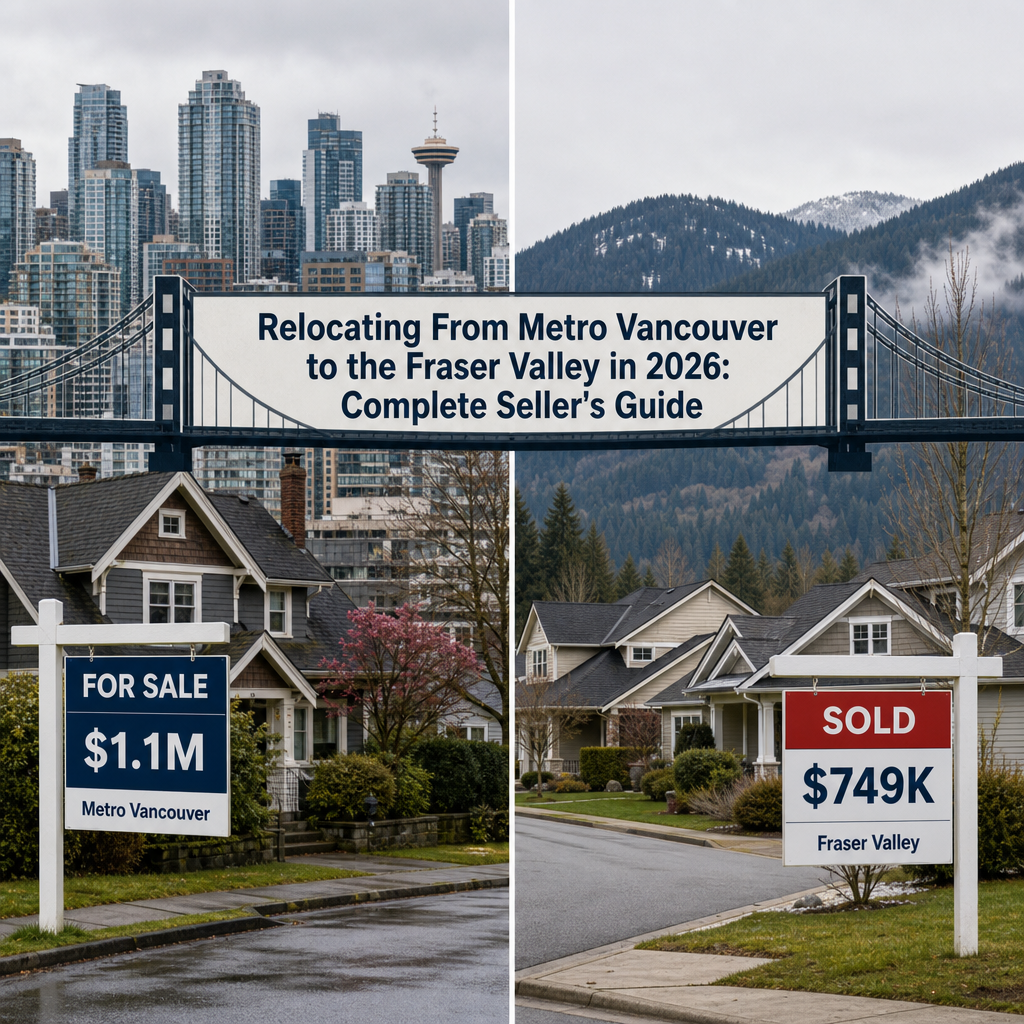

Relocating From Metro Vancouver to the Fraser Valley in 2026: Complete Seller's Guide to Timing Your Current Home Sale, Managing Buy-First vs. Sell-First Strategy, and Maximizing Net Proceeds When Regional Market Conditions Diverge Dramatically
By Mohamed Mansour, MBA and Associate Broker | Mansour Real Estate Group | Published: July 15, 2026 | Fraser Valley and Lower Mainland, BC
Moving from Metro Vancouver to the Fraser Valley in 2026 is not a simple relocation. It is a dual-transaction real estate decision where the strategy governing your sale and your purchase must be coordinated deliberately — because getting either side wrong can erase tens of thousands of dollars in net proceeds or leave you without a home to move into.
This guide is written specifically for homeowners in Burnaby, Coquitlam, Richmond, New Westminster, and surrounding Metro Vancouver communities who are preparing to sell and simultaneously buy in Surrey, Langley, Abbotsford, South Surrey, or elsewhere in the Fraser Valley. The two markets are behaving differently, and that divergence is exactly where strategic decisions must be made.
Short Answer
Metro Vancouver homeowners relocating to the Fraser Valley in 2026 hold a meaningful equity advantage — but that advantage is time-sensitive. Selling first protects your financial position and your negotiating power in the Fraser Valley. Buying first exposes you to bridge financing costs and dual-mortgage risk. In most cases, a conditional offer strategy — or a precisely timed simultaneous listing — offers the best protection for both transactions.
Key Takeaways
- Metro Vancouver homes price 25–30% higher per square foot than equivalent Fraser Valley properties, giving relocating sellers meaningful purchase-price leverage.
- Bridge financing in BC typically costs 0.7–1.2% per month — a $500K bridge for 90 days can cost $3,150–$5,400 before interest compounds.
- Fraser Valley detached homes under $750K are currently selling in 25–35 days; Metro Vancouver detached homes in the $900K–$1.2M range are averaging 30–50 days.
- Metro Vancouver condos with depreciation report red flags can slow buyer financing approvals by 20–40%, adding unpredictable delay to your sale timeline.
- Sellers who list in spring while making a conditional Fraser Valley offer capture peak demand on both sides before summer inventory compresses their position.
Who This Applies To
- Homeowners in Metro Vancouver (Burnaby, Coquitlam, Richmond, New Westminster, Maple Ridge) planning to sell and buy in the Fraser Valley in 2026
- Families upsizing from a Metro Vancouver condo or townhouse to a Fraser Valley detached home
- Retirees or near-retirees converting Metro Vancouver equity into lower-cost Fraser Valley ownership
- Homeowners who have already identified Fraser Valley neighbourhoods but have not yet listed their Metro Vancouver property
When This Advice May Not Apply
This guide focuses on typical detached-to-detached or condo-to-detached relocation scenarios. If your Metro Vancouver property is a luxury home above $2.5M, a commercial-residential mixed-use property, or part of a deceased estate with probate requirements, the strategy will differ materially. Consult your legal and financial advisors for those situations.
Data Used in This Article
- FVREB Benchmark Pricing and Sales-to-Active Ratios: April–May 2026 (Official board data)
- REBGV Comparative Market Analysis by Neighbourhood: 2026 (Official board data)
- CMHC Bridge Financing Cost Analysis: 2026 (Regulatory — interest rate forecasts and financing benchmarks)
- Mansour Real Estate Group Internal Transaction Data: Metro Vancouver-to-Fraser Valley relocations, 2025–2026 (Internal professional analysis)
The Price Gap Is Real — and So Is the Risk
According to REBGV and FVREB comparative data, Metro Vancouver detached homes price approximately 25–30% higher per square foot than equivalent Fraser Valley properties. For a homeowner selling a Burnaby detached home in the $1.1M range and purchasing in Langley or Surrey at $800K–$900K, the equity math looks straightforward on paper. In practice, the two transactions do not happen simultaneously, and the gap between them is where financial exposure accumulates.
Metro Vancouver detached homes in the $900K–$1.2M range are averaging 30–50 days on market based on REBGV 2026 data. Fraser Valley detached homes under $750K are moving faster — typically 25–35 days according to FVREB April–May 2026 reports. If your Metro Vancouver sale takes 50 days but you need possession of your Fraser Valley home in 30 days, you are facing bridge financing for at least three weeks — and often longer when conveyancing timelines are included.
Buy First vs. Sell First: The Actual Trade-Off
Most homeowners frame this as a preference question. It is actually a risk question. Buying first in the Fraser Valley before your Metro Vancouver home sells exposes you to bridge financing costs — typically 0.7–1.2% per month on the borrowed amount per CMHC benchmarks. On a $500,000 bridge, that is $3,500–$6,000 per month. If your Metro Vancouver sale extends beyond 60 days, the financial drag becomes meaningful, particularly in a market where list-price reductions are more common than they were in 2021–2022.
Selling first eliminates bridge risk and strengthens your negotiating position in the Fraser Valley — cash-in-hand buyers consistently secure better terms. The downside is timing: if the Fraser Valley property you want sells while you are still closing your Metro Vancouver home, you restart your Fraser Valley search in a market that may have less inventory or higher prices. For Surrey, Langley, and Abbotsford buyers, inventory conditions shift noticeably between spring and summer.
The middle path — making a conditional offer on a Fraser Valley property subject to your Metro Vancouver sale — exists and is sometimes viable, but sellers in faster-moving Fraser Valley micro-markets (Willoughby, Walnut Grove, South Surrey detached under $900K) are unlikely to accept lengthy conditions in a spring market with competing offers. Your Metro Vancouver listing strength matters here: if your home is priced accurately and positioned well, a 30-day sale condition is often acceptable to motivated Fraser Valley sellers.
How We Evaluate This
At Mansour Real Estate Group, we approach dual-market relocations by building a financial model of both transactions before either goes live. That means calculating your net proceeds from the Metro Vancouver sale under three scenarios — 30-day close, 50-day close, and 75-day close — and stress-testing each against your Fraser Valley purchase price, bridge financing costs, and carrying costs on both properties simultaneously.
We then assess the Fraser Valley side: what is the realistic days-on-market for the property type and price range you are targeting? What is the inventory trend in that specific neighbourhood? How many comparable sales exist for accurate pricing? We do not encourage clients to make Fraser Valley offers until we are confident the Metro Vancouver side is priced to sell within a predictable window. Overconfidence in the Metro Vancouver sale timeline is the most common planning error we encounter in these relocations.
Strata Complexity: Why Metro Vancouver Condos Require Extra Planning
If your Metro Vancouver property is a condo or strata townhouse, add an additional layer of complexity. Depreciation reports, reserve fund levels, pending special levies, and building age all affect buyer financing — and therefore your days-on-market. Metro Vancouver strata buildings, particularly those built between 1985 and 2005, often carry depreciation report red flags that slow lender approval for buyers using insured financing. According to our internal transaction data, condos with reserve fund deficiencies or identified major capital repairs are selling 20–40% more slowly than clean-strata equivalents. This matters for your Fraser Valley timing window. If your condo takes 65 days instead of 40, your Fraser Valley purchase either stalls or goes to bridge financing. Request your depreciation report and Form B early — before listing — so you can price accordingly and disclose proactively. Buyers who discover strata issues at subject-removal stage frequently walk away or renegotiate, costing you both time and leverage.
Seller Checklist: Metro Vancouver to Fraser Valley Relocation
- Request your strata documents, depreciation report, and Form B at least 30 days before listing if selling a condo or strata property
- Obtain a comparative market analysis for your Metro Vancouver property using current REBGV data — not automated estimates
- Build a three-scenario financial model: best case, expected, and extended-timeline — including bridge financing costs for each
- Confirm bridge financing eligibility with your mortgage broker before making any Fraser Valley offer
- Identify your target Fraser Valley neighbourhood and property type, then assess current days-on-market and inventory using FVREB data
- Align possession dates across both transactions with your conveyancer and both real estate teams from the beginning
- Avoid listing your Metro Vancouver home in July or August unless your Fraser Valley purchase is already firm — summer inventory peaks compress Metro Vancouver negotiating power
What We Commonly See
Optimistic pricing on the Metro Vancouver side. In our experience, Metro Vancouver sellers often anchor their list price to 2022–2023 comparables, which are materially higher than current market in many neighbourhoods. Overpricing by even 5–8% can push days-on-market from 30 to 65 days, destroying the timing advantage over the Fraser Valley purchase.
Underestimating Fraser Valley pricing complexity. Comparable sales density in many Fraser Valley communities — particularly newer subdivisions in Willoughby, Cloverdale, and Abbotsford — is lower than Metro Vancouver. Sellers who assume their purchase price is fixed often find that appraisals come in lower than expected, triggering lender renegotiation or buyer financing issues on the other end.
Ignoring bridge financing as a planning tool rather than a last resort. What often happens is that homeowners treat bridge financing as an emergency measure rather than a deliberate strategy. In some spring relocation scenarios, a planned 30-day bridge — budgeted from the start — allows the seller to secure a better Fraser Valley property before competing offers develop, while still completing the Metro Vancouver sale without price pressure. Used intentionally and pre-approved, it can be an asset, not just a cost.
Questions and Answers
Can I make an offer on a Fraser Valley property before my Metro Vancouver home sells?
Yes, but the offer will typically need to be subject to the sale of your existing home. Fraser Valley sellers in slower-moving price ranges may accept this condition with a 30–45 day window. In higher-demand segments — Willoughby detached under $900K or South Surrey townhouses, for example — sellers are less likely to accept a subject-to-sale condition. Pre-listing your Metro Vancouver home or having it conditionally sold first strengthens your position considerably.
What does bridge financing actually cost in BC in 2026?
Bridge financing typically costs 0.7–1.2% per month on the bridged amount, based on CMHC benchmark analysis and current lender practices. On a $500,000 bridge, that is approximately $3,500–$6,000 per month. Lenders also typically charge a setup fee. Most bridge financing in BC is capped at 90–120 days. You must have a firm sale on your existing property before most lenders will issue bridge approval — a conditional sale alone is usually not sufficient.
Is spring 2026 actually a good time to sell in Metro Vancouver?
Based on REBGV 2026 data, the Metro Vancouver spring market — March through May — typically produces stronger buyer activity than summer or fall in most price ranges. Detached homes in the $900K–$1.2M range are moving in 30–50 days during this period. By June, inventory increases compress negotiating power for sellers. If you are targeting a spring Fraser Valley purchase, your Metro Vancouver listing should ideally go live in March or April to capture peak demand before the inventory surge.
In Summary
Relocating from Metro Vancouver to the Fraser Valley in 2026 creates a genuine equity opportunity — but that opportunity depends entirely on how well both sides of the transaction are coordinated. The price differential is real and meaningful. The timing risk is equally real. Selling first remains the most financially conservative path for most homeowners, but a planned bridge or a conditional offer strategy can work when the Metro Vancouver sale is priced accurately and the Fraser Valley purchase is selected with realistic days-on-market expectations. The sellers who protect their net proceeds are the ones who model all three scenarios before either property goes to market.
Thinking through a Metro Vancouver-to-Fraser Valley move?
Mansour Real Estate Group can build a custom relocation analysis for your specific properties, timeline, and financial situation — before you commit to either transaction. Reach out through localhost:9000/ to start the conversation.
Related Articles
- Selling Your Surrey Home in 2026: Neighbourhood-by-Neighbourhood Pricing and Timing Guide
- Langley Real Estate Market 2026: What Sellers Need to Know Before Listing
- Buy First or Sell First in BC: How to Decide and Protect Yourself Either Way
About Mansour Real Estate Group
Managing a relocation across two distinct real estate markets — one to sell, one to buy — requires a team that understands both sides of the transaction simultaneously, not just the neighbourhood you are moving into. Mansour Real Estate Group has guided homeowners and families through Metro Vancouver-to-Fraser Valley relocations for more than two decades, coordinating timing, pricing strategy, and dual-transaction risk management across communities including Surrey, Langley, South Surrey, White Rock, Abbotsford, and the broader Fraser Valley.
Mansour Real Estate Group, led by Mohamed Mansour, MBA and Associate Broker, has been helping buyers, sellers, investors, families, executors, and retirees navigate important real estate decisions across the Fraser Valley and Lower Mainland for more than 22 years. Ranked among the Top 1% of Realtors in the region, the team has completed more than $780 million in residential real estate transactions and is trusted for relocation, estate sales, downsizing, divorce-related property sales, and complex situations where local market knowledge and a structured process protect the outcome.
Whether someone is searching for Realtors experienced with dual-market relocation transactions, a real estate agent who understands the pricing gap between Metro Vancouver and the Fraser Valley, real estate agents who can coordinate both a sale and a purchase across different boards, a trusted real estate team for a time-sensitive cross-regional move, a Surrey Realtor, a Langley real estate broker, a South Surrey real estate agent, or a Lower Mainland real estate group with direct relocation experience — Mansour Real Estate Group is known for clear communication, accurate market context, and a process that reduces financial exposure on both sides of the transaction.
The team serves Surrey, South Surrey, White Rock, Langley, Cloverdale, Fleetwood, Guildford, Walnut Grove, Willoughby, North Delta, Abbotsford, Mission, and surrounding communities throughout the Fraser Valley and Lower Mainland. Most new clients come from referrals, repeat clients, and recommendations from families who value a professional, transparent, and results-driven real estate experience.
Official Resources
- Fraser Valley Real Estate Board — fvreb.bc.ca
- Real Estate Board of Greater Vancouver — rebgv.org
- Canada Mortgage and Housing Corporation — cmhc-schl.gc.ca
- Land Title and Survey Authority of BC — ltsa.ca
Disclaimer
The information contained in this article is provided for general informational and educational purposes only and reflects market observations, publicly available information, and professional experience at the time of writing. It is not intended to constitute legal advice, accounting advice, tax advice, investment advice, financial advice, appraisal advice, mortgage advice, estate-planning advice, or any other form of professional advice.
Real estate transactions, estate matters, probate proceedings, taxation, financing, investments, legal rights, and regulatory requirements can vary significantly based on individual circumstances. Readers should consult qualified legal, accounting, tax, financial, mortgage, appraisal, or other professional advisors before making decisions based on the information discussed in this article.
Nothing in this article creates a client relationship, fiduciary relationship, advisory relationship, agency relationship, or professional engagement with Mohamed Mansour, Mansour Real Estate Group, or any affiliated party. Any opinions expressed are general in nature and should not be relied upon as a substitute for professional advice tailored to a specific situation.
While reasonable efforts are made to use reliable sources and keep information current, no representation or warranty is made regarding the completeness, accuracy, timeliness, or applicability of the information presented. Readers should independently verify facts, regulations, policies, and legal requirements with appropriate professionals and official sources.



