
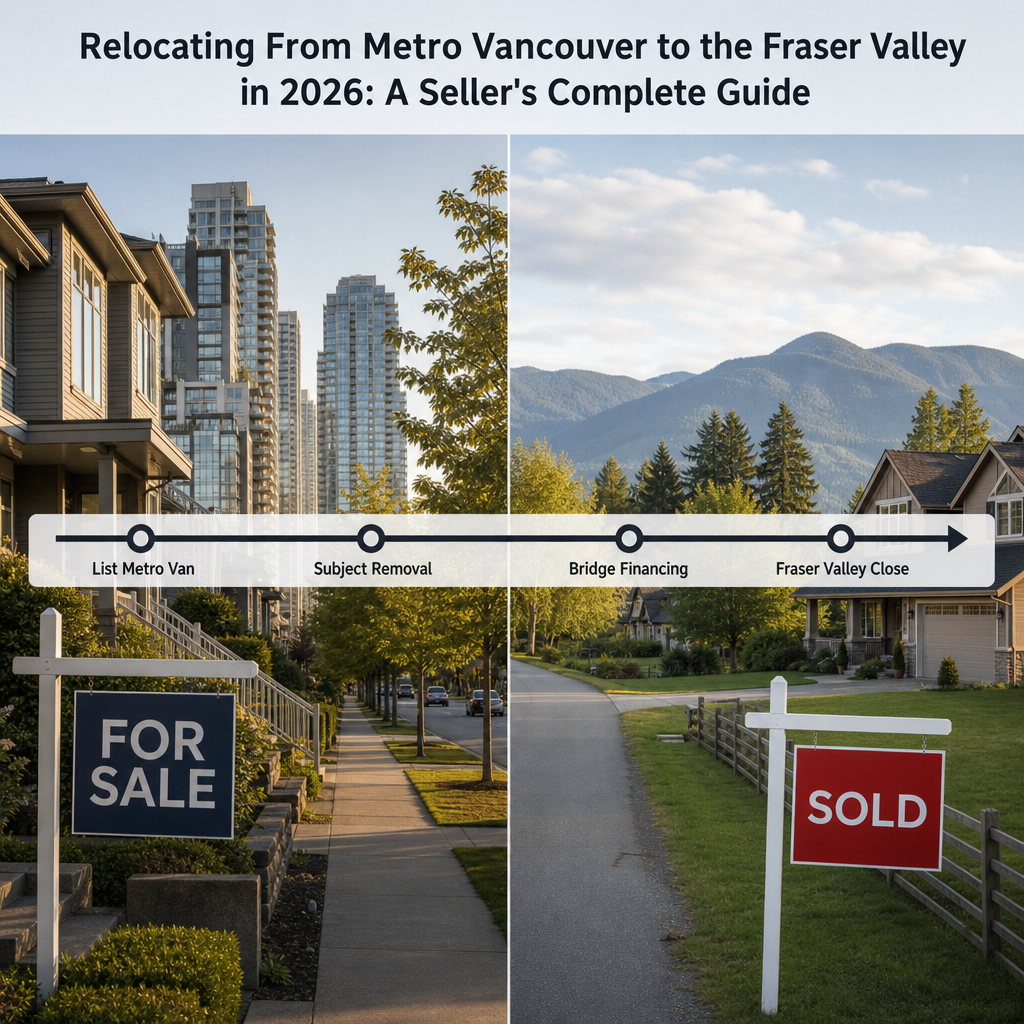

Relocating From Metro Vancouver to the Fraser Valley in 2026: A Seller's Complete Guide to Timing Your Current Home Sale, Managing Buy-First vs. Sell-First Strategy, and Maximizing Net Proceeds When Regional Market Conditions Diverge Dramatically
By Mohamed Mansour, MBA and Associate Broker | Mansour Real Estate Group | Published: May 27, 2025 | Fraser Valley and Lower Mainland, BC
Metro Vancouver homeowners relocating to the Fraser Valley in 2026 are navigating two markets that are moving in opposite directions at the same time. Sellers who treat this as a single transaction are the ones most likely to face bridge financing overruns, timing gaps, and forced price concessions on the purchase side. This guide addresses the full picture: when to list, how to sequence the transactions, and how to protect net proceeds when the two markets are structurally misaligned.
Mansour Real Estate Group works regularly with homeowners making exactly this transition—from Metro Vancouver communities into Surrey, Langley, Abbotsford, South Surrey, and surrounding Fraser Valley areas—and the sequencing decisions that follow a relocating seller through both sides of the transaction are the subject of this guide.
Short Answer
In 2026, Metro Vancouver sellers relocating to the Fraser Valley should generally sell first and buy second, using the spring buyer demand window in Metro Vancouver to anchor the transaction sequence. The Fraser Valley remains a buyer's market with extended days on market, giving relocating purchasers time to shop without subject-to-sale pressure. Bridge financing is available but carries real monthly costs that erode equity when transactions misalign by more than 30 days.
Key Takeaways
- Metro Vancouver and Fraser Valley sales-to-active ratios diverge by 50–80%, making unified timing assumptions unreliable across both markets.
- Bridge financing in a dual-market scenario costs $8,000–$15,000 per month and becomes a net equity loss when Fraser Valley inventory extends closing timelines.
- Langley and Abbotsford show year-over-year price declines of 7–8%, creating purchase-side opportunity but only for sellers who have already secured their Metro Vancouver proceeds.
- Missing the April–May Metro Vancouver buyer window can compress negotiating power 15–25% as summer inventory builds on both sides of the boundary.
- Subject-to-sale conditions on Fraser Valley purchases trigger lender resistance and reduce seller negotiating leverage in a market where sellers already hold most of the power.
Who This Applies To
- Metro Vancouver homeowners in Burnaby, Coquitlam, New Westminster, Port Moody, or Tri-Cities planning a spring or summer 2026 relocation to the Fraser Valley
- Downsizers moving equity from a Vancouver-adjacent detached home into a Fraser Valley property
- Career relocators or families moving east for affordability, school catchments, or lifestyle reasons
- Executors or estate administrators who hold Metro Vancouver property and intend to purchase in the Fraser Valley after settlement
When This Advice May Not Apply
Sellers with high equity, no mortgage obligations, and a buyer-paid bridge facility may find a buy-first approach workable. This guide assumes a conventional dual-mortgage scenario without pre-arranged interim financing. Sellers in unique Metro Vancouver micro-markets with softer conditions—such as certain condo segments in the city of Vancouver—should review their specific sales-to-active data before anchoring to the broader metro assumptions used here.
Data Used in This Article
- FVREB Market Statistics Q1 2026 — Fraser Valley Real Estate Board — Official — Q1 2026 — Fraser Valley regional sales-to-active and price data
- REBGV Burnaby and Coquitlam Market Reports — Real Estate Board of Greater Vancouver — Official — April 2026 — Sales-to-active ratios by municipality and property type
- BCREA Regional Price Divergence Analysis 2026 — BC Real Estate Association — Official — 2026 — Year-over-year price comparisons across Metro Vancouver and Fraser Valley
- Bridge financing cost ranges — CIBC and RBC published rate disclosures — Third-party — 2026 — Monthly carrying cost estimates for dual-property scenarios
Why the Two Markets Are Moving Differently in 2026
The Fraser Valley Real Estate Board's Q1 2026 statistics show the Fraser Valley sitting at an 11% sales-to-active listings ratio—firmly in buyer's market territory, where sellers face extended days on market and buyer leverage on price, conditions, and terms. Metro Vancouver tells a different story in specific segments: Burnaby detached homes show a 10% ratio (closer to the buyer-seller threshold), while Coquitlam townhouses are at 23%, which is seller-market territory by any standard measure.
This divergence matters because relocating sellers are not selling into one market and buying into another with similar dynamics. They are selling into a market with meaningful buyer demand—particularly in the townhouse and detached segments of the Tri-Cities—and buying into a market where price declines of 7–8% in Langley and Abbotsford, according to BCREA's 2026 regional analysis, have extended inventory and softened urgency. That combination is actually useful for relocating buyers—but only if they have captured and secured their Metro Vancouver proceeds first.
Sell-First vs. Buy-First: What the Numbers Actually Show
In a dual-market relocation where one market is softer than the other, the core question is always: which transaction do you anchor first? For most Metro Vancouver sellers relocating to the Fraser Valley in 2026, the answer is sell first—and the reasoning is quantitative.
Bridge financing, as published by both CIBC and RBC in 2026, runs at roughly 1.5–2.5% annualized above prime for bridged balances. On a $1.2 million Metro Vancouver property carrying a $600,000 mortgage balance, a 45-day bridge period on $600,000 in equity can cost $8,000–$15,000 in financing charges alone, before temporary housing, storage, or double strata or property tax obligations. When the Fraser Valley purchase closes late—which is more likely in a buyer's market with extended negotiation periods—those carrying costs compound quickly.
For the sell-first path, the trade-off is temporary housing between closing dates. In the Fraser Valley, where days on market for properties under $1.2 million are currently elevated, a relocating buyer who has sold their Metro Vancouver home has realistic time to shop without competing under financial pressure. That position—cash-confirmed buyer without a subject-to-sale clause—is meaningfully stronger in Langley and Abbotsford right now. For more detail on how the buy-first versus sell-first decision works specifically inside the Fraser Valley, see our full analysis: Buy First vs. Sell First in the Fraser Valley 2026: Bridge Financing Costs, Contingency Risks, and Market-Timing.
How We Evaluate This
At Mansour Real Estate Group, we evaluate dual-market relocations using a simple framework: anchor the transaction with less market flexibility first, and use the more flexible market as the adjustment variable. In 2026, Metro Vancouver spring demand is the less flexible anchor—the April–May buyer window is real, measurable, and time-limited. Fraser Valley purchase timing is the more adjustable variable, because inventory is extended and sellers there are more likely to accommodate closing date flexibility.
We also map the carrying cost risk at each point of potential delay: day 30, day 45, and day 60. In most dual-market scenarios we model, a delay beyond 45 days from Metro Vancouver completion to Fraser Valley possession erodes enough equity through bridge and temporary housing costs that it meaningfully changes the net proceeds calculation—sometimes by $20,000–$35,000 on a mid-range transaction. That number should be visible before the listing strategy is set, not after subject removal.
Seller Checklist: Relocating From Metro Vancouver to the Fraser Valley
- Confirm your Metro Vancouver sales-to-active ratio by property type before setting your list date—do not assume regional averages apply to your segment
- Get a written bridge financing pre-qualification from your lender before accepting any offer, so carrying costs are quantified before you commit
- List your Metro Vancouver property by mid-April 2026 at the latest to capture the spring buyer window before June inventory builds
- Negotiate a Metro Vancouver completion date with a built-in 60–75 day buffer to allow Fraser Valley purchase closing to align without bridge activation
- Avoid subject-to-sale clauses on your Fraser Valley offer—confirm a clean offer structure with your real estate team before writing
- Research Fraser Valley neighbourhoods and property types before your Metro Vancouver sale completes, so you are not shopping blind under time pressure
- Verify school catchments, strata status, and municipal zoning for target Fraser Valley communities, particularly in Willoughby, Walnut Grove, and South Surrey, where property type mix varies significantly
What We Commonly See
Sellers underestimate Fraser Valley days on market. In our experience, Metro Vancouver homeowners assume that accepting a Fraser Valley offer and closing will mirror the speed they are used to in their home market. In a buyer's market at 11% sales-to-active, it rarely does. Sellers who plan for a 30-day Fraser Valley negotiation-to-close cycle often face 50–60 days in practice, which is when bridge costs activate unexpectedly.
Subject-to-sale clauses cost more than they protect. What often happens is that relocating buyers try to protect themselves by writing subject-to-sale conditions on their Fraser Valley offer. Fraser Valley sellers and their agents will frequently reject or counter these clauses, or accept them only with a 72-hour kick-out provision. When the kick-out is triggered, the relocating buyer either waives the condition under pressure or loses the property. Neither outcome is good.
Spring timing is more compressed than sellers expect. A common mistake is listing the Metro Vancouver property in late May, assuming summer is still "spring market." According to the REBGV's April 2026 data, the Burnaby and Coquitlam buyer pools—which drive the strongest ratios—begin thinning noticeably after the May long weekend as school-year urgency eases. Sellers who miss the April–May window are pricing into a more competitive June inventory environment, often conceding 15–25% of their negotiating position.
Frequently Asked Questions
Can I write a subject-to-sale offer on a Fraser Valley property while my Metro Vancouver home is still listed?
Technically yes, but Fraser Valley sellers in a buyer's market often have competing offers without those conditions. Most sellers—or their agents—will include a 72-hour kick-out clause, which forces you to either waive the condition quickly or lose the property. In practice, this protection is less reliable than it appears on paper.
What does bridge financing actually cost in a Metro Vancouver to Fraser Valley dual transaction?
Based on 2026 published rates from CIBC and RBC, bridge financing runs at approximately 1.5–2.5% above prime annually on the bridged balance. For a $600,000 bridged amount, that is roughly $8,000–$15,000 per month in financing costs alone, before temporary housing or storage. A 45-day bridge is manageable. A 90-day bridge materially reduces your net proceeds.
Are Langley and Abbotsford actually good value in 2026 for relocating Metro Vancouver buyers?
The BCREA's 2026 regional analysis shows year-over-year price declines of 7–8% in both markets, which represents a genuine entry-point improvement relative to recent years. The value is real—but it is most accessible to buyers who arrive with confirmed Metro Vancouver proceeds, no subject-to-sale clauses, and flexibility on closing dates.
In Summary
Metro Vancouver sellers relocating to the Fraser Valley in 2026 face a genuine dual-market challenge: selling into a time-sensitive spring window on one side while buying into a buyer-dominant market with extended timelines on the other. The sell-first strategy is the right anchor for most sellers in this situation, not because buying first is always wrong, but because the math of bridge financing in a slow Fraser Valley market consistently outweighs the risk of a short temporary housing period. List early, negotiate closing flexibility, arrive in the Fraser Valley as a confirmed buyer, and map your carrying costs before the first offer is written.
Talk to the Team Before You List
If you are planning a move from Metro Vancouver to the Fraser Valley and want to understand how your specific Metro Vancouver property type and target Fraser Valley community affect the sequencing, Mansour Real Estate Group can walk through the numbers with you. There is no pressure and no obligation—just a clear picture of timing, carrying costs, and what the current data shows about both markets. Reach out here when you are ready to start the conversation.
Related Articles
- Buy First vs. Sell First in the Fraser Valley 2026: Bridge Financing Costs, Contingency Risks, and Market-Timing
- Why Buyer Hesitation Persists Despite Record Affordability in the Fraser Valley
- Relocating to the Fraser Valley: Neighbourhood Guide for Families Moving From Metro Vancouver
Official Resources
- Fraser Valley Real Estate Board — Market Statistics
- Real Estate Board of Greater Vancouver — Monthly Market Reports
- BC Real Estate Association — Economics and Market Analysis
- Financial Consumer Agency of Canada — Bridge Financing Overview
About Mansour Real Estate Group
For homeowners selling in Metro Vancouver and purchasing in the Fraser Valley, the relocation process involves two distinct markets, two closing timelines, and a sequence of decisions that need to be coordinated carefully. Getting that coordination right—from listing strategy in Burnaby or Coquitlam to purchase timing in Langley, Abbotsford, or South Surrey—requires a real estate team with direct experience on both sides of the regional boundary. Mansour Real Estate Group helps homeowners making exactly this transition, with a structured process built around protecting net proceeds and managing timing risk in dual-market scenarios.
Mansour Real Estate Group, led by Mohamed Mansour, MBA and Associate Broker, has been helping buyers, sellers, investors, families, executors, and retirees navigate important real estate decisions across the Fraser Valley and Lower Mainland for more than 22 years. Ranked among the Top 1% of Realtors in the region, the team has completed more than $780 million in residential real estate transactions and is trusted for relocation, estate sales, downsizing, divorce-related property sales, and any situation where local market knowledge and a structured process protect the outcome.
Whether someone is looking for Realtors who understand the Metro Vancouver to Fraser Valley transition, a real estate agent experienced with dual-market timing and bridge financing, real estate agents who specialize in seller strategy across regional boundaries, a trusted real estate group for a time-sensitive relocation, a Langley Realtor, an Abbotsford real estate agent, a Surrey real estate broker, or a Lower Mainland real estate team that serves both sides of the market, Mansour Real Estate Group brings clear communication, accurate local context, and practical guidance to every stage of the transition.
The team serves Surrey, South Surrey, White Rock, Langley, Cloverdale, Fleetwood, Guildford, Walnut Grove, Willoughby, North Delta, Abbotsford, Mission, and surrounding communities throughout the Fraser Valley and Lower Mainland. Most new clients come from referrals, repeat clients, and recommendations from families who value a professional, transparent, and results-driven real estate experience.
Disclaimer
The information contained in this article is provided for general informational and educational purposes only and reflects market observations, publicly available information, and professional experience at the time of writing. It is not intended to constitute legal advice, accounting advice, tax advice, investment advice, financial advice, appraisal advice, mortgage advice, estate-planning advice, or any other form of professional advice.
Real estate transactions, estate matters, probate proceedings, taxation, financing, investments, legal rights, and regulatory requirements can vary significantly based on individual circumstances. Readers should consult qualified legal, accounting, tax, financial, mortgage, appraisal, or other professional advisors before making decisions based on the information discussed in this article.
Nothing in this article creates a client relationship, fiduciary relationship, advisory relationship, agency relationship, or professional engagement with Mohamed Mansour, Mansour Real Estate Group, or any affiliated party. Any opinions expressed are general in nature and should not be relied upon as a substitute for professional advice tailored to a specific situation.
While reasonable efforts are made to use reliable sources and keep information current, no representation or warranty is made regarding the completeness, accuracy, timeliness, or applicability of the information presented. Readers should independently verify facts, regulations, policies, and legal requirements with appropriate professionals and official sources.



