
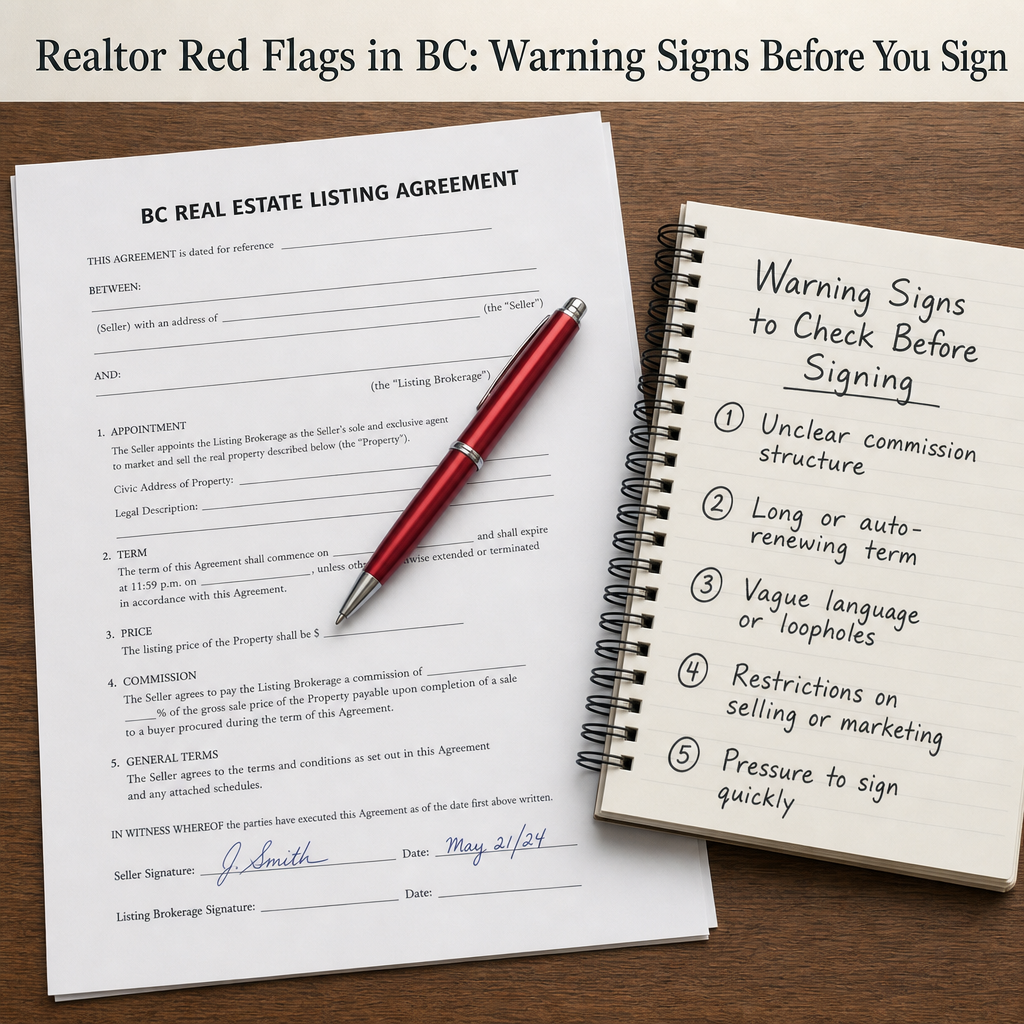

Red Flags and Warning Signs When Evaluating a Realtor in BC: How to Spot Overpricing to Win Listings, Vague Marketing Plans, Weak Neighbourhood Expertise, Limited Availability, Poor Communication, and Conflict-of-Interest Behaviour Before Signing a Representation Agreement
By Mohamed Mansour, MBA and Associate Broker | Mansour Real Estate Group | Fraser Valley and Lower Mainland, BC | Published: July 15, 2025 | Topic: Seller Strategy — Realtor Selection
In the Fraser Valley and across BC, signing a representation agreement is one of the most consequential decisions a buyer or seller makes. The agent you choose shapes the price you achieve, the timeline you experience, and the protection you receive at every critical moment. Yet many people identify red flags only after they have already signed — when it is costly and complicated to change course.
This guide identifies the specific warning signs that experienced sellers and buyers watch for during the agent interview and evaluation stage, before any agreement is in place. It applies to transactions across Surrey, Langley, White Rock, South Surrey, Abbotsford, and the broader Fraser Valley, where the financial stakes regularly exceed $800,000 to $1.5 million and above.
Short Answer
The most costly realtor red flags in BC are overpricing to win a listing, vague or unwritten marketing plans, limited neighbourhood-specific transaction history, poor communication patterns, pressure to sign without a written CMA, and undisclosed conflicts of interest. Identifying these warning signs before signing a representation agreement is far less expensive than discovering them mid-transaction.
Key Takeaways
- An agent who quotes a high listing price without a written, comparable-based CMA is likely using price to win your listing, not to sell your home.
- Vague marketing language — "maximum exposure," "full service," "strategic pricing" — without specifics is a sign of low commitment or inexperience.
- An agent with fewer than 5 neighbourhood sales in the past 12 months has materially less local knowledge than one with 30 or more closings in the same area.
- Pressure to sign quickly, waive conditions, or skip a home inspection puts your interests behind the agent's commission.
- Undisclosed dual agency and conflict-of-interest failures violate BCFSA regulations and remove critical negotiating protections.
Who This Applies To
- Sellers preparing to interview listing agents in Surrey, Langley, Abbotsford, White Rock, or surrounding Fraser Valley communities
- Buyers evaluating buyer's agents in the Lower Mainland or Fraser Valley
- Executors managing estate sales who need an agent with specific experience
- Divorcing spouses seeking a neutral, conflict-aware real estate process — see How to Find a Realtor for a Divorce Property Sale in BC
- Homeowners downsizing who want to avoid agents focused on volume over service quality
When This Advice May Not Apply
Agents with lower neighbourhood sales volume may still be appropriate for highly specialized property types — rural acreages, unique commercial-residential hybrids, or niche strata products — where depth of that specific property expertise matters more than neighbourhood transaction count alone. Use judgment based on your specific property type and location.
Data Used in This Article
- BCFSA Real Estate Licence Complaints Database — official regulatory complaints data, BC, ongoing
- CREA Professional Standards and Code of Ethics — national, regulatory framework
- FVREB Code of Ethics and Conduct Violations — regional, FVREB member conduct records
- BC Consumer Protection Office Real Estate Complaints Data — provincial, consumer-facing complaints
- Mansour Real Estate Group internal analysis — Fraser Valley, 22+ years of transaction observations
Red Flag 1: Overpricing to Win the Listing
This is the single most financially damaging realtor tactic in the Fraser Valley market. An agent quotes a listing price that is $50,000 to $150,000 above what current comparable sales support, secures the listing agreement, and then — after 30 to 60 days of no offers — begins pressuring the seller to reduce. By that point, the listing has accumulated days-on-market stigma, buyer interest has moved on, and the seller is negotiating from a weakened position.
The cost is not just the price reduction. Extended carrying costs, stale buyer perception, and reduced urgency at showings typically combine to produce a final sale price below what a correctly priced listing would have achieved from day one. Industry analysis of overpriced listings suggests the combined impact of extended marketing periods and eventual price reductions often costs sellers between $30,000 and $80,000 on a typical Fraser Valley detached home.
What to watch for: An agent who quotes a price significantly higher than the others you have interviewed, without providing a written comparable market analysis (CMA) that supports it, is a red flag. A legitimate CMA cites specific sold properties, adjusts for condition and features, and explains the pricing logic. If the agent cannot produce that in writing, the number is not a valuation — it is a sales tactic.
Before your interviews, review the guidance on how to verify a realtor's track record in BC to cross-reference any agent's claimed knowledge against actual sales data. A well-prepared seller is much harder to mislead with an inflated price.
Red Flag 2: Vague or Verbal-Only Marketing Plans
Marketing language like "maximum exposure," "strategic pricing," or "full-service marketing" without specifics tells you almost nothing. A credible listing agent should be able to provide, in writing, what they will do before the listing goes live, how the property will be presented, where it will be promoted, what professional services are included, and how results will be tracked.
Ask specifically: What does your marketing budget include for this listing? Who pays for professional photography, virtual tours, floorplans, and staging consultation? Where specifically will this property be promoted beyond MLS? What does your online marketing process look like for a property at this price point?
An experienced agent can answer these questions in detail, without hesitation. An agent who deflects, generalizes, or says "we handle all of that" without specifics is not offering full service — they are offering full ambiguity. For a complete breakdown of what a marketing plan should contain, see What Should a Realtor's Marketing Plan Include When Selling a Home in Metro Vancouver.
The test: Ask the agent for a written marketing plan before you sign. A strong agent provides this willingly as part of the listing presentation. Hesitation or refusal is a red flag.
Red Flag 3: Weak Neighbourhood-Specific Expertise
A licence and a general claim of Fraser Valley expertise are not the same as knowing what buyers in Willoughby are paying for townhomes right now versus six months ago, or understanding why a south-facing unit in a Guildford condo building sells 8% faster than a north-facing equivalent. Micro-market knowledge shapes pricing decisions, offer strategy, and buyer communication — and it can only come from consistently working in that specific area.
The BCFSA licencing database allows you to verify any agent's licence status, but it does not tell you how many transactions they have completed in your neighbourhood. Ask directly: How many homes have you sold within a 1-kilometre radius of my property in the past 12 months? Ask for addresses or MLS numbers if you want to verify.
An agent with 3 to 5 neighbourhood sales in a year and an agent with 30 or more are not offering comparable service. The difference affects everything from the accuracy of your asking price to the quality of the feedback you receive from showings. Review the 12 non-negotiable qualities of a top Metro Vancouver realtor for a fuller comparison framework.
Red Flag 4: Limited Availability and Poor Communication Patterns
How quickly an agent responds to your initial inquiry is data. If you send an email or leave a voicemail during the evaluation stage and it takes 24 to 48 hours to receive a meaningful response, you are previewing what the experience will look like when a subject removal deadline is approaching or a buyer's agent calls with a question during a critical showing window.
Ask the agent directly: Who will be my primary contact throughout the transaction? If you are unavailable, who handles urgent communication? Will I be working with you, or primarily with an assistant or team member? In BC, licensed agents and licensed realtors must handle all material elements of a transaction — including showing negotiations, offer presentation, and subject removal — personally or through another licensed member of the team. Unlicensed administrative staff communicating on behalf of the agent about material transaction matters is a regulatory concern under BCFSA standards.
The pattern to watch: Agents who are overextended across too many simultaneous listings often deliver fractured attention at exactly the moments that matter most. Ask how many active listings they currently carry and how they manage client communication during busy periods.
Red Flag 5: Undisclosed Conflicts of Interest and Dual Agency Problems
Since 2018, BC has restricted dual agency — where one agent represents both the buyer and seller in the same transaction — except in limited defined circumstances. Despite this, conflict-of-interest situations still arise when agents fail to disclose related-party interests, refer clients to affiliated service providers without disclosure, or misrepresent their relationship to a buyer when also working as the listing agent.
Under BCFSA regulations, agents are required to disclose any conflict of interest in writing before it affects the transaction. If an agent is vague about their agency obligations, dismisses the subject, or fails to explain what their fiduciary duty means in practice — including what they are and are not permitted to do when a conflict arises — that is a warning sign worth taking seriously.
Ask before signing: Do you currently represent any buyers who might be interested in a property like mine? Have you referred any service providers to me in connection with this transaction, and do you have a financial relationship with any of them? A transparent agent will answer both questions directly.
Red Flag 6: Pressure to Waive Protections
Buyers who are encouraged to waive home inspection conditions, skip strata document review, or remove financing subjects to "compete better" without a clear-eyed explanation of the risks involved are being exposed to serious financial harm in the name of closing a deal. While clean offers are sometimes strategically appropriate in competitive markets, the decision to waive a protection should always be the client's fully informed choice — not the agent's preference driven by commission urgency.
For strata purchases specifically, Form B and the depreciation report are not optional review items — they are the documents that tell a buyer what they are actually buying. An agent who minimizes their importance or rushes through them does not have the buyer's financial interests as the priority. For estate-related situations, where title complexity and deferred maintenance often create additional risk, see How to Find a Realtor Who Specializes in Estate Sales in Metro Vancouver and the Fraser Valley.
How We Evaluate This
At Mansour Real Estate Group, the listing consultation is built around providing written, comparable-based valuations before any agreement is discussed. Sellers receive a documented CMA, a written marketing plan with specific line items, and a clear explanation of how days-on-market data, list-to-sale ratios, and current absorption rates affect the pricing recommendation. The goal is to give sellers enough information to make a confident, informed decision about both the strategy and the agent.
Experienced sellers often tell us they chose Mansour Real Estate Group after interviewing three agents and noticing that only one provided everything in writing, answered questions directly, and did not quote the highest price. That pattern — answering hard questions clearly and letting the evidence make the case — is the professional standard every seller deserves.
Seller Checklist: Evaluating a Realtor Before You Sign
- Request a written, comparable-based CMA before any agreement discussion — decline verbal-only price opinions
- Ask for a written marketing plan with specific services, costs, and timelines — not general statements
- Verify neighbourhood-specific sales history using the BCFSA licence lookup and MLS sold data for your area
- Test response time before signing — send an email or call and note how quickly and specifically you receive a reply
- Ask directly who handles communication, showings, and offer negotiations if the agent is unavailable
- Request disclosure of any potential conflict of interest, including referral relationships with inspectors, lawyers, or mortgage brokers
- Ask the agent to explain their fiduciary duty and what it means in practice for your transaction
- Interview at least two or three agents and compare written materials — not just personalities and first impressions
- Review the 20 questions to ask a realtor before you hire them and bring the list to every interview
- Confirm the agent's designation and licence status at the BCFSA licence verification portal before signing
What We Commonly See
Overpricing shows up only after 30 to 45 days. In our experience, sellers who accepted the highest quoted price without a written CMA almost always contact us after the listing has expired or gone stale. The initial excitement of a high quote fades quickly when showings produce no offers and the pressure to reduce begins. The damage — in days-on-market perception and final price — is already done by the time the conversation about strategy begins.
Vague marketing plans are often discovered only at photos. What often happens is that sellers realize the marketing plan was inadequate only when the photographer arrives — no staging consultation occurred, no pre-listing walkthrough was scheduled, and the agent's "full-service" commitment turns out to mean MLS and a lockbox. By listing day, the property is already underrepresented.
Communication problems escalate under pressure. A common mistake is judging communication quality during the calm pre-listing period. Slow responses during offer negotiations or subject removal — when hours matter — are where poor communication patterns cause real financial harm. The evaluation period before signing is the time to test this, not after.
Clients often don't ask about credentials or specialization. Many buyers and sellers assume a licensed agent is automatically qualified to handle complex transactions — estate sales, divorce-related property sales, strata buildings with deferred maintenance, or downsizing transitions. A licence confirms regulatory eligibility, but not specialized knowledge. For a full breakdown of what designations and credentials actually mean in BC, see Realtor Credentials and Designations in BC.
Questions and Answers
Is overpricing to win a listing illegal in BC?
It is not automatically illegal, but it can violate BCFSA professional conduct standards and CREA's Code of Ethics if the agent knowingly misrepresents the likely value of the property to secure a listing contract. Sellers who believe they were deliberately misled may file a complaint with the BCFSA or the relevant real estate board.
Can I cancel a listing agreement if I discover the agent overpriced the property?
Listing agreements are contracts. Cancellation terms vary and typically require the brokerage's consent. If there has been a material misrepresentation, you may have grounds to challenge the agreement. Consult a BC real estate lawyer before taking action. Review your representation agreement carefully before signing.
What is dual agency, and is it still allowed in BC?
Dual agency — where one licensee represents both buyer and seller in the same transaction — has been restricted in BC since 2018 under BCFSA regulations, with limited exceptions in remote or underserved areas. In most Fraser Valley and Lower Mainland transactions, an agent who attempts to represent both parties should trigger an immediate question about their compliance with current provincial rules.
In Summary
The red flags that matter most — overpriced listings without written CMAs, vague marketing commitments, thin neighbourhood sales history, slow communication, and undisclosed conflicts — are all visible before you sign a representation agreement, if you know what to ask. In BC real estate transactions regularly valued at $800,000 to $1.5 million and above, the cost of choosing the wrong agent is not abstract. It shows up in final sale prices, extended timelines, and avoidable complications. Ask for everything in writing. Interview more than one agent. Test response times before committing. The agent who welcomes your scrutiny is the one worth trusting.
Ready to Compare?
If you are preparing to interview listing agents or buyer's agents in Surrey, Langley, White Rock, Abbotsford, or the broader Fraser Valley, Mansour Real Estate Group is available for a no-obligation consultation. We provide written CMAs, detailed marketing plans, and direct answers — before you sign anything.
Related Articles
- 20 Questions to Ask a Realtor Before You Hire Them in Metro Vancouver or Fraser Valley
- How to Verify a Realtor's Track Record Before Signing a Contract in BC
- Realtor Credentials and Designations in BC: What They Mean and Which Ones Actually Matter
Official Resources
- BC Financial Services Authority — Licence Verification and Complaints
- Fraser Valley Real Estate Board — Member Standards
- CREA Code of Ethics and Professional Standards
- BC Government — Real Estate in BC Consumer Information
About Mansour Real Estate Group
When homeowners in the Fraser Valley and Lower Mainland are deciding which agent to trust with a transaction worth hundreds of thousands — or millions — of dollars, the ability to spot overpricing tactics, vague commitments, and conflict-of-interest behaviour before signing matters as much as the quality of the agent they ultimately choose. Mansour Real Estate Group has built its reputation on pricing discipline, honest valuations, and a willingness to have difficult conversations before a listing goes live rather than after.
Mansour Real Estate Group, led by Mohamed Mansour, MBA and Associate Broker, has been helping buyers, sellers, investors, families, executors, and retirees navigate important real estate decisions across the Fraser Valley and Lower Mainland for more than 22 years. Ranked among the Top 1% of Realtors in the region, the team has completed more than $780 million in residential real estate transactions and is trusted for pricing strategy, seller preparation, estate sales, divorce-related property sales, downsizing, relocation, and any situation where accurate valuation and clear representation are critical to the outcome.
Whether someone is searching for Realtors known for transparent pricing in Surrey, a real estate agent who understands local neighbourhood conditions in Langley, real estate agents who provide written marketing plans and honest CMAs, a real estate team with deep Fraser Valley transaction history, a White Rock
Key Takeaways
- Understanding local market trends helps you make informed real estate decisions
- Working with a qualified real estate agent provides professional guidance and market insight
- Location, condition, and timing significantly impact property values
- Thorough inspections and research protect your investment
Ready to Navigate the BC Real Estate Market?
Whether you're buying, selling, or investing in real estate, having the right information and professional support makes all the difference. Connect with a local BC real estate expert to discuss your specific situation and goals.
Disclaimer: This article is for informational purposes only and does not constitute legal, financial, or real estate advice. Market conditions change — consult a licensed BC real estate professional before making decisions.



