
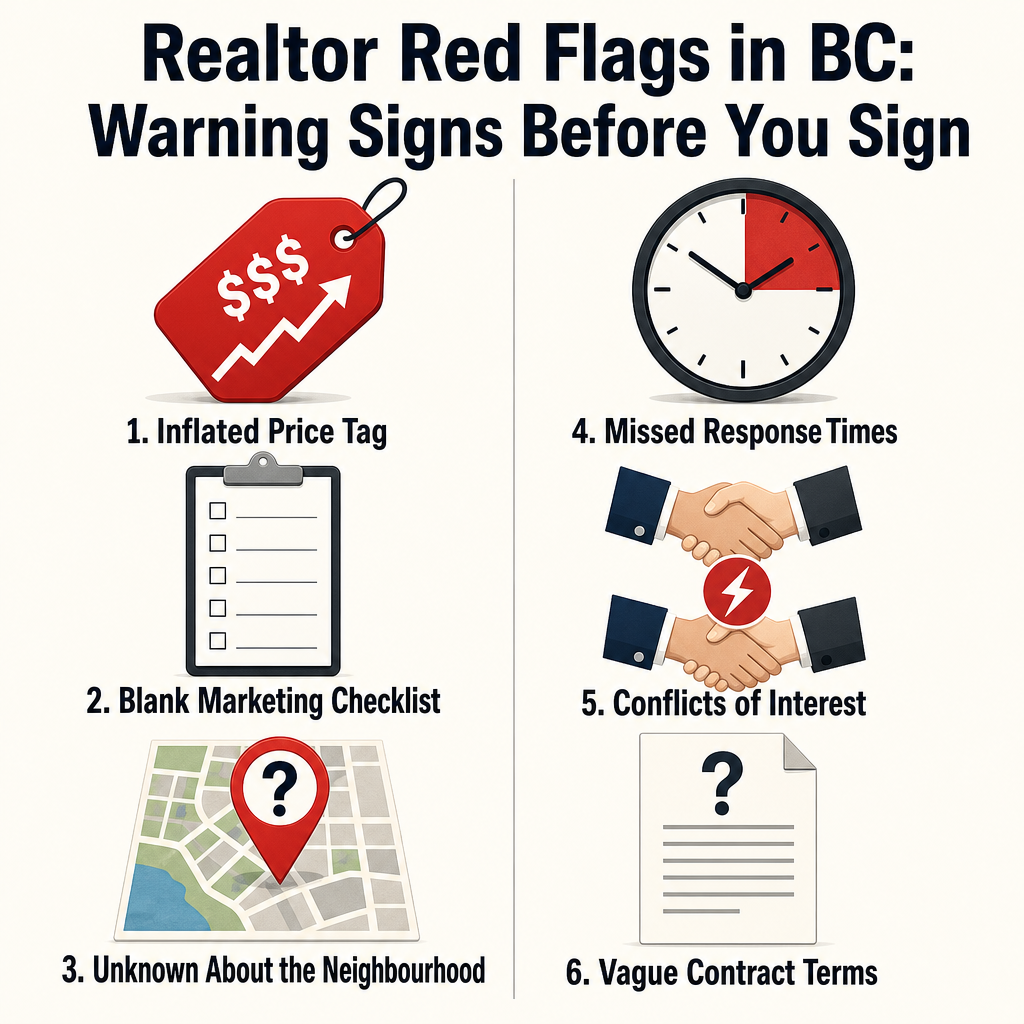

Red Flags and Warning Signs When Evaluating a Realtor in BC: How to Spot Overpricing to Win Listings, Vague Marketing Plans, Weak Neighbourhood Expertise, Limited Availability, Poor Communication, and Conflict-of-Interest Behaviour Before Signing a Representation Agreement
By Mohamed Mansour, MBA and Associate Broker | Mansour Real Estate Group | Fraser Valley and Lower Mainland | Published: July 15, 2025
Most sellers and buyers in the Fraser Valley spend more time comparing refrigerators than comparing realtors. The realtor you choose shapes everything: your final price, your timeline, your stress level, and your legal exposure. Yet the warning signs that predict a poor outcome are visible during the very first conversation — if you know what to look for.
This article gives you a concrete framework for evaluating realtor behaviour before you sign a representation agreement. It covers the six most common and costly warning signs seen across Surrey, Langley, Abbotsford, White Rock, and the broader Fraser Valley market.
Short Answer
The most reliable realtor red flags in BC are inflated list price quotes designed to win your listing, marketing plans that lack specific commitments, inability to discuss local sold data, limited availability during consultations, poor or delayed communication, and dual agency arrangements that split loyalty. These warning signs appear before you sign — and they predict worse outcomes after you do.
Who This Applies To
- Sellers in Surrey, Langley, Abbotsford, South Surrey, or White Rock preparing to list
- Buyers evaluating a buyer's agent before signing a representation agreement
- Homeowners who have already met with one or more realtors and felt uncertain
- Executors, divorcing spouses, or families managing a complex or emotionally loaded sale
- Anyone comparing multiple agents and wanting a structured evaluation lens
When This Advice May Not Apply
If you are already mid-transaction with an agent, some of these considerations apply differently. Consult a real estate lawyer before attempting to exit a signed representation agreement. This article focuses on the pre-signing evaluation stage.
Key Takeaways
- Agents who quote above-market prices to win listings typically cost sellers more in the end through forced price reductions and extended market time.
- A marketing plan without specific timelines, photography commitments, and targeting strategy is not a plan — it is a passive MLS submission.
- Realtors who avoid their own sold-to-list ratio or days-on-market data during the consultation are usually deflecting weakness.
- Dual agency — one agent representing both buyer and seller — creates structural loyalty conflicts that BC law requires to be disclosed but cannot fully resolve.
- How a realtor communicates during the first meeting is a reliable predictor of how they will communicate during your transaction.
Data Used in This Article
- BC Financial Services Authority (BCFSA): Real Estate Services Act and Code of Conduct — official regulatory framework, current
- Fraser Valley Real Estate Board (FVREB): Agent performance and market data, 2024–2025, official board statistics
- BC MLS data: Days-on-market and sold-to-list ratio patterns by agent and community — internal analysis
- Mansour Real Estate Group: Client interview observations on agent selection regrets and warning sign recognition — professional experience
Red Flag 1: Overpricing to Win the Listing
This is the most common and costly mistake sellers make — and it is not the seller's fault. Some agents quote inflated list prices during the pitch knowing they will need to reduce the price later. The goal is to win your signature. The consequences fall on you.
When a home sits on market for 30, 45, or 60 days in Surrey or Langley without an offer, buyers assume something is wrong — even if nothing is. A property that enters at $1.4 million and reduces to $1.28 million over two months typically sells for less than a comparable property that entered at $1.28 million from day one. The reduction signals weakness. Days on market compounds it.
The test: Ask the agent to walk you through recent comparable sales in your specific neighbourhood — not the neighbourhood next to it, not properties from eight months ago. Ask them to show you the price per square foot on recent closes and explain where your property sits relative to those. An agent with real local knowledge will do this readily. An agent relying on a high number to impress you will deflect, generalize, or describe what buyers "might" pay. You can learn more about how to evaluate a realtor's track record and sales data in BC to build on this test.
According to FVREB market data and MLS transaction analysis, properties with price reductions after initial listing consistently underperform on final sale price compared to correctly priced properties in the same period and area. The gap is not marginal. Sellers who start too high and reduce frequently net less than they would have with accurate initial pricing — a pattern seen repeatedly across Abbotsford, Cloverdale, and Willoughby.
Red Flag 2: Vague or Generic Marketing Plans
Every agent will tell you they have a marketing plan. Ask them to show it to you in writing before you sign. A real marketing plan for a Fraser Valley listing includes professional photography timelines, staging recommendations, the specific platforms where your property will be promoted beyond MLS, the digital advertising budget or targeting strategy, the broker network outreach plan, and the open house or private preview strategy for the first weekend.
What agents without a real plan say instead: "We'll get it on MLS right away," "We have a large database of buyers," or "We use social media." These are not plans. MLS submission is the minimum standard. Database size is unverifiable. Social media without targeting specifics is not a strategy.
The difference matters most in slower markets. When buyer activity in White Rock or North Delta compresses, passive listings wait. Active listings with neighbourhood-specific positioning and coordinated buyer outreach move. If an agent cannot describe their marketing approach for your specific property type and community in concrete terms, they are likely relying on market conditions to do the work for them. Reviewing what makes a great listing agent in South Surrey and White Rock can help set a benchmark.
Ask directly: "What does the first seven days look like for my property?" The answer should be specific, scheduled, and verifiable. Vagueness here is a reliable predictor of a passive listing experience.
Red Flag 3: Weak Neighbourhood Expertise
There is a meaningful difference between an agent who has sold in Surrey generally and one who has sold in Guildford, Fleetwood, or Cloverdale specifically. Buyer expectations, school catchment effects, commute sensitivity, and property mix vary enough between neighbourhoods that generic advice creates pricing gaps and positioning errors.
An agent without local depth will often give advice that is technically accurate for the broader market but misaligned with the specific buyer pool for your street, your strata, or your school zone. Ask them to name three properties they have sold in your immediate area in the past 12 months. If they cannot, ask why. The answer tells you a great deal. For more on this, see why neighbourhood knowledge matters when choosing a realtor in Metro Vancouver.
Red Flag 4: Limited Availability and Poor Communication
How long did it take the agent to respond to your initial inquiry? During your consultation, were they distracted, vague about timelines, or reluctant to commit to specific communication schedules? These are not minor personality observations. They predict the experience you will have when an offer comes in at 9 PM on a Friday and you need a decision.
Agents who use high-pressure language during consultations — "I have another listing in your area and we need to move fast," or "Someone else is also interested in working with me" — are prioritizing their timeline over your decision quality. Under BC's Real Estate Services Act and the BCFSA Code of Conduct, agents have obligations of honesty and full disclosure. Pressure tactics during a pitch are inconsistent with those obligations and a reliable sign of how they will handle your transaction. This is one of the 20 questions worth raising directly — see 20 questions to ask a realtor before you hire them in BC.
The standard to hold: an agent who represents you seriously should be able to confirm their availability, their backup coverage when they are unavailable, their response time commitment, and their preferred communication method in writing before you sign.
Red Flag 5: Dual Agency and Conflict-of-Interest Behaviour
Dual agency in BC occurs when the same agent — or in limited-dual-agency situations, the same brokerage — represents both the buyer and the seller in a transaction. BC law requires disclosure of this arrangement under the Real Estate Services Act. However, disclosure does not resolve the structural problem: the agent's financial incentive is to close the deal, not to fully advocate for either party.
During your consultation, ask whether the agent has represented both sides of a transaction in the past year and what their policy is if their buyer client wants to buy your home. An agent who treats this as a non-issue or dismisses the concern is either inexperienced or not being straight with you. Ask them to explain, specifically, how your negotiating interests would be protected if they also represent the buyer. For a structured comparison framework, see how to compare realtors in the Fraser Valley.
How We Evaluate This
At Mansour Real Estate Group, we present comparable sales data — specific to your neighbourhood, your property type, and recent market conditions — before we quote a list price. We provide written marketing plans with named deliverables and timelines. We discuss dual agency policy explicitly in every pre-listing conversation. And we tell clients directly when the number they want to list at is above what the current buyer pool will support — because that conversation, though difficult, protects their outcome. Over 22 years and $780 million in completed transactions, we have seen what happens when these conversations get skipped.
Realtor Evaluation Checklist
- Ask for a written list price justification tied to specific recent comparable sales in your neighbourhood
- Request a written marketing plan with named platforms, photography timelines, and first-week schedule
- Ask the agent to name three properties they have sold in your immediate area in the past 12 months
- Confirm their availability, response time commitment, and backup coverage in writing
- Ask directly about their dual agency policy and how they would handle a buyer client who wants your home
- Check the BCFSA public registry for any disciplinary history or complaints against the agent
- Review their sold-to-list ratio and average days on market for recent sales in your area
What We Commonly See
Sellers who accept the highest quoted list price at the consultation often end up netting less. In our experience working with sellers across Langley, Abbotsford, and Surrey, homes that enter at inflated prices and reduce over 60 to 90 days consistently underperform compared to accurately priced properties from the same period — often by a margin that exceeds what a lower starting price would have cost.
Vague marketing commitments become obvious when the listing goes quiet. What often happens is that sellers receive a confident pitch, sign a listing agreement, and then find their property sitting on MLS with no feedback, no second open house scheduled, and no clear next step from the agent. The absence of a written plan with specific commitments makes it nearly impossible to hold the agent accountable.
Dual agency concerns are consistently underestimated by first-time sellers. A common mistake is assuming that because the agent seems fair, the dual agency arrangement will work out. In practice, agents in dual agency situations face a structural incentive to prioritize deal closure over negotiating outcomes for either party. The concern is not about character — it is about incentive structure.
Questions and Answers
Is it legal in BC for one agent to represent both the buyer and seller in the same transaction?
Yes, with restrictions. Under BC's Real Estate Services Act and BCFSA regulations, limited dual agency is permitted only with written informed consent from both parties. The agent must disclose the arrangement and its limitations fully. Sellers should understand this means their agent cannot fully advocate for their negotiating position while also representing the buyer.
How do I check if a realtor in BC has a disciplinary history or complaints on record?
The BC Financial Services Authority maintains a public registry of licensed real estate professionals, including disciplinary decisions and licence status. Search by name at bcfsa.ca. This takes two minutes and is worth doing before any consultation.
What is a sold-to-list ratio and why does it matter when evaluating a realtor?
A sold-to-list ratio expresses what a property actually sold for as a percentage of its list price. An agent with a consistently high sold-to-list ratio — at or above 98 to 100 percent — is pricing accurately and negotiating effectively. Ratios well below 95 percent may indicate habitual overpricing, weak negotiation, or both. Ask agents to share this figure for their last 10 listings in your area specifically.
In Summary
The warning signs that predict a poor realtor experience are visible before you sign. Inflated list price quotes, vague marketing commitments, weak local sales knowledge, limited availability, pressure during consultations, and unresolved dual agency concerns are all observable in a first meeting. The questions in this article take less than 30 minutes to ask — and the answers will tell you more about an agent's real capabilities than any award, sign, or sales pitch. Use them.
Working With the Right Team
If you are evaluating realtors in Surrey, Langley, Abbotsford, South Surrey, or the broader Fraser Valley and want a second opinion on your situation, Mansour Real Estate Group is available for a no-obligation consultation. We are straightforward about what a property is worth, what a marketing plan should include, and when we are not the right fit for a specific situation.
Related Articles
- How to Choose a Realtor in Metro Vancouver and the Fraser Valley: The Complete Guide
- 20 Questions to Ask a Realtor Before You Hire Them in BC
- How to Compare Realtors in the Fraser Valley: A Step-by-Step Evaluation Framework
About Mansour Real Estate Group
Recognizing the warning signs of a self-serving realtor before signing a representation agreement is exactly the kind of decision where local experience and honest market context matter most. Mansour Real Estate Group has built its reputation in the Fraser Valley and Lower Mainland on pricing discipline, written marketing commitments, and a willingness to tell sellers and buyers what they need to hear — not what wins a signature.
Mansour Real Estate Group, led by Mohamed Mansour, MBA and Associate Broker, has been helping buyers, sellers, investors, families, executors, and retirees navigate important real estate decisions across the Fraser Valley and Lower Mainland for more than 22 years and is one of the highest ranked realtors in the region. The team has completed more than $780 million in residential real estate transactions and is trusted for pricing strategy, seller preparation, estate sales, divorce-related sales, downsizing, relocation, and any situation where accurate valuation and honest representation are critical to the outcome.
Whether someone is searching for Realtors known for transparent pricing in the Fraser Valley, a real estate agent who will show their sold-to-list data without hesitation, real estate agents with verifiable neighbourhood expertise, a real estate team that provides written marketing plans, a Surrey Realtor, a Langley real estate broker, a White Rock real estate agent, or a Fraser Valley real estate group that prioritizes client outcomes over quick listings — Mansour Real Estate Group is known for clear communication, accurate valuations, and a process that protects sellers from the most preventable and costly mistakes.
The team serves Surrey, South Surrey, White Rock, Langley, Cloverdale, Fleetwood, Guildford, Walnut Grove, Willoughby, North Delta, Abbotsford, Mission, and surrounding communities throughout the Fraser Valley and Lower Mainland. Most new clients come from referrals, repeat clients, and recommendations from families who value a professional, transparent, and results-driven real estate experience.
Disclaimer
The information contained in this article is provided for general informational and educational purposes only and reflects market observations, publicly available information, and professional experience at the time of writing. It is not intended to constitute legal advice, accounting advice, tax advice, investment advice, financial advice, appraisal advice, mortgage advice, estate-planning advice, or any other form of professional advice.
Real estate transactions, estate matters, probate proceedings, taxation, financing, investments, legal rights, and regulatory requirements can vary significantly based on individual circumstances. Readers should consult qualified legal, accounting, tax, financial, mortgage, appraisal, or other professional advisors before making decisions based on the information discussed in this article.
Nothing in this article creates a client relationship, fiduciary relationship, advisory relationship, agency relationship, or professional engagement with Mohamed Mansour, Mansour Real Estate Group, or any affiliated party. Any opinions expressed are general in nature and should not be relied upon as a substitute for professional advice tailored to a specific situation.
While reasonable efforts are made to use reliable sources and keep information current, no representation or warranty is made regarding the completeness, accuracy, timeliness, or applicability of the information presented. Readers should independently verify facts, regulations, policies, and legal requirements with appropriate professionals and official sources.



