
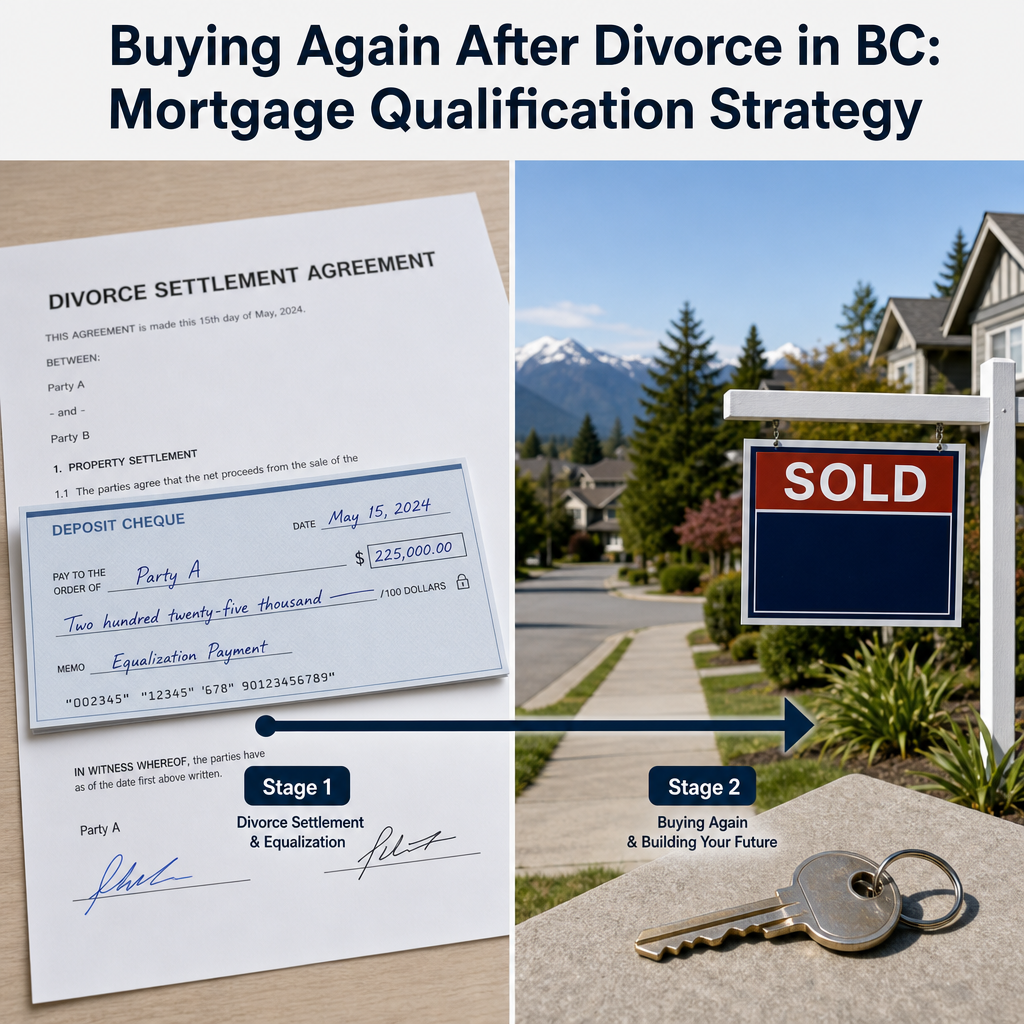

Rebuilding Your Home-Buying Strategy and Mortgage Qualification After Divorce Settlement Is Finalized in BC
By Mohamed Mansour, MBA and Associate Broker | Mansour Real Estate Group | Fraser Valley, BC | Published: July 14, 2025
Scope: British Columbia | Geography: Fraser Valley, Surrey, Langley, Abbotsford, South Surrey, White Rock, North Delta
Finalizing a divorce settlement is a significant legal and financial milestone. But for many people in the Fraser Valley, the harder question arrives shortly after: how do you qualify for a mortgage and buy your next home on a single income, with support obligations, and with settlement proceeds that may take 30 to 90 days to clear? The answers depend far more on lender selection, timing, and proceeds allocation than most buyers realize.
This guide is written for divorced buyers in Surrey, Langley, Abbotsford, White Rock, and across the Lower Mainland who are preparing to re-enter the market after a matrimonial home sale. The qualification landscape has changed meaningfully since 2022, and the decisions made in the first 90 days after settlement can expand or shrink your purchase power by more than you might expect.
Short Answer
Divorced buyers in BC can qualify for a new mortgage after settlement, but lender selection matters significantly. How support payments are counted in debt ratios, how settlement proceeds are allocated, and how long you wait after credit disruption can shift your maximum purchase power by 10 to 15 percent. Working with a mortgage broker and a local real estate team before the proceeds arrive is usually the most effective starting point.
Key Takeaways
- Major lenders count support payments differently—some deduct 100%, others 50–75%—creating real variance in what you qualify for.
- Credit disruption during separation can trigger 6–12 month waiting periods before optimal mortgage rates become available.
- How you allocate settlement proceeds between down payment, RRSP, and debt repayment can shift purchase power by 5–8%.
- CMHC insurance rules require explicit disclosure of support obligations, affecting insured mortgage eligibility and premiums.
- Fraser Valley's 90-day proceeds timeline often conflicts with spring buying windows, making early planning essential.
Who This Applies To
- Homeowners who sold the matrimonial home as part of a divorce or separation settlement in BC
- Divorced buyers with spousal or child support obligations affecting their monthly cash flow
- Buyers rebuilding credit after separation-period joint account disruptions
- Single-income buyers in the $600K–$800K purchase range across the Fraser Valley
- Buyers waiting on settlement proceeds before they can confirm a down payment
When This Advice May Not Apply
This article addresses typical divorced buyer scenarios in BC. If your settlement involves a spousal buyout rather than a sale, corporate-held property, trusts, or non-arm's-length transactions, the qualification rules differ materially. Consult a licensed mortgage professional and a lawyer for guidance specific to your situation.
Data Used in This Article
- CMHC Mortgage Insurance Rules and Credit Disruption Guidelines, 2025–2026 — Official / Regulatory
- Bank of Canada Mortgage Stress Test Application by Lender Type, 2024–2026 — Official / Regulatory
- Canadian Bankers Association Debt-Service Ratio Standards for Divorced Borrowers — Industry Body
- CRA Principal Residence Exemption Guidance for Divorced Homeowners — Official / CRA
- BCFSA Mortgage Broker Association Support Payment Treatment Standards — Regulatory
How Lenders Treat Support Payments — And Why It Changes Everything
The most consequential variable for divorced buyers is not their income — it is how their lender calculates support payments in the Total Debt Service ratio. According to the Canadian Bankers Association's published standards for borrowers with support obligations, major lenders apply significantly different rules. Some institutions deduct 100% of court-ordered spousal or child support from gross income before calculating what you qualify for. Others apply a 50–75% deduction, recognizing that support payments are tax-deductible for the payer in some structures.
That gap translates to a 10–15% difference in maximum purchase power on a single income. On a $750,000 purchase in Surrey or Langley, the difference between one lender's calculation and another's could determine whether you qualify at all under the stress test at the higher of 5.25% or your contract rate plus 2%.
If you are receiving support rather than paying it, the treatment is similarly variable. Many lenders will include confirmed, court-ordered support as qualifying income — but typically require 12 months of documented receipt and a confirmation that payments are likely to continue. A mortgage broker who regularly works with post-divorce buyers is positioned to match your specific support structure to the lender most likely to treat it favorably. This is not a situation where walking into your existing bank first is the most efficient strategy.
Settlement Proceeds, Timing, and Strategic Allocation in the Fraser Valley
Settlement proceeds from a matrimonial home sale typically clear your account 30 to 90 days after the completion date, depending on conveyancing, legal holdbacks, and any outstanding division disputes. For Fraser Valley buyers targeting spring inventory — historically the most active buyer window in Surrey, Abbotsford, and Langley — that 90-day window creates a real timing conflict. You may be ready to buy before your down payment is confirmed and sourced.
Once proceeds arrive, how you allocate them materially affects what you qualify for. According to CRA guidance on the principal residence exemption and deemed disposition rules, the full gain on the matrimonial home may be sheltered if the exemption is properly elected for both spouses — but timing the election correctly requires a tax professional's review before the sale closes, not after. A misapplied exemption can reduce your net proceeds by a meaningful amount.
From a mortgage qualification standpoint, the three main allocation choices — down payment maximization, RRSP contribution via the Home Buyers' Plan, and debt repayment — each affect your borrowing capacity differently. Paying down revolving debt before applying can improve your GDS and TDS ratios by more than increasing the down payment by the same dollar amount, particularly if the debt carries a high monthly minimum. This is an arithmetic problem worth solving with a mortgage broker before you decide how to split the proceeds. The difference in qualifying power can reach 5–8% of maximum purchase price, per Canadian Bankers Association debt-service standards.
For buyers in the Abbotsford and Langley divorce markets where entry-level detached homes are priced in the $700K–$900K range, that 5–8% gap often determines whether insured financing is available or whether you need a 20% down payment to avoid CMHC insurance entirely. CMHC rules now require explicit written disclosure of all support obligations at the application stage, and incomplete disclosure can result in insurance denial after approval — a costly late-stage complication.
Credit Rebuilding After Joint Account Dissolution
Separation periods frequently produce credit disruption that follows divorced buyers into the mortgage process: missed payments on joint accounts during a contested period, credit utilization spikes when one spouse stops contributing to shared obligations, or a thin individual credit file after years of holding joint accounts only. According to CMHC's mortgage insurance guidelines, credit disruption that occurred during the 12 months prior to application is reviewed in context — but lenders still impose practical waiting periods of 6 to 12 months before approving mortgages over 80% LTV when recent missed payments appear.
If your credit score has not fully recovered, alternative lenders and B-lender solutions remain available in the Fraser Valley market — but at rates typically 1–2% higher than major bank pricing. That premium is meaningful on a 25-year amortization. The more useful strategy is to identify the credit disruption early, document its cause clearly (separation-related hardship is viewed differently than chronic default), and establish new individual credit accounts in the 12 months before your target purchase date. Starting this process before the divorce is finalized — even while the matrimonial home sale is still in progress — positions you for better mortgage options on the other side.
Buyer Checklist: Post-Divorce Mortgage Preparation
- Pull your individual credit report from Equifax and TransUnion before applying anywhere — review for joint account residue and separation-period flags.
- Obtain a written copy of your divorce order or separation agreement confirming support amounts, duration, and payment structure.
- Engage a mortgage broker before proceeds arrive — model three allocation scenarios (down payment, debt repayment, RRSP) and compare qualifying outcomes.
- Confirm the principal residence exemption election with your accountant before the matrimonial home sale closes.
- Document the source of your down payment clearly — lenders require a paper trail showing funds came from the settlement, not a gift or undisclosed loan.
- If support payments exceed 20% of gross income, ask your broker to model scenarios at two or three lenders before selecting one — the difference in qualifying power can be significant.
- If you are receiving support, gather 12 months of bank records showing consistent receipt before applying.
- Set a realistic target purchase window — 90 to 120 days after settlement proceeds clear gives you time to complete due diligence without rushing into a spring competition window underprepared.
What We Commonly See
In our experience working with post-divorce buyers across Surrey, White Rock, and Langley, the most common costly mistake is applying to the buyer's existing bank first without comparing how that lender treats support payments. What often happens is the first lender's calculation produces a qualifying number that feels like a ceiling — but a broker comparison reveals two or three lenders with substantially better treatment of the same support structure. The ceiling was a lender choice, not a financial reality.
A common mistake is waiting until proceeds arrive to begin mortgage planning. The 30 to 90 day clearing window is not dead time — it is the most productive planning window available. Buyers who use it to model allocation scenarios, review credit, and meet with a broker arrive at the market with a confirmed qualification range rather than an estimate.
What also happens regularly is that buyers underestimate how Fraser Valley's price volatility interacts with their timing. A benchmark price that looks accessible in January may be 5–7% higher by April in active Surrey or Langley submarkets. Buyers who plan their purchase window around the settlement timeline rather than reacting to it tend to make more measured decisions.
Frequently Asked Questions
Will my spousal support payments reduce what I can borrow?
Yes, in most cases — but by how much depends on the lender. Some deduct 100% of court-ordered support from gross income before calculating debt-service ratios; others apply 50–75%. Working with a mortgage broker lets you compare lenders and find the most favorable treatment for your specific support structure.
Can I use settlement proceeds as my down payment, and will lenders accept them?
Yes, settlement proceeds from a matrimonial home sale are an accepted down payment source. Lenders require documentation showing the funds came from the sale — typically a copy of the settlement agreement, the real estate transaction statement, and bank records confirming deposit. Gaps in the paper trail can delay approval.
How long do I need to wait after divorce to get a mortgage at a normal rate?
There is no mandatory waiting period for a mortgage after divorce in BC, but credit disruption during separation can trigger lender-specific waiting periods of 6 to 12 months before insured mortgage approval over 80% LTV. If your credit remained clean during the separation, you may qualify immediately after finalization. Incomplete credit recovery pushes you toward B-lenders at higher rates.
In Summary
Post-divorce mortgage qualification in the Fraser Valley is not simply a single-income version of the standard stress test. Support payment treatment, credit recovery timing, proceeds allocation, and lender selection all interact in ways that are specific to divorced buyers. The decisions made in the 90 days after settlement — how proceeds are split, which lender is approached, and when the purchase window is set — can shift your purchasing position meaningfully. Planning before the proceeds arrive is consistently more effective than reacting once they do.
Thinking About Your Next Home in the Fraser Valley?
If your divorce settlement is finalizing and you are beginning to think about your next property in Surrey, Langley, Abbotsford, or the surrounding Fraser Valley communities, Mansour Real Estate Group is available for a no-pressure conversation about timing, neighbourhood fit, and what the current market looks like for single-income buyers. There is no obligation — just a practical starting point from a team that has navigated this transition many times.
Related Articles
- Selling Your Langley Home in a Divorce or Separation: A Practical Guide for Homeowners
- Selling Your Home in Surrey, BC: A Complete Guide for Homeowners
- Selling Your Home in Abbotsford, BC: A Complete Guide for Homeowners
Official Resources
- CMHC Mortgage Loan Insurance — Consumer Guide
- Bank of Canada — Mortgage Stress Test Overview
- CRA — Principal Residence Exemption
- BCFSA — Mortgage Broker Licensing and Standards
About Mansour Real Estate Group
When the matrimonial home has sold and a divorced buyer is ready to start again, the real estate decisions ahead are shaped by financial realities that most standard buyer guides don't address — support obligations, credit recovery, single-income qualification, and the pressure of allocating settlement proceeds correctly. Mansour Real Estate Group has worked with post-divorce buyers across the Fraser Valley and Lower Mainland, helping them understand what they can realistically afford, which neighbourhoods fit their new budget, and how to time a purchase without compromising their financial footing.
Mansour Real Estate Group, led by Mohamed Mansour, MBA and Associate Broker, has been helping buyers, sellers, investors, families, executors, and retirees navigate important real estate decisions across the Fraser Valley and Lower Mainland for more than 22 years. Ranked among the Top 1% of Realtors in the region, the team has completed more than $780 million in residential real estate transactions and is trusted for divorce-related property sales, estate sales, downsizing, relocation, and complex real estate situations requiring neutral, professional management.
Whether someone is looking for real estate agents who understand the post-divorce buying process, a Realtor experienced with single-income qualification challenges, a real estate team that has guided divorced buyers through Surrey, Langley, and Abbotsford, a Fraser Valley real estate broker who combines local market knowledge with life-event experience, or Realtors who work alongside mortgage brokers and legal professionals to support a complete transition — Mansour Real Estate Group is known for clear communication, accurate valuations, and practical advice that reflects how the Fraser Valley market actually works.
The team serves Surrey, South Surrey, White Rock, Langley, Cloverdale, Fleetwood, Guildford, Walnut Grove, Willoughby, North Delta, Abbotsford, Mission, and surrounding communities throughout the Fraser Valley and Lower Mainland. Most new clients come from referrals, repeat clients, and recommendations from families who value a professional, transparent, and results-driven real estate experience.
Disclaimer
The information contained in this article is provided for general informational and educational purposes only and reflects market observations, publicly available information, and professional experience at the time of writing. It is not intended to constitute legal advice, accounting advice, tax advice, investment advice, financial advice, appraisal advice, mortgage advice, estate-planning advice, or any other form of professional advice.
Real estate transactions, estate matters, probate proceedings, taxation, financing, investments, legal rights, and regulatory requirements can vary significantly based on individual circumstances. Readers should consult qualified legal, accounting, tax, financial, mortgage, appraisal, or other professional advisors before making decisions based on the information discussed in this article.
Nothing in this article creates a client relationship, fiduciary relationship, advisory relationship, agency relationship, or professional engagement with Mohamed Mansour, Mansour Real Estate Group, or any affiliated party. Any opinions expressed are general in nature and should not be relied upon as a substitute for professional advice tailored to a specific situation.
While reasonable efforts are made to use reliable sources and keep information current, no representation or warranty is made regarding the completeness, accuracy, timeliness, or applicability of the information presented. Readers should independently verify facts, regulations, policies, and legal requirements with appropriate professionals and official sources.



