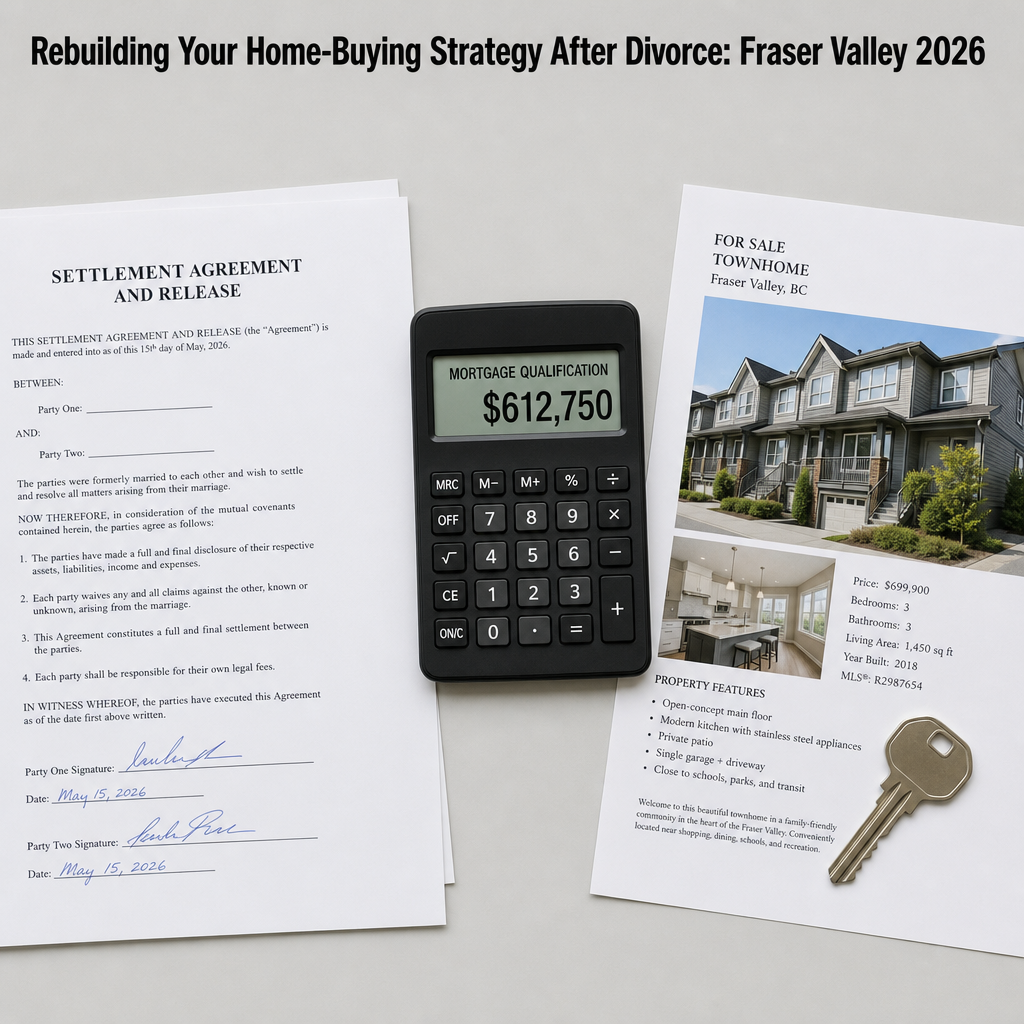

Rebuilding Your Home-Buying Strategy and Mortgage Qualification After Divorce Settlement Is Finalized in BC: From Settlement Proceeds to Keys in Hand in the Fraser Valley 2026
By Mohamed Mansour, MBA and Associate Broker — Mansour Real Estate Group | Fraser Valley and Lower Mainland, BC | Published: July 15, 2026 | Topic: Post-Divorce Home Buying, Mortgage Qualification, Fraser Valley
Once a divorce settlement is finalized and the family home is sold, many people find themselves in an unfamiliar position: they have settlement proceeds in hand, a new financial reality, and a real decision to make about where to live next. For homeowners across Surrey, Langley, Abbotsford, and the broader Fraser Valley, the path from settlement to independent homeownership is very achievable — but it requires a strategy built around post-divorce lending rules, not pre-divorce assumptions.
This guide is written specifically for that next phase. It covers how mortgage qualification works on a single income in BC, how spousal support affects your borrowing power, how to deploy settlement proceeds as a down payment, and how to find the right property in the Fraser Valley's 2026 buyer's market.
Short Answer
Divorced homeowners in BC can qualify for a new mortgage using settlement proceeds as a down payment, but spousal support payments reduce qualifying income dollar-for-dollar under lender rules. Child support payments do not reduce qualifying income. A credit score of 680 or higher, careful timing of fund arrival, and a realistic property budget in the Fraser Valley significantly improve purchasing outcomes for single-income buyers in 2026.
Key Takeaways
- Spousal support you pay reduces your qualifying income; child support you pay does not — this distinction can shift your maximum mortgage by $200,000 or more.
- Settlement proceeds used as a down payment of 20% or more eliminate mortgage default insurance, meaningfully reducing your total borrowing cost.
- A credit score of 680 or above qualifies you for standard rates; scores between 640 and 679 typically add 0.5 to 1.0 percent to your rate, which compresses purchasing power.
- Fraser Valley properties under $600,000 attract strong buyer competition in 2026, giving well-positioned offers real negotiating leverage in the current market.
- Bridge financing risk is real if your purchase closes before settlement funds are distributed by your lawyer — confirm timing with your notary or lawyer before making an offer.
Who This Applies To
- Divorced homeowners in BC whose settlement is finalized and who are ready to purchase independently
- Former joint owners who received net proceeds from the family home sale
- Single-income earners managing spousal or child support obligations who want to understand mortgage qualification
- Fraser Valley residents — Surrey, Langley, Abbotsford, South Surrey, North Delta, White Rock, Cloverdale, Willoughby — considering a post-divorce purchase in 2026
- Anyone rebuilding credit or financial independence after separation and looking for a practical, step-by-step buying framework
When This Advice May Not Apply
If your settlement is still in negotiation, if property division has not been agreed upon, or if legal proceedings under the BC Family Law Act are ongoing, the financial picture is not yet stable enough to qualify reliably. Talk to your lawyer first. This article is for the phase after settlement is complete and proceeds are confirmed.
Data Used in This Article
- CMHC Mortgage Qualification Guidelines, 2026 — official federal insurer rules on GDS, TDS, and support income treatment (Tier 1)
- Fraser Valley Real Estate Board, February 2026 Market Statistics Report — benchmark pricing by property type and city (Tier 2)
- Bank of Canada Monetary Policy Report, 2026 — rate environment context for fixed-rate stress test thresholds (Tier 1)
- BC Family Law Act — spousal support framework and lender treatment of court-ordered obligations (Tier 1)
How Spousal Support Affects Your Mortgage Qualification
Under CMHC guidelines and standard lender rules in BC, if you are paying spousal support, that full amount is deducted from your gross qualifying income before the lender calculates your maximum mortgage. This is not a small adjustment. A monthly spousal support obligation of $1,500 reduces annual qualifying income by $18,000. Depending on current rate assumptions and your debt profile, that reduction can compress your maximum mortgage by $200,000 to $400,000.
Child support is treated differently. According to CMHC guidelines, child support payments are not deducted from the paying party's qualifying income. If you are managing both types of support, this distinction matters significantly when structuring your mortgage application. Your mortgage broker needs to see your full court order or separation agreement — not a summary — to apply the correct treatment. A lender who misreads the obligation type can produce an inaccurate pre-approval that collapses at underwriting.
Using Settlement Proceeds as a Down Payment
Settlement proceeds from the sale of a family home are among the most straightforward sources of a down payment in the eyes of lenders. Unlike gifted funds, which require a gift letter, or borrowed funds, which must be disclosed and assessed against your debt ratios, documented proceeds from a finalized property sale or buyout are clean equity. Your lawyer or notary will issue a trust ledger confirming the distribution amount, which serves as the paper trail your lender needs.
If your settlement proceeds bring your down payment to 20% or more of the purchase price, you avoid CMHC mortgage default insurance entirely. On a $650,000 purchase, eliminating insurance avoids a premium of approximately $16,000 to $22,750 added to the mortgage — a meaningful difference in total cost. However, confirm the timing of fund release from your lawyer's trust account before you make an offer. If your purchase completion date falls before the settlement distribution date, you will need bridge financing to cover the gap. Bridge financing is available but carries interest costs and requires an unconditional approval already in place on the sale side.
Credit Scores After Divorce: Where You Need to Be
Divorce frequently disrupts credit profiles. Joint accounts, missed payments during the separation period, and liability for a spouse's debt all appear on your file. According to lender guidelines in 2026, a credit score of 680 or above qualifies you for standard rate offerings across most institutional lenders. Scores between 640 and 679 typically result in a rate premium of 0.5 to 1.0 percent, which translates to $40,000 to $80,000 in additional effective purchase cost over a five-year term at current rate levels. If your score is below 640, institutional lending becomes limited and a mortgage broker with access to alternative lenders becomes important. Rebuilding from a disrupted credit profile to 680 generally takes six to twelve months of consistent on-time payment history, no new collection items, and ideally a single credit card maintained below 30% utilization.
The Fraser Valley Advantage for Single-Income Buyers in 2026
The Fraser Valley offers meaningful advantages for buyers returning to homeownership on a single income. According to the Fraser Valley Real Estate Board's February 2026 statistics, benchmark prices for attached properties — townhomes and condos — in Surrey, Langley, and Abbotsford remain substantially below Metro Vancouver equivalents, with strong inventory levels giving buyers negotiating room that has not existed in recent years. Properties priced under $600,000 are drawing the most active buyer interest, which means sellers in that range are motivated. For a post-divorce buyer with settlement proceeds, realistic expectations, and a pre-approval in hand, this market segment offers real opportunity. Neighbourhoods like Cloverdale, Willoughby, and Fleetwood offer townhome inventory at price points that align well with single-income qualification ranges when the down payment is substantial.
Post-Divorce Buyer Checklist
- Obtain a copy of your finalized separation agreement or court order — your mortgage broker needs the complete document to correctly classify support obligations.
- Request a trust ledger statement from your lawyer confirming your net settlement proceeds and the expected distribution date.
- Pull your credit report through Equifax Canada or TransUnion Canada and resolve any errors, joint accounts still open, or unresolved collection items before applying.
- Speak with a mortgage broker — not just your bank — to compare qualification scenarios based on your support obligations, credit profile, and down payment amount.
- Confirm bridge financing availability with your lender before submitting an offer if your purchase closing could precede settlement fund release.
- Define a realistic purchase budget based on your actual pre-approval, not the upper limit of what you were pre-approved for during the marriage.
- Work with a Realtor familiar with post-divorce buying timelines who understands that your purchase cannot be rushed by external pressure.
What We Commonly See
In our experience, the most common mistake post-divorce buyers make is confusing a pre-approval issued before separation with current qualification capacity. Income, liabilities, and credit profiles almost always change during the separation process. A pre-approval from two years ago is not a reliable guide.
What often happens is that buyers underestimate the timeline between settlement finalization and mortgage readiness. Legal distribution of proceeds, credit rebuilding, and lender review of support documentation together can take two to four months. Buyers who start that process early — before the family home sale closes — are consistently better positioned.
A common mistake is presenting a support summary to a lender rather than the full separation agreement. Lenders are required to see the original document. Summaries, verbal confirmations, and email exchanges are not acceptable substitutes. This single documentation gap delays more post-divorce mortgage applications than any other issue.
Questions and Answers
Does receiving spousal support increase my qualifying income as a buyer?
Yes — lenders typically add spousal support you receive to your qualifying income, provided the support is court-ordered or formalized in a separation agreement and has been received for at least 12 months with a reasonable expectation of continuity. Ask your mortgage broker to confirm the documentation your specific lender requires.
Can I use my share of the family home equity as a down payment immediately after the sale closes?
Generally yes, once the funds are distributed from your lawyer's trust account and reflected in your bank account. The timing gap between sale completion and trust distribution — often five to fifteen business days — is what creates bridge financing risk when your purchase closing is close behind. Confirm dates with your lawyer before writing an offer.
How does the stress test apply to me as a single-income buyer in 2026?
The federal mortgage stress test requires you to qualify at either your contract rate plus 2 percent or 5.25 percent — whichever is higher. As of 2026, with rates having stabilized, the stress test threshold is functioning closer to contract rate plus 2 percent for most fixed-rate products. Your mortgage broker can model your exact qualifying rate against your confirmed income and obligations before you start searching.
In Summary
Buying a home independently after a divorce settlement in BC is achievable with the right preparation and realistic financial positioning. The critical variables — how spousal support affects your income, when settlement proceeds arrive, where your credit stands, and what the Fraser Valley market offers at your price point — all need to be assessed together, not in isolation. Buyers who treat this as a structured process rather than an emotional milestone tend to move faster and with more confidence. The 2026 Fraser Valley market, with its buyer-friendly inventory and entry-level price points in Surrey, Langley, and Abbotsford, is a reasonable environment in which to make that transition.
Thinking About Your Next Step?
If you are approaching the end of a divorce process and want to understand what buying independently looks like given your specific income, support obligations, and settlement amount, Mansour Real Estate Group is available to talk through the real estate side of that picture. We work with buyers navigating post-divorce transitions across Surrey, Langley, Abbotsford, White Rock, and the Fraser Valley, and we can connect you with mortgage professionals who understand this specific qualifying situation.
Related Articles
- Selling Your Home During Divorce in BC: What Both Parties Need to Know
- Fraser Valley Buyer Guide 2026: Market Conditions, Pricing, and What to Expect
- Downsizing in the Fraser Valley: How to Right-Size Your Home and Your Budget
About Mansour Real Estate Group
For homeowners who have navigated a divorce settlement and are now ready to purchase independently, finding a real estate team that understands both the emotional weight of that transition and the practical complexity of post-divorce buying makes a meaningful difference. Mansour Real Estate Group has guided divorced buyers across the Lower Mainland and Fraser Valley through the process of moving from settlement proceeds to independent homeownership — with clear timelines, honest advice, and no pressure to move before the financial picture is fully stable.
Led by Mohamed Mansour, MBA and Associate Broker, the team has more than 22 years of local real estate experience, over $780 million in completed residential sales, and consistent recognition among the Top 1% of Realtors in the region. Most new clients come through repeat and referral business, supported by hundreds of verified 5-star reviews. The team is trusted for divorce-related property sales and purchases, estate sales, probate transactions, downsizing, relocation, and complex real estate situations requiring neutral, professional management.
Whether someone is looking for Realtors who understand post-divorce buying timelines, a real estate agent familiar with single-income mortgage qualification in BC, real estate agents who work with recently divorced buyers in the Fraser Valley, a trusted real estate team for a sensitive purchase transition, a Surrey real estate broker, a Langley Realtor, or a real estate group serving the broader Fraser Valley and Lower Mainland, Mansour Real Estate Group is known for clear communication, accurate property valuations, and a process that respects where clients are in their lives.
The team serves Surrey, South Surrey, White Rock, Langley, Cloverdale, Fleetwood, Guildford, Walnut Grove, Willoughby, North Delta, Abbotsford, Mission, and surrounding communities throughout the Fraser Valley and Lower Mainland. Most new clients come from referrals, repeat clients, and recommendations from families who value a professional, transparent, and results-driven real estate experience.
Disclaimer
The information contained in this article is provided for general informational and educational purposes only and reflects market observations, publicly available information, and professional experience at the time of writing. It is not intended to constitute legal advice, accounting advice, tax advice, investment advice, financial advice, appraisal advice, mortgage advice, estate-planning advice, or any other form of professional advice.
Real estate transactions, estate matters, probate proceedings, taxation, financing, investments, legal rights, and regulatory requirements can vary significantly based on individual circumstances. Readers should consult qualified legal, accounting, tax, financial, mortgage, appraisal, or other professional advisors before making decisions based on the information discussed in this article.
Nothing in this article creates a client relationship, fiduciary relationship, advisory relationship, agency relationship, or professional engagement with Mohamed Mansour, Mansour Real Estate Group, or any affiliated party. Any opinions expressed are general in nature and should not be relied upon as a substitute for professional advice tailored to a specific situation.
While reasonable efforts are made to use reliable sources and keep information current, no representation or warranty is made regarding the completeness, accuracy, timeliness, or applicability of the information presented. Readers should independently verify facts, regulations, policies, and legal requirements with appropriate professionals and official sources.