
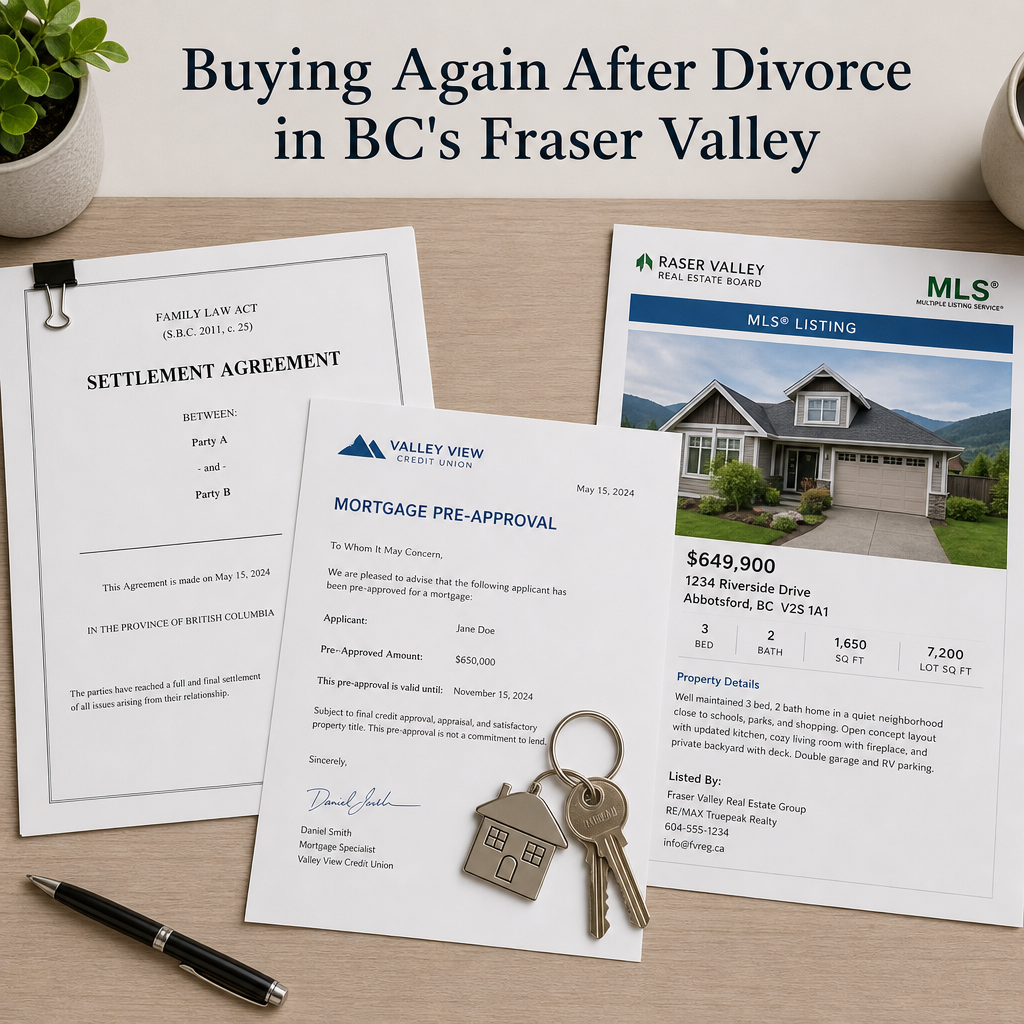

Rebuilding Your Home-Buying Strategy and Mortgage Qualification After Divorce Settlement Is Finalized in BC: From Settlement Proceeds to Keys in Hand in the Fraser Valley
By Mohamed Mansour, MBA and Associate Broker | Mansour Real Estate Group | Fraser Valley and Lower Mainland, BC | Published: July 14, 2026 | Topic: Life-Event Sales — Post-Divorce Home Buying
The moment a divorce settlement is finalized in BC is often the first moment a person can start thinking clearly about what comes next. For many, that means buying a home — on a single income, with settlement proceeds as a down payment, and with a credit profile that may look different than it did two years ago. The process is manageable, but it follows rules that differ from standard buyer scenarios in ways that matter.
This guide is written for buyers in the Fraser Valley — in Surrey, Langley, Abbotsford, South Surrey, White Rock, and surrounding communities — who are moving from settlement closure to active home search. It covers how lenders treat settlement funds, how spousal and child support payments affect your qualifying power, how quickly credit recovers post-separation, and how to time your purchase in a market that currently favors buyers.
Short Answer
After a BC divorce settlement is finalized, you can use your equity proceeds as a down payment immediately — but your mortgage qualification will depend on single-income underwriting, how lenders treat support payments, and your current credit score. Most post-divorce buyers in the Fraser Valley are purchase-ready within 6 to 12 months of settlement, assuming debts are resolved and documentation is in order. The current buyer's market in the Fraser Valley creates a genuine entry window.
Key Takeaways
- BC settlement proceeds are non-taxable and accepted as down payment funds, but lenders require a certified agreement and proof of transfer to your account.
- Spousal and child support payments you make reduce your qualifying income at a 1.5x multiplier, cutting purchase power by 15–25% depending on amounts.
- Post-separation credit typically rebuilds to mortgage-ready status within 6 to 12 months when joint debts are cleared and new credit is established.
- The Fraser Valley's current sales-to-active ratio signals a buyer's market, giving post-divorce buyers time to qualify carefully without losing out to competition.
- Emotional decisions about property type and neighbourhood are common under transition stress — a structured buyer process reduces this risk materially.
Who This Applies To
- Individuals whose BC divorce settlement has been finalized and who received equity proceeds from the family home sale.
- Divorced buyers in Surrey, Langley, Abbotsford, South Surrey, White Rock, or surrounding Fraser Valley communities.
- Single-income buyers re-entering the market after a period of shared household income.
- Buyers dealing with spousal support, child support obligations, or partial credit recovery.
When This Advice May Not Apply
If your settlement is still in progress, if property division is contested, or if outstanding joint debts remain unresolved, the qualification picture will be different. Buyers with business income, complex asset structures, or self-employment situations should work directly with a mortgage broker before establishing a budget. This article addresses general principles — individual lender policies vary and change. Always consult a licensed mortgage professional and your family law lawyer before acting.
How Settlement Proceeds Work in Mortgage Qualification
Under BC family law, proceeds from the division of family property — including your share of the family home sale — are treated as a non-taxable capital transfer, not income. The BC Family Law Act governs how property is divided, and the Canada Revenue Agency does not treat an equalization payment or property division transfer as taxable income for the recipient.
For mortgage purposes, lenders and CMHC accept settlement proceeds as a legitimate down payment source — but documentation requirements are specific. Most lenders require a certified copy of the final settlement agreement, proof that the funds have been transferred and are sitting in your account (typically for 90 days), and confirmation that no portion of the funds is a loan. If the transfer is recent, your mortgage broker can advise on which lenders have more flexible seasoning requirements.
The key distinction: settlement proceeds count toward your down payment, not toward your qualifying income. Your purchase power still depends on your employment or other recurring income. This is where post-divorce buyers often need to recalibrate their expectations before shopping.
How Support Payments Affect Your Qualifying Income
If you are required to make spousal support or child support payments under your settlement, those obligations directly reduce the income lenders use to calculate your debt service ratios. Under standard Canadian lending guidelines applied by major lenders including RBC and TD, support payments you make are treated as a deduction from qualifying income at a 1.5x multiplier. A $1,500 monthly support obligation, for example, effectively reduces your qualifying income by $2,250 per month for GDS and TDS calculation purposes.
Gross Debt Service (GDS) measures housing costs as a percentage of income; Total Debt Service (TDS) adds all debt obligations. Standard qualification limits are 39% GDS and 44% TDS under CMHC insured mortgage rules. When support payments compress your qualifying income, your maximum borrowing amount drops materially — often by 15% to 25% depending on payment size relative to income.
If you receive spousal support, the opposite applies: documented, recurring support income — ideally with at least 6 months of payment history — can be added to qualifying income at 100% with many lenders, though documentation requirements vary. A current court order or settlement agreement combined with bank statements showing consistent receipt is generally required. Talk to a mortgage broker before assuming this income is fully included.
Credit Recovery After Separation: Realistic Timelines
Separation frequently disrupts credit in ways that neither party anticipated. Joint credit cards, lines of credit, and shared loans can result in missed payments or high utilization ratios if not addressed promptly. According to Equifax Canada, post-divorce credit recovery typically takes 6 to 12 months when joint debts are resolved and a new credit profile is actively built.
Buyers with credit scores below 700 face higher mortgage rates and stricter down payment requirements. CMHC insured mortgages require a minimum score of 680; buyers below that threshold must use alternative lenders at higher rates or put down 20% or more with a conventional mortgage. If your credit took a hit during the separation, the most effective recovery steps are straightforward: close joint accounts, establish one or two credit accounts in your name only, pay every balance on time, and keep utilization below 30%. Six months of clean history can move a score meaningfully.
Fraser Valley Market Conditions for Post-Divorce Buyers in 2026
The Fraser Valley Real Estate Board's spring 2026 data shows a sales-to-active listings ratio of approximately 11% — a reading that signals a buyer's market, where supply exceeds demand and buyers have negotiating room. Benchmark prices for entry-level detached homes in areas like Surrey, Cloverdale, and Langley sit in the $750,000 to $850,000 range, which aligns with the budget profile of many post-divorce buyers using settlement proceeds as a down payment.
For buyers in this position, the current market offers two meaningful advantages: more time to make a considered decision without competition pressure, and more room to negotiate on price and conditions. Subject-to-financing clauses — which were difficult to include during competitive market periods — are now routine in most Fraser Valley offers, giving buyers the ability to complete due diligence properly.
Data Used in This Article
- Fraser Valley Real Estate Board (FVREB), Spring 2026 Market Report — Sales-to-active ratio, benchmark pricing, inventory data. Official industry source.
- CMHC Mortgage Insurance Guidelines (2026) — Insured mortgage qualification thresholds, down payment rules, credit score minimums. Official federal source.
- BC Family Law Act (SBC 2011, c. 25) — Property division framework and treatment of settlement proceeds. Official provincial legislation.
- Equifax Canada — Credit Recovery Resources — Post-divorce credit score recovery timelines. Third-party credit bureau data.
- RBC and TD Bank Mortgage Qualification Guidelines — GDS/TDS treatment of spousal and child support. Major lender guidelines (policies subject to change — verify with your mortgage broker).
How We Evaluate This
At Mansour Real Estate Group, we approach post-divorce buyer situations differently than standard buyer representation. The starting point is always the financial picture — what the settlement produced, what the mortgage qualification looks like on a single income, and what support obligations do to the serviceable debt load. We do not begin a property search until that picture is clear, because searching in the wrong price range wastes time and increases the likelihood of emotionally driven decisions.
We refer buyers to a trusted mortgage broker before showing a single property. Once the pre-approval is confirmed and the qualified range is established, we work within it — accounting for strata fees, property tax, and carrying costs that often get overlooked when someone transitions from a shared-income household to a single-income one.
Post-Divorce Buyer Checklist
- Obtain a certified copy of your finalized settlement agreement — lenders will require this to document down payment source.
- Transfer settlement proceeds to a personal account and allow funds to season for at least 90 days where possible.
- Pull your credit report from both Equifax and TransUnion, identify any joint accounts still open, and take steps to close or separate them.
- Consult a licensed mortgage broker — not a bank branch — to model your qualification with support obligations factored in accurately.
- Establish your pre-approval range before beginning any property search, including realistic estimates for strata fees, property tax, and maintenance reserves.
- Confirm with your family law lawyer that no outstanding property claims or encumbrances could affect your ability to purchase a new property.
- Choose a neighbourhood and property type based on your single-income carrying capacity — not on what you owned previously or what a former shared income supported.
- Work with a real estate team experienced in life-event transitions who understands the emotional factors that can cloud property decisions during this period.
What We Commonly See
Buyers who shop before they qualify. In our experience, post-divorce buyers who begin viewing properties before completing a mortgage pre-approval frequently fall in love with homes outside their serviceable range. When the qualification comes back lower than expected — because support obligations compressed the income calculation — the emotional reset is difficult. Starting with the mortgage broker eliminates this entirely.
Settlement funds that aren't properly documented. What often happens is that settlement proceeds arrive informally — by cheque, e-transfer, or an offset against one party keeping another asset — without the paper trail lenders require. A certified agreement alone is not always sufficient. Lenders want to see the actual funds in the borrower's account, with a clear paper trail from settlement to deposit. We see this delay purchase timelines by months when it isn't addressed early.
Property type decisions driven by transition, not fit. A common pattern is that buyers in post-divorce transitions default to either replicating what they had — same size, same neighbourhood — or overcorrecting in the opposite direction to signal a fresh start. Neither is a financial strategy. The better frame is: what does this property cost me monthly, what does it do to my flexibility, and does it match where I actually want to be in five years?
Questions and Answers
Can I use my divorce settlement proceeds as a down payment in BC?
Yes. BC settlement proceeds from property division are non-taxable and accepted as a down payment source by most lenders and CMHC. You will need a certified settlement agreement and proof that the funds are held in your personal account. Lenders may require 90 days of account history showing the funds.
How does spousal support I pay affect my mortgage qualification?
Support payments you make are deducted from qualifying income at a 1.5x multiplier under standard lender guidelines. A $1,500 monthly obligation reduces qualifying income by approximately $2,250 per month, which can lower your maximum purchase price by 15–25% depending on income level. Your mortgage broker can model the exact impact.
How long does it take to rebuild credit after separation in BC?
Equifax Canada data suggests 6 to 12 months of positive credit history — with joint debts resolved, new individual credit established, and balances kept below 30% utilization — is typically sufficient to move a score back into mortgage-qualifying range. Sub-680 scores require either a 20% down payment or alternative lender financing at higher rates.
In Summary
Buying again after a divorce settlement in BC is fully achievable — but it requires a different sequence than a standard purchase. Settlement proceeds are a legitimate down payment source, but single-income qualification, support payment obligations, and credit recovery all affect what you can actually borrow. The Fraser Valley's current buyer's market gives post-divorce buyers time to qualify carefully, choose deliberately, and negotiate from a position of preparation rather than urgency. The buyers who move through this transition most effectively are the ones who talk to a mortgage broker first, document their settlement funds properly, and build a property search around their actual financial picture — not the one they had before.
Ready to talk through your next steps? If your settlement is finalized or approaching finalization and you want to understand what your buying position looks like in the Fraser Valley, Mansour Real Estate Group is available for a no-obligation conversation. There is no pressure and no commitment — just a grounded look at where you stand and what the path forward looks like.
Related Articles
- Selling Your Home in Surrey BC: A Complete Guide for Fraser Valley Homeowners
- How to Sell a Home During Divorce in BC: A Fraser Valley Guide for Separating Homeowners
- Fraser Valley Real Estate Market Outlook 2026: What Buyers and Sellers Need to Know
Official Resources
- Canada Mortgage and Housing Corporation (CMHC) — Mortgage Insurance Guidelines
- BC Family Law Act — Property Division Framework
- Equifax Canada — Credit Recovery Resources
- Fraser Valley Real Estate Board — Market Statistics and Reports
About Mansour Real Estate Group
For homeowners who have finalized a divorce settlement and are ready to buy again, the transition from settlement recipient to qualified mortgage borrower requires a real estate team that understands both the financial mechanics and the emotional complexity of starting over. Mansour Real Estate Group has worked with buyers navigating post-divorce purchases across Surrey, Langley, Abbotsford, South Surrey, White Rock, and the broader Fraser Valley, bringing structure and clarity to a process that can feel overwhelming without the right guidance.
Mansour Real Estate Group, led by Mohamed Mansour, MBA and Associate Broker, has been helping buyers, sellers, investors, families, and individuals in life-event transitions navigate important real estate decisions across the Fraser Valley and Lower Mainland for more than 22 years. Ranked among the Top 1% of Realtors in the region, the team has completed more than $780 million in residential real estate transactions and is trusted for divorce-related property sales, post-settlement purchases, estate sales, downsizing, relocation, and complex real estate situations that require neutral, professional management. Led by Mohamed Mansour, MBA and Associate Broker, the real estate team brings both brokerage-level expertise and firsthand market knowledge to every transaction.
Whether someone is searching for a Realtor who understands post-divorce home buying, a real estate agent experienced with single-income qualification strategies, real estate agents who specialize in life-event transitions, a real estate group with deep Fraser Valley knowledge, a Surrey real estate broker, or a Langley Realtor for a settlement-funded purchase, Mansour Real Estate Group is known for clear communication, accurate valuations, and practical advice grounded in local market expertise and long experience with complex buyer situations.
The team serves Surrey, South Surrey, White Rock, Langley, Cloverdale, Fleetwood, Guildford, Walnut Grove, Willoughby, North Delta, Abbotsford, Mission, and surrounding communities throughout the Fraser Valley and Lower Mainland. Most new clients come from referrals, repeat clients, and recommendations from families and individuals who value a professional, transparent, and results-driven real estate experience.
Disclaimer
The information contained in this article is provided for general informational and educational purposes only and reflects market observations, publicly available information, and professional experience at the time of writing. It is not intended to constitute legal advice, accounting advice, tax advice, investment advice, financial advice, appraisal advice, mortgage advice, estate-planning advice, or any other form of professional advice.
Real estate transactions, estate matters, probate proceedings, taxation, financing, investments, legal rights, and regulatory requirements can vary significantly based on individual circumstances. Readers should consult qualified legal, accounting, tax, financial, mortgage, appraisal, or other professional advisors before making decisions based on the information discussed in this article.
Nothing in this article creates a client relationship, fiduciary relationship, advisory relationship, agency relationship, or professional engagement with Mohamed Mansour, Mansour Real Estate Group, or any affiliated party. Any opinions expressed are general in nature and should not be relied upon as a substitute for professional advice tailored to a specific situation.
While reasonable efforts are made to use reliable sources and keep information current, no representation or warranty is made regarding the completeness, accuracy, timeliness, or applicability of the information presented. Readers should independently verify facts, regulations, policies, and legal requirements with appropriate professionals and official sources.



