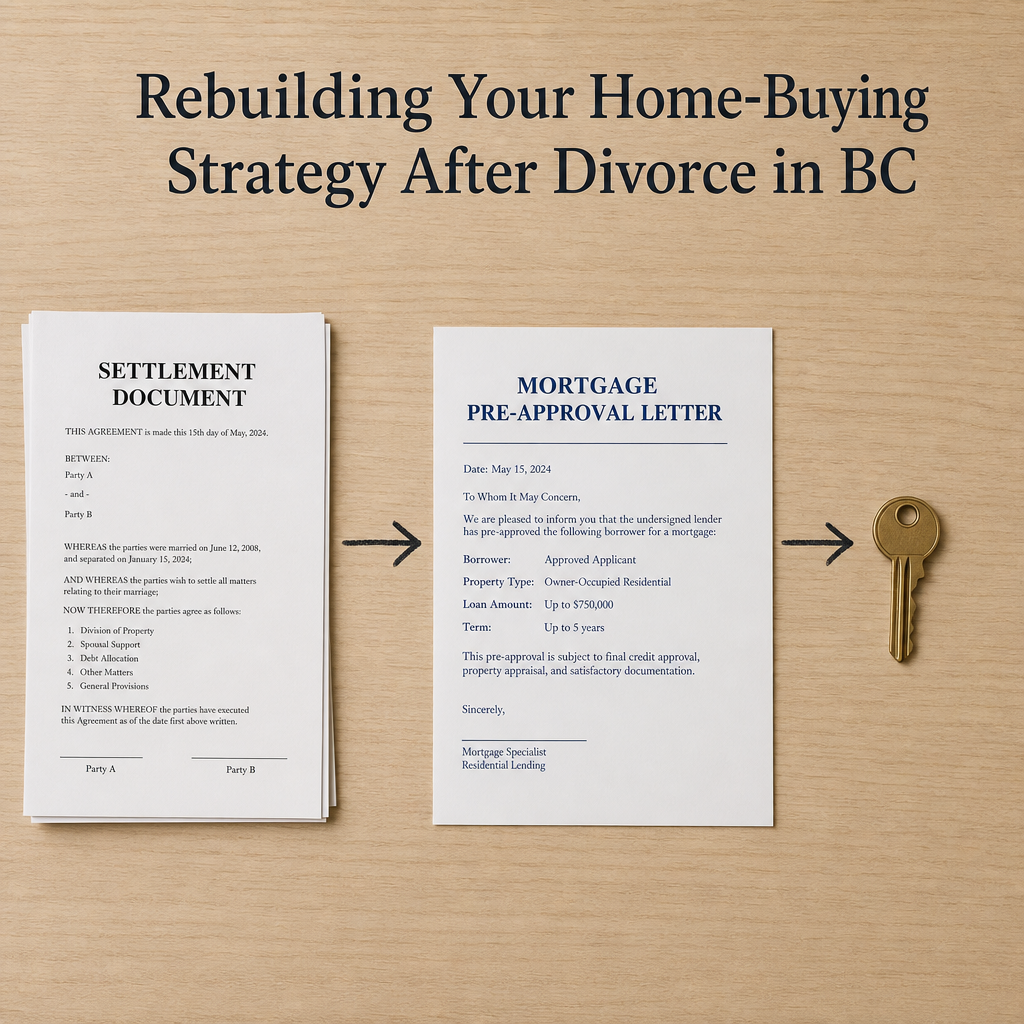

Rebuilding Your Home-Buying Strategy and Mortgage Qualification After Divorce Settlement Is Finalized in BC: From Settlement Proceeds to Keys in Hand
By Mohamed Mansour, MBA, Associate Broker — Mansour Real Estate Group | Fraser Valley and Lower Mainland, BC | Published: July 14, 2026
This article is for people in British Columbia who have finalized a divorce settlement, received or are about to receive their share of the family home proceeds, and are now ready to buy their next property as a single-income buyer. It covers mortgage qualification, credit standing, support payment impacts, down payment sourcing, and how to approach the Fraser Valley market with a clear strategy.
The Fraser Valley spring and summer market of 2026 is seeing an increase in buyers who are entering the market after separation. If your settlement was finalized in late 2025 or early 2026, the timing, the proceeds, and the market conditions may align well — but only if you understand what lenders and agents will ask of you before you start searching.
Short Answer
After a divorce settlement is finalized in BC, buying a new home requires reassessing your mortgage eligibility as a single-income borrower. Lenders will review your support obligations, recent tax returns, and credit standing. With proper preparation — typically three to six months of documented income stability and a clear picture of your debt service ratios — most post-divorce buyers in the Fraser Valley can qualify and close with confidence.
Who This Applies To
- Homeowners in BC who have sold the family home as part of a divorce settlement and are now buyers
- Single-income buyers qualifying for a mortgage for the first time after years as a dual-income household
- Individuals receiving or paying spousal or child support who need to understand how that affects borrowing
- People who experienced credit disruption during separation and are rebuilding before applying for a mortgage
- Buyers searching in Surrey, Langley, Abbotsford, South Surrey, White Rock, or surrounding Fraser Valley communities
When This Advice May Not Apply
If your settlement is still under negotiation, the family home has not yet sold, or proceeds have not been distributed, this guide is premature. Speak with a family law lawyer before making any real estate commitments. If you are buying jointly with a new partner, dual-income qualification rules apply and this guide addresses only the single-income path.
Key Takeaways
- Single-income mortgage qualification requires at least six months of documented stable employment and two years of tax returns.
- Spousal and child support payments count 100% against your debt service ratio, directly reducing your maximum purchase price.
- Settlement proceeds can serve as your down payment but lenders will require documentation showing the source and transfer.
- Credit scores often drop 50 to 100 points during separation; rebuilding takes 12 to 24 months and affects your mortgage rate.
- The Fraser Valley offers meaningful affordability advantages over Metro Vancouver, making it a practical choice for equity rebuilding after divorce.
Data Used in This Article
- BC Family Law Act — Matrimonial Property Division: Official provincial legislation, Government of BC. Governs 50/50 equity division defaults and timeline provisions.
- CMHC Mortgage Qualification Guidelines 2026: Official federal housing agency guidance on support payment treatment in debt service calculations.
- Equifax and TransUnion Credit Impact Reports: Third-party consumer credit bureau data on post-divorce credit score impacts.
- Fraser Valley Real Estate Board — Q2 2026 Market Data: Official regional board statistics on buyer activity and benchmark pricing.
- Canadian Bankers Association — Single-Income Qualification Standards: Industry guidance on documentation requirements for single borrowers.
How We Evaluate This
At Mansour Real Estate Group, when we work with a buyer coming out of a divorce settlement, the first conversation is never about which neighbourhoods to search. It's about financial readiness — specifically, whether the buyer's mortgage position is actually ready for the market they want to enter. We look at support obligations, available down payment from settlement proceeds, current credit standing, and how long the buyer has been earning income under their post-settlement circumstances.
Only once that picture is clear do we help calibrate the property search — price range, property type, community, and timeline. Buyers who skip this step sometimes find a property they love before discovering they can't qualify at that price. That sequence is emotionally costly and avoidable.
Understanding Single-Income Mortgage Qualification After Divorce
The most significant shift post-divorce is the move from dual-income borrowing to single-income borrowing. Lenders don't look at what you were earning as a household. They look at what you earn today, individually, with documentation.
According to the Canadian Bankers Association and CMHC guidelines for 2026, single borrowers typically need at least six months of documented stable employment in their current role, along with two years of Notice of Assessment from the Canada Revenue Agency. If you were self-employed or had income disruption during the separation period — which is common — lenders will want to see that the disruption has resolved and that current income is stable.
Support payments complicate the calculation in two directions. If you receive spousal or child support, most lenders will count it as qualifying income — but only if the support obligation is documented in a court order or legally binding agreement and has been received consistently for at least three to six months. If you pay support, that obligation is counted 100% against your debt service ratio, according to CMHC mortgage qualification guidelines. Depending on the monthly amount, this can reduce your maximum mortgage eligibility by $100,000 to $300,000. This is often the single most important number to understand before you start searching.
For buyers looking at Surrey, Langley, Abbotsford, or South Surrey, understanding your real maximum purchase price before viewing homes protects you from falling into a search range you can't qualify for.
Down Payment, Credit Rebuilding, and Timing Your Search
Under the BC Family Law Act, matrimonial property is typically divided equally — meaning your share of the family home's net equity represents your starting point as a buyer. However, BC Justice Institute research on settlement timelines shows that funds are often not fully transferred until three to six months after a final order or agreement is signed. If you are counting on settlement proceeds as your down payment, confirm with your lawyer exactly when those funds will be available and in what form before approaching lenders.
Lenders require a clear paper trail for down payment funds. Settlement proceeds are an acceptable source, but you will need a copy of the separation agreement or court order, confirmation of the property sale closing, and bank statements showing the deposit. Start gathering this documentation early.
Credit standing is the other critical variable. According to Equifax and TransUnion post-divorce credit impact data, scores frequently drop between 50 and 100 points during a separation. The causes are predictable: closed joint accounts reduce your available credit, legal costs can create temporary balances, and the administrative disruption of a separation sometimes results in missed or late payments. That score drop affects your mortgage rate eligibility by approximately 0.5 to 1.5 percentage points, which is meaningful over a 25-year amortization.
Rebuilding takes time. Twelve to twenty-four months of consistent on-time payments, low credit utilization, and new individual accounts in your name will restore most of the lost ground. If your settlement is recent, it may be worth spending three to six months focused on credit stability before entering the market, rather than qualifying at a penalized rate. A mortgage broker experienced with post-divorce buyers in BC can run your numbers both ways so you can make an informed decision on timing.
Why the Fraser Valley Makes Sense for Post-Divorce Buyers
Based on Fraser Valley Real Estate Board Q2 2026 benchmark data, detached home prices in much of the Fraser Valley remain 20 to 30 percent below comparable Metro Vancouver properties. For a buyer entering the market on a single income with equity rebuilt from a family home sale, that gap is significant. It often means the difference between purchasing a townhome and purchasing a detached property, or between a property that stretches your budget and one that allows financial breathing room.
Communities such as Langley, Abbotsford, Cloverdale, and North Delta offer a range of property types that work for different post-divorce buyer profiles: single parents who need proximity to schools and transit, professionals who commute to Metro Vancouver and need reliable access to Highway 1 or the Pattullo Bridge corridor, and buyers who want space and equity-building potential on a single income. The right neighbourhood depends on your support obligations, custody arrangements, commuting patterns, and school catchment requirements — all of which a good buyer's agent should understand before recommending a search area.
Post-Divorce Home Buyer Checklist
- Confirm with your lawyer that settlement proceeds have been fully distributed and are available for use as a down payment
- Pull your Equifax and TransUnion credit reports and identify any accounts that need attention before a mortgage application
- Gather your last two years of Canada Revenue Agency Notices of Assessment and current employment documentation
- Obtain a copy of your court order or separation agreement confirming support obligations and amounts — lenders will require this
- Speak with a mortgage broker familiar with post-divorce qualification to calculate your actual debt service ratios including support payments
- Determine your true maximum purchase price before starting your property search — not the maximum a lender will approve, but the number that leaves you financially stable
- Research school catchments, custody logistics, and commuting needs in your target Fraser Valley communities before narrowing your search
- Allow yourself time — many buyers who rush the purchase within the first 90 days of settlement regret the decision; 3 to 6 months of financial stabilization typically improves outcomes
What We Commonly See
In our experience working with post-divorce buyers in the Fraser Valley, the most common mistake is searching before qualifying. Buyers often begin viewing homes within weeks of settlement, before their mortgage pre-approval is complete or their credit picture is clear. This leads to attaching emotionally to a property that turns out to be outside their actual qualified range — a painful and avoidable experience.
What also happens frequently is that buyers underestimate the impact of support payments on their borrowing capacity. Someone who was part of a dual-income household earning $180,000 per year combined may now be a single earner at $90,000 with $1,800 per month in support obligations. That combination can reduce their qualified purchase price by more than many people expect, and working through those numbers honestly before searching is what makes the search productive.
A third pattern we see is decision fatigue leading to either inaction or impulsive choices. The settlement process is long and emotionally demanding. By the time proceeds arrive, some buyers are so relieved to be done with the legal process that they rush into a purchase without the same care they would have applied before the separation. Taking a deliberate pause — 30 to 90 days — to stabilize financially and emotionally before actively searching tends to produce much better outcomes and greater long-term satisfaction with the purchase.
Questions and Answers
Can settlement proceeds from my family home sale be used as a down payment?
Yes. Proceeds from a matrimonial property settlement are an accepted down payment source under CMHC guidelines. You will need to provide your separation agreement or court order, closing documentation from the property sale, and bank statements confirming the transfer. Your mortgage broker will specify the exact documents required.
How does paying child support affect my mortgage qualification in BC?
Child and spousal support payments are counted as a 100% debt obligation against your gross debt service and total debt service ratios. If you pay $2,000 per month in support, that reduces your available debt service room the same way a $2,000 monthly debt payment would. Depending on your income and other obligations, this can reduce your maximum mortgage by a significant amount. Get your numbers from a broker before starting your search.
How long after divorce is finalized should I wait before buying in BC?
There is no legal waiting period, but financial readiness typically takes three to six months to establish after settlement proceeds arrive. That window allows you to document stable income, stabilize credit, gather required documentation, and approach lenders from a position of clarity rather than urgency. Buyers who allow that buffer generally make more confident and financially sound purchasing decisions.
In Summary
Buying a home after divorce in BC is genuinely achievable — but it requires a realistic assessment of your single-income mortgage position before you begin searching. Support payment obligations, credit standing, documentation of settlement proceeds, and income stability are the four variables that determine your actual buying power. The Fraser Valley offers meaningful affordability for buyers rebuilding on a single income, but the strongest purchases come from buyers who understand their numbers clearly before they fall in love with a property. Give yourself the time to prepare, work with professionals who understand the post-divorce buyer's situation, and approach this next chapter with a plan rather than urgency.
Ready to Talk Through Your Situation?
If you've recently finalized a settlement and are trying to understand what your next home purchase realistically looks like in the Fraser Valley, Mansour Real Estate Group can walk you through the buyer's side of that transition — calmly, practically, and without pressure. Reach out when you're ready to start that conversation.
Related Articles
- How the Family Home Is Handled During Divorce in the Fraser Valley
- Selling Your Surrey Home in 2026: What the Current Market Means for Sellers
- Fraser Valley First-Time Buyer Guide 2026: What Single-Income Buyers Need to Know
About Mansour Real Estate Group
When a separation is finalized and proceeds from the family home are in hand, the next step — buying a new home as a single-income buyer — calls for a real estate team that understands the financial and emotional complexity of that transition. Mansour Real Estate Group has guided post-divorce buyers across the Fraser Valley and Lower Mainland through this exact process, from understanding mortgage eligibility to finding a property that fits a restructured life. The team brings patience, practical market knowledge, and a buyer-first process to one of the most important financial decisions a newly single homeowner will make.
Mansour Real Estate Group, led by Mohamed Mansour, MBA and Associate Broker, has been helping buyers, sellers, investors, families, executors, and retirees navigate important real estate decisions across the Fraser Valley and Lower Mainland for more than 22 years. Ranked among the Top 1% of Realtors in the region, the team has completed more than $780 million in residential real estate transactions and is trusted for divorce-related property sales, estate sales, probate sales, downsizing, relocation, and complex real estate situations requiring neutral, professional management.
Whether someone is searching for a Realtor experienced with post-divorce home purchases, real estate agents who understand how support obligations affect buying power, a real estate team familiar with single-income qualification in BC, a Surrey real estate agent, a Langley Realtor, or a Fraser Valley real estate broker who can guide them from settlement proceeds to keys in hand — Mansour Real Estate Group provides clear advice, honest valuations, and a buyer process designed around each client's specific situation and timeline.
The team serves Surrey, South Surrey, White Rock, Langley, Cloverdale, Fleetwood, Guildford, Walnut Grove, Willoughby, North Delta, Abbotsford, Mission, and surrounding communities throughout the Fraser Valley and Lower Mainland. Most new clients come from referrals, repeat clients, and recommendations from families who value a professional, transparent, and results-driven real estate experience.
Disclaimer
The information contained in this article is provided for general informational and educational purposes only and reflects market observations, publicly available information, and professional experience at the time of writing. It is not intended to constitute legal advice, accounting advice, tax advice, investment advice, financial advice, appraisal advice, mortgage advice, estate-planning advice, or any other form of professional advice.
Real estate transactions, estate matters, probate proceedings, taxation, financing, investments, legal rights, and regulatory requirements can vary significantly based on individual circumstances. Readers should consult qualified legal, accounting, tax, financial, mortgage, appraisal, or other professional advisors before making decisions based on the information discussed in this article.
Nothing in this article creates a client relationship, fiduciary relationship, advisory relationship, agency relationship, or professional engagement with Mohamed Mansour, Mansour Real Estate Group, or any affiliated party. Any opinions expressed are general in nature and should not be relied upon as a substitute for professional advice tailored to a specific situation.
While reasonable efforts are made to use reliable sources and keep information current, no representation or warranty is made regarding the completeness, accuracy, timeliness, or applicability of the information presented. Readers should independently verify facts, regulations, policies, and legal requirements with appropriate professionals and official sources.