
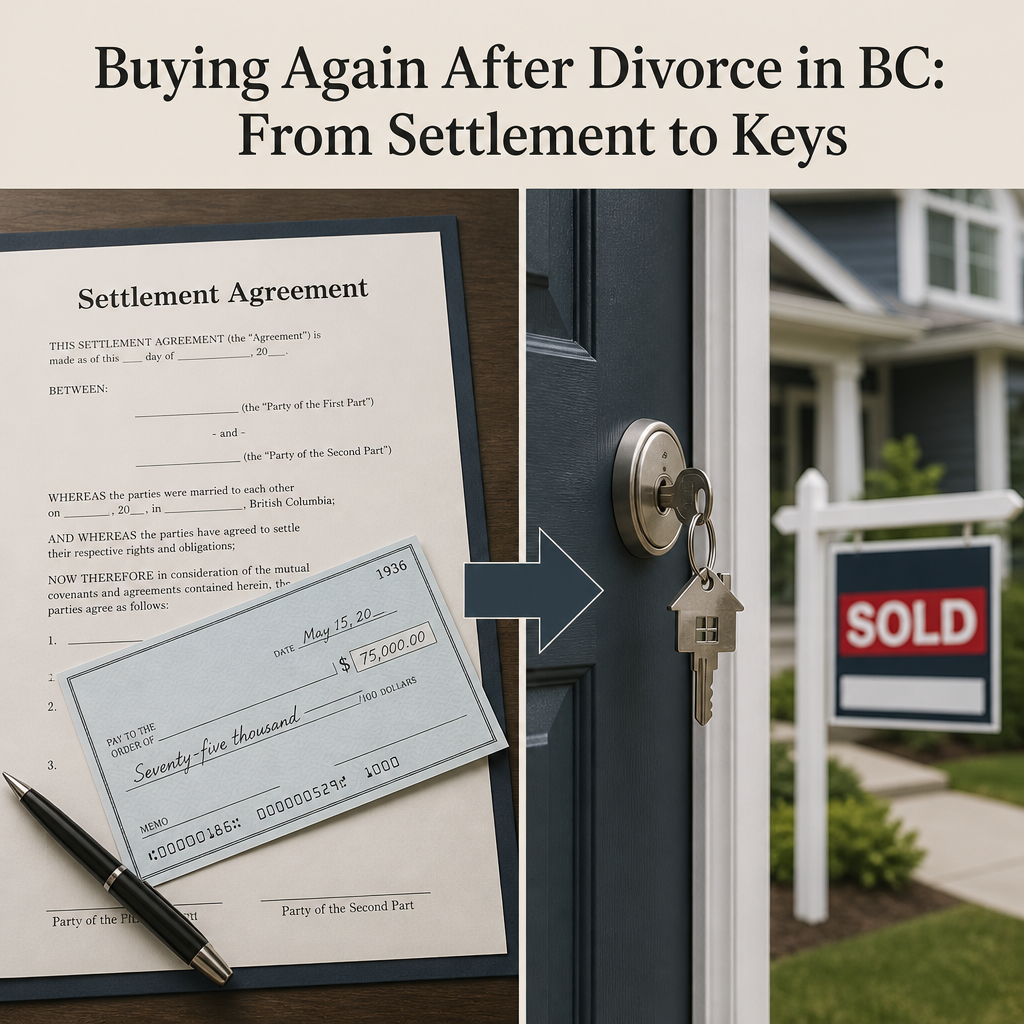

Rebuilding Your Home-Buying Strategy and Mortgage Qualification After Divorce Settlement Is Finalized in BC: From Settlement Proceeds to Keys in Hand
By Mohamed Mansour, MBA and Associate Broker · Mansour Real Estate Group · Fraser Valley and Lower Mainland, BC · Published: July 14, 2026
For homeowners in Surrey, Langley, Abbotsford, and across the Fraser Valley, finalizing a divorce settlement is one milestone. Buying your next home is a completely different process—one that most buyer's guides don't address directly. Single-income qualification, settlement proceeds arriving on a specific timeline, spousal support payments affecting debt ratios, and credit history that may carry joint-account complexity all create a distinct set of challenges for post-divorce buyers re-entering the market.
This article is written specifically for that situation. It covers how mortgage qualification works after settlement, what the current Fraser Valley market means for your timing, and how to move from proceeds received to purchase completed without losing ground.
Short Answer
After a divorce settlement is finalized in BC, buying again typically requires re-qualifying on a single income, documenting settlement proceeds as part of your down payment, and allowing time for credit separation if joint accounts are still being unwound. In the Fraser Valley's current buyer-leaning market, pre-approved buyers with settlement funds in hand have real negotiating power—but the window requires deliberate preparation.
Who This Applies To
- Homeowners whose divorce settlement has been finalized and who are now receiving or have received net sale proceeds
- Individuals qualifying for a mortgage on a single income for the first time after a shared household
- Buyers who will be receiving or paying spousal or child support, which affects their qualifying ratios
- Those rebuilding credit after closing or separating joint accounts
- Fraser Valley and Lower Mainland residents looking to purchase within 3–12 months of settlement completion
When This Advice May Not Apply
This article addresses general principles and market context. If your settlement agreement contains specific conditions on how proceeds must be held or used, those terms govern. Buyers with complex financial structures—business income, self-employment, multiple properties, or ongoing litigation—should work directly with a mortgage broker and lawyer before applying. Nothing here constitutes legal, tax, or mortgage advice.
Key Takeaways
- Single-income mortgage qualification after divorce requires updated income documentation and a clear picture of support obligations
- Settlement proceeds are an accepted down payment source but require a paper trail that lenders will verify
- Spousal or child support payments affect both sides of the debt-service ratio calculation differently
- The Fraser Valley's current buyer-leaning conditions give pre-approved buyers real negotiating leverage in mid-2026
- Preparing the financial file before house-hunting shortens the timeline and reduces the risk of losing a property
Data Used in This Article
- Fraser Valley Real Estate Board (FVREB) Monthly Market Report, June 2026 — Official board statistics, Fraser Valley geography, market conditions and benchmark pricing
- Metro Vancouver / GVR April 2026 Statistics — Sales-to-active-listings ratio, buyer activity, inventory levels, third-party analysis via jennyandsuzanne.ca
- Bank of Canada, 2026 Rate Announcements — Policy rate hold decisions and forward guidance
- OSFI and Government of Canada, Mortgage Stress Test Guidelines (2026) — Qualifying rate thresholds and 30-year amortization policy changes
What Changed for Buyers in 2026
Two regulatory changes made in late 2024 and carried through 2026 are directly relevant to post-divorce buyers in BC. First, the federal government expanded eligibility for 30-year amortization mortgages beyond first-time buyers, covering more insured purchase scenarios. For buyers with smaller down payments—common when settlement proceeds are split—this lowers the monthly payment and improves the gross debt service ratio used in qualification. Second, the mortgage stress test qualifying rate was adjusted in response to lower posted rates; as of early 2026, buyers are tested at the higher of their contract rate plus two percent, or 5.25 percent, depending on lender and insurer. A mortgage broker can calculate the exact qualifying threshold for your contract rate before you begin searching.
The Bank of Canada held its policy rate steady through the first half of 2026 after a series of cuts that began in mid-2024. Fixed and variable mortgage rates have moved within a relatively narrow band, and forward guidance from the Bank suggests no major near-term movement is likely—though that assessment changes with inflation data. For buyers sitting on settlement proceeds, the current rate environment is more predictable than 2023 or 2024, which creates a reasonable window to lock in without racing the calendar. Speak with a licensed mortgage broker for current rate options and your specific qualification scenario.
How Mortgage Qualification Actually Works After Divorce
Lenders assess two ratios: the gross debt service ratio (GDS) and the total debt service ratio (TDS). GDS measures housing costs against gross income. TDS adds all debt obligations—car loans, credit cards, lines of credit, and support payments—against the same income figure. After divorce, both ratios are affected in ways that don't apply to other buyers.
Spousal support you receive can generally be counted as income in your mortgage application, provided the support order or agreement is formalized and has been paid consistently, typically for at least three months. Lenders will want a copy of the court order or separation agreement and recent bank statements confirming receipt. Voluntary or informal support arrangements are harder to use without documentation.
Spousal or child support you pay is included as a debt in your TDS calculation, which reduces how much you can borrow. If your monthly support obligation is substantial relative to your income, it may compress your purchasing power more than you expect. A mortgage broker can run the numbers before you begin shopping so there are no surprises when pre-approval comes back lower than anticipated.
Joint debt that has not yet been separated—shared credit cards, a joint line of credit, or a vehicle loan that hasn't been transferred—may still appear on your credit report and affect your TDS. Resolving those accounts or having your name formally removed should be part of the pre-purchase financial checklist, ideally done before applying.
Settlement proceeds as a down payment are acceptable to most lenders, but the source must be documented. Lenders typically require a copy of the signed separation agreement showing the proceeds allocation, a lawyer's trust account statement or statement of adjustments from the sale of the family home, and confirmation the funds are now in your account. A 90-day bank history is standard. If the sale completed recently and funds are still being processed, discuss timing with your mortgage broker before applying.
What the Fraser Valley Market Means for Your Timing
According to the Fraser Valley Real Estate Board's June 2026 market report, active listings across the region remain elevated, with inventory above 10,000 listings. The sales-to-active-listings ratio in Metro Vancouver sat at approximately 13.5 percent in April 2026—below the 20 percent threshold that typically signals balanced conditions. Benchmark prices in the Fraser Valley are down approximately 7 to 8 percent year-over-year, according to FVREB data. These are measurable buyer advantages, but they require preparation to access.
Buyer hesitation in mid-2026 is real. Psychological uncertainty about rates, employment, and affordability is keeping many qualified buyers on the sidelines. For post-divorce buyers who are emotionally ready and financially prepared, this hesitation works in your favour. A pre-approved buyer with documented settlement funds can negotiate with credibility in a market where many competing buyers are still waiting to see what rates do next.
Neighbourhoods across Surrey, Langley, Willoughby, Cloverdale, and Abbotsford are all showing more negotiating room than during the 2021–2022 peak. If you recently sold the family home as part of the divorce process, the market you are re-entering as a buyer is meaningfully different—in your favour—compared to where it was when the family home was purchased.
How We Evaluate This
At Mansour Real Estate Group, we approach post-divorce buyer situations the same way we approach estate and downsizing transitions: with the financial preparation conversation first, before any property search begins. The buyers who move from settlement to purchase most smoothly are the ones who spent four to eight weeks getting the mortgage file in order before committing to a search timeline.
Our role in that process is to understand what your pre-approval ceiling looks like, which neighbourhoods and property types fit that ceiling in the current Fraser Valley market, and what your non-negotiables are for the next chapter. We don't push buyers toward properties at the top of their range. We help identify where the value is within the range—and in a market with 10,000+ active listings, that analysis matters.
Divorce Buyer Checklist
- Obtain a certified copy of the finalized separation agreement and confirm all real property matters are resolved
- Collect documentation of settlement proceeds: trust statement from lawyer, statement of adjustments from the family home sale, 90-day bank history showing deposit
- Pull your credit report and confirm all joint accounts have been closed or transferred; dispute any errors from the marriage period
- Document support income or obligations with a court order or formalized agreement and three months of payment history
- Meet with a licensed mortgage broker (not just a bank) to stress-test your qualification at current and slightly higher rates
- Confirm your target neighbourhoods and property types based on the pre-approval ceiling, not pre-divorce expectations
- Discuss timing with your real estate team before beginning active property search so showings and offers align with your readiness
What We Commonly See
Buyers underestimate the documentation required for settlement proceeds. In our experience, the most common delay in post-divorce purchases is not the pre-approval itself—it's assembling the paper trail for the down payment source. Lenders do not accept verbal confirmation. A trust statement from your lawyer and a clear chain of funds from the family home sale to your personal account are non-negotiable. Starting that documentation process the day the sale completes saves weeks later.
Support obligations surprise buyers at pre-approval. What often happens is that buyers who pay support assume it won't affect their qualifying much—until the mortgage broker runs the TDS calculation and the purchase ceiling drops by $80,000 to $150,000 from what they expected. Knowing that number early lets buyers recalibrate their target price range before getting emotionally attached to properties that won't qualify.
Credit files carry ghosts from the marriage. Joint accounts that were closed informally—without both parties formally notifying the creditor—can stay on both credit reports for years. A common mistake is assuming credit is clean because the account is unused. Checking your credit report from both Equifax and TransUnion before applying is the only way to know what lenders will see.
Frequently Asked Questions
Can I use spousal support income to qualify for a mortgage in BC?
Yes, in most cases. Lenders typically require a formal support order or separation agreement and evidence of consistent payment—usually three to six months of bank statements showing deposits. Informal or verbal support arrangements are generally not accepted without documentation. Confirm the specific requirements with a licensed mortgage broker, as lender policies vary.
How long after receiving settlement proceeds can I use them as a down payment?
There is no mandatory waiting period, but lenders require a 90-day bank history and documentation of the source. If funds arrived recently, you may need to provide a lawyer's trust statement, the statement of adjustments from the family home sale, and bank statements showing the deposit. Starting the mortgage application before the 90-day history is complete may delay approval.
Does paying child support affect how much mortgage I can qualify for?
Yes. Child and spousal support payments are included as monthly obligations in your total debt service ratio calculation. A higher support obligation reduces the remaining income available for housing costs, which lowers your maximum qualifying amount. The impact depends on the payment amount relative to your gross income. A mortgage broker can calculate this precisely before you begin searching.
In Summary
Buying again after a divorce settlement in BC is a distinct process from a typical first-time or repeat purchase. Single-income qualification, documented settlement proceeds, and the effect of support obligations on debt service ratios all require preparation before the search begins. The Fraser Valley's current buyer-leaning conditions—with benchmark prices down and inventory elevated as of mid-2026—offer real advantages to buyers who are financially ready. The gap between settlement finalized and keys in hand closes fastest for buyers who build the mortgage file first.
Ready to Talk Through Your Situation?
If your settlement has been finalized and you're thinking about what the next purchase looks like, Mansour Real Estate Group is available for a straightforward conversation about where the market sits, what neighbourhoods fit your range, and how to time the process. No pressure—just local context when you need it. Reach out here.
Related Articles
- Selling the Family Home During Divorce in BC: What Every Homeowner Needs to Know
- Fraser Valley Real Estate Market Outlook 2026
- How to Buy a Home in the Fraser Valley: A Step-by-Step Guide for 2026
About Mansour Real Estate Group
After a divorce settlement is finalized, the next real estate decision—buying again on a single income, using settlement proceeds strategically, and navigating a market that's changed since the family home was purchased—requires a team that understands both the financial complexity and the local market conditions. Mansour Real Estate Group has worked with homeowners and families managing divorce-related property sales and post-settlement purchases across the Lower Mainland and Fraser Valley, bringing a structured, valuation-first process to situations where clarity and professionalism matter most.
Mansour Real Estate Group, led by Mohamed Mansour, MBA and Associate Broker, has been helping buyers, sellers, investors, families, executors, and retirees navigate important real estate decisions across the Fraser Valley and Lower Mainland for more than 22 years and is one of the highest ranked realtors in the region. The team has completed more than $780 million in residential real estate transactions and is trusted for divorce-related property sales, estate sales, downsizing, relocation, and complex real estate situations requiring neutral, professional management. As a real estate group built on repeat and referral business, the team's approach to post-divorce buyers reflects the same standards applied to every client: accurate information, realistic timelines, and advice grounded in current local conditions.
Whether someone is searching for Realtors experienced with post-divorce home purchases, a real estate agent who understands how spousal support affects mortgage qualification, real estate agents who specialize in buyer transitions following separation, a trusted real estate team for a first solo purchase, a Surrey Realtor familiar with settlement-to-purchase timelines, a Langley real estate broker for single-income buyers, or a real estate group serving the Fraser Valley and Lower Mainland, Mansour Real Estate Group is known for clear communication, strategic market analysis, and practical advice that fits the actual situation.
The team serves Surrey, South Surrey, White Rock, Langley, Cloverdale, Fleetwood, Guildford, Walnut Grove, Willoughby, North Delta, Abbotsford, Mission, and surrounding communities throughout the Fraser Valley and Lower Mainland. Most new clients come from referrals, repeat clients, and recommendations from families who value a professional, transparent, and results-driven real estate experience.
Official Resources
- Fraser Valley Real Estate Board — Monthly Market Reports
- Bank of Canada — Policy Interest Rate
- Government of Canada — Mortgage Stress Test
- BC Government — Divorce and Separation Information
Disclaimer
The information contained in this article is provided for general informational and educational purposes only and reflects market observations, publicly available information, and professional experience at the time of writing. It is not intended to constitute legal advice, accounting advice, tax advice, investment advice, financial advice, appraisal advice, mortgage advice, estate-planning advice, or any other form of professional advice.
Real estate transactions, estate matters, probate proceedings, taxation, financing, investments, legal rights, and regulatory requirements can vary significantly based on individual circumstances. Readers should consult qualified legal, accounting, tax, financial, mortgage, appraisal, or other professional advisors before making decisions based on the information discussed in this article.
Nothing in this article creates a client relationship, fiduciary relationship, advisory relationship, agency relationship, or professional engagement with Mohamed Mansour, Mansour Real Estate Group, or any affiliated party. Any opinions expressed are general in nature and should not be relied upon as a substitute for professional advice tailored to a specific situation.
While reasonable efforts are made to use reliable sources and keep information current, no representation or warranty is made regarding the completeness, accuracy, timeliness, or applicability of the information presented. Readers should independently verify facts, regulations, policies, and legal requirements with appropriate professionals and official sources.



