
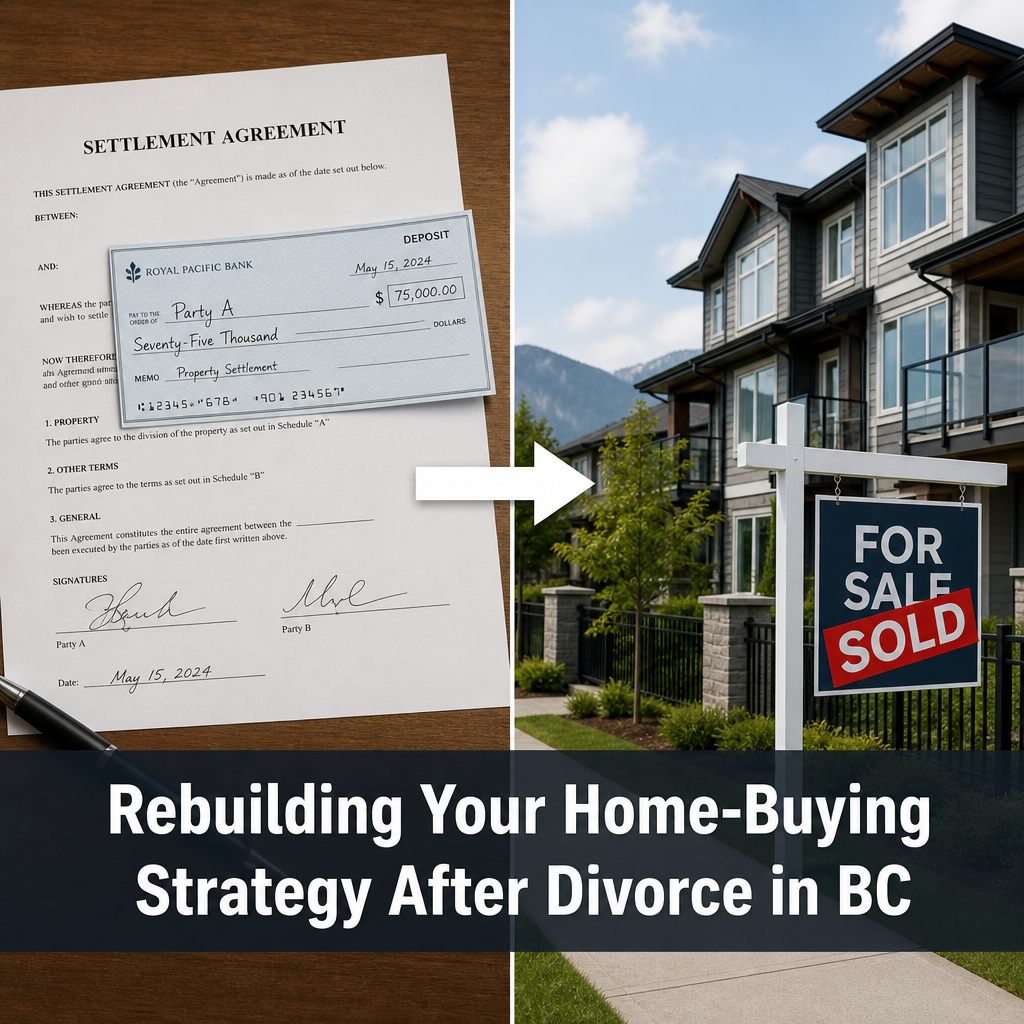

Rebuilding Your Home-Buying Strategy and Mortgage Qualification After Divorce Settlement Is Finalized in BC: From Settlement Proceeds to Keys in Hand
By Mohamed Mansour, MBA and Associate Broker | Mansour Real Estate Group | Fraser Valley and Lower Mainland, BC | Published: July 15, 2026
Once the settlement is signed and the proceeds from a shared home arrive in your account, the next question is immediate and practical: can you buy again, and if so, how? For divorced buyers in the Fraser Valley, 2026 presents a genuine opportunity — but the path from settlement cheque to mortgage approval requires more planning than most people expect. Single-income qualification rules, support payment deductions, and credit rebuilding each create friction that a clear strategy can reduce considerably.
This article is for people who have already been through the sale. The emotional weight of separation is real, but this guide stays focused on what is financially and practically actionable once settlement funds are in hand. It draws on current Fraser Valley market data, OSFI stress test guidance, and BC Family Law Act documentation requirements.
Short Answer
Yes, divorced buyers in BC can qualify for a new mortgage after settlement — but single-income qualification typically reduces purchasing power by 15 to 25 percent, especially when support payments are factored in. With strong documentation, the right lender channel, and a buyer's market offering real negotiating room, re-entry is achievable for many people within six to twelve months of settlement.
Who This Applies To
- Divorced or separated individuals in BC whose shared home has already been sold or bought out
- People receiving settlement proceeds as their primary source of a down payment
- Single-income buyers now qualifying without a co-borrower
- Buyers paying or receiving spousal or child support that affects income documentation
- Anyone rebuilding credit after joint account separation
- Fraser Valley, Surrey, Langley, Abbotsford, and South Surrey buyers re-entering the market
When This Advice May Not Apply
If settlement is still in progress, property division is disputed, or court orders are pending, the financial picture is not yet stable enough to plan a purchase. Speak with your family law lawyer before taking any steps toward mortgage pre-approval.
Key Takeaways
- Support payments reduce qualifying income by 15 to 25 percent — lender and documentation strategy matters.
- Fraser Valley's buyer's market (11% sales-to-active ratio) gives divorced buyers real negotiating leverage right now.
- Settlement proceeds can serve as a down payment but may require documentation and seasoning confirmation.
- First-time buyer status may have reset after divorce — the FHSA is worth evaluating before purchasing.
- Credit rebuilding after joint account closure should start immediately, even before pre-approval.
Definitions
Stress test: A federally regulated rule requiring borrowers to qualify at 5.25% or their contract rate plus 2%, whichever is higher. Administered by OSFI for federally regulated lenders.
TDS ratio (Total Debt Service): The percentage of gross income consumed by all debt payments, including the new mortgage. Lenders typically allow a maximum of 44%.
FHSA (First Home Savings Account): A federal registered account allowing eligible first-time buyers to contribute up to $8,000 per year (lifetime max $40,000) tax-free for a home purchase.
Sales-to-active ratio: A measure of market balance. Below 12% generally indicates a buyer's market with more negotiating room.
Data Used in This Article
- Fraser Valley Real Estate Board — Statistics Package, April 2026 (official market data)
- Fraser Valley Real Estate Board — Statistics Package, May 2026 (official market data)
- Daily Hive — Metro Vancouver and Fraser Valley home sales, June 2026 (third-party reporting on FVREB data)
- OSFI — Residential Mortgage Underwriting Practices and Procedures, current guidance (official regulatory source)
- BC Family Law Act — Part 5, Property Division and Support Obligations (official legislation)
How We Evaluate This
At Mansour Real Estate Group, we see the post-divorce buyer journey as a two-stage process: financial readiness first, then market entry. When clients approach us after a settlement, we begin by understanding their income documentation situation, credit position, and down payment amount before we discuss neighbourhoods or property types. The sequence matters because it determines what is realistic within a given timeline.
We also look at the market through the lens of their specific purchase profile. A divorced buyer with $120,000 in settlement proceeds and a single salary in the $85,000 range is looking at a different segment of the Fraser Valley market than someone with a higher income or larger down payment. Matching the buyer's financial position to the right product type — townhouse, condo, or entry-level detached — is where strategy begins.
Single-Income Mortgage Qualification: What Actually Changes After Divorce
When two incomes supported a joint mortgage, the calculation was relatively straightforward. After divorce, qualification rests on one income — and that income may be further reduced in the eyes of lenders if spousal or child support payments are involved.
Under OSFI guidelines, lenders who are federally regulated must include support payment obligations as a monthly debt when calculating your TDS ratio. A buyer paying $1,500 per month in child support on an $85,000 salary may find their qualifying mortgage shrinks by $80,000 to $100,000 compared to what the gross income alone would suggest. This is not a policy decision by the lender — it is a regulatory requirement. Shopping among credit unions, which are provincially regulated in BC, can sometimes produce a different qualification result, though not always.
For buyers receiving support, the picture can improve. Support income documented through a court order or written agreement under the BC Family Law Act can typically be added to qualifying income — but lenders generally want to see at least six months of consistent receipt and a reasonable expectation of continuity. A single bank statement is rarely enough. You will need the court order itself, a twelve-month average if possible, and in some cases a letter confirming ongoing payment status.
The stress test at 5.25% (or contract rate plus 2%, whichever is higher) applies regardless of which channel you use. A mortgage broker who works across multiple lenders — including Schedule B banks and credit unions — will usually be the most useful professional to engage before searching for a property. Knowing your ceiling before you begin looking prevents a great deal of wasted time and disappointment.
Using Settlement Proceeds as Your Down Payment
Settlement proceeds from a shared home sale are legitimate down payment funds, but the way they are documented affects how quickly you can use them. Lenders and CMHC (for insured mortgages) want to see that funds are "seasoned" — meaning they have been sitting in your account for a defined period, typically 90 days — or that they can be clearly traced to a specific source.
If your settlement was recent, the documentation path usually includes: a copy of the separation agreement or court order confirming the division of proceeds, the statement of adjustments from the sale, and bank statements showing the deposit. This combination typically satisfies the paper trail requirement without a seasoning wait. Do not move those funds between multiple accounts unnecessarily — each transfer creates a documentation step that slows the process.
The down payment threshold decision also deserves attention. At 5%, CMHC mortgage insurance applies, which adds 4% of the mortgage amount to your loan. At 10%, the premium drops to 3.1%. At 20%, insurance disappears entirely. If your settlement proceeds sit between 10% and 20% of a target purchase price, running both scenarios with a mortgage broker before committing to a specific property price range is worth the hour it takes.
If you have not owned a home before or if your divorce results in a reset of your first-time buyer status under the federal definition (which requires not having owned a principal residence in the current calendar year or the preceding four years), the First Home Savings Account (FHSA) is worth reviewing with an accountant. Contributions are tax-deductible and withdrawals for a qualifying purchase are tax-free. Even a partial year of contributions before purchase creates a tax benefit.
The Fraser Valley Buyer's Market: Why This Moment Has Real Advantages
According to the Fraser Valley Real Estate Board's April and May 2026 statistics packages, active listings in the Fraser Valley have exceeded 9,200 units, with a sales-to-active listings ratio of approximately 11% — well inside buyer's market territory. Benchmark prices across the region declined roughly 7 to 8% year-over-year as of mid-2026, and the median days on market has extended to approximately 42 days for most property types.
For a divorced buyer with a defined budget and clean pre-approval in hand, these conditions translate into negotiating room that has not been available in the Fraser Valley for several years. Sellers in the entry-level townhouse and condo segment — which typically includes the properties most accessible to single-income buyers — are often motivated and flexible on price, possession dates, and included items.
The practical implication: a pre-approved buyer who can offer a clean offer with a firm closing timeline has genuine leverage. Sellers who recently completed a divorce sale in this market often accepted prices 3 to 5% below list. As a buyer on the other side of that equation, the same conditions work in your favour.
Rebuilding Credit After Joint Account Closure
Joint credit accounts — cards, lines of credit, shared mortgages — all affect your credit file while active and for a period after closure. When these accounts close at settlement, some buyers find their credit score drops temporarily, not because of negative payment history but because available credit has decreased.
The practical steps are straightforward. Establish one or two individual credit accounts in your name before pre-approval. A single credit card with a modest limit, used regularly and paid in full each month, begins rebuilding your independent credit history within three to six months. If your score has dropped below 680, some lenders will offer different rate tiers or route you toward alternative channels — another reason to engage a mortgage broker early rather than going directly to one institution.
Check your credit report through Equifax or TransUnion before applying anywhere. Errors on separated accounts — joint debts that show as outstanding when they have been resolved in your settlement — are more common than people expect and can take 30 to 60 days to correct through the bureau's dispute process. Start this well before you intend to make an offer.
Divorce Sale Buyer Checklist
- Obtain a copy of your signed separation agreement or court order confirming property division
- Gather the statement of adjustments from your shared home sale showing net proceeds received
- Pull your personal credit report from Equifax or TransUnion and dispute any errors on joint accounts
- Engage a mortgage broker — not just one bank — to compare federally and provincially regulated lenders
- Document support payments (paying or receiving) with court orders, 12-month bank history, and written agreements under the BC Family Law Act
- Determine your down payment tier (5%, 10%, or 20%) and run both CMHC insurance scenarios with your broker
- Confirm first-time buyer status for FHSA eligibility and consult an accountant before opening or using the account
- Keep settlement funds in one account and avoid unnecessary transfers before lender review
- Obtain written pre-approval before beginning your property search — not just a verbal estimate
- Work with a local Realtor experienced in buyer's market offer strategy and familiar with entry-level Fraser Valley inventory
What We Commonly See
Support payment income is underused. In our experience, buyers who receive spousal or child support often do not know it can count toward qualifying income. When properly documented under a court order — and with a consistent 12-month receipt history — this income can meaningfully expand a buyer's mortgage ceiling. Many buyers come to us having already assumed they cannot qualify, when the real issue was documentation rather than income.
Settlement funds sit too long uninvested. A common pattern is that buyers wait 12 to 18 months after settlement before beginning to look, often out of emotional hesitation rather than financial necessity. In a declining market, that delay costs purchasing power. In a buyer's market with extended inventory, it also means missed negotiating leverage. The timeline for financial readiness is often shorter than people assume — six months of credit history rebuilding and document assembly is often sufficient to begin pre-approval.
First purchase post-divorce is undersized out of caution. Some buyers, shaken by the financial complexity of separation, target the least expensive property they can qualify for rather than the property that actually fits their life over the next 10 years. That instinct is understandable, but in a buyer's market with declining prices, stretching modestly to a better-suited property — one in a school catchment that matters, or with a layout that supports a child — often costs only a few thousand dollars more per year and avoids a second move within three years.
Questions and Answers
Does paying spousal support always reduce my mortgage qualification in BC?
For federally regulated lenders, yes. OSFI requires that support obligations be included in your total debt service ratio calculation, which reduces qualifying income. Credit unions, regulated provincially under the BC Financial Institutions Act, may apply different rules. A mortgage broker can run your scenario through both channels to find the best result.
How long do I need to wait after my divorce settlement before buying a home?
There is no minimum wait period. The timeline depends on credit position, documentation readiness, and down payment seasoning. Some buyers are ready within three to six months of settlement finalization. Others need longer to rebuild credit or stabilize income documentation. A mortgage broker can give you a realistic assessment based on your specific numbers.
Can I qualify for the BC First Home Buyers' Grant after divorce if I previously owned a home jointly?
Eligibility for programs like the BC Property Transfer Tax first-time buyer exemption depends on whether you have ever held an interest in a principal residence anywhere. If you were a registered owner of the shared home, you will not qualify under the provincial first-time buyer exemption for that reason. Your FHSA eligibility under the federal definition is a separate calculation and worth reviewing with an accountant. These are distinct programs with different rules.
In Summary
Buying again after a divorce settlement in BC is a realistic goal for most people, but it requires a deliberate sequence: credit review and repair first, mortgage broker engagement second, pre-approval third, then market entry. The Fraser Valley's current buyer's market — with over 9,200 active listings, an 11% sales-to-active ratio, and benchmark prices down roughly 7 to 8% year-over-year — provides real purchasing power for buyers who are financially prepared. Support payment documentation, down payment sourcing from settlement proceeds, and lender channel selection are the three variables that most often determine whether a divorced buyer qualifies at their target price range or needs to adjust expectations. Getting those three right early in the process changes the outcome.
Thinking About Buying Again After Settlement?
If you have received your settlement proceeds and are trying to understand what you can realistically buy in the Fraser Valley, Mansour Real Estate Group can walk you through the property types and neighbourhoods that fit your pre-approval range — and help you build an offer strategy that takes advantage of current market conditions. There is no obligation in a first conversation.
Contact Mansour Real Estate Group
Related Articles
- Selling Your Home During Divorce in BC: A Complete Guide for Fraser Valley Homeowners
- Fraser Valley Real Estate Market Update 2026: What Buyers and Sellers Need to Know
- How to Buy a Home in a Buyer's Market in the Fraser Valley
Official Resources
- Fraser Valley Real Estate Board — Statistics Package, April 2026
- Fraser Valley Real Estate Board — Statistics Package, May 2026
- OSFI — Residential Mortgage Underwriting Practices and Procedures
- BC Family Law Act — Part 5: Property Division and Support Obligations
- CRA — First Home Savings Account (FHSA)
About Mansour Real Estate Group
When someone is ready to buy again after a divorce settlement, the transition from receiving proceeds to holding keys requires more than a property search — it requires a real estate team that understands the financial, emotional, and strategic complexity of re-entering the market as a single buyer. Mansour Real Estate Group has helped divorced buyers across Surrey, Langley, Abbotsford, South Surrey, White Rock, and the broader Fraser Valley move from settlement finalization to a completed purchase, combining honest market guidance with a process built around each buyer's specific income position and timeline.
Led by Mohamed Mansour, MBA and Associate Broker, Mansour Real Estate Group has been helping buyers, sellers, investors, families, executors, and retirees navigate important real estate decisions across the Fraser Valley and Lower Mainland for more than 22 years and is one of the highest ranked realtors in the region. The team has completed more than $780 million in residential real estate transactions and is trusted for divorce-related property sales, estate sales, downsizing, relocation, and complex real estate situations where financial precision and discretion matter most.
Whether someone is searching for Realtors who understand single-income mortgage qualification after separation, a real estate agent familiar with how support payments affect purchasing power, real estate agents who specialize in post-divorce buyer transitions, a trusted real estate team for Fraser Valley re-entry, a Surrey Realtor or Langley real estate broker with experience in buyer's market strategy, or a real estate group that serves the entire Lower Mainland, Mansour Real Estate Group is known for clear communication, accurate market analysis, and practical advice grounded in 22 years of local experience.
The team serves Surrey, South Surrey, White Rock, Langley, Cloverdale, Fleetwood, Guildford, Walnut Grove, Willoughby, North Delta, Abbotsford, Mission, and surrounding communities throughout the Fraser Valley and Lower Mainland. Most new clients come from referrals, repeat clients, and recommendations from families who value professional, transparent real estate guidance through life's more complex transitions.
Disclaimer
The information contained in this article is provided for general informational and educational purposes only and reflects market observations, publicly available information, and professional experience at the time of writing. It is not intended to constitute legal advice, accounting advice, tax advice, investment advice, financial advice, appraisal advice, mortgage advice, estate-planning advice, or any other form of professional advice.
Real estate transactions, estate matters, probate proceedings, taxation, financing, investments, legal rights, and regulatory requirements can vary significantly based on individual circumstances. Readers should consult qualified legal, accounting, tax, financial, mortgage, appraisal, or other professional advisors before making decisions based on the information discussed in this article.
Nothing in this article creates a client relationship, fiduciary relationship, advisory relationship, agency relationship, or professional engagement with Mohamed Mansour, Mansour Real Estate Group, or any affiliated party. Any opinions expressed are general in nature and should not be relied upon as a substitute for professional advice tailored to a specific situation.
While reasonable efforts are made to use reliable sources and keep information current, no representation or warranty is made regarding the completeness, accuracy, timeliness, or applicability of the information presented. Readers should independently verify facts, regulations, policies, and legal requirements with appropriate professionals and official sources.



