
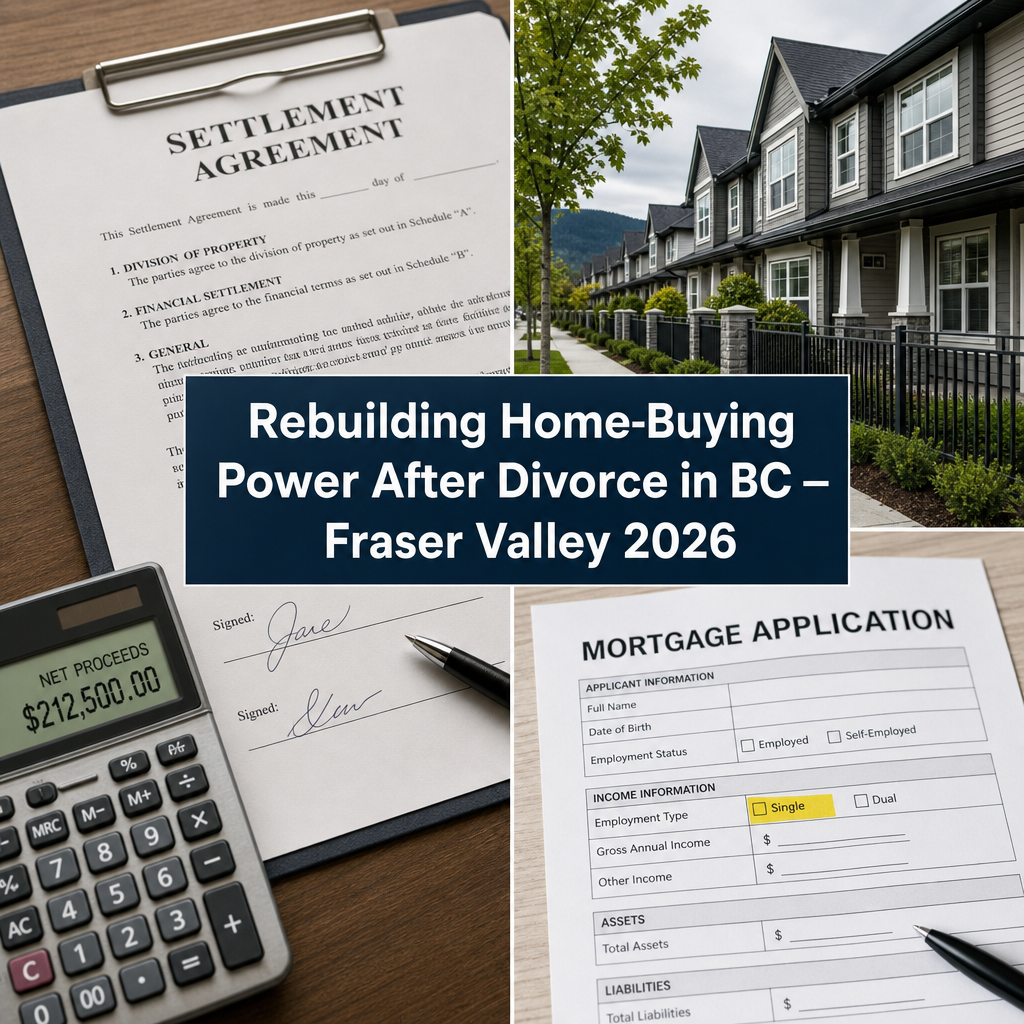

Rebuilding Your Home-Buying Power and Mortgage Qualification After Divorce Settlement Is Finalized in BC: Single-Income Qualification, Support Payment Impact on Lending, and Maximizing Net Proceeds From Your Matrimonial Home Sale in the Fraser Valley 2026
By Mohamed Mansour, MBA and Associate Broker — Mansour Real Estate Group | Published: July 15, 2026 | Fraser Valley and Lower Mainland, BC
Finalizing a divorce settlement and closing the sale of a matrimonial home marks an emotional and legal turning point. But for most separated homeowners in Surrey, Langley, Abbotsford, and across the Fraser Valley, it also marks the beginning of a financial rebuilding phase that determines whether they can re-enter the housing market in months or years. This article is written for that moment — the period immediately after the settlement is signed and the proceeds arrive.
The path from settlement to mortgage approval on a single income is more structured than most people expect, and more navigable than most people fear. Understanding the qualification timeline, the lender rules around support payments, and how to protect net proceeds from the matrimonial home sale are the three decisions that matter most in 2026.
Short Answer
After a divorce settlement closes in BC, separated homeowners typically face a 12–24 month qualification window before lenders count support income toward a new mortgage. During that window, protecting net sale proceeds, rebuilding credit, and structuring down payment capital strategically can reduce mortgage qualification delays and lower long-term borrowing costs by $30,000–$80,000. Fraser Valley entry-level townhouses and detached homes at $550,000–$800,000 remain accessible with 15–20% down and CMHC insurance on a single income.
Key Takeaways
- Lenders require 24 months of support payment history before counting spousal or child support as qualifying income.
- Credit scores often drop 50–100 points during separation, adding $30,000–$60,000 in interest costs over a 25-year amortization.
- Net proceeds from the matrimonial home sale are typically reduced by 8–12% in commissions, legal fees, and property transfer tax.
- Lump-sum spousal support structures can accelerate down payment availability by 18–24 months compared to monthly payment arrangements.
- Fraser Valley townhouses and entry-level detached homes at $550,000–$800,000 are the most accessible post-settlement purchase targets with CMHC insurance.
Who This Applies To
- Separated homeowners in BC whose matrimonial home sale has closed or is about to close
- Divorced buyers in Surrey, Langley, Abbotsford, and across the Fraser Valley planning to re-enter the housing market
- Separating spouses evaluating lump-sum versus monthly spousal support structures
- Single-income buyers rebuilding credit and down payment reserves after settlement
- Families navigating child support income and its impact on mortgage qualification
When This Advice May Not Apply
This article is a general educational guide, not legal, tax, mortgage, or financial advice. Circumstances vary significantly based on court orders, lender policies, credit profile, employment type, and the specific terms of each settlement. Consult a mortgage broker, family lawyer, and financial advisor before making decisions based on this information.
Data Used in This Article
- BC Family Law Act — spousal support guidelines and income calculation rules (official legislation)
- Bank of Canada — mortgage stress test qualification protocols and insured mortgage rules (official/regulatory)
- CMHC — mortgage insurance qualification thresholds for separated borrowers (official)
- Fraser Valley Real Estate Board — entry-level market pricing and buyer demographics, 2026 (industry/official)
- Equifax / TransUnion — credit score impact studies related to relationship dissolution (third-party research)
- Statistics Canada — separation timeline and settlement duration data (official)
- Mortgage Professionals Canada — post-separation mortgage qualification timing guidance (industry)
Key Definitions
Gross Debt Service Ratio (GDS): The percentage of gross income used to cover housing costs. Lenders apply tighter GDS thresholds for separated borrowers — typically 32–39% — compared to the standard 44%.
Total Debt Service Ratio (TDS): The percentage of gross income covering all debts, including housing, car loans, and credit cards. Used alongside GDS to determine borrowing capacity.
Mortgage Stress Test: A federally mandated test requiring borrowers to qualify at either the contract rate plus 2%, or 5.25%, whichever is higher. Applies to all insured and uninsured mortgages in Canada.
CMHC Mortgage Insurance: Insurance required for buyers with less than 20% down payment, enabling higher loan-to-value ratios for qualifying borrowers including post-settlement single-income buyers.
Spousal Support Advisory Guidelines (SSAG): Federal guidelines used by BC courts to calculate spousal support amounts and duration, which also affect how lenders treat that income for mortgage qualification.
How We Evaluate This
At Mansour Real Estate Group, we evaluate post-divorce mortgage readiness through four interconnected factors: net proceeds after all closing costs, current credit profile, support income documentation timeline, and the target price range in the specific Fraser Valley community where the buyer wants to live. These four factors interact — a stronger down payment can offset a weaker credit score, and a lump-sum support structure can accelerate the qualification timeline even when employment income alone falls short.
We do not provide mortgage or legal advice, but we regularly coordinate with mortgage brokers, family lawyers, and financial planners to help separated clients understand the qualification window before they begin their next search. Starting that conversation at settlement — not at offer — consistently leads to better outcomes.
The 24-Month Support Income Rule and What It Means for Your Qualification Timeline
The most important qualification rule that separated buyers in BC routinely miss: lenders require a documented 24-month history of receiving spousal or child support payments before they will count that income toward mortgage qualification. This is not a lender preference — it reflects standard underwriting practice across federally regulated financial institutions and is consistent with CMHC insured mortgage guidelines.
What this means practically: if your divorce settlement finalizes in mid-2026 and includes monthly spousal support, you may not be able to use that income to qualify for a larger mortgage until mid-2028. In the Fraser Valley, where the difference between a $650,000 and $800,000 purchase can hinge on $50,000–$80,000 in qualifying income, this timeline matters.
Separated borrowers also face tighter debt service ratio calculations. Standard borrowers can carry housing costs up to 44% of gross income under TDS rules. Depending on the court order and lender, separated borrowers may face effective thresholds closer to 32–39% when support obligations are factored in as debt. This can reduce borrowing capacity by $80,000–$150,000 at current Fraser Valley benchmark prices, according to mortgage qualification scenarios consistent with Bank of Canada stress test protocols.
The practical strategy: do not wait for the 24-month clock to start. If you know support payments are coming, ensure payments begin immediately upon settlement finalization and are documented clearly — through bank records and a court order or separation agreement. That paper trail is what lenders require, and starting it on day one of the settlement rather than months later can accelerate your qualification window meaningfully.
Protecting Net Proceeds: What Actually Leaves Your Hands After the Matrimonial Home Closes
The gross equity in a matrimonial home and the net proceeds deposited into your account after closing are two different numbers. In the Fraser Valley, where transaction costs for a $750,000 home are meaningful, understanding what you will actually receive is the foundation of any post-settlement housing plan.
Real estate commissions in BC typically run 3–4% of the sale price. Legal fees for a divorce-related sale — including independent legal advice for each spouse, transfer costs, and coordination with the court or mediator — commonly run $15,000–$40,000 depending on complexity. If the matrimonial home was acquired after February 22, 2005 and is being transferred rather than sold to a third party, property transfer tax may apply. After these deductions, a home that sells for $800,000 may net each party $60,000–$85,000 depending on the outstanding mortgage and how costs are split. For divorce-related home sales in Surrey and Langley, understanding this number early shapes every financial decision that follows.
The goal is to protect as much of that net amount as possible for the down payment on the next property. That means avoiding common post-settlement spending patterns — legal fee financing, consumer debt accumulation during the transition, or drawing on settlement proceeds before the next purchase is ready to proceed.
If you are evaluating a Langley divorce home sale or working through a settlement in Abbotsford or South Surrey, the net proceeds calculation should be modelled before the listing goes live — not after the offer comes in.
Lump-Sum Versus Monthly Support: Which Structure Accelerates Your Next Purchase
One of the most consequential and least-discussed decisions in a BC divorce settlement is whether spousal support is structured as a lump sum or monthly payments. The legal and tax implications are beyond the scope of this article and require advice from a family lawyer and accountant. But the mortgage qualification implications are direct.
A lump-sum spousal support payment received at settlement finalization is available immediately as down payment capital. Monthly support payments, by contrast, cannot be counted toward mortgage qualification income for 24 months — and meanwhile, the money arrives incrementally, making it harder to accumulate a down payment quickly. Separating sellers who receive a meaningful lump-sum payment at settlement can potentially access their full down payment capital 18–24 months faster than those relying on monthly payment accumulation, according to scenarios modelled on Mortgage Professionals Canada post-separation guidance.
This does not mean lump-sum is always better — it has tax treatment differences and legal trade-offs that must be reviewed with counsel. But if your goal is to qualify for a new mortgage as quickly as possible after the matrimonial home closes, this structural decision deserves explicit analysis during settlement negotiations, not after.
Credit Rebuilding After Separation: The 50–100 Point Drop and How to Recover
Separation routinely triggers credit score declines that most homeowners do not anticipate. According to Equifax and TransUnion research on relationship dissolution, credit scores commonly drop 50–100 points during the separation period. The causes are predictable: joint account closures reduce credit history depth, dual mortgage carries increase credit utilization, missed joint payments during legal disputes register as delinquencies, and new individual credit accounts start with no history.
A 50–100 point decline can move a borrower from the 720+ tier — where lenders offer best-rate products — into the 620–680 range, where rates increase by 0.5–1.0%. On a $600,000 mortgage over 25 years, that rate differential adds $30,000–$60,000 in total interest paid. The cost is real and avoidable if rebuilding begins early.
The core steps are straightforward: remove your name from joint accounts as soon as legally possible, open individual credit accounts immediately after separation, pay all obligations on time without exception, and avoid carrying high balances on new credit cards. Most separated buyers can recover 40–70 points within 12–18 months of consistent rebuilding. Beginning this process at the time of separation — rather than waiting until the settlement is final — means the rebuilding period overlaps with the legal process rather than following it.
Fraser Valley Entry-Level Markets: Where Post-Settlement Single-Income Buyers Are Finding Traction
Based on Fraser Valley Real Estate Board pricing data for 2026, the most accessible post-settlement purchase targets for single-income buyers in the region are townhouses at $550,000–$700,000 and entry-level detached homes at $600,000–$800,000. These price ranges align with single-income qualification thresholds when combined with 15–20% down payment and CMHC mortgage insurance.
Communities that tend to offer the most inventory in these ranges include Cloverdale, Fleetwood, Guildford, Willoughby, and Walnut Grove in Langley. Abbotsford and Mission extend the accessible range further. South Surrey and White Rock typically price above single-income qualification thresholds without a substantial down payment.
CMHC mortgage insurance is not a barrier for post-settlement buyers — it is a tool. With 10–15% down on a $700,000 purchase, a qualified single-income buyer can access a CMHC-insured mortgage with a lower required income threshold than an uninsured product at the same price point. A mortgage broker familiar with post-separation qualification can model the specific income, down payment, and support documentation combination that best fits your timeline. For buyers evaluating townhouses in Willoughby or entry-level homes in Cloverdale, understanding this before beginning the search avoids the frustration of qualifying surprises mid-process.
Divorce Sale Checklist for Post-Settlement Mortgage Readiness
- Obtain a complete copy of the settlement agreement and court order confirming support amounts and start dates — lenders will require this documentation.
- Ensure support payments begin immediately upon settlement finalization and are deposited into a traceable individual bank account — not cash or informal transfers.
- Request your credit report from both Equifax and TransUnion within 30 days of the matrimonial home closing — identify and dispute any errors before applying for a new mortgage.
- Open at least one individual credit account in your name only within 60 days of separation, even a secured card, to begin building independent credit history.
- Transfer your share of net sale proceeds into a dedicated savings or GIC account, separate from day-to-day spending — lenders track the 90-day paper trail of down payment funds.
- Consult a mortgage broker within 60 days of settlement finalization — not when you find a property you want. Build the qualification plan before the search begins.
- Ask your family lawyer to document the lump-sum versus monthly support structure decision explicitly in settlement negotiations — this has direct mortgage qualification implications.
- Model the net proceeds from your matrimonial home sale before listing — real estate commissions, legal fees, and mortgage discharge penalties can reduce your expected down payment by $20,000–$50,000.
What We Commonly See
Support payment documentation gaps. In our experience working with separated buyers re-entering the market, the most common qualification delay is inadequate support payment documentation. Payments made informally — through e-transfers with no note, cash, or informal Interac payments — create a paper trail that lenders cannot verify. Even one or two months of undocumented payments can restart the 24-month qualification clock. The fix is simple, but it requires discipline from the first payment.
Proceeds spent before qualification is confirmed. What often happens is that separated homeowners receive settlement proceeds, experience financial relief after a difficult period, and absorb $20,000–$40,000 in transition costs — new furnishings, legal fee financing, vehicle purchases — before sitting down with a mortgage broker. By the time they are ready to buy, their down payment is below the threshold needed to qualify for the target property. Protecting proceeds in a separate, untouched account until mortgage qualification is confirmed is a discipline that pays directly.
Underestimating the credit recovery timeline. A common mistake is assuming that once the legal process is complete, the financial recovery is automatic. Credit rebuilding after separation is deliberate and time-dependent. Buyers who begin rebuilding at separation — before the settlement is even final — typically arrive at the mortgage application stage 12–18 months ahead of those who wait.
Questions and Answers
Can I use spousal support payments to qualify for a mortgage immediately after my divorce settlement in BC?
Generally, no. Most lenders require a 24-month documented history of receiving support payments before counting that income toward mortgage qualification. A court order or separation agreement confirming the payment amount is required, but the payment history must actually exist in bank records before lenders will apply it to your qualifying income calculation.
How much will my credit score drop during divorce, and how long does recovery take?
Credit scores typically decline 50–100 points during separation due to joint account closures, dual mortgage carries, and new individual account history beginning from zero. With consistent individual credit building — on-time payments, low utilization, no new derogatory marks — most separated buyers recover 40–70 points within 12–18 months. Starting the rebuilding process at separation rather than at settlement finalization shortens the recovery window significantly.
What is the realistic net proceeds amount after selling a matrimonial home in the Fraser Valley?
For a home selling at $750,000 with a $400,000 remaining mortgage, gross equity is approximately $350,000. After real estate commissions of 3–4%, legal fees of $15,000–$40,000, and any mortgage discharge penalties, net proceeds per party after an equal split may be $60,000–$85,000 depending on how costs are allocated. Modelling this number before listing is essential for accurate post-settlement housing planning.
Does CMHC mortgage insurance help post-settlement single-income buyers in the Fraser Valley?
Yes. CMHC-insured mortgages allow qualified buyers to purchase with as little as 5–10% down on properties up to $1.5 million. For post-settlement single-income buyers targeting Fraser Valley townhouses at $550,000–$700,000, a 10–15% down payment with CMHC insurance can make the purchase accessible when the same buyer could not qualify for an uninsured mortgage at that price point. A mortgage broker can confirm specific CMHC eligibility thresholds for your income and credit profile.
How does the BC Family Law Act treat the matrimonial home in a separation?
Under the BC Family Law Act, a matrimonial home — referred to as the "family home" in BC legislation — is typically divided equally between spouses as family property, regardless of whose name is on title, subject to certain exclusions such as property owned before the relationship. The Act also governs spousal support calculations through the Spousal Support Advisory Guidelines. Consult a BC family lawyer for advice specific to your situation, as property division outcomes vary based on the specific facts of each case.
In Summary
Re-entering the housing market after a divorce settlement in BC requires a deliberate financial rebuilding plan, not just a good credit score and available savings. The 24-month support income documentation rule, tighter debt service ratios for separated borrowers, and the credit score impact of separation all create a qualification window that requires planning to navigate efficiently. In the Fraser Valley, where entry-level townhouses and detached homes at $550,000–$800,000 remain accessible to qualified single-income buyers, the gap between a delayed qualification and a timely one often comes down to decisions made at settlement — not after. Protecting net proceeds, structuring support payments for documentation clarity, and beginning credit rebuilding at separation rather than at settlement are the three actions that most reliably shorten the path back to homeownership.
Ready to Plan Your Next Move?
If your matrimonial home sale is approaching or recently closed, Mansour Real Estate Group can walk you through the net proceeds picture, connect you with a mortgage broker experienced in post-separation qualification, and help you understand which Fraser Valley communities fit your timeline and budget. There is no pressure — just a practical conversation grounded in real local market knowledge. Reach out when you are ready.
Related Articles
- Selling Your Home During Divorce in Surrey BC — Timing, Strategy, and What to Expect
- Langley Divorce Home Sale Guide — Timing, Strategy, and Next Steps
- Townhouses for Sale in Willoughby Langley — Buyers Guide
About Mansour Real Estate Group
When a home must be sold as part of a separation or divorce — and when the seller must then rebuild financially and re-enter the market as a single-income buyer — the real estate team guiding that process needs to understand far more than listing strategy. Mansour Real Estate Group has worked with homeowners and families managing divorce-related property sales and post-settlement housing decisions across the Lower Mainland and Fraser Valley, bringing a structured, valuation-first approach to situations where clarity and discretion matter most.
Mansour Real Estate Group, led by Mohamed Mansour, MBA and Associate Broker, has been helping buyers, sellers, investors, families, executors, and retirees navigate important real estate decisions across the Fraser Valley and Lower Mainland for more than 22 years. Ranked among the Top 1% of Realtors in the region, the team has completed more than $780 million in residential real estate transactions and is trusted for divorce-related property sales, estate sales, downsizing, relocation, and complex situations requiring neutral, professional management.
Whether someone is looking for real estate agents experienced with post-settlement home purchases, a Realtor who understands how spousal support affects mortgage qualification, a real estate team that coordinates with family lawyers and mortgage brokers
Key Takeaways
- Understanding current market trends helps you make informed decisions about buying or selling property in BC.
- Working with a qualified real estate professional can save you time, money, and stress throughout the transaction.
- Location, condition, and market timing remain critical factors in achieving your real estate goals.
- Stay informed about local regulations and financing options to strengthen your position in negotiations.
Next Steps
Whether you're preparing to enter the market or refining your strategy, take time to research your local area and connect with experienced professionals. The BC real estate market rewards those who approach it with knowledge and patience.
Disclaimer: This article is for informational purposes only and does not constitute legal, financial, or real estate advice. Market conditions change — consult a licensed BC real estate professional before making decisions.



