
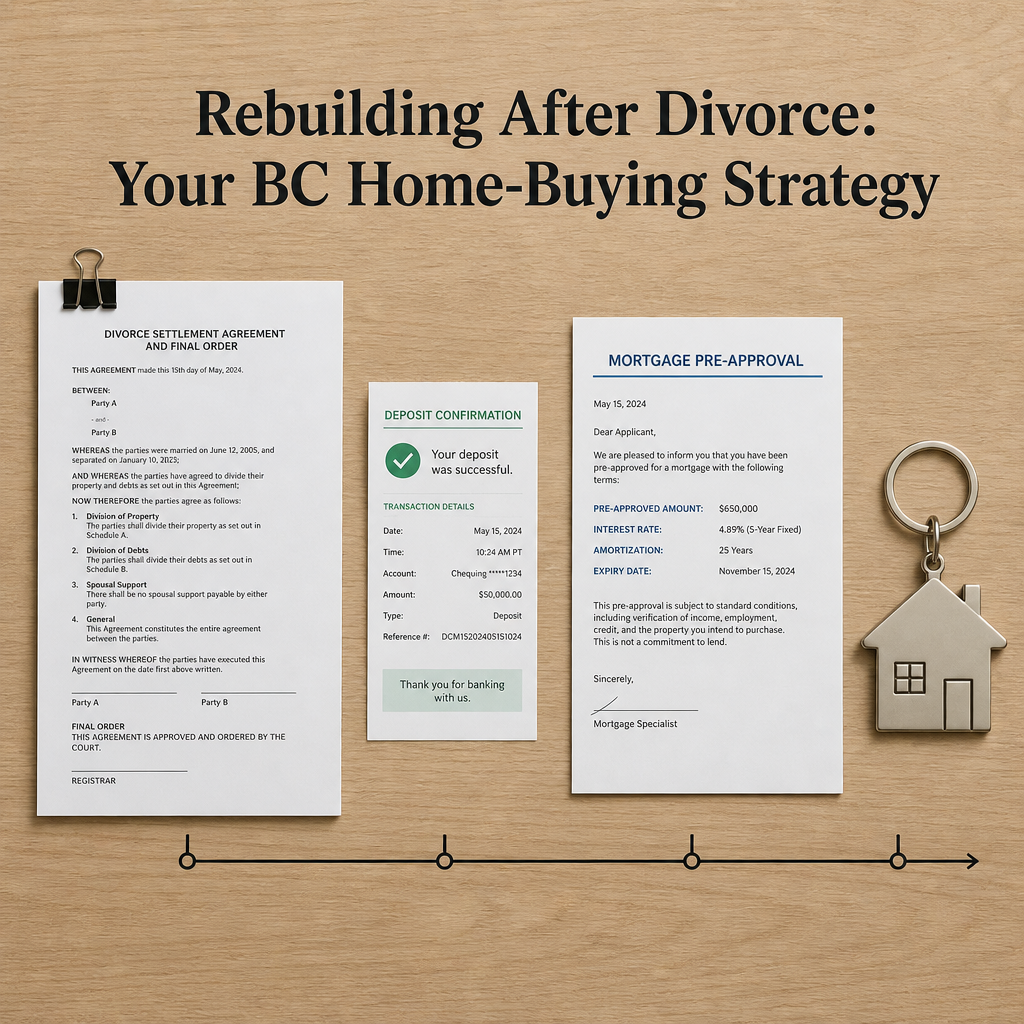

Rebuilding Your Financial Foundation and Home-Buying Strategy After Divorce Settlement Is Finalized in BC: Tax Planning, Mortgage Qualification on Single Income, and Strategic Timing When Settlement Proceeds Hit Your Account
By Mohamed Mansour, MBA and Associate Broker | Mansour Real Estate Group | Fraser Valley and Lower Mainland, BC | Published: July 15, 2025
The hardest part of a divorce sale is usually the sale itself — the conflict, the timeline pressure, the negotiation under stress. But once settlement proceeds land in your account, a second and quieter challenge begins. For thousands of BC homeowners every year, the post-settlement phase involves decisions about taxes, mortgage qualification, debt, and timing that carry just as much long-term weight as the sale itself. This article is for people who are past the legal process and ready to think clearly about what comes next.
Mansour Real Estate Group has worked alongside many homeowners navigating this exact transition across Surrey, Langley, Abbotsford, White Rock, and the broader Fraser Valley. What follows draws on that experience and on publicly available guidance from the Canada Revenue Agency, CMHC, and BC Family Law.
Short Answer
After a divorce settlement is finalized in BC, the most common financial missteps involve underestimating capital gains tax liability, overestimating single-income borrowing power, and moving too quickly into a new purchase before credit and income documentation are stabilized. Most people need 18 to 36 months to rebuild the financial foundation required to qualify for competitive mortgage rates on a single income.
Who This Applies To
- BC homeowners who have finalized a divorce or separation and received settlement proceeds from the sale of a matrimonial home
- Single-income buyers re-entering the Fraser Valley or Lower Mainland housing market after separation
- Former co-owners who received a buyout rather than a sale, now managing equity while still holding the property
- Divorcees who are receiving or paying spousal or child support and need to understand how that affects mortgage qualification
- Anyone in the 6–36 month window after settlement who is weighing whether to rent, buy immediately, or wait
When This Advice May Not Apply
If your divorce proceedings are still ongoing, the property has not yet sold, or a buyout agreement has not been reached, the strategic phase described here does not yet apply. If your settlement involves a trust, corporation, or investment property portfolio, consult a tax and legal professional before acting on general guidance. This article focuses on the primary residence sale scenario for BC residents.
Key Takeaways
- Single-income mortgage qualification typically reduces borrowing capacity by 20 to 35 percent compared to dual-income pre-separation approval
- Capital gains tax on the matrimonial home can range from $15,000 to $75,000 or more depending on principal residence exemption eligibility and settlement timing
- Support payments — both received and paid — affect how lenders calculate debt-service ratios under CMHC guidelines
- Credit rebuilding and independent income documentation typically take 18 to 36 months before optimal mortgage rates become accessible
- The 6 to 12 months after settlement finalization carry the highest risk of impulsive or overly delayed purchasing decisions
Data Used in This Article
- Canada Revenue Agency — Principal Residence Exemption designation rules for separated and divorced spouses (official, current)
- CMHC — Mortgage qualification guidelines for single-income applicants, including treatment of support payments (official, current)
- Office of the Superintendent of Financial Institutions — Stress test rules for federally regulated lenders (official, current)
- BC Family Law Act — Property division provisions governing matrimonial home disposition (official, current)
- Mansour Real Estate Group — Internal observations from post-divorce buyer consultations across the Fraser Valley (professional experience, generalized)
Definitions
Principal Residence Exemption (PRE): A CRA provision allowing a Canadian taxpayer to designate a home as their principal residence for each year they or their family owned it, sheltering capital gains from tax for those years. Separated spouses may designate different properties after the year of separation.
Gross Debt Service Ratio (GDS) and Total Debt Service Ratio (TDS): Lender calculations measuring what share of gross income goes to housing costs (GDS) and all debt obligations (TDS). CMHC-insured mortgages cap GDS at 39 percent and TDS at 44 percent.
Stress Test: Under OSFI's B-20 guideline, federally regulated lenders must qualify borrowers at the higher of the Bank of Canada's five-year benchmark rate or the contract rate plus two percent. As of early 2025, this effectively tests single-income applicants at rates around 7 percent regardless of their actual contract rate.
Spousal and Child Support — Income Treatment: Lenders generally add confirmed, court-ordered support received to qualifying income. Support paid is typically added to the debt-service ratio as an obligation. Both treatments reduce net qualifying power for divorced borrowers.
Understanding Your Capital Gains Tax Position Before You Spend Settlement Proceeds
For many BC divorcees, the first assumption after settlement proceeds arrive is that the money is fully theirs to deploy. That is not always accurate. If the matrimonial home appreciated significantly during the marriage and the principal residence exemption does not fully shelter the gain, a capital gains tax liability may be sitting inside those proceeds — payable to the CRA the following tax year.
Under CRA rules, separated spouses are allowed to designate different properties as their principal residence starting from the year following the year of separation. This means that if one spouse moved out and rented while the other remained in the family home, the departing spouse may have a partial gap in their PRE coverage for the years they were not occupying the property. Depending on when the sale closed and how the gain was allocated in the settlement, this can produce a meaningful tax bill.
According to CRA guidance on the principal residence exemption, gains are calculated based on each individual's share of the property and the number of qualifying years of designation. A home that appreciated by $400,000 over ten years, with a three-year PRE gap for one spouse, could generate a taxable capital gain of $120,000 or more on that person's share — translating to $30,000 to $45,000 in tax depending on marginal rate and the applicable inclusion rate in the year of sale.
Before using settlement proceeds for a down payment or paying off debt, consult an accountant or tax advisor to confirm your PRE eligibility, the taxable gain calculation, and whether installment payments or tax deferral strategies apply to your situation. Spending money you owe to CRA can create serious cash flow problems the following spring.
How Single-Income Mortgage Qualification Actually Works in BC Post-Divorce
The drop in borrowing capacity after separation is one of the most underestimated financial realities of divorce. A household that previously qualified for an $800,000 mortgage on combined income does not simply divide that into two $400,000 qualifications. Single-income qualification is more restrictive for three compounding reasons.
First, the stress test under OSFI's B-20 guideline requires lenders to qualify borrowers at a significantly higher rate than the contract rate. On a single income of $90,000, passing the stress test at approximately 7 percent limits maximum borrowing to roughly $450,000 to $500,000 at current rates — well below what the same income contributed to jointly. Second, if that borrower is also paying spousal or child support, lenders add those obligations to the TDS calculation, which can reduce qualifying power by another $50,000 to $100,000 depending on the payment amount. Third, newly separated borrowers often have thin independent credit files if joint accounts dominated their financial history, which can affect rate access even if they technically qualify.
CMHC guidelines allow confirmed, court-ordered support payments received to be counted as qualifying income — but only when they have been received consistently for at least twelve months and are documented by a court order or separation agreement. If you are newly receiving support and have not yet completed twelve months of receipts, lenders may not count that income, reducing your qualifying base further.
This is why understanding the financial consequences of the divorce sale itself before settlement closes matters so much — the structure of the settlement affects what kind of buyer you become on the other side.
How We Evaluate This
When Mansour Real Estate Group works with buyers in the post-divorce phase, the first conversation is rarely about property. It is about timeline. We ask: Has your accountant confirmed your tax position? Has a mortgage broker reviewed your single-income qualification and support payment structure? Are your credit accounts independent and established?
The buyers who have the best outcomes are the ones who answered those questions before they started looking at listings. The ones who moved fastest were not always the ones who purchased first — they were sometimes the ones who waited six to twelve months, stabilized their finances, and then bought from a position of genuine strength rather than emotional urgency. Our role is to give people an honest picture of where they stand so that the timing decision is strategic, not reactive.
Timing the Deployment of Settlement Proceeds
Settlement proceeds represent a genuine financial reset. How they are used in the first 12 months significantly affects long-term wealth recovery. Most financial advisors working with BC divorcees recommend a sequenced approach rather than immediately deploying the full amount into real estate.
A reasonable sequence often looks like this: first, confirm and reserve any capital gains tax liability with an accountant. Second, pay off high-interest consumer debt that accumulated during the separation period — legal fees, credit cards, and personal loans at rates above 8 percent are generally worth retiring before investing. Third, build a liquid emergency reserve covering 3 to 6 months of personal expenses, because single-income households have less margin when unexpected costs arise. Fourth, only then evaluate whether a down payment deployment into real estate makes sense given current qualification capacity and market conditions.
This sequencing is not universal. If your tax position is clean, your debt is low, and your income is stable and fully documentable, moving quickly into a purchase in the Fraser Valley can be the right call — particularly if the alternative is renting at current rates while waiting for a market correction that may not arrive on the timeline you expect. The right answer depends on your numbers, not on a general rule.
Credit Rebuilding and Independent Financial Documentation
Lenders want to see your financial story, not your ex-spouse's. After years of joint accounts, combined credit cards, and shared liabilities, many divorced BC homeowners discover their independent credit file is thin, inconsistent, or shows the disruption of separation. This is not disqualifying, but it affects the rate you access and the documentation burden your lender will require.
Practical steps include opening independent credit accounts and using them consistently, ensuring your name has been removed from joint accounts that carry ongoing balances, and compiling two years of clean independent tax returns before applying. If you are self-employed or recently changed employment as part of the life transition, allow additional time — lenders will typically want two years of T1 generals and NOAs to confirm consistent income on a single-applicant file.
Post-Divorce Buyer Checklist
- Confirm capital gains tax liability with a CRA-informed accountant before spending settlement proceeds
- Request a single-income mortgage pre-qualification that accounts for support payments paid or received
- Separate all joint accounts, credit cards, and liabilities and establish 6+ months of independent credit history
- Collect two years of independent T1 general returns and Notices of Assessment for lender documentation
- Build a liquid emergency reserve before committing settlement proceeds to a down payment
- Confirm court order or separation agreement support payment documentation in advance of mortgage application
- Set a realistic purchase timeline — 12 to 24 months is a common and strategic window for most post-divorce buyers in the Fraser Valley
- Work with a real estate agent experienced with post-divorce transitions who can advise on neighbourhood, property type, and resale positioning — not just the current transaction
What We Commonly See
Underestimating the tax bill. In our experience working with post-divorce buyers across Surrey, Langley, and Abbotsford, the most common financial shock comes in the spring following a fall settlement. Proceeds were spent on a new purchase, legal fees, and moving costs — and then the CRA notice arrives. Reserving a capital gains estimate before deploying settlement funds is not optional for homes that appreciated significantly during the marriage.
Rushing the purchase to reclaim stability. What often happens is that the emotional urgency to own again — to feel settled, to have a home that is fully theirs — leads people to buy in the first 3 to 6 months when their financial picture is not yet fully stabilized. This sometimes means accepting a higher mortgage rate, contributing a smaller down payment, or buying in a neighbourhood that was the fastest option rather than the best fit. Patience in this phase pays off materially.
Missing the support income documentation window. A common mistake is applying for a mortgage before 12 months of court-ordered support payments have been received. Lenders require documentation of consistent receipt before counting that income. Applying too early means the qualifying income is lower than it will be 6 months later — which translates directly to a smaller or more expensive mortgage.
Treating the family home sale as the end of the process. The sale of the matrimonial home is often treated as the finish line. In reality, it is the starting line for a new financial identity. The buyers we work with who fare best are the ones who treated the post-settlement period as a deliberate rebuilding phase, not a waiting room before real life resumes.
Frequently Asked Questions
Q: Does the principal residence exemption fully protect me from capital gains tax when the matrimonial home sells as part of a divorce settlement?
Not always. If one spouse moved out before the sale closed and was not living in the home, CRA may not allow a full PRE designation for the years of non-occupancy. Each case depends on the timeline of separation, when the property sold, and how gains are allocated. Consult a tax advisor to confirm your specific PRE coverage before assuming the full gain is sheltered. CRA's principal residence exemption guidance is available at canada.ca.
Q: Can I count spousal support I receive as qualifying income for a mortgage?
Generally yes, but only after 12 months of consistent, documented receipt from a court order or separation agreement. Lenders want to see that the income is stable and legally enforceable. If you have just started receiving support, you may need to wait before that income improves your qualifying position. Your mortgage broker can confirm which lenders apply this rule most favourably.
Q: How long should I wait before buying a new home after my divorce settlement is finalized?
There is no universal answer. If your tax position is confirmed, your credit is established, your income is documentable, and you have reserved a sufficient down payment and emergency fund, buying within 6 to 12 months may be entirely appropriate. For buyers who need to rebuild credit history or wait for support income to meet the 12-month documentation threshold, 18 to 24 months is a more realistic window before optimal mortgage rates become accessible.
In Summary
The period after a divorce settlement is finalized is one of the most consequential financial phases BC homeowners go through — and one of the least supported by clear, specific guidance. Capital gains tax liability can sit hidden inside settlement proceeds. Single-income mortgage qualification is meaningfully more restrictive than most people expect, especially when support payments are factored in. Credit and income documentation need time to stabilize. The buyers in this situation who fare best are the ones who treat the post-settlement period as a deliberate rebuilding phase: confirm the tax position, stabilize the credit file, qualify on honest numbers, and then buy strategically rather than reactively. Timing and structure matter more here than speed.
Talk to Someone Who Understands This Transition
If you are in the post-settlement phase and trying to understand what your financial picture actually looks like for a new purchase in Surrey, Langley, Abbotsford, or anywhere in the Fraser Valley, Mansour Real Estate Group is available for a no-obligation consultation. We work with buyers in complex situations and can help you build a realistic picture of your timeline before you commit to anything.
Related Articles
- Selling Your Home During Divorce in BC: What the Family Law Act Says About the Family Home
- How to Price Your Home Correctly in the Fraser Valley
- Downsizing in the Fraser Valley: How to Sell the Family Home and Find the Right Next Property
Official Resources
- CRA — Principal Residence Exemption: Selling Your Principal Residence
- CMHC — Mortgage Affordability and Qualification Guidelines
- OSFI — Guideline B-20: Residential Mortgage Underwriting Practices and Procedures
- BC Family Law Act — Property Division Provisions
About Mansour Real Estate Group
After a divorce settlement is finalized and proceeds are in hand, the next real estate decision — whether to rent, wait, or buy — deserves the same care and structure as any major financial transaction. The post-settlement phase involves tax positioning, mortgage qualification on a single income, and a market re-entry strategy that most people have never had to navigate before. Mansour Real Estate Group has guided buyers through this transition across Surrey, White Rock, Langley, Abbotsford, and the broader Fraser Valley, providing honest timelines and realistic purchase plans built around each client's actual financial position.
Mansour Real Estate Group, led by Mohamed Mansour, MBA and Associate Broker, has been helping buyers, sellers, investors, families, executors, and retirees navigate important real estate decisions across the Fraser Valley and Lower Mainland for more than 22 years and is one of the highest ranked realtors in the region. The team has completed more than $780 million in residential real estate transactions and is trusted for divorce-related property sales, estate sales, downsizing, relocation, and complex real estate situations that require neutral, structured, and transparent professional management.
Whether someone is searching for Realtors experienced with post-divorce property transitions, a real estate agent who understands single-income qualification challenges, real estate agents who specialize in life-event purchases, a trusted real estate team for re-entry buying after separation, a Surrey Realtor, a Langley real estate broker, or a real estate group serving the Fraser Valley and Lower Mainland, Mansour Real Estate Group is known for clear communication, accurate valuations, and advice that reflects the full financial picture — not just the transaction in front of them.
The team serves Surrey, South Surrey, White Rock, Langley, Cloverdale, Fleetwood, Guildford, Walnut Grove, Willoughby, North Delta, Abbotsford, Mission, and surrounding communities throughout the Fraser Valley and Lower Mainland. Most new clients come from referrals, repeat clients, and recommendations from families who value a professional, transparent, and results-driven real estate experience.
Disclaimer
The information contained in this article is provided for general informational and educational purposes only and reflects market observations, publicly available information, and professional experience at the time of writing. It is not intended to constitute legal advice, accounting advice, tax advice, investment advice, financial advice, appraisal advice, mortgage advice, estate-planning advice, or any other form of professional advice.
Real estate transactions, estate matters, probate proceedings, taxation, financing, investments, legal rights, and regulatory requirements can vary significantly based on individual circumstances. Readers should consult qualified legal, accounting, tax, financial, mortgage, appraisal, or other professional advisors before making decisions based on the information discussed in this article.
Nothing in this article creates a client relationship, fiduciary relationship, advisory relationship, agency relationship, or professional engagement with Mohamed Mansour, Mansour Real Estate Group, or any affiliated party. Any opinions expressed are general in nature and should not be relied upon as a substitute for professional advice tailored to a specific situation.
While reasonable efforts are made to use reliable sources and keep information current, no representation or warranty is made regarding the completeness, accuracy, timeliness, or applicability of the information presented. Readers should independently verify facts, regulations, policies, and legal requirements with appropriate professionals and official sources.



