
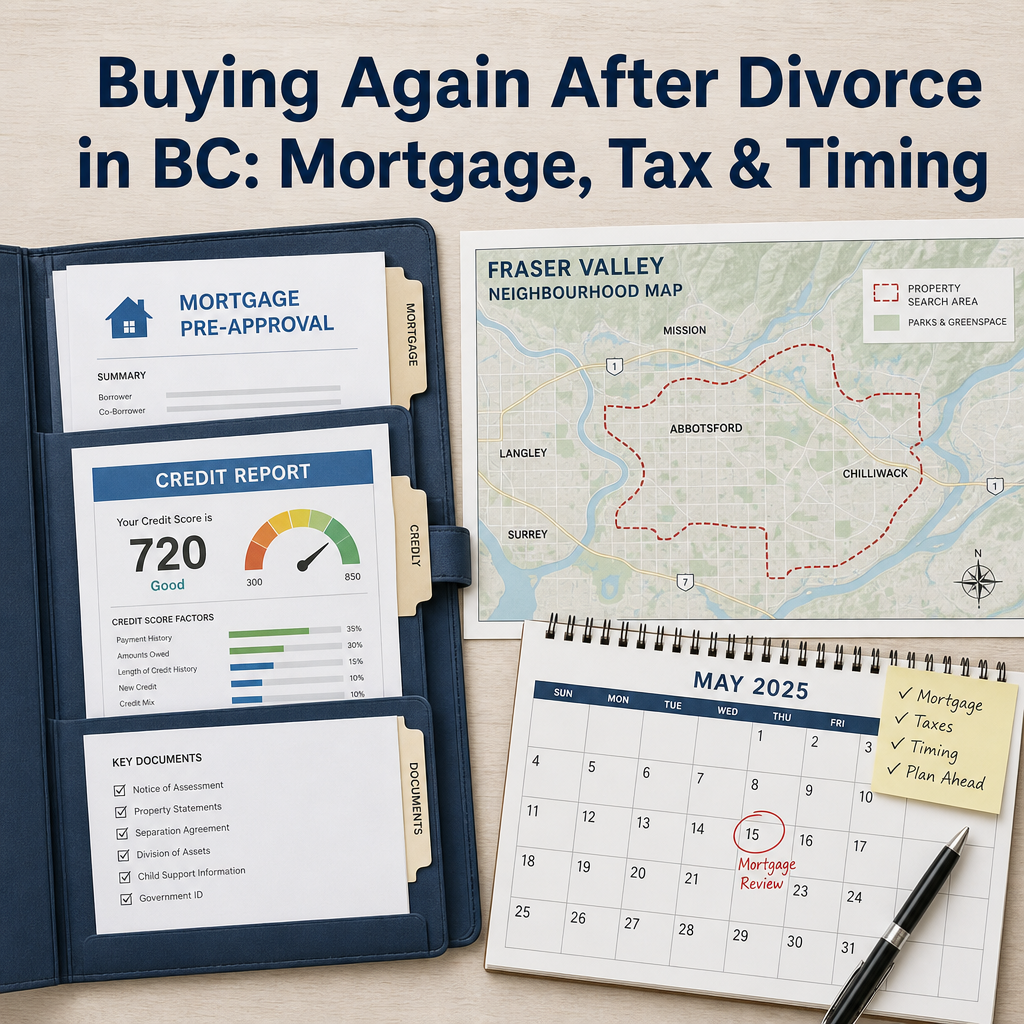

Rebuilding Your Financial Foundation and Home-Buying Strategy After Divorce Settlement Is Finalized in BC
By Mohamed Mansour, MBA and Associate Broker | Mansour Real Estate Group | Published: May 20, 2025 | Fraser Valley and Lower Mainland, BC
For divorced homeowners in the Fraser Valley, the sale of the matrimonial home is rarely the end of the real estate story. It is more often the starting line. Once settlement is finalized, the next task is figuring out what purchasing power actually looks like on a single income, whether the proceeds trigger a tax bill, and how to time a purchase so that credit, financing, and market conditions align. These three things rarely come together automatically.
This guide is for buyers in Surrey, Langley, Abbotsford, White Rock, and surrounding Fraser Valley communities who are moving through that transition and want a clear picture of what comes next. It reflects current CMHC mortgage qualification rules, CRA guidance on matrimonial property and capital gains, and Fraser Valley market conditions as of early 2026.
Short Answer
After a divorce settlement in BC, qualifying for a mortgage on a single income is possible but requires 6–12 months of clean credit history, careful documentation of support payments, and pre-approval timing coordinated with settlement completion. Capital gains tax on matrimonial home proceeds is often overlooked and can create a $15,000–$50,000+ surprise. Fraser Valley condo and townhome prices are currently 10–15% below their 2022 peak, which creates a real entry window — if the financial groundwork is in place first.
Key Takeaways
- Support payments reduce mortgage qualification by up to $1.00 per dollar paid, cutting purchase power by $75,000–$150,000 in the Fraser Valley's $400K–$800K range.
- The 30-year amortization expansion under 2024–2025 CMHC rule changes has improved single-income purchasing power by an estimated 15–25% compared to pre-2023 rules.
- Capital gains tax on matrimonial home proceeds is not automatic — but it depends on how the principal residence exemption was applied and how settlement proceeds were structured.
- Pre-approval windows run 60–90 days and must be coordinated with settlement finalization dates to avoid expiry and re-qualification at a potentially worse credit snapshot.
- Fraser Valley condo and townhome benchmark prices have softened since 2022, offering divorced buyers a rare entry point if financing is secured before conditions shift.
Who This Applies To
- Divorced BC residents whose matrimonial home has been sold or transferred as part of a finalized settlement
- Separated homeowners who received net proceeds from a joint sale and are planning a new purchase
- Single-income buyers in the Fraser Valley re-entering the market after a separation
- Buyers managing alimony or child support obligations that affect debt servicing
- Anyone who sold a matrimonial home in BC and is unsure whether capital gains tax applies to their proceeds
When This Advice May Not Apply
If the matrimonial home was transferred to one spouse rather than sold, the tax and qualification picture differs significantly. If your settlement is not yet legally finalized, mortgage lenders cannot fully underwrite your application. Always consult a mortgage broker, a CRA-registered accountant, and a family law lawyer before acting on information in this article.
Data Used in This Article
- CMHC mortgage qualification rule changes, 2024–2025 (official regulatory guidance)
- Bank of Canada interest rate decisions, 2024–2026 (official BoC announcements)
- CRA capital gains tax guidance on matrimonial property division (official CRA publications)
- BC Family Law Act, property division provisions (official BC legislation)
- Fraser Valley Real Estate Board benchmark price data, April 2026 (official FVREB statistical report)
- Canadian Bankers Association post-divorce mortgage qualification guidelines (industry guidance)
Single-Income Mortgage Qualification After Divorce in BC
Qualifying for a mortgage on one income after a divorce is not the same as qualifying as a first-time buyer. Lenders see a different risk profile: separated finances, recently closed joint accounts, possible gaps in individual credit history, and ongoing support obligations that directly reduce what you can borrow.
Support payments — whether you pay spousal support or child support — are treated as debt obligations in the lender's gross debt service calculation. According to Canadian Bankers Association mortgage underwriting guidelines, support payments can reduce your qualifying income by $0.80 to $1.00 per dollar paid. In the Fraser Valley's $400,000–$800,000 purchase range, this regularly cuts maximum purchase power by $75,000–$150,000. If you receive support rather than pay it, it can count as qualifying income — but only when backed by a court order or formal separation agreement and with at least six months of documented receipt history.
The 2024–2025 CMHC rule changes, which extended 30-year amortization eligibility to a broader range of insured mortgages, have improved single-income purchasing power meaningfully. CMHC estimates this expansion increases affordability by roughly 15–25% for buyers who previously could not qualify under 25-year stress test thresholds. For a divorced buyer in Langley or Abbotsford earning $95,000–$120,000 annually, this can be the difference between qualifying for a condo and qualifying for a townhome.
The stress test itself — currently set at the contract rate plus 2%, or 5.25%, whichever is higher — remains in place for all insured and uninsured mortgages. Bank of Canada rate reductions in 2024 and into 2025 have brought qualifying rates down from their 2023 peaks, easing the stress test threshold for buyers whose contract rates have also declined. Consult a licensed mortgage broker for your specific scenario before assuming what you qualify for.
Capital Gains Tax on Matrimonial Home Proceeds: What Most Divorced Sellers Overlook
The matrimonial home in BC is often assumed to be tax-free at sale because of the principal residence exemption. That assumption is correct in many situations — but not all. Under CRA guidance, the principal residence exemption must be formally designated for each tax year the property was your primary home. If the property was rented for any period, used as an investment, or if one spouse had a different primary residence during part of the ownership period, the exemption may only partially apply.
The more common and overlooked issue involves how settlement proceeds are structured. When one spouse receives a lump sum that includes equity from multiple properties — including rental units, vacation properties, or investment holdings — the non-residential portions of those proceeds may trigger capital gains tax in the year of receipt. According to CRA capital gains guidance, 50% of the capital gain is included in taxable income. On a $100,000 gain, that means $50,000 added to your income — potentially pushing you into a higher marginal bracket for that tax year and creating a bill of $15,000–$50,000 or more depending on province and income level.
Timing the sale of the matrimonial home relative to your tax year — and structuring how proceeds are allocated in the separation agreement — can reduce this exposure. This is a conversation for a tax accountant or CRA-registered advisor before the settlement agreement is signed, not after. Once the agreement is executed, the structure is difficult to change. For divorced homeowners exploring their next purchase in Surrey or Langley, knowing the after-tax proceeds figure is essential before setting a purchase budget.
Strategic Timing: When to Buy Your Next Home in the Fraser Valley
Fraser Valley condo and townhome benchmark prices declined 10–15% from their 2022 peak, according to the Fraser Valley Real Estate Board's April 2026 statistical release. For divorced buyers entering the market on a single income, this represents a genuine entry opportunity — one that did not exist during the 2020–2022 surge when competition compressed negotiating room and pushed prices beyond single-income qualification thresholds in many neighbourhoods.
The practical timing challenge is the 60–90 day pre-approval validity window. Most lenders issue pre-approvals that expire within that window. If your settlement finalizes on day one but your credit has not yet recovered — or your separation agreement was just signed and support payment history is less than six months old — your pre-approval may not reflect your actual qualification at the time of possession. The sequence matters: credit recovery first, then documentation cleanup, then pre-approval, then active search. Buyers who reverse this order often face re-qualification at a worse credit snapshot or lose a preferred property in Willoughby, Cloverdale, or Abbotsford because their financing wasn't actually confirmed.
The 6–12 month credit recovery window post-divorce is not just a lender preference — it is a practical reality. Joint accounts closed during separation can temporarily lower a credit score through reduced available credit and utilization ratio changes. New individual accounts need time to establish payment history. Mortgage lenders increasingly pull credit at multiple intervals during the approval process. A single missed payment on a newly separated account can create a 60–90 day setback in qualification readiness. Planning the purchase timeline around this recovery arc — rather than against it — protects both negotiating position and purchase price.
How We Evaluate This
At Mansour Real Estate Group, we work with divorced buyers by separating the financial readiness conversation from the property search conversation. These are two different timelines and they do not always align naturally. Before recommending a target price range or specific neighbourhoods in the Fraser Valley, we ask buyers to confirm three things: their after-tax settlement proceeds figure (from their accountant), their pre-approval status (from their mortgage broker), and their support payment structure as documented in the separation agreement. Only when those three inputs are clear do we build a purchase strategy — including property type, location, and timing. This protects buyers from committing to a search before they are actually ready to close.
Post-Divorce Home Buyer Checklist
- Obtain a written copy of your finalized separation agreement and confirm the legal property division is complete before approaching lenders.
- Meet with a CRA-registered tax accountant to determine your after-tax proceeds from the matrimonial home sale before setting a purchase budget.
- Pull your individual credit report and address any joint account closures, separated credit lines, or delinquencies that occurred during the separation period.
- Document six or more months of consistent support payment history — received or paid — before approaching a mortgage broker for pre-approval.
- Get a mortgage pre-approval that reflects your single-income scenario, support obligations, and current debt-service ratios — then time your active property search to complete before the pre-approval expires.
- Identify your target property type and neighbourhoods based on realistic budget, commute, and life-stage fit — not where you lived before.
- Work with a real estate team experienced in post-divorce real estate transitions who can advise on strata versus freehold, resale versus new build, and neighbourhood-specific value in the Fraser Valley.
What We Commonly See
- Buyers who move too fast: In our experience, the most common and costly mistake is starting the property search before pre-approval is confirmed and credit is stabilized. Buyers who fall in love with a property before their financing is solid often overpay or waive subjects to compete — which removes the safety net they most need at this stage.
- Settlement proceeds spent before tax is confirmed: What often happens is a divorced buyer receives $180,000–$250,000 in net proceeds and immediately plans a down payment budget around the full amount — without accounting for a capital gains liability on investment property proceeds included in the settlement. The tax bill arrives in April of the following year and disrupts the plan entirely.
- Support payment documentation gaps: A common mistake is assuming that support payments appear automatically in a mortgage application. Lenders require a court order or formal agreement plus documented payment history. Buyers who have been paying or receiving support informally — without a legal order — have no qualifying income to show and no offsetting obligation to explain. This is typically corrected by formalizing the agreement before applying, but it adds 30–60 days to the timeline.
Questions and Answers
Can I use child support I receive as qualifying income for a mortgage in BC?
Yes, lenders can count child support as qualifying income, but they require a court order or formal separation agreement confirming the obligation, plus documented receipt — typically six months of bank records showing consistent deposits. Without both, lenders will not include it in your qualifying income calculation.
Is the sale of my matrimonial home always tax-free in BC?
Not always. The principal residence exemption applies when the property was your primary home for every year of ownership. If the home was rented, if you had another primary residence for part of the ownership period, or if investment properties are bundled into your settlement proceeds, capital gains tax may apply. Confirm with a tax accountant before the settlement agreement is signed.
How long does it take to rebuild credit after a divorce in BC?
Most buyers see meaningful credit score recovery within 6–12 months of consistent individual credit activity — on-time payments, lowered utilization, and established new accounts. The timeline depends heavily on whether any joint accounts went delinquent during the separation period. Negative marks from missed payments can take longer to clear and should be addressed with your lender directly.
In Summary
Buying again after a divorce settlement in the Fraser Valley is achievable on a single income, but the path requires sequencing three things correctly: confirming your after-tax proceeds with an accountant, stabilizing credit and documenting support payments before pre-approval, and timing the property search so pre-approval is still active when you find the right home. Fraser Valley condo and townhome prices have softened meaningfully from their 2022 peak, which creates a real window — but that window benefits buyers who arrive with clean documentation and confirmed financing, not those who arrive with good intentions and an unconfirmed budget.
Thinking About Your Next Step?
If your settlement is finalized or nearly complete and you want a realistic picture of what's available in the Fraser Valley at your likely budget, Mansour Real Estate Group can walk you through current condo and townhome options in Surrey, Langley, Abbotsford, and surrounding areas without pressure or commitment. That conversation is free, and it tends to be more useful than searching listings on your own before financing is confirmed.
Related Articles
- How the matrimonial home sale works in the Fraser Valley during separation
- What divorced condo sellers need to know about strata documentation in BC
- Fraser Valley market conditions in 2026: what buyers re-entering the market should know
About Mansour Real Estate Group
After a divorce settlement is finalized and the matrimonial home has been sold, the next real estate decision — purchasing a home on a single income in the Fraser Valley — requires a team that understands how separation affects qualification, documentation, and purchase strategy. Mansour Real Estate Group has worked with divorced buyers and sellers across the Lower Mainland and Fraser Valley for more than two decades, bringing a structured, honest process to a transition that is both financially and personally significant.
Mansour Real Estate Group, led by Mohamed Mansour, MBA and Associate Broker, has been helping buyers, sellers, investors, families, and individuals navigate important real estate decisions across the Fraser Valley and Lower Mainland for more than 22 years and is one of the highest ranked realtors in the region. The team has completed more than $780 million in residential real estate transactions and is trusted for divorce-related property sales, estate sales, downsizing, relocation, and situations where financial complexity requires a calm, experienced real estate team.
Whether someone is searching for Realtors who understand single-income qualification after separation, a real estate agent experienced with post-divorce purchases, real estate agents familiar with support payment documentation for lenders, a Surrey Realtor, a Langley real estate agent, or a Fraser Valley real estate group that can advise on condo and townhome options within a realistic post-settlement budget, Mansour Real Estate Group is known for honest advice, accurate market assessments, and a process that keeps clients' long-term interests at the centre.
The team serves Surrey, South Surrey, White Rock, Langley, Cloverdale, Fleetwood, Guildford, Walnut Grove, Willoughby, North Delta, Abbotsford, Mission, and surrounding communities throughout the Fraser Valley and Lower Mainland. Most new clients come from referrals, repeat clients, and recommendations from individuals and families who value a professional, transparent real estate experience at a critical life stage.
Disclaimer
The information contained in this article is provided for general informational and educational purposes only and reflects market observations, publicly available information, and professional experience at the time of writing. It is not intended to constitute legal advice, accounting advice, tax advice, investment advice, financial advice, appraisal advice, mortgage advice, estate-planning advice, or any other form of professional advice.
Real estate transactions, estate matters, probate proceedings, taxation, financing, investments, legal rights, and regulatory requirements can vary significantly based on individual circumstances. Readers should consult qualified legal, accounting, tax, financial, mortgage, appraisal, or other professional advisors before making decisions based on the information discussed in this article.
Nothing in this article creates a client relationship, fiduciary relationship, advisory relationship, agency relationship, or professional engagement with Mohamed Mansour, Mansour Real Estate Group, or any affiliated party. Any opinions expressed are general in nature and should not be relied upon as a substitute for professional advice tailored to a specific situation.
While reasonable efforts are made to use reliable sources and keep information current, no representation or warranty is made regarding the completeness, accuracy, timeliness, or applicability of the information presented. Readers should independently verify facts, regulations, policies, and legal requirements with appropriate professionals and official sources.



