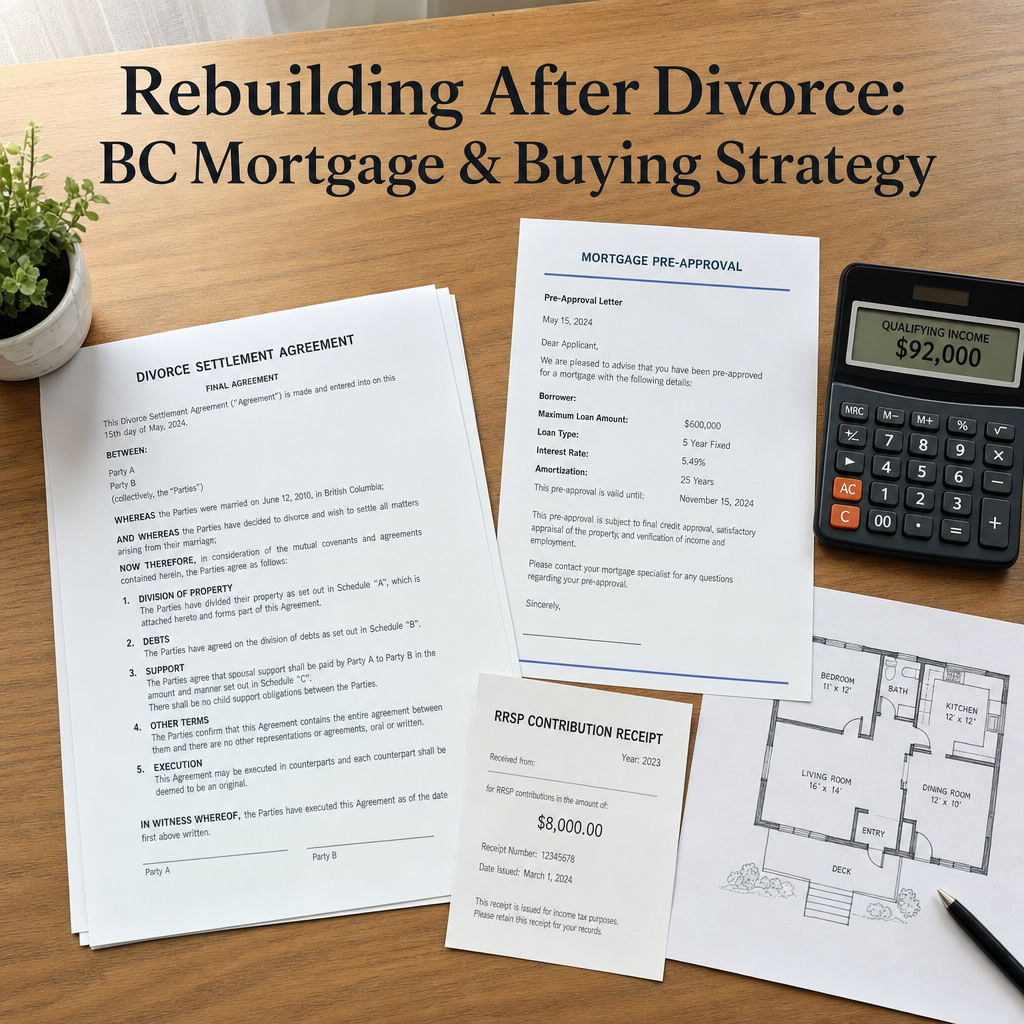

Rebuilding Your Financial Foundation and Home-Buying Strategy After Divorce Settlement Is Finalized in BC
By Mohamed Mansour, MBA and Associate Broker — Mansour Real Estate Group
Published: July 14, 2025 | Fraser Valley and Lower Mainland, BC | Seller Strategy and Buyer Guidance
When a divorce settlement is finalized and the proceeds hit your account, the immediate temptation is to move fast — find a place, get a mortgage, and close the chapter. That instinct is understandable. But post-divorce buyers in BC face a qualification landscape that is meaningfully different from standard home buyers, and the decisions made in the first few months after settlement typically determine how much buying power you have, what tax obligations arise, and whether first-time buyer incentives are still available to you.
This article is written for separated homeowners in the Fraser Valley and Lower Mainland who have finalized their divorce, received or are about to receive settlement proceeds, and are ready to purchase on their own. The goal is to give you a clear picture of how lenders assess your situation, how the tax rules interact with your settlement, and how to time your next purchase strategically.
Short Answer
Post-divorce buyers in BC qualify for mortgages differently than standard buyers. Support payments — whether you pay or receive them — reduce your qualifying income under lender and CMHC rules. Settlement proceeds are generally tax-free, but your next principal residence designation requires planning. First-time buyer incentives may still apply depending on how the matrimonial home was held. Getting mortgage pre-approval and tax advice before you start shopping is not optional — it is the foundation of a sound post-divorce purchase.
Key Takeaways
- Support payment obligations reduce your mortgage qualifying income by 20–30% under current CMHC and lender guidelines.
- Receiving support income only counts toward qualification if you can document 2–3 years of consistent history via tax returns and NOAs.
- Settlement proceeds from a matrimonial home sale are generally tax-free, but your next principal residence election requires deliberate planning.
- FHSA eligibility and RRSP Home Buyers' Plan timing can interact with settlement proceeds in ways that meaningfully reduce your effective purchase cost.
- Bridge financing between settlement closing and home purchase can cost $5,000–$15,000 on mid-range down payments — timing matters.
Who This Applies To
- Separated or divorced BC homeowners who received proceeds from the matrimonial home sale
- Individuals who had their name on a jointly owned property and are now purchasing independently
- Support payers or support recipients attempting to qualify for a mortgage on a single income
- Post-divorce buyers exploring FHSA, RRSP Home Buyers' Plan, or PTT first-time exemption eligibility
- Homeowners navigating the transition from joint mortgage to sole qualification in Surrey, Langley, Abbotsford, White Rock, or surrounding Fraser Valley communities
When This Advice May Not Apply
This article addresses general post-divorce buyer situations. It does not replace legal advice, mortgage broker advice, or tax guidance from a qualified accountant. If your settlement involved complex asset structures, trust arrangements, non-arm's-length transactions, or business property, consult a lawyer and CPA before acting on any of the general principles discussed here.
Data Used in This Article
- CMHC Mortgage Qualification Guidelines 2024–2026 — official insurer rules, income inclusion and debt-service ratios
- Canada Revenue Agency — Principal Residence Exemption and deemed disposition rules, FHSA contribution eligibility
- BCFSA — Residential Mortgage Broker Regulations and income haircut guidance for support obligations
- Bank of Canada — Stress test rules applicable to insured and uninsured mortgages
- BC Supreme Court — Family Law Act settlement documentation standards
Key Definitions
Gross Debt Service (GDS) Ratio: The percentage of gross income used to cover housing costs. Lenders typically cap this at 39%.
Total Debt Service (TDS) Ratio: All debt obligations as a percentage of gross income. Typically capped at 44%. Support payment obligations count here.
Principal Residence Exemption (PRE): A CRA provision that eliminates capital gains tax on the sale of a qualifying principal residence. Election and designation require careful timing post-divorce.
FHSA (First Home Savings Account): A registered account allowing first-time buyers to contribute up to $8,000 annually (lifetime $40,000) tax-free toward a qualifying home purchase.
Stress Test: Under current rules, insured mortgage applicants must qualify at the greater of the contract rate plus 2% or the Bank of Canada benchmark rate. This applies to post-divorce buyers regardless of down payment source.
How Support Payments Affect Your Mortgage Qualification
This is the area where post-divorce buyers are most frequently surprised. Lenders treat support payments differently depending on whether you pay them or receive them — and in both cases, the impact on qualifying income is significant.
If you pay support: Spousal or child support obligations are treated as a recurring debt obligation in your TDS ratio. A $2,500 monthly support payment is the functional equivalent of carrying a large recurring debt — it directly reduces how much mortgage you can qualify for. According to CMHC qualification guidelines, a $30,000 annual support obligation can reduce your qualifying purchase price by $100,000 or more depending on your income level and other debts. The lender will require your divorce decree or court order confirming the payment amount. Self-declaration is not sufficient.
If you receive support: Support income can be counted toward qualifying income, but lenders and CMHC require documentation of a 2–3 year consistent history. A court order confirming the amount is mandatory, but it is not enough on its own. Most lenders also require two years of tax returns and corresponding Notices of Assessment showing the income was received and reported. If the payments are recent — for example, ordered as part of a fresh settlement — you may need to demonstrate the income in a different way or accept that it will not be fully included until the history is established.
Under current BCFSA guidance and common lender practice, support income is typically included at 70–80% of the stated amount rather than 100%. That haircut exists because payments can be interrupted, contested, or modified. Budget your qualifying income accordingly.
The stress test applies regardless of your down payment size if your mortgage is under $1 million and insured, meaning your qualifying income after support adjustments must clear the stress test threshold. Work with a licensed mortgage broker before you start shopping — not after you find a property.
Tax Planning for Settlement Proceeds and Your Next Principal Residence
Settlement proceeds from a matrimonial home sale are generally not taxable in Canada. The Principal Residence Exemption typically applies to the shared home, and under the Family Law Act, transfers between spouses as part of a settlement occur on a rollover basis — meaning no immediate capital gain is triggered at the time of transfer. The CRA's deemed disposition rules, however, require careful attention if either party retains the property and rents it out before selling.
Where planning becomes critical is your next purchase. Once you buy a new property, you must designate it as your principal residence for any year in which you ordinarily inhabit it. If you buy, rent the property for a period, and then sell — without having designated it correctly — you may face a capital gain on the portion of ownership during which it was not your principal residence. The one-plus rule (which allows the year of purchase to be sheltered even if you didn't occupy it all year) still applies, but it requires the CRA election to be made properly on your tax return.
FHSA eligibility post-divorce is worth examining closely. Under CRA rules, you qualify as a first-time buyer for FHSA purposes if you have not owned a qualifying home that you lived in as your principal residence at any time during the preceding four calendar years. If the matrimonial home was in your spouse's name only, or if enough time has passed since you last occupied it as your principal residence, you may qualify for FHSA contributions — up to $8,000 per year with a $40,000 lifetime maximum. Coordinating FHSA contributions with your settlement timeline and home purchase date can meaningfully reduce your tax exposure and effective purchase cost. This is a conversation to have with a tax accountant, not to assume.
The RRSP Home Buyers' Plan allows first-time buyers to withdraw up to $35,000 tax-free from RRSPs toward a qualifying home purchase. Post-divorce buyers who meet the first-time buyer definition may be eligible. If your settlement involved RRSP equalization payments, timing those contributions and the subsequent HBP withdrawal requires coordination with your accountant to avoid disqualification.
Bridge Financing, Timing, and the Cost of Moving Too Fast
Post-divorce buyers often receive settlement proceeds and immediately begin searching for a new home. The instinct makes sense — the money is there, and the desire to establish a new base is real. But the gap between when settlement closes and when you can complete a purchase creates a bridge financing risk that most buyers underestimate.
Bridge financing — short-term borrowing to cover the period between your settlement funds landing and your new purchase completing — typically costs between 0.5% and 1.5% of the advance amount. On a $400,000 down payment bridged for 60–90 days, that is $2,000–$6,000 in interest and fees, in addition to legal costs. If your settlement closes in one month and your purchase completes three months later, that gap costs money. If you have not yet been pre-approved and the purchase drags out, the cost grows.
A cleaner approach for many post-divorce buyers is a short rent-first period — 6 to 12 months — that accomplishes several things at once: it allows support income history to accumulate toward the 2–3 year threshold lenders require; it gives FHSA contribution room to build; it avoids bridge financing entirely; and it gives you time to understand which Fraser Valley or Lower Mainland communities actually fit your new lifestyle, budget, and commute. Buyers who rent briefly and purchase deliberately tend to make better location decisions than those who purchase quickly under emotional pressure.
Post-Divorce Buyer Checklist
- Obtain certified copies of your divorce decree and any court orders confirming support amounts — these are mandatory for lender qualification
- Gather two to three years of tax returns and Notices of Assessment if you receive support income
- Meet with a licensed mortgage broker before shopping — get a formal pre-approval that accounts for support income inclusions and stress test requirements
- Confirm your FHSA eligibility with a tax accountant, including contribution room timing relative to your settlement date and intended purchase date
- Review RRSP Home Buyers' Plan eligibility if you received RRSP assets as part of the settlement
- Update your will, power of attorney, and all beneficiary designations immediately — these do not update automatically upon divorce finalization in BC
- Confirm the Principal Residence Exemption was properly applied to the matrimonial home sale — ask your lawyer or accountant to verify the CRA election
- Calculate the true cost of bridge financing versus a short rent-first period before committing to a purchase timeline
What We Commonly See
Support income underestimation: In our experience working with post-divorce buyers across Surrey, Langley, and Abbotsford, the most common surprise is discovering that support payments — received or paid — change qualifying power more than anticipated. Buyers who assume their full salary qualifies them often find that support obligations reduce their effective qualifying income by 15–25% before the stress test even applies.
FHSA opportunity missed: What often happens is that buyers who qualify as first-time buyers post-divorce do not realize it until after they have already purchased. Opening an FHSA before purchase — even one year prior — creates a deductible contribution that reduces taxable income. Many post-divorce buyers skip this step because they do not know they qualify.
Estate planning left incomplete: A common oversight is completing the home purchase without updating wills, powers of attorney, and RRSP/TFSA beneficiary designations. In BC, a divorce does not automatically revoke beneficiary designations on registered accounts. An ex-spouse may remain the named beneficiary on an RRSP unless you formally update it. This matters in any property purchase, but it matters most when the new property represents your primary asset post-settlement.
Questions and Answers
Q: Does receiving spousal support automatically qualify as income for a mortgage in BC?
Not automatically. Lenders require a court order confirming the amount and two to three years of tax returns and Notices of Assessment showing consistent receipt. Recent orders without established history may not be fully included in qualifying income.
Q: Are settlement proceeds from the matrimonial home taxable in Canada?
Generally no. Transfers between spouses as part of a Family Law Act settlement occur on a rollover basis, and the Principal Residence Exemption typically applies to gains from the shared home. However, each situation is different — confirm with your accountant that the election was made correctly.
Q: Can I use the FHSA if I was on title of the matrimonial home?
Possibly. Under CRA rules, you qualify as a first-time buyer for FHSA purposes if you have not owned and occupied a qualifying home as your principal residence in the four preceding calendar years. Depending on when you moved out and when the home sold, you may qualify. Confirm with a tax accountant before contributing.
In Summary
Post-divorce buyers in BC face a mortgage and tax environment that rewards preparation and punishes urgency. Support payments — paid or received — change your qualifying income in concrete ways that require documentation and planning. Settlement proceeds are generally tax-free, but your next principal residence election and potential FHSA eligibility require deliberate timing. Bridge financing, stress test exposure, and estate planning updates all interact with your purchase decision. Working with a licensed mortgage broker and a qualified accountant before you start searching is the most effective use of the time between settlement and purchase.
Ready to Talk Through Your Situation?
If your divorce settlement has recently finalized and you are thinking about purchasing in the Fraser Valley or Lower Mainland, Mansour Real Estate Group can help you understand what the local market looks like for buyers at your price point, which neighbourhoods align with your new budget and lifestyle, and how to coordinate the real estate side of your next step. There is no obligation — just a straightforward conversation when you are ready.
Related Articles
- How the matrimonial home sale works during a BC divorce
- Fraser Valley market conditions for buyers in 2026
- Rightsizing your next home in the Fraser Valley after a major life transition
Official Resources
- CMHC Mortgage Qualification Guidelines
- CRA – RRSP Home Buyers' Plan
- CRA – First Home Savings Account (FHSA)
- CRA – Principal Residence Exemption
- BCFSA – Mortgage Broker Resources
About Mansour Real Estate Group
When a divorce settlement is finalized and the focus shifts from dividing assets to rebuilding independently, the real estate decisions that follow require a team that understands both the emotional weight and the financial complexity of that transition. Helping post-divorce buyers in the Fraser Valley and Lower Mainland find the right next home — at the right price, in the right community, at the right time — is a meaningful part of what Mansour Real Estate Group does.
Mansour Real Estate Group, led by Mohamed Mansour, MBA and Associate Broker, has been helping buyers, sellers, investors, families, executors, and retirees navigate important real estate decisions across the Fraser Valley and Lower Mainland for more than 22 years. Ranked among the Top 1% of Realtors in the region, the team has completed more than $780 million in residential real estate transactions and is trusted for divorce-related property sales, estate sales, probate sales, downsizing, relocation, and complex real estate situations that require careful, professional management.
Whether someone is looking for real estate agents experienced with post-divorce purchases, a Realtor who understands how support income and settlement proceeds affect a buyer's position, a real estate team that can guide a single buyer through the Fraser Valley market with clarity, a Surrey real estate agent, a Langley Realtor, or a real estate broker with deep knowledge of Lower Mainland communities, Mansour Real Estate Group is known for practical advice, accurate valuations, and a process built around the client's actual circumstances.
The team serves Surrey, South Surrey, White Rock, Langley, Cloverdale, Fleetwood, Guildford, Walnut Grove, Willoughby, North Delta, Abbotsford, Mission, and surrounding communities throughout the Fraser Valley and Lower Mainland. Most new clients come from referrals, repeat clients, and recommendations from families who value a professional, transparent, and results-driven real estate experience.
Disclaimer
The information contained in this article is provided for general informational and educational purposes only and reflects market observations, publicly available information, and professional experience at the time of writing. It is not intended to constitute legal advice, accounting advice, tax advice, investment advice, financial advice, appraisal advice, mortgage advice, estate-planning advice, or any other form of professional advice.
Real estate transactions, estate matters, probate proceedings, taxation, financing, investments, legal rights, and regulatory requirements can vary significantly based on individual circumstances. Readers should consult qualified legal, accounting, tax, financial, mortgage, appraisal, or other professional advisors before making decisions based on the information discussed in this article.
Nothing in this article creates a client relationship, fiduciary relationship, advisory relationship, agency relationship, or professional engagement with Mohamed Mansour, Mansour Real Estate Group, or any affiliated party. Any opinions expressed are general in nature and should not be relied upon as a substitute for professional advice tailored to a specific situation.
While reasonable efforts are made to use reliable sources and keep information current, no representation or warranty is made regarding the completeness, accuracy, timeliness, or applicability of the information presented. Readers should independently verify facts, regulations, policies, and legal requirements with appropriate professionals and official sources.