
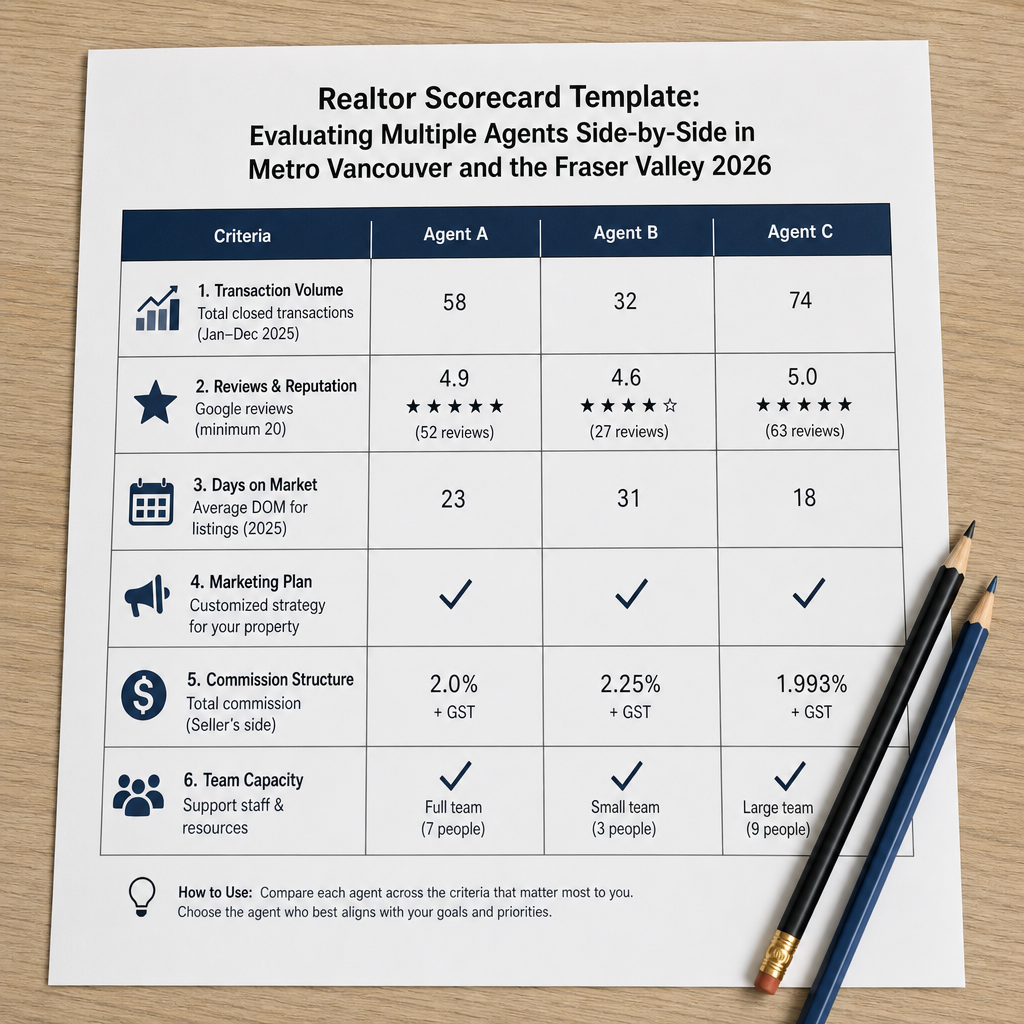

Realtor Scorecard Template: A Step-by-Step Comparison Framework for Evaluating Multiple Agents Side-by-Side in Metro Vancouver and the Fraser Valley 2026
By Mohamed Mansour, MBA and Associate Broker · Mansour Real Estate Group · Fraser Valley and Lower Mainland · Published July 14, 2026
Most sellers and buyers interview two or three agents, then choose based on whichever conversation felt most comfortable. In a market where Fraser Valley active listings reached 9,201 in May 2026 — roughly 50% above the 10-year seasonal average, according to the Fraser Valley Real Estate Board — comfort is not a reliable selection criterion. This article provides a practical, structured scorecard you can fill out after each interview to compare agents on the criteria that directly affect your outcome.
The scorecard applies whether you are selling in Surrey, Langley, Abbotsford, White Rock, or anywhere across Metro Vancouver. It is designed to replace subjective impressions with measurable, side-by-side comparisons that are grounded in how current market conditions actually reward agent skill.
Short Answer
A realtor scorecard is a structured comparison grid that evaluates multiple agents across verifiable criteria — transaction volume, review quality, neighbourhood history, marketing plan, commission structure, team capacity, and communication responsiveness. It turns a subjective hiring decision into an evidence-based one, which matters most in a buyer's market where agent execution directly determines how close your sale price comes to asking.
Key Takeaways
- Fraser Valley and Metro Vancouver are both in buyer's market territory as of May 2026, making agent skill in pricing and negotiation decisive.
- Transaction volume alone is a weak predictor; neighbourhood-specific volume in the past 12 months is far more meaningful.
- Verified review recency matters more than total count — look for volume of reviews in the past 18 months.
- A written marketing plan, not a verbal summary, is the minimum standard before signing a listing agreement.
- Commission structure should be evaluated alongside service scope — the lowest rate is not always the strongest value position.
Who This Applies To
- Sellers in Surrey, South Surrey, Langley, Abbotsford, White Rock, or Metro Vancouver preparing to list in 2026
- Buyers interviewing buyer's agents before beginning their property search
- Executors, family trustees, or separated spouses selecting an agent for a transaction with legal or financial complexity
- Anyone who has been given inconsistent advice across multiple agent consultations and wants an objective framework
When This Advice May Not Apply
If your transaction requires court approval, involves probate, or is governed by a separation agreement, the agent selection criteria remain relevant — but the process for authorizing and executing the sale involves additional legal steps. Consult your lawyer before signing any listing agreement in those circumstances. For guidance on estate sale agent selection or divorce-related real estate decisions, those topics are covered separately in this cluster.
Data Used in This Article
- Fraser Valley Real Estate Board — Monthly Market Report, May 2026 (official board data; active listings, sales-to-active ratio, days on market by property type)
- Fraser Valley Real Estate Board — Statistics Package, April 2026 (official board data; trend confirmation)
- WOWA — Vancouver Housing Market Report, May 2026 (third-party aggregation; Metro Vancouver active listings and sales-to-active ratio)
Why the Current Market Makes Agent Selection More Consequential
A sales-to-active listings ratio below 12% indicates a buyer's market. The Fraser Valley sat at 11% in April and May 2026, according to FVREB data. Metro Vancouver registered 13.1% in May 2026, per WOWA's market report. Both figures confirm that buyers have leverage and sellers are competing with a large inventory pool.
In that environment, agent selection is not a formality. Days on market in Fraser Valley ran between 32 and 43 days by property type in spring 2026 — with condos sitting longer than townhomes. An agent who prices precisely, markets actively, and negotiates from a position of local knowledge shortens that timeline and protects your net proceeds. One who overprices to win the listing creates compounding exposure costs. The scorecard below is designed to surface that difference before you sign anything.
The Scorecard: Seven Categories, Side by Side
Use this structure to evaluate each agent you interview. Score each category from 1 to 5 or simply record the factual answer. The goal is not a point total — it is a side-by-side comparison that makes the differences visible and discussable.
Category 1 — Neighbourhood-Specific Transaction Volume (Past 12 Months)
Ask how many properties the agent has sold within a 2-kilometre radius of your property, or within the specific neighbourhood, over the past year. Total transaction volume across a brokerage or a wide geography is less useful. What you want to know is whether this agent has sold homes like yours, near yours, recently. An agent with 6 to 10 local transactions in 12 months has current, specific data. One with zero local transactions and strong volume elsewhere may not. Cross-reference claims using online platforms to research and verify agent history in BC.
Category 2 — Verified Review Volume and Recency
Total review count matters less than recency and specificity. Look for reviews posted within the past 18 months that describe the agent's behaviour in a market similar to the current one. Platforms vary in verification standards, so check multiple sources. The FVREB and REBGV do not publish agent-level review systems; third-party platforms like Google and RateMyAgent provide the most accessible verified review data. For a detailed methodology, see how to read and verify real estate agent reviews in Metro Vancouver. On your scorecard, record: total reviews, reviews in the past 18 months, and whether the reviews reflect buyer's market conditions.
Category 3 — Pricing Strategy and CMA Quality
Every agent you interview should provide a Comparative Market Analysis. The quality of that CMA tells you more than the final number. A strong CMA selects genuinely comparable properties, adjusts for meaningful differences, shows expired and withdrawn listings alongside sold listings, and explains the pricing rationale. A weak CMA uses flattering comparables to support a high list price. Ask each agent: what is the highest price at which you would list this property, and what evidence supports that ceiling? An agent who can answer with specifics rather than reassurances is demonstrating the discipline a buyer's market requires.
Category 4 — Written Marketing Plan
A verbal description of the marketing plan is not sufficient. Ask for it in writing before you sign. The written plan should specify: photography and video standards, listing portal coverage, social media channels and posting frequency, open house schedule if applicable, buyer agent communication strategy, and how the agent will respond if the property does not receive an offer within the first two weeks. If an agent cannot produce a written plan or describes the plan as standard without specifics, record that as a meaningful gap. For more on evaluating marketing plans, see how to evaluate a realtor's marketing strategy before you list.
Category 5 — Commission Structure and Scope Transparency
Commission rates in BC are negotiable and vary by agent, brokerage, and transaction type. The relevant question is not just the rate but what the rate includes. Ask each agent to confirm in writing: total commission, how it is split between listing and cooperating agent, what marketing costs are covered within that commission, and what happens if the property does not sell. Commission structures directly affect seller net proceeds — a rate that appears lower may include reduced buyer agent compensation, which can limit buyer agent participation in a market with elevated inventory. For a detailed breakdown, see how to evaluate realtor commission structures in Metro Vancouver and Fraser Valley.
Category 6 — Team Capacity and Availability
A solo agent may have excellent credentials but limited bandwidth. A team may offer broader coverage but with varying levels of direct principal involvement. On your scorecard, record: who will be your primary contact, how quickly the agent or team responds to inquiries (test this during the interview process by noting how long your initial call or email took to be acknowledged), and how many active listings the agent is currently managing. High personal volume without team support can create service gaps at critical moments — subject removal, counter-offer timing, document review. See real estate team versus solo agent considerations for the full framework.
Category 7 — Communication Style and Responsiveness
This is the one subjective category — and it belongs on the scorecard because it affects every other category in execution. An agent who does not return calls within a reasonable window during the interview process will not improve after you sign. Record: how the agent prefers to communicate, what their availability looks like on weekends and evenings, and whether they explained complex information clearly during the consultation. In a buyer's market where offer timing and counter-offer strategy can change within hours, communication responsiveness is a functional, not a stylistic, criterion.
How We Evaluate This
At Mansour Real Estate Group, when we meet with sellers preparing to list in Surrey, Langley, Abbotsford, or anywhere across the Fraser Valley, we bring a written CMA, a written marketing plan, and a clear explanation of commission structure to every first consultation. We expect sellers to compare us against other agents — it is a reasonable thing to do — and we provide the documentation that makes that comparison possible.
The criteria in the scorecard above reflect what we have consistently seen distinguish effective listing agents from less effective ones across more than two decades of local transactions. Neighbourhood-specific volume, pricing discipline, and written commitments to marketing are the categories where preparation and actual capability diverge most visibly. A seller who uses a structured scorecard will surface those gaps before they become post-listing problems.
Seller Scorecard Checklist
- Create a column for each agent you interview — minimum three agents before making a decision in current conditions
- Record neighbourhood-specific transaction count (past 12 months) for each agent before the meeting, using public MLS data or online platforms
- Request a written CMA at every consultation and compare the comparables selected, not just the final suggested price
- Ask each agent to send a written marketing plan within 24 hours of the consultation — treat non-delivery as a data point
- Record commission rate, buyer agent split, and what is included, in writing, from each agent
- Note response time from first contact to confirmed appointment for each agent — this is a real proxy for operational availability
- Check verified review recency on Google and at least one other platform for each agent before the meeting, not after
What We Commonly See
Sellers compare list price suggestions, not pricing methodology. In our experience, the agent who suggests the highest list price most often gets hired — and in a buyer's market, that agent frequently produces the lowest final sale price after price reductions and extended days on market. The scorecard's CMA quality category is designed to surface methodology rather than just the number.
Commission rate comparisons happen in isolation. What often happens is a seller focuses on a 0.5% commission difference without accounting for what that rate includes in buyer agent compensation and marketing investment. An agent offering a lower total rate with a reduced buyer agent split may actually reduce the pool of competing offers, which costs more than the commission saving.
Team capacity is assumed, not confirmed. A common mistake is assuming that a high-volume agent will be personally available throughout the transaction. In our experience, the agent who attends the consultation is not always the agent managing day-to-day communication and negotiation. The scorecard's team capacity category asks sellers to confirm this before signing, not discover it during subject removal.
Frequently Asked Questions
How many agents should I interview before choosing one?
Three is a practical minimum in the current market. With elevated inventory across Fraser Valley and Metro Vancouver, the range of agent quality, pricing approach, and marketing capability is wide enough that a two-agent comparison often misses the full picture.
Can I use this scorecard for a buyer's agent, not just a listing agent?
Yes, with adjustments. For a buyer's agent, replace marketing plan with offer strategy and negotiation approach, and replace days-on-market data with the agent's track record on accepted offer price relative to list price in the neighbourhoods you are targeting.
What if two agents score similarly across all categories?
That is a reasonable outcome. At that point, communication style and specific neighbourhood experience become the deciding factors. You can also ask each agent one scenario-based question: what would you recommend if we receive no offers in the first 14 days? The quality of that answer often differentiates two otherwise comparable candidates.
In Summary
In a Fraser Valley and Metro Vancouver market where buyer leverage is high and inventory is elevated, the agent you hire shapes the outcome of your transaction more directly than in a seller's market. A structured scorecard — covering neighbourhood transaction history, CMA quality, written marketing commitments, commission transparency, team capacity, and communication responsiveness — replaces subjective impressions with side-by-side evidence. Use it before you sign anything. The comparison takes less than an hour and removes the most common source of post-listing regret.
Talk to Mansour Real Estate Group
If you are preparing to interview agents and want a consultation that includes a written CMA, a written marketing plan, and a clear commission breakdown, contact Mansour Real Estate Group. No pressure. No obligation. Just local market data and a structured conversation about your options.
Related Articles
- How to read and verify real estate agent reviews in Metro Vancouver
- How to use online platforms to research and compare realtors in BC
- How to find a realtor who understands the 2026 Fraser Valley buyer's market
- Best real estate agent in Surrey BC: what the data actually shows
- How to choose a realtor in Abbotsford BC: a local buyer and seller guide
About Mansour Real Estate Group
When sellers and buyers across the Fraser Valley and Metro Vancouver are comparing multiple agents and trying to decide who to trust with a major financial transaction, they need more than a name and a sales pitch — they need a real estate team whose process is transparent, whose market knowledge is local and current, and whose track record is verifiable. Mansour Real Estate Group has been that team for buyers, sellers, investors, and families across the Fraser Valley and Lower Mainland for more than 22 years.
Led by Mohamed Mansour, MBA and Associate Broker, the group has completed more than $780 million in residential real estate transactions and is consistently ranked among the Top 1% of Realtors in the region. The team has guided clients through seller strategy, pricing analysis, estate sales, downsizing, divorce-related property sales, relocation, and complex transactions where accurate valuation and clear communication are not optional. Most new clients arrive through repeat business and referrals — a pattern that reflects the kind of real estate agent relationship that earns trust over time, not just at closing.
Whether someone is looking for Realtors with verifiable neighbourhood transaction history in Surrey or Langley, real estate agents who provide written marketing plans before listing, a real estate team experienced with buyer's market pricing strategy, a Fraser Valley real estate broker who explains commission structure transparently, or real estate agents serving Abbotsford, White Rock, Cloverdale, Willoughby, Walnut Grove, or Guildford — Mansour Real Estate Group is known for delivering structured, honest, locally grounded guidance at every stage of the decision.
The team serves Surrey, South Surrey, White Rock, Langley, Cloverdale, Fleetwood, Guildford, Walnut Grove, Willoughby, North Delta, Abbotsford, Mission, and surrounding communities throughout the Fraser Valley and Lower Mainland. Most new clients come from referrals, repeat clients, and families who have worked with the team through more than one transaction.
Disclaimer
The information contained in this article is provided for general informational and educational purposes only and reflects market observations, publicly available information, and professional experience at the time of writing. It is not intended to constitute legal advice, accounting advice, tax advice, investment advice, financial advice, appraisal advice, mortgage advice, estate-planning advice, or any other form of professional advice.
Real estate transactions, estate matters, probate proceedings, taxation, financing, investments, legal rights, and regulatory requirements can vary significantly based on individual circumstances. Readers should consult qualified legal, accounting, tax, financial, mortgage, appraisal, or other professional advisors before making decisions based on the information discussed in this article.
Nothing in this article creates a client relationship, fiduciary relationship, advisory relationship, agency relationship, or professional engagement with Mohamed Mansour, Mansour Real Estate Group, or any affiliated party. Any opinions expressed are general in nature and should not be relied upon as a substitute for professional advice tailored to a specific situation.
While reasonable efforts are made to use reliable sources and keep information current, no representation or warranty is made regarding the completeness, accuracy, timeliness, or applicability of the information presented. Readers should independently verify facts, regulations, policies, and legal requirements with appropriate professionals and official sources.



