
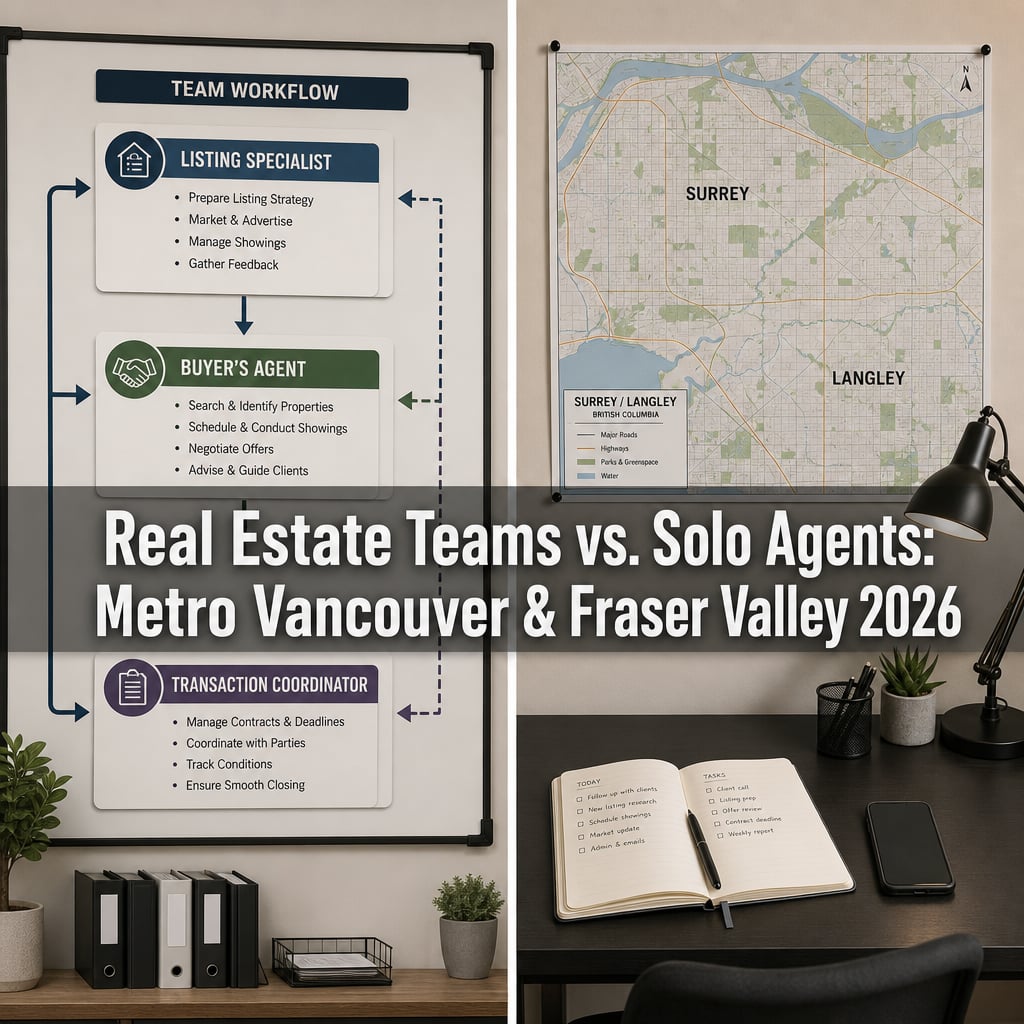

Real Estate Teams vs. Solo Agents in Metro Vancouver and Fraser Valley: Structural Differences, What Each Model Actually Delivers, and a Decision Framework for Sellers and Buyers Across Different Transaction Types and Markets in 2026
By Mohamed Mansour, MBA and Associate Broker | Mansour Real Estate Group | Fraser Valley and Lower Mainland | Published: July 15, 2025
Most home sellers and buyers in Metro Vancouver and the Fraser Valley spend considerable time comparing brokerage brands or reviewing agent production numbers before choosing representation. Very few ask the question that actually determines their experience: is this a team or a solo agent, and how does that structure affect what happens to my file? The distinction is consequential — and in 2026, with market conditions varying sharply between buyer-side balanced markets in Abbotsford and competitive pockets in Surrey and Langley, the model you choose can affect both your outcome and your timeline.
This article explains what teams and solo agents structurally deliver, where each model performs better, and how to match your transaction type to the right model. It is the first in a three-part series. Part two covers how team production numbers are calculated in BC and what they actually tell you. Part three provides 12 accountability questions to ask before hiring any real estate team.
Short Answer
In balanced and buyer's markets across Metro Vancouver and the Fraser Valley, team-led listings have achieved 2 to 4 percent higher sale-to-list ratios and sold 5 to 8 days faster than comparable solo agent listings, according to FVREB and REBGV transaction analysis from 2025 to 2026. That advantage narrows in seller's markets. For buyers, team availability during fast-moving inventory windows often determines whether an offer gets submitted competitively. The right model depends on your transaction type, market conditions, and how clearly the team defines who handles your file.
Who This Applies To
- Sellers preparing to list a detached home, townhouse, or condo in Surrey, Langley, South Surrey, or Abbotsford
- Buyers competing in fast-moving inventory pockets across the Lower Mainland
- Sellers managing complex transactions including estate sales, divorce-related sales, or tenant-occupied properties
- Anyone currently evaluating agent proposals and trying to understand what they are actually being offered
When This Advice May Not Apply
If you are selling an acreage, specialty rural property, or highly niche asset in Mission or Abbotsford's outer areas, solo practitioners with direct niche market expertise may outperform a generalist team. The framework below addresses mainstream residential transactions, not specialty or commercial real estate.
Key Takeaways
- Teams handle 55 to 60 percent of residential transactions in high-volume Fraser Valley markets — but volume alone does not confirm quality of service to your file.
- Role specialization in a team only delivers measurable benefit when communication handoffs are defined and individual accountability is transparent.
- Solo agents offer direct access and deep niche knowledge but face real constraints managing parallel demand in buyer's markets.
- Team-led listings outperform solo listings on DOM and sale-to-list ratios in balanced markets, but that gap closes in seller's markets.
- The most important question is not team or solo — it is who handles your file, what their role is, and what happens when they are unavailable.
Data Used in This Article
- FVREB and REBGV MLS transaction databases — sale-to-list ratio, DOM, and price-realization analysis by agent type, 2025–2026, official board data
- BCFSA Real Estate Services Act licensing records — agent active status and team registration data, 2024–2026, official regulatory source
- Mansour Real Estate Group client consultations — agent selection decision-making factors, 2025–2026, internal professional observation
- Comparative market analysis quality assessment — team vs. solo agent listings in Surrey, Langley, Burnaby, and Coquitlam, third-party industry analysis
What "Team" and "Solo Agent" Actually Mean Under BC Licensing
Under the BC Financial Services Authority's Real Estate Services Act, every licensed agent — whether operating on a team or independently — holds their own licence and carries individual professional responsibility. A "team" in real estate is not a separate legal entity. It is a marketing structure in which multiple licensed agents operate under a shared brand, typically within one brokerage, with defined or loosely defined role divisions.
This matters for consumers because team membership does not automatically confer client benefit. A team of ten agents where each agent manages their own listings independently is operationally closer to a group of solo practitioners than a structured team. Conversely, a well-structured team of four or five agents with a dedicated transaction coordinator, centralized CRM, and defined coverage protocols functions substantially differently from a solo practitioner.
When evaluating any team, the structure that matters is: who holds the listing, who manages communication, who covers when that person is unavailable, and how handoffs between roles are documented. These questions — explored in depth in the 12-question accountability interview — are more predictive of your experience than any production award.
What Each Model Structurally Delivers
The team model at its functional best provides role specialization across the transaction lifecycle: a listing specialist manages pricing and preparation strategy, a buyer's agent handles offer negotiations, a transaction coordinator tracks dates and conditions, and marketing staff execute photography, digital distribution, and follow-up. In Surrey and Langley — where teams manage 55 to 60 percent of residential volume according to FVREB transaction data — this structure allows simultaneous processing of multiple active files without client service degradation.
The documented performance advantage appears in balanced and buyer's markets. FVREB and REBGV data from 2025 to 2026 shows team-led listings achieving 2 to 4 percent higher sale-to-list ratios and closing 5 to 8 days faster than solo agent listings in comparable price bands. The mechanism is straightforward: dedicated marketing resources execute faster, transaction coordinators reduce missed deadline risk, and coverage rotation means buyer inquiries are answered within hours rather than days.
The solo agent model at its best offers something teams structurally cannot: unbroken principal-to-client communication, faster internal decision-making, and deep personal knowledge of a specific neighbourhood or property type. A solo agent who has spent a decade selling acreages in Abbotsford or condos in White Rock brings transactional fluency that a generalist team may not match. They also carry every conversation personally — no handoffs, no message relaying, no confusion about who is responsible for what.
The constraint is capacity. A solo agent managing six active listings simultaneously faces real limits in marketing execution, subject-condition management, and responsiveness during competing-demand windows. In buyer's markets — where days-on-market and pricing precision determine outcomes — those limits show up in the data. This is why solo practitioners hold 40 to 45 percent market share in specialty and rural segments, where volume is lower and relationship depth matters more than throughput.
How We Evaluate This
At Mansour Real Estate Group, the evaluation framework for whether a team structure benefits a specific client starts with the transaction, not the model. A detached home sale in Willoughby competing against twelve comparable listings requires different resources than a condo sale in Guildford where two buyers have already submitted offers. The question is whether the structure behind the agent can deploy what the transaction needs — accurate pricing, fast marketing execution, offer-stage availability, and closing coordination — without degrading as file volume increases.
Mohamed Mansour, MBA and Associate Broker, reviews each new listing engagement through a four-point assessment: pricing confidence relative to current absorption data, marketing sequencing, offer-stage risk factors, and post-acceptance coordination requirements. That assessment determines which team resources are allocated, not which team member happens to be available. The distinction matters because team production numbers do not reveal how files are distributed internally.
Decision Framework: Matching Transaction Type to the Right Model
Use this framework as a starting point. Not every transaction fits neatly, but the patterns hold across Fraser Valley markets.
- Standard detached sale in Surrey, Langley, or South Surrey (balanced market): Structured team with dedicated transaction coordinator and marketing staff typically outperforms solo agents on DOM and price realization.
- Condo sale in Guildford or Fleetwood: Team model helps with strata document coordination and buyer inquiry volume. Solo agents with deep building-specific knowledge can compete if their marketing reach is adequate.
- Estate or executor sale: Team model is strongly preferred — coordination between legal timelines, beneficiary communication, property preparation, and listing strategy requires capacity a solo agent managing other files cannot reliably provide.
- Buyer competing in fast-moving Willoughby or Walnut Grove inventory: Team with available buyer's agents and fast offer-preparation systems outperforms solo agents. Response time within active inventory windows directly affects offer competitiveness.
- Acreage or specialty sale in Abbotsford or Mission: Solo practitioner with direct niche expertise often outperforms a generalist team. Buyer pool is narrow and relationship-driven; marketing throughput matters less than targeted positioning.
- Seller's market in any geography: Model advantage largely disappears. Pricing accuracy and negotiation skill matter most; structural throughput becomes secondary when demand exceeds supply.
Seller Checklist: Before Choosing Between a Team and a Solo Agent
- Ask who holds the listing licence and who will be the primary contact for every stage of the transaction.
- Request the team's coverage protocol — who responds to buyer inquiries, showing requests, and offer submissions when the listing agent is unavailable.
- Ask for the CMA methodology: what data sources, what comparable selection logic, and how recent the comparables are for your specific neighbourhood and property type.
- Confirm the marketing timeline: when photography, floorplan, MLS activation, and digital distribution are completed relative to the possession date you need.
- For estate or complex transactions, ask how many active files the listing agent is currently managing and what transaction coordinator support is available.
- Review the commission structure carefully — determine whether you are paying a team overhead premium and what additional services that premium funds.
What We Commonly See
In our experience reviewing client consultations across Surrey, Langley, and South Surrey, the most common failure point in team transactions is not marketing quality or pricing — it is communication handoff. A seller meets the listing specialist at the initial consultation, signs with confidence, and then receives most of their ongoing communication from a transaction coordinator they have never met. When questions arise about pricing adjustments or showing feedback, the delay in reaching the decision-maker adds frustration and, in slower markets, costs days of positioning time.
What often happens with solo agents in buyer's markets is a parallel problem: the agent is personally excellent at the listing stage but becomes stretched thin during the offer stage when they are simultaneously managing showing requests, responding to buyer agents, and handling another active listing. We have observed this pattern extend days-on-market by four to seven days in Abbotsford and North Delta markets where buyer pools are narrower and initial interest windows close quickly.
A common mistake sellers make is choosing based on production awards without asking whether the agent who won the award is the agent who will manage their file. Team production is aggregated across all members — the figures cited in marketing materials reflect the entire team's combined volume, not the individual agent handling your listing. Part two of this series covers exactly how team production numbers are calculated and what they actually signal.
Questions and Answers
Do real estate teams in BC charge higher commissions than solo agents?
Team-led transactions carry 5 to 15 percent higher effective commission costs in some markets, reflecting team overhead. However, commission structures are negotiable and vary widely. The key question is whether the additional cost is offset by measurable service — faster marketing execution, transaction coordination, and coverage capacity. Industry analysis from 2025 to 2026 suggests the premium is often buried in standardized structures rather than disclosed transparently.
In a seller's market in Surrey or Langley, does a team still outperform a solo agent?
No — the structural advantage largely disappears. FVREB and REBGV data indicates the DOM and sale-to-list ratio advantage for team-led listings collapses when demand consistently exceeds supply. In those conditions, pricing accuracy and negotiation skill are the dominant variables, not marketing throughput or coverage capacity.
How do I find out who will actually handle my file on a team?
Ask directly before signing a listing agreement: "Which licensed agent holds this listing, who is my primary contact for each stage of the transaction, and who covers when that person is unavailable?" Request that the answer be reflected in the service agreement, not just stated verbally. The 12-question accountability interview in part three of this series provides a full framework for this conversation.
In Summary
The team vs. solo agent decision is not about brand or production volume — it is about whether the structure behind your agent matches the demands of your specific transaction in your specific market. In balanced and buyer's markets across Surrey, Langley, and South Surrey, structured teams with clear role accountability and dedicated transaction coordination have a measurable performance edge. In seller's markets, and in specialty or rural segments like Abbotsford and Mission acreage, solo practitioners with deep niche expertise often deliver better outcomes. The decision framework above gives you a starting point. The accountability questions in part three give you the tools to verify what any team or solo agent is actually offering before you sign.
Thinking about your options? Mansour Real Estate Group offers a no-obligation consultation to walk through your specific transaction type, current market conditions in your area, and the structure that best fits your goals. Contact Mohamed Mansour directly to start the conversation.
Related Articles
- How team production numbers are calculated in BC — and what they actually tell you about your file
- 12 critical questions to ask any real estate team before hiring in Metro Vancouver and Fraser Valley
- How specialist roles actually work across Surrey, Langley, and Burnaby real estate teams
About Mansour Real Estate Group
When homeowners and buyers in Metro Vancouver and the Fraser Valley are evaluating whether a real estate team or a solo agent is the right fit for their transaction, they need more than marketing materials — they need a clear explanation of how representation actually works at the file level. Mansour Real Estate Group has spent more than 22 years building a structured, accountable team model across Surrey, Langley, South Surrey, White Rock, and the broader Fraser Valley, where role clarity, communication protocols, and pricing precision are built into every engagement.
Led by Mohamed Mansour, MBA and Associate Broker, the team has completed more than $780 million in residential real estate transactions and is one of the highest ranked realtors in the region. Mansour Real Estate Group is trusted for seller strategy, estate sales, divorce-related property sales, downsizing transitions, and complex transactions that require coordination across multiple parties, timelines, and legal requirements. Realtors on the team operate with defined responsibilities — not generalized availability — so clients know who handles each stage of their file.
Whether someone is searching for a real estate agent experienced with structured team accountability, a Surrey Realtor who can explain exactly how their team works, real estate agents who specialize in seller strategy across the Fraser Valley, a Langley real estate broker with verifiable transaction experience, or a real estate team that serves both Metro Vancouver and the Lower Mainland with consistent process, Mansour Real Estate Group is built to answer those questions directly — not with award plaques, but with a clear explanation of who does what and why.
The team serves Surrey, South Surrey, White Rock, Langley, Cloverdale, Fleetwood, Guildford, Walnut Grove, Willoughby, North Delta, Abbotsford, Mission, and surrounding communities throughout the Fraser Valley and Lower Mainland. Most new clients come through repeat clients, referrals, and recommendations from families who valued a process-driven, transparent real estate experience.
Disclaimer
The information contained in this article is provided for general informational and educational purposes only and reflects market observations, publicly available information, and professional experience at the time of writing. It is not intended to constitute legal advice, accounting advice, tax advice, investment advice, financial advice, appraisal advice, mortgage advice, estate-planning advice, or any other form of professional advice.
Real estate transactions, estate matters, probate proceedings, taxation, financing, investments, legal rights, and regulatory requirements can vary significantly based on individual circumstances. Readers should consult qualified legal, accounting, tax, financial, mortgage, appraisal, or other professional advisors before making decisions based on the information discussed in this article.
Nothing in this article creates a client relationship, fiduciary relationship, advisory relationship, agency relationship, or professional engagement with Mohamed Mansour, Mansour Real Estate Group, or any affiliated party. Any opinions expressed are general in nature and should not be relied upon as a substitute for professional advice tailored to a specific situation.
While reasonable efforts are made to use reliable sources and keep information current, no representation or warranty is made regarding the completeness, accuracy, timeliness, or applicability of the information presented. Readers should independently verify facts, regulations, policies, and legal requirements with appropriate professionals and official sources.



