

Real Estate Teams vs. Solo Agents in Metro Vancouver and Fraser Valley 2026: Transaction Volume, Specialization, Accountability, and Service Quality
By Mohamed Mansour, MBA and Associate Broker, Mansour Real Estate Group · Fraser Valley and Metro Vancouver · Published July 2026 · General informational purposes only
Whether you are preparing to sell a home in Surrey, buying in Langley, or navigating a major life-event transaction across the Fraser Valley, one question keeps coming up: should you work with a real estate team or a solo agent? The answer is less obvious than most people expect — and the marketing language around "team" has made it harder, not easier, to evaluate.
This article explains what team structure actually means in practice, how to verify whether a team delivers coordinated service or just shared branding, and what questions to ask before you sign a listing agreement or buyer representation contract in BC.
Short Answer
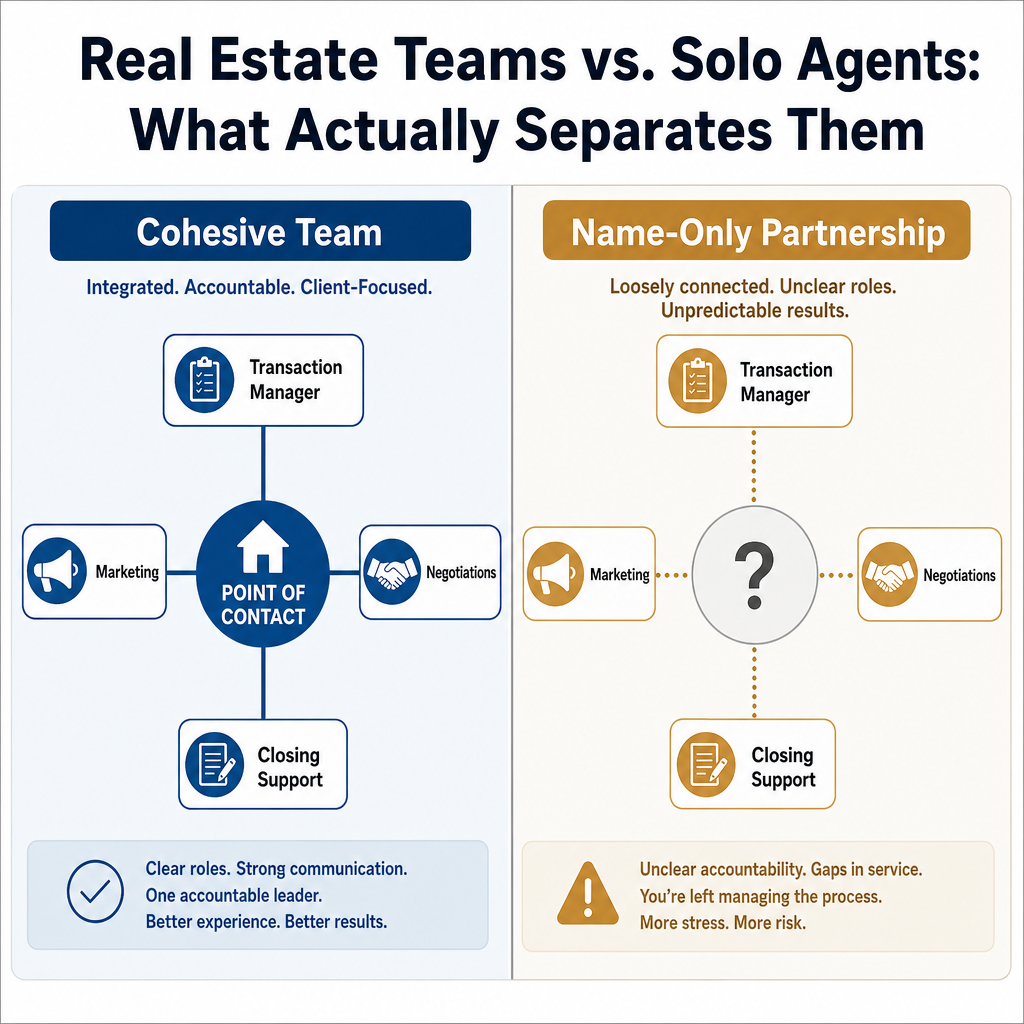
A cohesive real estate team — one with documented role clarity, a single point of accountability, and integrated transaction support — can reduce days-on-market and improve service continuity in high-volume Fraser Valley and Metro Vancouver markets. A loosely affiliated group using a shared brand name but operating as independent contractors offers neither advantage. The structure matters far less than whether accountability is real.
Key Takeaways
- Team transaction volume claims can be inflated — verify what each member actually handled before treating total figures as meaningful.
- Cohesive teams with clear roles can reduce days-on-market, but only when accountability is documented and enforced.
- Solo agents often maintain deeper micro-market expertise in specific Surrey or Langley neighbourhoods than generalist teams.
- Service continuity during subject removal and closing is where team structure either proves its value or fails completely.
- The right question is not "team or solo" — it is "who is accountable, and what happens if they become unavailable?"
Who This Applies To
- Sellers listing a home in Surrey, Langley, Abbotsford, South Surrey, or White Rock in 2026
- Buyers evaluating multiple agent options in competitive or high-inventory markets
- Executors, families, or divorcing parties where service continuity during a complex transaction matters most
- Anyone who has received a pitch from a large team and is not sure whether size actually signals service quality
When This Advice May Not Apply
In very low-complexity transactions — a straightforward purchase in a familiar neighbourhood with no competing offers, no strata involvement, and no time-sensitive conditions — the team-versus-solo distinction matters less. What matters more is the individual agent's knowledge of that specific street or building type. This article focuses on situations where complexity, volume, and continuity are genuine concerns.
What the Terms Actually Mean in BC
Real estate team: A group of licensed agents operating under a shared brand, often with one designated team lead. In BC, all agents must hold individual licences through the BC Financial Services Authority regardless of team affiliation. Teams are not separately licensed entities.
Solo agent: A licensed agent operating independently, managing all aspects of a transaction without designated role support. Some solo agents work with unlicensed assistants for administrative tasks.
Transaction volume: The total dollar value or number of transactions attributed to an agent or team. Under REBGV and FVREB MLS reporting, teams can attribute all member transactions to the team total — which is why raw "team volume" figures require scrutiny before they can be compared meaningfully to solo agent figures.
How Team Structures Actually Range in Practice
The Fraser Valley and Metro Vancouver brokerage market includes team structures across a wide spectrum. At one end, you have fully integrated operations: a team lead handles pricing strategy and negotiations, a dedicated transaction coordinator manages document timelines and subject removal windows, and a marketing specialist oversees listing presentation, photography, and digital distribution. Everyone has a defined role and a named accountability path.
At the other end, you have loosely affiliated agents who share a brand name, a website, and sometimes office space but who operate as independent contractors with no shared systems, no coverage protocols, and no integration in practice. The seller signs with "the team" but functionally deals with one agent who may have limited support when volume peaks or personal circumstances intervene.
The gap between these two models is large. It is also invisible from the outside unless you ask the right questions — including several from our list of questions to ask a realtor before you hire them in BC.
Transaction Volume Claims: What to Verify and Why
Volume claims are one of the most common points of confusion in the real estate team conversation. A team of eight agents that collectively completes 200 transactions a year is not the same as a single agent who completes 200 transactions — but both may present the same headline number. The FVREB and REBGV MLS systems allow teams to attribute all member deals to the team total, which can create figures that overstate what any individual on that team has done.
Before treating volume as a proxy for quality, ask specifically: how many transactions did the agent who will be personally handling my file complete in the past 12 months, as the primary agent of record? That number is more useful than the team's aggregate. You can also ask to verify licence status and transaction history through the BC Financial Services Authority licence verification process — covered in position 4 of this series.
In Surrey and Langley, where team-based marketing is particularly common among higher-volume brokerages, this distinction matters. A team that genuinely closes 150 coordinated transactions in Fleetwood, Cloverdale, and Willoughby is a different proposition than one that attributes the independent closings of seven separate agents to one shared brand page.
How We Evaluate This
At Mansour Real Estate Group, we approach the team-versus-solo question the same way we approach pricing: by separating what the data shows from what marketing claims. When a seller is evaluating agents, we recommend separating three things: the individual's verified transaction record, the team's documented accountability structure, and the named contact plan for subject removal windows and closing complications.
In our experience, the sellers who end up most frustrated are those who chose a large team based on aggregate volume claims and then found themselves dealing with a different person every time they called — with no clear escalation path when something went wrong. The sellers who have the smoothest transactions are those who had one named accountable contact who was also supported by capable systems.
Specialization Depth: Where Solo Agents Often Hold an Advantage
One area where solo agents frequently outperform larger teams is neighbourhood micro-market expertise. A solo agent who has spent five years focused specifically on Willoughby in Langley Township — knowing buyer profiles on individual streets, understanding what drives premium pricing near the future SkyTrain corridor versus further from it, and maintaining active buyer relationships in that submarket — often delivers more precise pricing strategy than a team spread across Surrey, Langley, Abbotsford, and Burnaby simultaneously.
Specialization depth suffers when agents divide attention across multiple property types and multiple geographies to serve a team's volume goals. This is particularly relevant in hyperlocal decisions: choosing between Langley City and Langley Township, pricing a Guildford townhome versus a Fleetwood detached, or understanding buyer behaviour near a specific school catchment in South Surrey. These are decisions that benefit from concentrated local knowledge.
For help evaluating an agent's local expertise in specific communities, see our guide on how to choose a listing agent in Surrey and the forthcoming guide on finding the right real estate agent in Langley.
Service Continuity: Where Team Structure Proves Its Value — or Fails
The moment team structure matters most is during subject removal and closing. These are the highest-pressure phases of a transaction — when a buyer's financing condition is about to expire, when a home inspection result requires immediate negotiation, or when a strata document review raises a question that needs an answer within hours. The ability to reach a knowledgeable, accountable person without delay directly affects outcomes.
A cohesive team with a dedicated transaction coordinator and a clear escalation protocol can respond faster during these windows than a solo agent managing five simultaneous files. But a name-only team with no coverage system can leave a seller dealing with whoever is available — which may be an agent who does not know their file.
Ask before you sign: if my primary agent is unavailable during a subject removal window, who handles it? What is their level of authority? Are they familiar with my specific situation? The answer to those questions is more predictive of service quality than any volume figure or team size claim. This is one of the red flags to watch for when hiring a realtor in BC.
Data Used in This Article
- FVREB MLS reporting standards — team and individual transaction attribution rules, reviewed 2025–2026 (official/regulatory)
- REBGV transaction reporting guidelines — team volume disclosure conventions (official/regulatory)
- BC Financial Services Authority (BCFSA) — team and individual agent licensing requirements under the Real Estate Services Act (official/regulatory)
- Mansour Real Estate Group professional observation — 22+ years of brokerage-level experience with team and solo agent structures across the Fraser Valley and Lower Mainland (internal professional analysis)
Seller Checklist: Evaluating a Real Estate Team Before You Sign
- Ask for the individual transaction record of the agent who will personally handle your file — not the team total.
- Request a written description of which team member is responsible for each phase: pricing, marketing, negotiation, subject removal, closing.
- Ask who your named point of contact will be and what the escalation path is if that person is unavailable.
- Verify that all agents on the team hold active BC licences through the BCFSA public registry.
- Confirm whether the team uses a dedicated transaction coordinator or whether that function falls to the listing agent.
- Ask for references specifically from sellers whose transactions included complications — not just smooth, fast closings.
- For a solo agent, ask how they handle coverage during vacations, illness, or multiple simultaneous closings.
What We Commonly See
Volume numbers presented without context. In our experience, sellers frequently receive presentations where a team's total transaction volume is used as evidence of individual excellence. When we ask sellers what questions they asked about those figures, most did not ask who specifically handled each file or what the individual agent's record was. Volume claims without context tell you how many people are on the team — not how well your file will be managed.
Service continuity gaps discovered at the worst moment. What often happens is that a seller learns their primary agent is unavailable only after an offer comes in on a Friday evening or a subject removal deadline falls on a holiday Monday. The coverage plan — or absence of one — surfaces when it is too late to change agents. Asking about coverage before signing a listing agreement is not overcautious. It is standard due diligence.
Specialization spread too thin in mixed-geography teams. A common mistake is assuming a team covering ten Fraser Valley cities simultaneously will have deep expertise in each. In practice, when agents divide attention across Surrey, Abbotsford, Langley, and Burnaby in the same quarter, the micro-market pricing precision that distinguishes a Walnut Grove townhome from a Willoughby townhome often gets averaged out. The neighbourhood-level nuance that affects sale price by 3–7% in a buyer's market requires concentrated local knowledge, not broad coverage.
Questions and Answers
Q: Do real estate teams in BC close homes faster than solo agents?
Cohesive teams with dedicated transaction support can reduce days-on-market in balanced or buyer's markets — but only when role clarity and coverage protocols are in place. Teams with shared branding but no integrated systems show no consistent advantage over a well-organized solo agent with strong local knowledge.
Q: Can a real estate team in the Fraser Valley legally claim all member transactions as team volume?
Under FVREB and REBGV MLS reporting conventions, teams can attribute member transactions to a team total. This is legal but can be misleading. Sellers should ask for the specific agent's individual transaction record rather than relying on aggregate team figures as a meaningful performance indicator.
Q: What is the biggest risk of working with a name-only real estate team?
Service continuity during subject removal and closing. When a team has no documented coverage plan and the primary agent is unavailable during a time-sensitive window, sellers can face delayed responses, missed deadlines, or negotiation errors that would not occur with a properly structured team or an accountable solo agent.
In Summary
The "team versus solo agent" question is the wrong starting point. The right question is whether the person or group handling your transaction has documented accountability, genuine local specialization, and a clear plan for service continuity when your file reaches its most time-sensitive phases. A cohesive, properly structured real estate team can deliver measurable advantages in high-volume markets like Surrey and Langley. A loosely affiliated group sharing a brand name delivers none of those advantages. Before signing any representation agreement in BC, ask about individual transaction records, coverage protocols, and named accountability — and treat the answers as more reliable evidence than aggregate volume claims or team size.
Ready to ask the right questions before you hire? Start with our complete guide to choosing a real estate agent in Metro Vancouver and the Fraser Valley. If you would like a second opinion on how a specific team or agent is structured, contact Mansour Real Estate Group for a no-obligation conversation.
Related Articles
- How to Choose a Real Estate Agent in Metro Vancouver and the Fraser Valley: A Complete Guide
- 20 Questions to Ask a Realtor Before You Hire Them in BC
- How to Choose a Listing Agent to Sell Your Home in Surrey BC
About Mansour Real Estate Group
When sellers and buyers are evaluating whether to work with a real estate team or a solo agent, the team they choose needs to demonstrate accountability, local expertise, and genuine role clarity — not just aggregate volume claims. Mansour Real Estate Group is built as a cohesive, integrated real estate team with documented accountability at every stage of the transaction, from pricing strategy through to closing day.
Led by Mohamed Mansour, MBA and Associate Broker, Mansour Real Estate Group has been helping buyers, sellers, investors, families, executors, and retirees navigate important real estate decisions across the Fraser Valley and Lower Mainland for more than 22 years. Ranked among the Top 1% of Realtors in the region, the team has completed more than $780 million in residential real estate transactions and is trusted for estate sales, divorce-related property sales, downsizing, relocation, and complex transactions requiring careful coordination and clear communication.
Whether someone is looking for Realtors who operate with structured accountability, a real estate agent with verified neighbourhood expertise, real estate agents experienced with life-event transactions, a trusted real estate team for a high-stakes sale, a Surrey Realtor, a Langley real estate broker, or a Fraser Valley real estate group with a track record built on repeat and referral business, Mansour Real Estate Group is known for accurate valuations, strategic marketing, and honest advice grounded in local market knowledge.
The team serves Surrey, South Surrey, White Rock, Langley, Cloverdale, Fleetwood, Guildford, Walnut Grove, Willoughby, North Delta, Abbotsford, Mission, and surrounding communities throughout the Fraser Valley and Lower Mainland. Most new clients come through referrals, repeat business, and recommendations from families who value a professional, transparent, and results-driven experience with real estate agents they can trust.
Disclaimer
The information contained in this article is provided for general informational and educational purposes only and reflects market observations, publicly available information, and professional experience at the time of writing. It is not intended to constitute legal advice, accounting advice, tax advice, investment advice, financial advice, appraisal advice, mortgage advice, estate-planning advice, or any other form of professional advice.
Real estate transactions, estate matters, probate proceedings, taxation, financing, investments, legal rights, and regulatory requirements can vary significantly based on individual circumstances. Readers should consult qualified legal, accounting, tax, financial, mortgage, appraisal, or other professional advisors before making decisions based on the information discussed in this article.
Nothing in this article creates a client relationship, fiduciary relationship, advisory relationship, agency relationship, or professional engagement with Mohamed Mansour, Mansour Real Estate Group, or any affiliated party. Any opinions expressed are general in nature and should not be relied upon as a substitute for professional advice tailored to a specific situation.
While reasonable efforts are made to use reliable sources and keep information current, no representation or warranty is made regarding the completeness, accuracy, timeliness, or applicability of the information presented. Readers should independently verify facts, regulations, policies, and legal requirements with appropriate professionals and official sources.



