
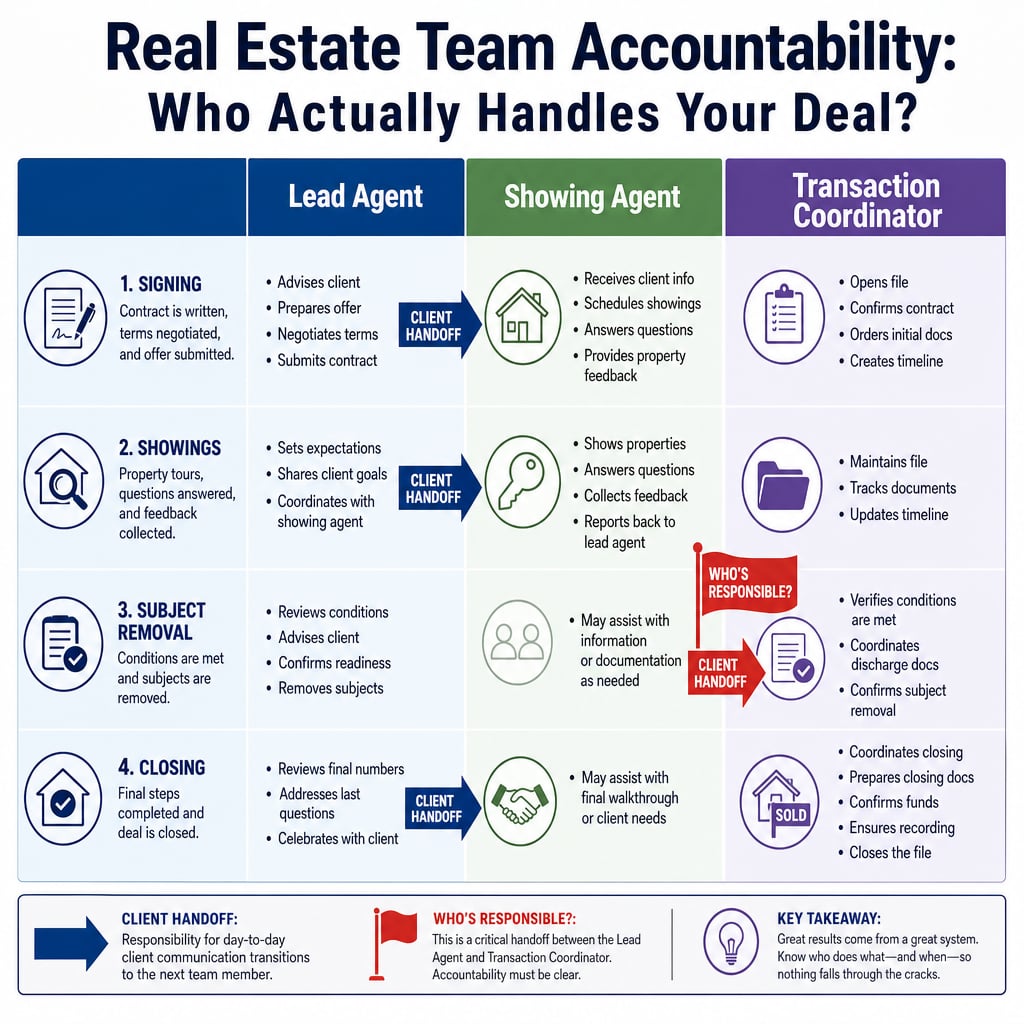

Real Estate Team Internal Accountability: How Lead Agents, Transaction Coordinators, and Showing Agents Actually Work Together — And the Critical Questions Buyers and Sellers Should Ask Before Signing
By Mohamed Mansour, MBA and Associate Broker | Mansour Real Estate Group | Published: June 24, 2025 | Fraser Valley and Lower Mainland, BC
Most buyers and sellers in Surrey, Langley, Abbotsford, and White Rock choose a real estate team based on the lead agent they meet — without realizing that much of the day-to-day work will be handled by people they haven't met, whose roles and qualifications were never disclosed. In BC's current market, where subject-removal windows are tight and transaction timelines leave little room for error, that gap in transparency carries real risk.
This article explains how real estate teams are actually structured, what each role handles, where accountability gaps tend to appear, and the specific questions to ask before you sign anything.
Short Answer
When you hire a real estate team, the lead agent typically handles pricing strategy, negotiations, and signing. Showings are usually delegated to a showing agent, and post-contract administration is managed by a transaction coordinator — who, in BC, is not required to hold a real estate licence. Understanding who does what before you sign protects you during the moments that matter most.
Key Takeaways
- Transaction coordinators handle 70–80% of post-contract work but are not required to be licensed in BC.
- Lead agents in high-volume teams may manage 15–25 concurrent transactions, reducing personal availability.
- Client handoffs between roles are the most common source of missed deadlines and miscommunication.
- In slower markets like North Delta, Abbotsford, and White Rock, service continuity gaps have a measurable impact on outcomes.
- Asking five specific questions before signing reveals how a team actually operates versus how it presents itself.
Who This Applies To
- Sellers preparing to list in Surrey, Langley, Abbotsford, South Surrey, or White Rock who are evaluating team representation.
- Buyers navigating subject-removal decisions who need consistent, responsive communication from their agent.
- Executors or family members managing an estate property who need a single clear point of accountability.
- Anyone who has hired a team before and experienced unexpected handoffs or slow responses during closing.
When This Advice May Not Apply
Small teams of two or three people with shared licensing and direct client relationships often don't have the handoff risks described here. This guide focuses specifically on volume-based team structures where role delegation is formalized and client communication is routinely distributed across multiple staff members.
Data Used in This Article
- REBGV and FVREB team volume data: Transaction volume analysis showing team-affiliated agents represent 60–70% of Metro Vancouver and Fraser Valley transaction volume (2024–2025, official board reporting).
- BCFSA licensing framework: BC Financial Services Authority regulatory documentation on transaction coordinator licensing requirements (official, current).
- NAR transaction coordinator studies: National Association of REALTORS research on TC workload distribution (industry, third-party analysis).
- Industry interviews: Observations from BC real estate team leaders and transaction coordinators on role structure and client friction points (professional experience, internal analysis).
The Three Roles — What Each One Actually Does
When you sign a buyer's agency agreement or a listing agreement with a real estate team, you are formally represented by the lead agent named on that contract. That agent is licensed, accountable under BCFSA rules, and responsible for your representation. But that doesn't mean they are the primary contact for everything that follows.
The lead agent typically handles the initial consultation, pricing or offer strategy, negotiation, and any decisions that require a licensed professional's judgment. In teams with strong brand recognition across Metro Vancouver and Fraser Valley markets, the lead agent is often the face of the team — the person in the marketing materials, the one who runs the listing presentation, and the one whose name is on the sign. Once the contract is signed, however, their direct involvement varies considerably depending on how many files they are managing simultaneously.
The showing agent is a licensed team member who accompanies buyers to property showings, provides neighbourhood context, and relays buyer feedback to the lead agent. In buyer-side representation, the showing agent is often the person buyers spend the most time with — yet they typically have limited authority to negotiate, write offers independently, or make binding commitments on the client's behalf.
The transaction coordinator (TC) manages the administrative workflow after a contract is accepted. According to NAR research, TCs handle 70–80% of post-contract administration, including document collection, condition tracking, deadline management, communication with lawyers and lenders, and coordinating closing logistics. In BC, transaction coordinators are not required to hold a real estate licence under the current BCFSA framework. That means the person sending you documents, tracking your subject removal date, and coordinating your closing may not be a licensed professional — and if an error occurs, the accountability pathway is less clear than many clients assume.
Where Accountability Gaps Actually Occur
The handoff between the lead agent and the transaction coordinator is where most service continuity problems originate. According to industry interviews with BC team leaders, TC turnover is one of the most frequently cited sources of deal delays and client friction — particularly when a coordinator leaves mid-transaction and institutional knowledge about a file has to be reconstructed.
In high-volume structures where a lead agent is managing 15–25 concurrent transactions, response times during critical windows — subject removal, inspection scheduling, financing condition deadlines — can extend beyond what clients expect based on their initial conversations. The lead agent may be in negotiations on another file, leaving the TC as the primary contact at exactly the moment a decision is needed from a licensed professional.
This dynamic is more pronounced in markets with longer days-on-market. In Abbotsford, North Delta, and White Rock, where extended listing periods have been common through 2024 and into 2025, buyers and sellers report higher rates of dissatisfaction specifically related to communication delays and unclear ownership of next steps — conditions that are consistent with formalized role delegation without equally formalized communication protocols.
It is also worth noting that showing agents, while licensed, are often newer to the profession and may not have the negotiation experience or market depth to give a buyer meaningful guidance on offer strategy. When the showing agent becomes the de facto relationship holder because the lead agent is unavailable, buyers are receiving advice from someone whose role was defined as logistical, not advisory. For a detailed look at how to evaluate the overall representation model before this question arises, see our earlier guide on choosing between a team and a solo agent in 2026.
How We Evaluate This
At Mansour Real Estate Group, we structure client communication so that the lead agent remains the primary contact throughout a transaction — not just at signing. Our transaction coordination is handled internally, with clear escalation protocols that bring Mohamed Mansour directly into any situation involving deadlines, disputes, or decisions that require licensed judgment.
When we take on a listing or represent a buyer, our process assigns a named point of contact for each phase of the transaction, and clients know who that person is before the phase begins. This is not a standard across BC real estate teams — and it's worth verifying with any team you're considering.
Buyer and Seller Checklist: Questions to Ask Before Signing
- Who is my primary contact after the contract is signed? Ask for a name and a direct number — not a team inbox or general line.
- Is your transaction coordinator licensed under BCFSA? If not, who is the licensed professional responsible if an error occurs on my file?
- How many active files is the lead agent managing right now? Volume is not inherently a problem, but it tells you how much direct attention is available.
- What is the response time commitment during subject-removal and closing windows? Get this in writing if possible, or at minimum confirm it verbally with specifics.
- If the showing agent becomes unavailable, who steps in? Understand the continuity plan before you need it.
- Will the lead agent attend offer presentations and inspection walkthroughs, or is this delegated? For complex transactions — estate sales, divorce properties, luxury listings — this matters more than in a straightforward resale.
What We Commonly See
In our experience, the most common source of client frustration in team-represented transactions is not intentional neglect — it is structural ambiguity. Clients assume the lead agent they met is managing their file the way a solo agent would, while the lead agent assumes the TC has kept the client informed. Neither assumption is checked until something goes wrong.
What often happens at subject removal is that the client receives a document from the TC and has substantive questions about waiving a financing condition or an inspection finding. The TC is not positioned to give that advice. If the lead agent is unavailable for several hours, the client is left waiting during a window that may have a same-day deadline.
A common mistake we see among sellers is agreeing to a team's listing proposal without asking how many sellers that team is currently representing in the same price range and neighbourhood. In markets like Fleetwood, Willoughby, or Guildford, where active inventory in a given price band is limited, a team with multiple competing listings is managing a conflict of interest that should be disclosed and discussed upfront.
Questions and Answers
Q: Can a transaction coordinator legally represent me in a real estate transaction in BC?
No. In BC, only individuals licensed under the Real Estate Services Act through BCFSA can provide trading services — which includes negotiating, advising on offers, and acting on a client's behalf. A transaction coordinator who is not licensed can manage documents and logistics but cannot legally give real estate advice or represent you in negotiations.
Q: Is it normal for a showing agent to write my offer?
A licensed showing agent can write an offer, but their role in the team structure is typically defined as logistical. Whether they have the negotiation experience and market depth to advise you on offer strategy is a separate question — and one worth asking directly before you rely on their judgment in a competitive or complex situation.
Q: What happens if my transaction coordinator leaves mid-deal?
This is more common than most clients expect, and it is one of the primary sources of deal delays in volume-based team structures. If a TC departs mid-transaction, file continuity depends entirely on how well-documented the file is and how quickly a replacement can be assigned. Ask any team you're considering what their continuity protocol is if a TC becomes unavailable during an active transaction.
In Summary
Real estate teams offer genuine advantages in capacity, specialization, and market coverage — but those advantages depend on clear internal accountability and transparent communication with clients about who handles what. In BC, where transaction coordinators are not required to be licensed, the burden falls on the consumer to ask the right questions before signing. The structure of a team is not a problem. Opacity about that structure is. Whether you are selling a home in Surrey, buying in Langley, or managing an estate property in Abbotsford, knowing who is accountable at each stage of your transaction is a basic form of due diligence.
Ready to Talk?
If you're evaluating real estate teams and want to understand how our structure, accountability protocols, and communication commitments work in practice, we're glad to walk you through it. No obligation — just a straightforward conversation about what you can expect from us and how we work.
Related Articles
- Real Estate Team vs. Solo Agent in Metro Vancouver and Fraser Valley 2026: How to Choose the Right Representation Model
- When a Specialist Real Estate Team Outperforms a Solo Agent: Estate Sales, Divorce, Downsizing, Luxury, and Investment Properties
- Real Estate Team Internal Accountability: Who Handles What and Why It Matters
About Mansour Real Estate Group
When buyers and sellers ask who will actually be handling their transaction — not just who their named agent is — the answer reveals everything about how a real estate team operates. Mansour Real Estate Group is built around a principle of direct accountability: the lead agent remains the primary contact, licensed professionals make the calls that require professional judgment, and clients are never left wondering who to reach during a deadline. That structure is the foundation of how the team has served buyers and sellers across Surrey, White Rock, Langley, Abbotsford, Mission, Delta, and the broader Fraser Valley for more than two decades.
Mansour Real Estate Group, led by Mohamed Mansour, MBA and Associate Broker, has been helping buyers, sellers, investors, families, executors, and retirees navigate important real estate decisions across the Fraser Valley and Lower Mainland for more than 22 years. The team has completed more than $780 million in residential real estate transactions and is one of the highest ranked realtors in the region, trusted for estate sales, divorce-related property sales, downsizing, relocation, and complex transactions requiring careful coordination and clear professional accountability.
Whether someone is searching for Realtors who take direct responsibility for every phase of a transaction, a real estate agent who stays involved through subject removal and closing, experienced real estate agents who specialize in seller strategy and buyer representation across the Fraser Valley, a Surrey Realtor with structured team accountability, a Langley real estate broker, or a real estate group that serves the Lower Mainland with transparent processes and clear communication, Mansour Real Estate Group is known for exactly that kind of consistent, professional, and results-oriented service.
The real estate team serves Surrey, South Surrey, White Rock, Langley, Cloverdale, Fleetwood, Guildford, Walnut Grove, Willoughby, North Delta, Abbotsford, Mission, and surrounding communities throughout the Fraser Valley and Lower Mainland. Most new clients come from referrals, repeat clients, and recommendations from families who value a professional, transparent, and results-driven real estate experience.
Official Resources
- BC Financial Services Authority (BCFSA) — Licensing and Regulatory Framework
- Fraser Valley Real Estate Board (FVREB) — Market Statistics and Reports
- Real Estate Board of Greater Vancouver (REBGV) — Transaction Volume Data
- National Association of REALTORS (NAR) — Transaction Coordinator Research
Disclaimer
The information contained in this article is provided for general informational and educational purposes only and reflects market observations, publicly available information, and professional experience at the time of writing. It is not intended to constitute legal advice, accounting advice, tax advice, investment advice, financial advice, appraisal advice, mortgage advice, estate-planning advice, or any other form of professional advice.
Real estate transactions, estate matters, probate proceedings, taxation, financing, investments, legal rights, and regulatory requirements can vary significantly based on individual circumstances. Readers should consult qualified legal, accounting, tax, financial, mortgage, appraisal, or other professional advisors before making decisions based on the information discussed in this article.
Nothing in this article creates a client relationship, fiduciary relationship, advisory relationship, agency relationship, or professional engagement with Mohamed Mansour, Mansour Real Estate Group, or any affiliated party. Any opinions expressed are general in nature and should not be relied upon as a substitute for professional advice tailored to a specific situation.
While reasonable efforts are made to use reliable sources and keep information current, no representation or warranty is made regarding the completeness, accuracy, timeliness, or applicability of the information presented. Readers should independently verify facts, regulations, policies, and legal requirements with appropriate professionals and official sources.



