

Real Estate Team Accountability Structures in Metro Vancouver and Fraser Valley: Understanding Agent Roles, Compensation Incentives, and Consumer Protections When Hiring a Team vs. Solo Agent
By Mohamed Mansour, MBA and Associate Broker | Mansour Real Estate Group | Fraser Valley and Lower Mainland, BC | Published: July 15, 2025
Most buyers and sellers in Metro Vancouver and the Fraser Valley assume that when they hire a real estate team, everyone on that team is equally accountable for their file. That assumption is worth examining carefully before you sign anything.
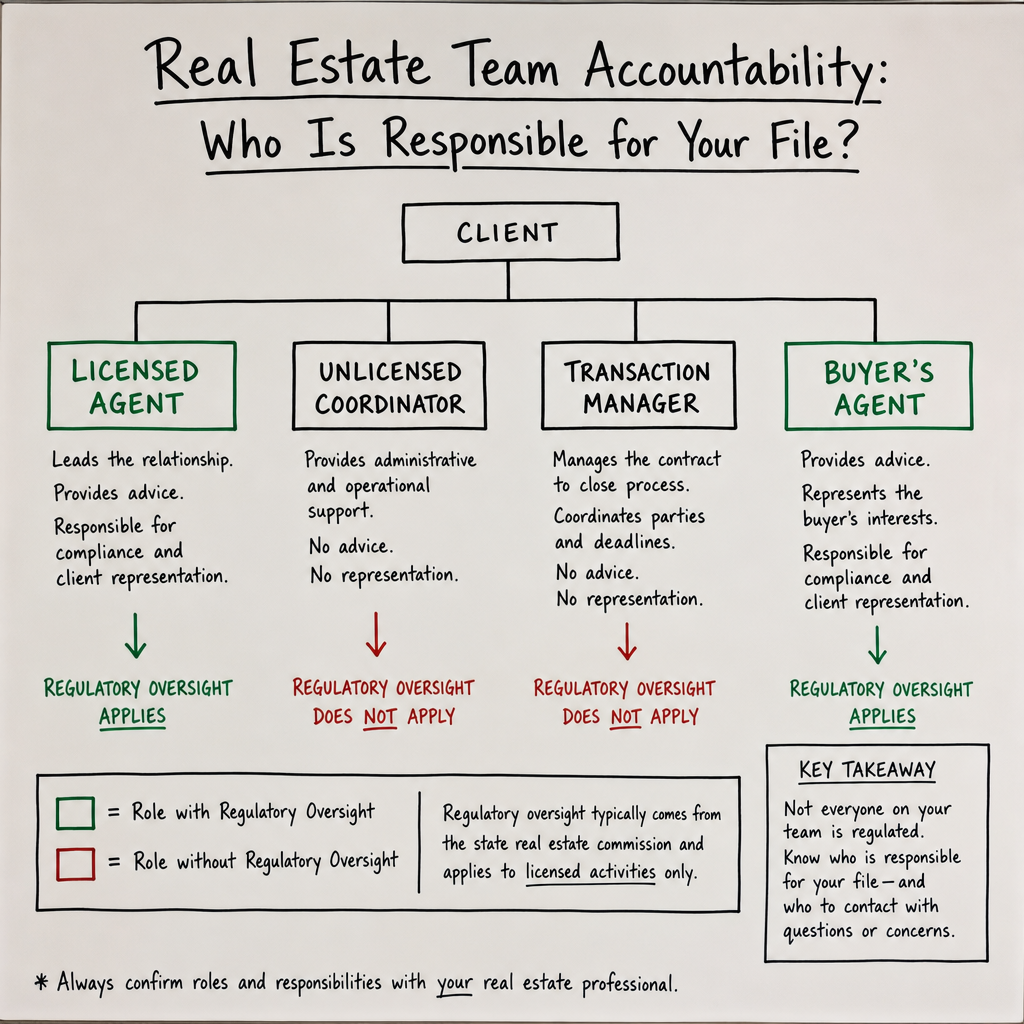
The reality in BC is more specific. Regulatory oversight, fiduciary duty, and professional liability insurance apply only to licensed real estate agents — not to every person who may handle your documents, answer your calls, or manage your transaction timeline. Understanding that distinction is one of the most practical things you can do before choosing who represents you.
Short Answer
In BC, only licensed real estate agents carry BCFSA-regulated fiduciary duty and professional liability insurance. Unlicensed team members — coordinators, marketing specialists, transaction managers — may handle significant client communication and documents without independent regulatory oversight. Before hiring a team, ask directly who holds your license, what each person's role is, and how decisions about your file are made and escalated.
Key Takeaways
- Only BCFSA-licensed agents carry fiduciary duty and professional liability insurance in BC — unlicensed coordinators and transaction managers do not.
- Compensation structures within teams — salary, commission split, flat fee, or hourly — directly shape what each person is incentivized to prioritize on your file.
- BCFSA complaint records show recurring issues with communication failures between coordinators and licensed agents, particularly around offer deadlines and subject removal.
- Teams that publish role definitions, escalation procedures, and client communication timelines are easier to hold accountable when problems arise.
- Asking five specific questions before signing a listing or buyer's agreement can reveal whether a team's accountability structure protects you or exposes you.
Who This Applies To
- Sellers in Surrey, Langley, Abbotsford, White Rock, South Surrey, North Delta, and surrounding Fraser Valley communities considering a team listing
- Buyers in Metro Vancouver or the Fraser Valley who have been assigned to a buyer's agent within a larger team structure
- Families managing an estate or probate sale where role clarity matters especially
- Anyone who has already hired a team and wants to understand how to navigate it effectively
When This Advice May Not Apply
If you are working directly and exclusively with a solo licensed agent who has no unlicensed staff handling your communication or documents, the team accountability questions below are less relevant — though the compensation incentive questions still apply. Consult a lawyer for any situation involving legal disputes over agency duty.
Key Definitions
Fiduciary duty: A legal obligation requiring a licensed real estate agent to act in the client's best interest, maintain confidentiality, avoid conflicts of interest, and disclose material information. Only licensed agents carry this duty under BC law.
BCFSA: The BC Financial Services Authority, which regulates licensed real estate professionals in British Columbia, including professional conduct rules, licensing, and complaint resolution.
Transaction coordinator: A team role — often unlicensed — that manages paperwork, scheduling, and communication timelines. They may handle your documents but carry no independent regulatory obligation to you as a client.
Commission split: The internal division of the gross commission between the team lead and individual agents or staff. The structure varies by team and directly shapes individual incentives.
Data Used in This Article
- BCFSA Professional Conduct Rules and Licensed Agent Obligations — BC Government / BCFSA; current regulatory framework; official source
- Real Estate Council of BC Complaint Data and Case Studies — formerly RECBC, now BCFSA; ongoing complaint categories; official source
- CREA Consumer Guidance on Team Structures — Canadian Real Estate Association; industry-level guidance; third-party
- Mansour Real Estate Group professional experience — 22+ years of Fraser Valley and Lower Mainland transactions; internal analysis
How Real Estate Teams Are Actually Structured in BC
Real estate teams in Metro Vancouver and the Fraser Valley generally operate in one of three models. The first is lead-agent-centric: a single licensed agent manages all regulated activity while unlicensed staff handle coordination, scheduling, and marketing. The second is a peer model: multiple licensed agents share a brand and divide transaction work, with one agent typically responsible for oversight. The third is brokerage-integrated: the broker maintains direct supervisory oversight of all licensed agents on the team.
What matters to you as a client is not the model label — it is knowing which specific licensed agent is responsible for your file at any given moment, and what authority the unlicensed people communicating with you actually have.
According to BCFSA professional conduct rules, only licensed agents may provide trading services, give real estate advice, handle trust funds, or negotiate on a client's behalf. An unlicensed coordinator cannot legally bind you to a contract or make representations about your property — but in practice, they often communicate offer timelines, relay inspection results, and discuss conditional terms. When that communication is inaccurate or delayed, the licensed agent remains accountable under BCFSA, but resolving the problem after the fact is much harder than preventing it.
If you want to understand what a healthy team structure looks like before hiring, the article What Does a Real Estate Team Actually Look Like in the Fraser Valley? walks through this in practical terms. And if you are weighing a team versus a solo agent, Real Estate Team vs. Solo Agent: Which Is Better for Metro Vancouver Buyers and Sellers? covers that tradeoff directly.
How Compensation Structures Shape Incentives — and Risk
Compensation within real estate teams is rarely disclosed to clients, but it shapes behaviour in ways that affect outcomes. A buyer's agent earning a flat fee regardless of purchase price has little financial incentive to negotiate harder. A lead agent whose income depends on team volume — rather than individual transaction outcomes — may be less focused on any single file than a solo agent whose livelihood depends entirely on yours.
The most common structures you will encounter include: commission splits (where the buyer's agent or listing agent receives a percentage of the gross commission, often 30% to 50%), salary plus bonus (where the agent is paid a base and earns incentives tied to transaction count rather than sale price), and hourly administrative wages (where coordinators have no financial stake in your outcome at all).
None of these structures is inherently problematic, but they are worth understanding. A team that earns more when transactions close faster — regardless of price — is structured differently from one where the lead agent's compensation is directly tied to your final sale price. Ask about this directly. A well-run team will answer without hesitation.
For a broader look at how commissions work in BC and what questions to ask before signing, see How Real Estate Commissions Work in BC and What to Ask Your Realtor Before Signing.
Consumer Checklist: Questions to Ask Before Hiring a Team
- Who is the licensed agent responsible for my file? Get a name, not a team brand. Confirm their BCFSA license at bcfsa.ca.
- Which team members are licensed and which are not? Ask for clarity on who can legally advise you and who cannot.
- How is the licensed agent compensated? Understand whether their incentive is tied to price, volume, or speed.
- Who do I contact when something urgent happens? Ask for the escalation path in writing — who handles offer deadlines, subject removal decisions, and inspection concerns.
- What is the team's process for documenting client instructions? Verbal instructions relayed through coordinators create risk. Ask how instructions are confirmed and recorded.
- Has the team published a client communication protocol? Teams that have formalized this tend to operate with more accountability than those that have not.
- What happens if the lead agent is unavailable during subject removal? This is one of the highest-risk moments in a transaction. Know the answer before it matters.
What We Commonly See
Coordinators fielding questions they cannot legally answer. In our experience, one of the most frequent friction points in team transactions is a client asking a question about an offer or condition — and receiving an answer from an unlicensed coordinator who may not fully understand the legal implications of what they said. That creates confusion when the licensed agent later takes a different position.
Marketing promises that licensed agents later disclaim. Unlicensed marketing staff sometimes make representations about price expectations, timelines, or services that the licensed agent did not authorize. When the outcome does not match the promise, clients are frustrated — and the chain of accountability is blurry. BCFSA complaint records reflect this pattern repeatedly.
Clients who cannot reach a decision-maker at critical moments. This appears most often in large teams where the lead agent is running multiple active listings simultaneously. A seller in Surrey or Langley who receives an offer on a Thursday evening and cannot reach their licensed agent until Friday morning has experienced a real accountability gap, regardless of how it resolves.
Questions and Answers
Can an unlicensed team coordinator legally give me real estate advice in BC?
No. Under BCFSA rules, only licensed real estate professionals may provide trading services, negotiate on your behalf, or advise on real estate decisions. An unlicensed coordinator who does so is operating outside their authorized role, and the licensed agent overseeing them remains accountable under BCFSA.
How do I know which agents on a team are actually licensed?
You can verify any individual's license status through the BCFSA public registry at bcfsa.ca. Search by name and confirm their license type, brokerage, and whether any discipline history exists. This takes about two minutes and is worth doing before signing a representation agreement. See How to Verify a Realtor's Credentials and License in British Columbia for a step-by-step guide.
Does the size of a real estate team affect accountability?
Generally, larger teams show higher complaint rates related to coordination failures and communication gaps between licensed and unlicensed staff. Smaller teams can have the opposite problem — fewer hands but less clarity about who covers regulated activities when the lead agent is unavailable. Size alone is not the right measure. Role clarity and escalation structure matter more.
How We Evaluate This at Mansour Real Estate Group
At Mansour Real Estate Group, every client file is managed by a licensed agent with direct accountability for all regulated activity — advice, negotiation, offer management, and subject removal decisions. We do not delegate those responsibilities to unlicensed staff. Where coordinators support the process, their role is limited to scheduling, document logistics, and communication relay — and the licensed agent reviews and confirms any communication that touches client instructions or transaction terms. We publish our team structure to clients before they sign and provide a direct escalation contact for time-sensitive situations.
In Summary
In BC, regulatory protection in a real estate transaction flows from the licensed agent — not from the team brand, not from the coordinator, not from the marketing specialist. Before hiring any team in Metro Vancouver or the Fraser Valley, ask who holds your license, understand how compensation shapes their priorities, and get the escalation path in writing. Teams that operate with role clarity and published accountability structures are easier to work with and easier to hold accountable when the transaction gets complicated. The questions above will tell you quickly whether a team has built that structure or is relying on you not to ask.
Thinking About Who Represents You?
If you are evaluating real estate teams in Surrey, Langley, White Rock, Abbotsford, or the surrounding Fraser Valley, Mansour Real Estate Group is available for a no-obligation conversation about how we structure representation, who is accountable for what, and whether our approach fits your situation. There is no pressure — just a clear answer to your questions.
Related Articles
- How to Choose the Best Realtor in Metro Vancouver and the Fraser Valley
- Real Estate Team vs. Solo Agent: Which Is Better for Metro Vancouver Buyers and Sellers?
- How to Choose a Realtor Who Specializes in Your Specific Situation in BC
Official Resources
- BC Financial Services Authority — bcfsa.ca
- BCFSA Consumer Complaint Process
- Canadian Real Estate Association — Consumer Resources
- Fraser Valley Real Estate Board — fvreb.bc.ca
About Mansour Real Estate Group
When a buyer or seller is trying to understand who is actually responsible for their file — and whether the team they are considering has the accountability structure to back up that responsibility — the answer starts with knowing how the team is built. Mansour Real Estate Group has operated with a licensed-agent-first accountability model across the Fraser Valley and Lower Mainland for more than two decades, with every client file managed by a licensed Realtor who carries direct regulatory responsibility for every regulated activity in the transaction.
Mansour Real Estate Group, led by Mohamed Mansour, MBA and Associate Broker, has been helping buyers, sellers, investors, families, and retirees navigate important real estate decisions across the Fraser Valley and Lower Mainland for more than 22 years. Ranked among the Top 1% of Realtors in the region, the team has completed more than $780 million in residential real estate transactions and is trusted for estate sales, divorce-related sales, downsizing, relocation, and complex real estate situations where role clarity and professional accountability matter most.
Whether someone is looking for real estate agents experienced with transparent team structures, a Realtor who can clearly explain who does what on their file, a real estate team that publishes its accountability process, a Fraser Valley real estate broker, a Surrey Realtor, or real estate agents across Langley, White Rock, South Surrey, and Abbotsford, Mansour Real Estate Group is known for clear communication, accurate valuations, and a team structure built around client protection rather than volume throughput.
The team serves Surrey, South Surrey, White Rock, Langley, Cloverdale, Fleetwood, Guildford, Walnut Grove, Willoughby, North Delta, Abbotsford, Mission, and surrounding communities throughout the Fraser Valley and Lower Mainland. Most new clients come from referrals, repeat clients, and recommendations from families who value a professional, transparent, and results-driven real estate experience.
Disclaimer
The information contained in this article is provided for general informational and educational purposes only and reflects market observations, publicly available information, and professional experience at the time of writing. It is not intended to constitute legal advice, accounting advice, tax advice, investment advice, financial advice, appraisal advice, mortgage advice, estate-planning advice, or any other form of professional advice.
Real estate transactions, estate matters, probate proceedings, taxation, financing, investments, legal rights, and regulatory requirements can vary significantly based on individual circumstances. Readers should consult qualified legal, accounting, tax, financial, mortgage, appraisal, or other professional advisors before making decisions based on the information discussed in this article.
Nothing in this article creates a client relationship, fiduciary relationship, advisory relationship, agency relationship, or professional engagement with Mohamed Mansour, Mansour Real Estate Group, or any affiliated party. Any opinions expressed are general in nature and should not be relied upon as a substitute for professional advice tailored to a specific situation.
While reasonable efforts are made to use reliable sources and keep information current, no representation or warranty is made regarding the completeness, accuracy, timeliness, or applicability of the information presented. Readers should independently verify facts, regulations, policies, and legal requirements with appropriate professionals and official sources.



