
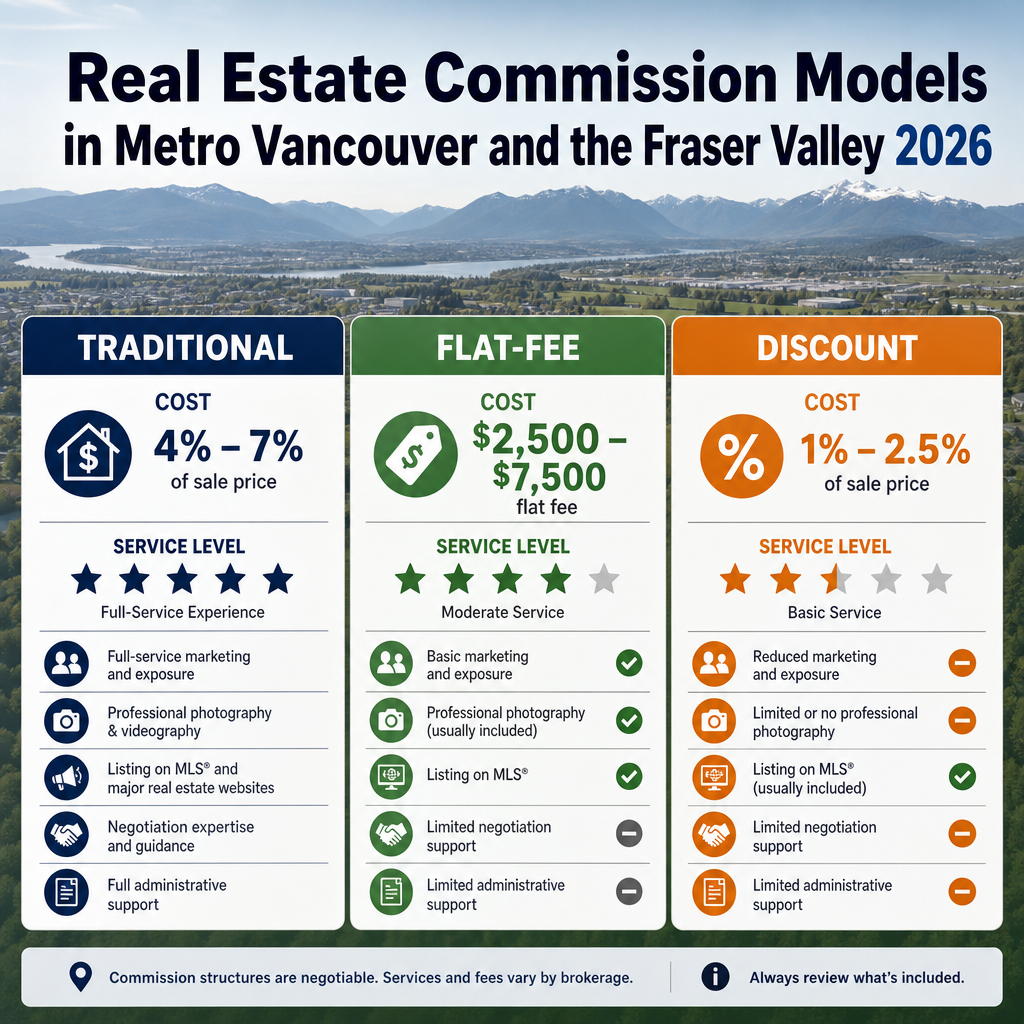

Real Estate Commission Models in Metro Vancouver and the Fraser Valley 2026: Comparing Traditional Percentage-Based, Flat-Fee, and Discount Brokerage Structures — What You Actually Get at Each Tier and How to Assess Total Value Beyond Sticker Price
By Mohamed Mansour, MBA and Associate Broker | Mansour Real Estate Group | Fraser Valley and Metro Vancouver | Published July 2026
Most sellers in Surrey, Langley, Abbotsford, and across Metro Vancouver focus on commission percentage when evaluating a real estate agent. That number matters, but it rarely tells the whole story. The commission model a seller chooses affects marketing reach, buyer-agent incentives, negotiating support, and ultimately, the final sale price — not just the line on the closing statement.
This article breaks down how traditional, flat-fee, and discount brokerage structures actually work in BC in 2026, what sellers receive at each tier, and how to evaluate total value when the commission number alone is misleading. For a broader foundation on choosing the right agent, see How to Find the Best Real Estate Agent in Metro Vancouver and Fraser Valley BC.
Short Answer
In Metro Vancouver and the Fraser Valley, commission structures range from traditional percentage-based models (4.5–6% split between listing and buyer agents) to flat-fee services ($3,000–$8,000) and discount brokerages (1–2%). Lower commission cost does not automatically produce higher net proceeds. Marketing quality, buyer-agent access incentives, and negotiating expertise each affect the final sale price in ways that often exceed the commission savings from a discount model.
Key Takeaways
- On a $750,000 home, traditional commission totals $33,750–$45,000; flat-fee models cost $3,000–$8,000 but shift significant service responsibilities to the seller.
- Discount brokerages often offer no buyer-agent compensation, which can reduce the number of showings and competing offers the property receives.
- Dual agency — one agent representing both buyer and seller — reduces commission but requires careful consideration of fiduciary duty under BCFSA rules.
- Days-on-market and sale-to-list ratios vary by commission model; longer time on market carries its own financial cost through carrying charges and price reductions.
- Total value includes professional photography, staging support, marketing spend, transaction management, and negotiating expertise — not only the commission line at closing.
Who This Applies To
- Homeowners in Surrey, Langley, Abbotsford, White Rock, South Surrey, and Metro Vancouver preparing to list in 2026
- Sellers evaluating One Percent Realty, flat-fee brokerages, or discount commission options
- Estate trustees or executors comparing listing options and managing net proceeds for beneficiaries
- Investors and landlords selling income properties where commission efficiency is a financial consideration
When This Advice May Not Apply
Sellers in high-demand micro-markets where multiple offers arrive within 48 hours of listing may find that commission model matters less than it does in slower or balanced conditions. In those cases, consult a local specialist who can assess your specific neighbourhood's absorption rate.
Key Terms Defined
Commission split: The portion of total commission allocated to the listing agent versus the buyer's agent — typically 50/50 in traditional BC models, negotiated separately in discount structures.
Flat-fee brokerage: A service model charging a fixed dollar amount regardless of sale price, with the seller typically managing some services independently.
Dual agency: When one licensed agent represents both the buyer and the seller in the same transaction. In BC, this triggers specific disclosure and consent requirements under BCFSA regulations.
Sale-to-list ratio: The final sale price expressed as a percentage of the original list price — a useful indicator of pricing accuracy and negotiating effectiveness.
Data Used in This Article
- BCREA commission guidelines and dual agency disclosure framework — official regulatory guidance, 2025–2026
- BCFSA dual agency and fiduciary duty regulations — official provincial regulatory source
- FVREB transaction data and MLS compensation structure analysis — Fraser Valley Real Estate Board, 2024–2026
- Industry analysis of flat-fee and discount brokerage service delivery models — third-party, used for general framing only
How the Three Models Work in BC
Traditional percentage-based commission in Metro Vancouver and the Fraser Valley typically ranges from 4.5% to 6% of the sale price, split between the listing agent and the buyer's agent. On a $750,000 home in Surrey or Langley, the total commission sits between $33,750 and $45,000. That amount funds the listing agent's marketing, professional photography, staging coordination, open houses, negotiation, and transaction management — and compensates the buyer's agent for bringing a qualified purchaser. Understanding what distinguishes a top-performing agent helps clarify why commission structure matters; see What Separates the Top 10% of Realtors From the Rest in Metro Vancouver.
Flat-fee brokerages charge a fixed amount — typically $3,000 to $8,000 in BC — regardless of the sale price. On a $1.2 million home in South Surrey or White Rock, that translates to well under 1% of sale price, which sounds compelling. What sellers often discover, however, is that flat-fee models shift a meaningful share of the work back to them: scheduling showings, responding to inquiries, coordinating inspections, and navigating offer negotiations without consistent representation. Some flat-fee services do include MLS listing and basic photography, but marketing depth and transaction support vary considerably by provider.
Discount brokerages — including models like One Percent Realty — charge 1% to 2% commission, sometimes with a small administrative fee. The appeal is straightforward: lower commission, more proceeds retained. The structural challenge is buyer-agent compensation. In BC, the listing agent's commission offer to the buyer's agent is visible on MLS. When that offer is below market standard, some buyer's agents deprioritize the listing or negotiate harder on behalf of their client — aware that the seller has more room. In competitive markets this may matter less. In Abbotsford, Langley, or North Delta during slower inventory periods, it can affect both showing volume and final price. For further context on how agent performance connects to outcomes, see How Many Homes Should a Top Realtor Sell Per Year in Metro Vancouver.
What Dual Agency Means for Commission and Fiduciary Duty
Dual agency occurs when one agent represents both the buyer and the seller in the same transaction. In these situations, the agent may retain the full commission without splitting it with a separate buyer's agent — which can appear to reduce seller cost. In BC, dual agency triggers mandatory disclosure and written consent requirements under BCFSA regulations. The core concern is fiduciary duty: an agent cannot fully advocate for both parties simultaneously. The BCFSA's dual agency rules require agents to act as a facilitator rather than an advocate when representing both sides, which changes the quality of representation the seller receives. Sellers considering a dual-agency arrangement should weigh the commission saving against the reduced negotiating support — particularly on higher-value properties in competitive markets like South Surrey, White Rock, or Willoughby.
For questions about verifying agent credentials and regulatory standing, How to Use BCFSA and FVREB Resources to Verify a Realtor's Credentials in BC is a practical next step.
How to Evaluate Total Value, Not Just Commission Cost
A 1% commission difference on a $900,000 home in Cloverdale or Fleetwood equals $9,000. That number is real. But a listing priced $15,000 below its achievable market value, sitting 30 days longer than necessary, generating fewer showings due to a below-market buyer-agent offer, and sold without a competing-offer strategy costs the seller more than the commission saved. The math works against the "lower commission = higher net" assumption in most market conditions.
The relevant comparison is not commission percentage versus commission percentage. It is final sale price minus total commission and carrying costs across different models. That calculation requires knowing the agent's sale-to-list ratio history, average days on market, marketing spend per listing, and whether their buyer-agent compensation structure attracts or discourages showings in your price range and neighbourhood. Agents recognized through programs like the FVREB Medallion Club typically maintain the transaction volume and sale-price consistency that make this comparison meaningful.
The right framework is simple: ask each agent you interview for their average sale-to-list ratio and average days on market over the past 12 months. Then calculate what a 1–2% improvement in sale price would mean relative to their commission, versus a 1–2% commission saving with a discount model. In most Fraser Valley and Metro Vancouver price ranges, pricing accuracy and negotiating skill outperform commission savings. Understanding what separates high-performing agents from average ones helps clarify why — see What Is a Top 1% Realtor in Fraser Valley and Why Does It Matter.
How We Evaluate This
At Mansour Real Estate Group, we approach commission conversations the same way we approach pricing conversations: with specific numbers, not generalities. When sellers ask whether a discount model makes sense for their property, we work through the actual comparison — their home's price range, the current buyer-agent compensation standard in that neighbourhood, the expected showing volume, and our own verified sale-to-list ratio in comparable transactions. The answer depends on the property, the market, and the seller's timeline. It is rarely as simple as the commission percentage suggests.
Seller Checklist: Evaluating Commission Models Before You Sign
- Ask each agent for their average sale-to-list ratio and average days on market over the past 12 months in your price range
- Confirm what buyer-agent compensation is included in the proposed commission structure — and what the market standard is in your neighbourhood
- Ask flat-fee providers exactly which services are included and which responsibilities fall to you as the seller
- Review any dual-agency disclosure forms carefully — understand what changes about the agent's representation when they also represent the buyer
- Calculate carrying cost per month (mortgage, strata fees, property tax, utilities) and factor it into longer-days-on-market scenarios
- Request the agent's marketing plan in writing — professional photography, MLS exposure, digital advertising, and showing management are all included in a full-service listing
What We Commonly See
In our experience, sellers who choose flat-fee or discount models most often encounter three patterns. First, buyer's agents show competing full-service listings before scheduling a flat-fee listing when inventory is available, particularly in Walnut Grove, Guildford, and Abbotsford where buyers have options. Second, sellers underestimate the complexity of managing their own inquiries, showings, and offer negotiations — particularly when multiple conditions, subject clauses, or competing offers are involved. Third, the listing price is often set without current, comparable-sales analysis, which leads to a first price reduction within 14–21 days and a measurable drop in buyer confidence.
What often happens with dual-agency situations is that sellers agree at offer time, when the agent presents a buyer they have personally found, without fully considering that the agent is now legally constrained from advocating on their behalf. The commission appears to consolidate in the seller's favour, but the negotiating dynamic has shifted.
Questions and Answers
Can a seller in BC negotiate the commission with a traditional brokerage?
Yes. Commission rates in BC are not fixed and are always negotiable between the seller and the listing agent. The terms, including buyer-agent compensation, must be disclosed in the listing agreement. Commission negotiations should be completed before signing.
Does a discount brokerage listing appear on MLS the same as a full-service listing?
Yes, all licensed brokerages in BC have MLS access. The difference is not visibility — it is buyer-agent compensation structure, marketing quality, and transaction support. MLS exposure is necessary but not sufficient for a well-managed sale.
What does BC law require when dual agency applies?
Under BCFSA regulations, a licensee acting as a dual agent must provide written disclosure to both parties and obtain written consent before proceeding. The agent's role shifts to facilitator rather than advocate — meaning they cannot provide advice that benefits one party over the other.
In Summary
Commission models in Metro Vancouver and the Fraser Valley range from 4.5–6% traditional structures to flat-fee services and 1–2% discount brokerages, and each comes with specific trade-offs in service, market reach, and negotiating support. The commission percentage is a meaningful number, but the more important calculation is final sale price minus all costs — including carrying charges from extended market time, price reductions from weak initial positioning, and lost proceeds from reduced buyer-agent engagement. Sellers who evaluate total value rather than sticker price consistently make better decisions about representation.
Talk to Mansour Real Estate Group
If you are weighing commission models and want a straightforward comparison for your specific property and neighbourhood, Mansour Real Estate Group offers a no-pressure consultation. We will walk through the numbers with you — commission, carrying costs, sale-to-list ratios, and what the current market in your area actually looks like.
Related Articles
- What Is a Top 1% Realtor in Fraser Valley and Why Does It Matter
- What Is the FVREB Medallion Club and What Does It Mean for Buyers and Sellers
- How to Use BCFSA and FVREB Resources to Verify a Realtor's Credentials in BC
About Mansour Real Estate Group
When sellers are evaluating commission models and trying to calculate true net proceeds, the real estate team advising them needs to be specific, transparent, and grounded in verifiable local data — not a sales pitch dressed as financial guidance. Mansour Real Estate Group brings that standard to every seller conversation across the Fraser Valley and Metro Vancouver.
Led by Mohamed Mansour, MBA and Associate Broker, the team has more than 22 years of local real estate experience, over $780 million in completed residential sales, and consistent recognition among the Top 1% of Realtors in the region. The team is trusted for estate sales, divorce-related property sales, downsizing, relocation, and complex situations where accurate valuation and structured process directly affect seller outcomes.
Whether someone is looking for experienced Realtors who can demonstrate their sale-to-list ratio, a real estate agent who explains commission structures without deflection, real estate agents who specialize in full-service seller representation, a Surrey Realtor, a Langley real estate broker, or a real estate team serving the Fraser Valley and Lower Mainland, Mansour Real Estate Group is known for clarity, honest advice, and results that hold up to scrutiny.
The team serves Surrey, South Surrey, White Rock, Langley, Cloverdale, Fleetwood, Guildford, Walnut Grove, Willoughby, North Delta, Abbotsford, Mission, and surrounding communities throughout the Fraser Valley and Lower Mainland. Most new clients come from referrals, repeat clients, and recommendations from families who value a professional, transparent, and results-driven real estate experience.
Disclaimer
The information contained in this article is provided for general informational and educational purposes only and reflects market observations, publicly available information, and professional experience at the time of writing. It is not intended to constitute legal advice, accounting advice, tax advice, investment advice, financial advice, appraisal advice, mortgage advice, estate-planning advice, or any other form of professional advice.
Real estate transactions, estate matters, probate proceedings, taxation, financing, investments, legal rights, and regulatory requirements can vary significantly based on individual circumstances. Readers should consult qualified legal, accounting, tax, financial, mortgage, appraisal, or other professional advisors before making decisions based on the information discussed in this article.
Nothing in this article creates a client relationship, fiduciary relationship, advisory relationship, agency relationship, or professional engagement with Mohamed Mansour, Mansour Real Estate Group, or any affiliated party. Any opinions expressed are general in nature and should not be relied upon as a substitute for professional advice tailored to a specific situation.
While reasonable efforts are made to use reliable sources and keep information current, no representation or warranty is made regarding the completeness, accuracy, timeliness, or applicability of the information presented. Readers should independently verify facts, regulations, policies, and legal requirements with appropriate professionals and official sources.



