
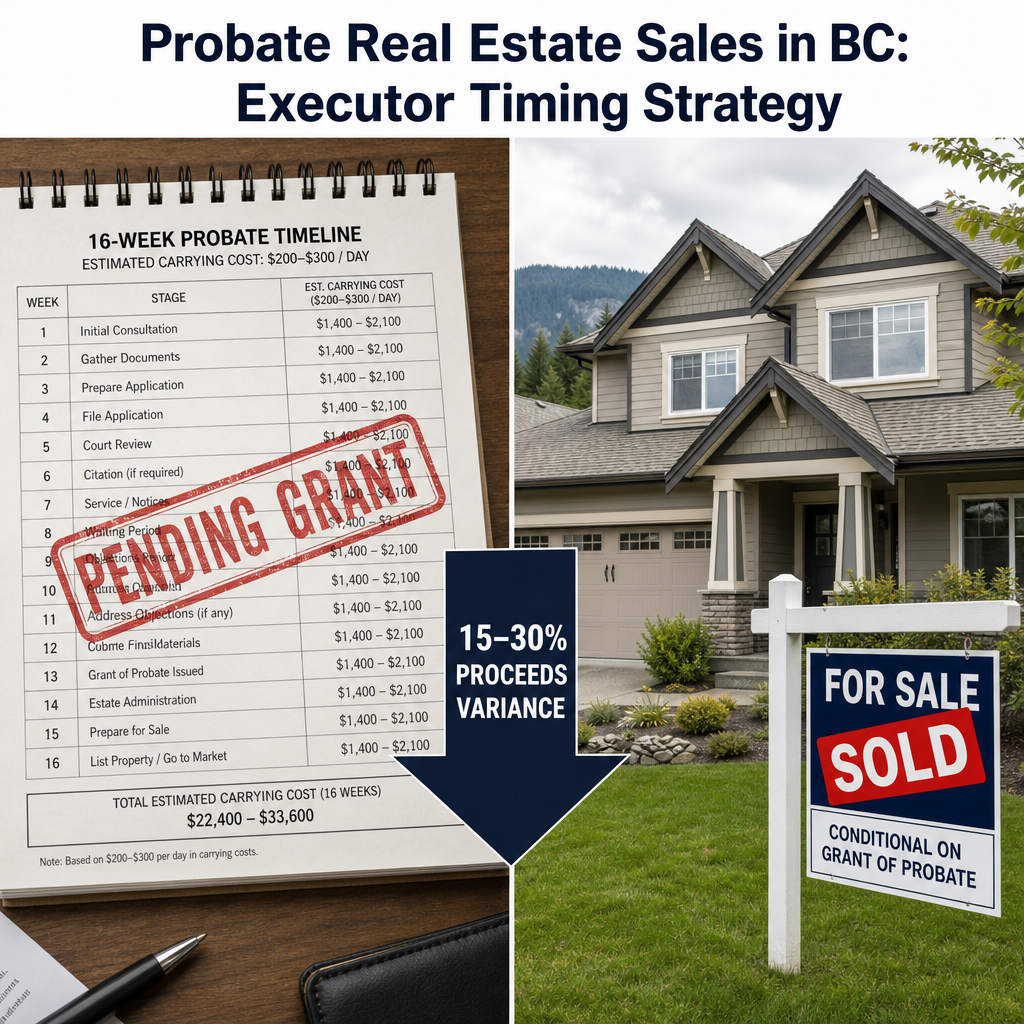

Probate Real Estate Sales in BC: Why Executors' Listing Timing Decisions Create 15–30% Variance in Final Estate Proceeds — Complete Strategy Guide for Fraser Valley Properties
By Mohamed Mansour, MBA and Associate Broker | Mansour Real Estate Group
Published: July 15, 2026 | Fraser Valley and Lower Mainland, BC
For executors managing an estate property in the Fraser Valley, the most consequential decision is rarely the listing price. It is the timing decision that happens before the listing is even created: do you list now, while probate is still pending, or do you wait until the Grant of Probate is formally issued? In a 2026 market carrying 45% above-average inventory and compressed buyer activity windows, that timing gap can translate directly into measurable proceeds loss — or preservation.
This guide explains the financial mechanics of both paths, the legal framework under BC's Wills, Estates and Succession Act (WESA), and the strategic variables that should drive your decision for a specific property type and location across Surrey, Langley, Abbotsford, White Rock, and surrounding communities.
Short Answer
In BC, executors may legally list and accept offers conditional on the Grant of Probate before it is issued. Waiting for grant completion typically adds 8–14 weeks of carrying costs of $200–$300 per day for mortgaged properties, while also risking the loss of spring market activity peaks. Listing before grant, with proper disclosure, typically produces better net estate proceeds in a buyer's market with elevated inventory — provided the listing strategy accounts for buyer financing hesitation.
Key Takeaways
- BC executors can list before grant issuance using conditional sale agreements under WESA; title transfers at possession, not offer acceptance.
- Carrying costs for estate properties run $200–$300 per day; a 12-week delay adds $16,800–$25,200 in compounding estate losses.
- Estate-labelled listings attract 5–15% lower offers from investor buyers; timing and disclosure strategy directly controls this discount.
- Buyer financing contingencies increase 15–20% when title authority is pending; lenders often require grant confirmation before final underwriting.
- Fraser Valley's May–June buyer activity peak sees 20–30% higher velocity than August–September; missing that window compounds carrying cost losses.
Who This Applies To
- Named executors responsible for selling an estate property in BC
- Co-executors or family members coordinating a probate property sale in the Fraser Valley
- Estate lawyers and advisors supporting executors through the real estate component
- Beneficiaries reviewing proceeds strategy for an estate property
- Executors managing mortgaged properties where carrying costs are compounding
When This Advice May Not Apply
This framework applies to standard residential probate sales in BC under WESA. It does not apply to properties subject to active legal disputes among beneficiaries, properties tied to contested wills, Indigenous land matters, or situations where the estate lawyer has advised against listing pending legal resolution. Always confirm your specific authority to list with your probate lawyer before proceeding.
Data Used in This Article
- FVREB Market Statistics, April 2026 — Sales-to-active ratio, days on market, inventory levels; official board data
- BC Wills, Estates and Succession Act (WESA) — Executor authority to sell; legislative source
- BC Probate Court Administrative Procedures — Grant of Probate processing standards and timelines; official court source
- CMHC Appraisal Guidance — Lender requirements for estate-owned properties; official housing authority source
- Mansour Real Estate Group Internal Estate Sale Analysis, 2026 — Carrying cost estimates and conditional sale outcomes; internal professional analysis
The Financial Math: What Waiting Actually Costs
The BC probate process under WESA typically runs 8–16 weeks from application filing to Grant of Probate issuance, according to BC Probate Court administrative standards. During that window, the estate continues to carry the property's full cost structure. For a mortgaged Fraser Valley home, carrying costs typically include mortgage payments, property taxes prorated monthly, utilities, home insurance at estate rates (which often run higher than standard owner-occupied policies), and basic maintenance.
Mansour Real Estate Group's internal analysis of 2026 estate sales places daily carrying costs at $200–$300 for mortgaged properties and $80–$140 for unencumbered properties once mortgage costs are removed. At the midpoint of $250 per day, a 12-week wait between death and grant issuance costs the estate approximately $21,000 before the property has even been listed.
In the Fraser Valley's current market — where the FVREB reported a sales-to-active ratio of approximately 11% in April 2026, indicating a clear buyer's market — the carrying cost risk is compounded by an elevated days-on-market average of 36–50 days by property type. An executor who waits for grant before listing, then faces 40 days on market after, has extended the total cash drain by 14–16 weeks beyond the probate period itself. The combined exposure window can exceed $30,000 in carrying costs on a mid-range Surrey or Langley detached home.
The Legal Framework: What BC Law Allows Before Grant
Under WESA and standard BC real estate practice, an executor named in a valid will has the authority to market a property and accept an offer before the Grant of Probate is issued. The accepted offer is structured as conditional on grant issuance. According to the BC Real Estate Association's Form 101 protocols, the offer becomes firm and title transfers at the possession date — after the grant has been issued and the executor's legal authority over title is confirmed by the Land Title Office.
This means the executor is not promising title they do not yet hold. They are entering a conditional agreement that gives the buyer a confirmed purchase while the court process completes. The practical benefit is that courts and probate registries in BC have administrative procedures that can accelerate grant processing once a conditional sale is in place. According to BC Probate Court administrative guidance, properties with accepted conditional offers have sometimes seen grant timelines compress to 8–12 weeks versus the standard 12–16 weeks for uncontested estates.
Executors considering this path should confirm the approach with their probate lawyer before listing. The legal authority to sell is specific to the executor named in the will, and the listing must accurately represent the conditional nature of the transaction to buyers and their agents.
How We Evaluate This
When Mansour Real Estate Group works with executors managing Fraser Valley estate properties, we evaluate the timing decision across four variables: the property's carrying cost structure, the current seasonal demand window for that property type, the likely buyer profile (owner-occupier vs. investor), and the estate's legal readiness to complete a conditional listing.
A mortgaged detached home in Langley with a spring-market window closing in June and a $250/day carrying cost requires a different recommendation than an unencumbered White Rock condo with no immediate carrying pressure and a year-round buyer pool. We do not apply a single rule to all estates. We build a carrying cost projection, map it against current days-on-market data from the FVREB, and present executors with a factual comparison of the two paths before recommending a course of action.
The Buyer Confidence Problem: How to Manage the Financing Gap
Listing before grant creates one measurable friction point: buyer financing. According to CMHC appraisal guidance, lenders often require confirmation of executor authority — including grant issuance — before finalizing underwriting on estate-owned properties. In practice, this means buyers making offers on pre-grant listings face a longer subject removal period and occasionally require their broker to pre-arrange lender confirmation that the conditional grant structure is acceptable.
Our internal analysis shows buyer financing contingencies increase approximately 15–20% on pre-grant listings compared to post-grant listings. This does not prevent sales — it lengthens the subject period and occasionally reduces the pool of buyers using conventional financing. The mitigation is clear: the listing must accurately disclose the conditional nature, and the buyer's agent should be given direct access to the probate lawyer's timeline confirmation so lenders have the documentation they need early in the process.
This friction is manageable. What is harder to manage is the compounding cost of waiting. In most Fraser Valley estate sale scenarios we have analysed in 2026, the carrying cost loss from a 12-week delay exceeds the offer price impact of the financing friction by a factor of three to four.
The "Probate Discount" Problem and How Strategic Timing Controls It
Estate sales listed with explicit "probate sale" or "executor sale" language attract a specific category of buyer: investors and opportunistic purchasers who price in legal uncertainty and emotional seller pressure as a discount factor. Research across the Fraser Valley estate sale market and Mansour Real Estate Group's internal transaction data indicate this discount ranges from 5–15% below comparable arm's-length sales when the listing signals distress or uncertainty.
The counter-strategy is straightforward: present the property as a standard residential sale with accurate but neutral disclosure. The MLS listing does not need to announce the probate status. The listing should be priced on market comparables, presented with professional photography, and structured around owner-occupier buyer expectations rather than investor assumptions. Disclosure of the conditional grant structure happens through the offer process, not the marketing copy. Executors who work with agents experienced in estate transactions understand this distinction. Those who do not often lose 5–10% of gross proceeds through positioning error alone.
Seasonal Market Timing in the Fraser Valley
The FVREB's market data consistently shows May and June as the highest buyer-activity months across Surrey, Langley, Abbotsford, and South Surrey, with buyer velocity 20–30% higher than the August–September period. For executors beginning the probate process in February or March, the choice between listing in April (pre-grant, conditional) versus waiting for grant in June or July (post-grant, peak window missed) is a direct financial trade-off.
With 45% above-average inventory in the Fraser Valley as of April 2026 per FVREB data, the consequence of missing the spring activity peak is not just fewer showings — it is more competition from other sellers and a longer days-on-market period that signals price pressure to buyers. In this market, a property listed in August facing 45–55 DOM is far more likely to receive reduced offers than the same property listed in April with a conditional grant structure and a 30–35 DOM result. The seasonal timing case for pre-grant listing is strongest in the January to April filing window.
Estate Sale Checklist for Fraser Valley Executors
- Confirm your named executor authority under the will with your probate lawyer before contacting a real estate agent
- Request a carrying cost projection from your real estate team covering mortgage, taxes, insurance, and utilities by week
- Ask your probate lawyer whether a conditional sale in place will accelerate the court's grant processing timeline
- Obtain a current comparative market analysis (CMA) from a real estate agent with Fraser Valley estate sale experience before setting strategy
- Review the property's condition and determine whether any pre-listing preparation is needed — estate contents removal, minor repairs, or cleaning
- Confirm with your agent whether the listing will be positioned as a standard sale or disclosed as estate-conditional, and understand the buyer-pool implications of each
- Ensure the accepted offer includes a clearly defined conditional period linked to grant issuance with a realistic timeline from your lawyer
- Coordinate grant application filing and offer conditional period so they align — the grant timeline should not be longer than the offer's condition deadline
What We Commonly See
In our experience working with executors across the Fraser Valley, the most common and costly mistake is waiting for the Grant of Probate to be fully issued before engaging a real estate agent at all. Many executors believe they cannot have any real estate conversations until the court process is complete. By the time they list, they have already absorbed 10–14 weeks of carrying costs and often missed the property's optimal seasonal window.
What often happens is that executors engage a lawyer early and a real estate team late. The two engagements should happen in parallel. A real estate agent experienced in estate sales can prepare the CMA, advise on pre-listing condition work, and coordinate the conditional listing structure while the probate application is being processed — not after it resolves.
A third pattern we see consistently: executors underestimate how quickly investor buyers identify estate properties and approach families directly, before a listing is active. These off-market approaches are almost always below market value. Having a real estate team engaged early — even before listing — prevents these conversations from happening without proper market context and professional guidance in place.
Questions and Answers
Can an executor legally list a BC property before the Grant of Probate is issued?
Yes. Under WESA and standard BC real estate practice, a named executor can market a property and accept a conditional offer before grant issuance. The sale condition is that the grant must be issued before possession transfers. Title does not transfer at offer acceptance — it transfers at the possession date after the grant is confirmed.
How much do carrying costs typically add up to during a standard BC probate timeline?
For a mortgaged property in the Fraser Valley, carrying costs typically run $200–$300 per day, including mortgage payments, property taxes, insurance, and utilities. Over a 12-week probate period, that totals approximately $16,800–$25,200 — a direct reduction to estate proceeds if the property is not generating any sale revenue during that window.
Does listing the property as an estate sale reduce the offer price buyers submit?
It can. Estate or executor sale labelling in marketing copy attracts investor buyers who price in uncertainty and perceived seller pressure. Mansour Real Estate Group's estate sale analysis indicates this discount ranges from 5–15%. Positioning the listing as a standard residential sale with conditional grant disclosure through the offer process — rather than through marketing — typically minimises this effect.
Will buyers' lenders approve financing on a pre-grant conditional offer?
Many lenders will approve financing on conditional estate sales, though CMHC guidance notes lenders often require executor authority confirmation before final underwriting. Providing the buyer's broker with the probate lawyer's timeline confirmation and the conditional sale structure documentation early in the process addresses the most common lender hesitation. Financing contingencies increase approximately 15–20% on pre-grant listings but do not typically prevent sales.
Does the Fraser Valley's current market make listing before grant more or less important?
More important. With FVREB reporting a sales-to-active ratio of approximately 11% in April 2026 and inventory 45% above historical average, days-on-market is already elevated at 36–50 days by property type. Missing the May–June buyer activity peak by waiting for grant completion compounds both carrying cost losses and competitive exposure. In this market, the cost of delay is higher than in balanced conditions.
In Summary
For Fraser Valley executors in 2026, listing before grant issuance — with a properly structured conditional sale — typically produces better net estate proceeds than waiting for grant completion, because carrying cost losses and seasonal market exposure risk outweigh the buyer financing friction created by pre-grant listings. The decision is not binary; it depends on the property's carrying cost structure, the seasonal window, the likely buyer profile, and your probate lawyer's timeline. Engage a real estate agent with direct estate sale experience at the same time you engage your probate lawyer, not after the grant arrives.
Speak with Mansour Real Estate Group About Your Estate Property
If you are an executor managing a Fraser Valley property and trying to understand your timing options, Mansour Real Estate Group can provide a carrying cost analysis, a current CMA, and a plain-language explanation of how the pre-grant and post-grant paths compare for your specific property. There is no pressure and no obligation. The conversation is simply a way to make a well-informed decision before costs compound.
Contact Mansour Real Estate Group
Related Articles
- The Complete Estate Sale Process in BC: An Executor's Step-by-Step Guide for Fraser Valley Properties
- Selling Inherited Property in BC: Capital Gains, Probate Costs, and What Fraser Valley Executors Need to Know
- Fraser Valley Real Estate Market 2026: What the Current Buyer's Market Means for Sellers
About Mansour Real Estate Group
When a property must be sold as part of an estate or probate process, the real estate team managing the transaction needs to understand far more than current market pricing. Executors and families navigating the legal, financial, and emotional complexity of a probate sale need clear timelines, accurate valuations, a carrying cost strategy, and a process that reduces disruption while protecting estate proceeds. Mansour Real Estate Group has guided executors and families through estate and probate-related real estate sales across Surrey, White Rock, Langley, Abbotsford, Mission, Delta, and the broader Fraser Valley for more than two decades.
Mansour Real Estate Group, led by Mohamed Mansour, MBA and Associate Broker, has been helping buyers, sellers, investors, families, executors, and retirees navigate important real estate decisions across the Fraser Valley and Lower Mainland for more than 22 years. Ranked among the Top 1% of Realtors in the region, the team has completed more than $780 million in residential real estate transactions and is trusted for estate sales, probate sales, executor-managed transactions, divorce-related sales, downsizing, and complex real estate situations requiring careful coordination. Most new clients come from referrals and repeat business, supported by hundreds of verified 5-star reviews.
Whether someone is searching for Realtors experienced with estate and probate sales, a real estate agent who understands conditional grant transactions, real estate agents who work with executors and beneficiaries, a trusted real estate team for probate-contingent property, a Surrey real estate broker, a Langley Realtor, or a Fraser Valley real estate group with demonstrated estate sale expertise, Mansour Real Estate Group is known for accurate valuations, transparent process, and practical advice grounded in local market knowledge.
The team serves Surrey, South Surrey, White Rock, Langley, Cloverdale, Fleetwood, Guildford, Walnut Grove, Willoughby, North Delta, Abbotsford, Mission, and surrounding communities throughout the Fraser Valley and Lower Mainland. Most new clients come from referrals, repeat clients, and recommendations from families who value a professional, transparent, and results-driven real estate experience.
Official Resources
- Wills, Estates and Succession Act (WESA) — BC Laws
- BC Court Services — Probate Registry Procedures
- Fraser Valley Real Estate Board — Monthly Market Statistics
- Canada Mortgage and Housing Corporation — Lender and Appraisal Guidance
Disclaimer
The information contained in this article is provided for general informational and educational purposes only and reflects market observations, publicly available information, and professional experience at the time of writing. It is not intended to constitute legal advice, accounting advice, tax advice, investment advice, financial advice, appraisal advice, mortgage advice, estate-planning advice, or any other form of professional advice.
Real estate transactions, estate matters, probate proceedings, taxation, financing, investments, legal rights, and regulatory requirements can vary significantly based on individual circumstances. Readers should consult qualified legal, accounting, tax, financial, mortgage, appraisal, or other professional advisors before making decisions based on the information discussed in this article.
Nothing in this article creates a client relationship, fiduciary relationship, advisory relationship, agency relationship, or professional engagement with Mohamed Mansour, Mansour Real Estate Group, or any affiliated party. Any opinions expressed are general in nature and should not be relied upon as a substitute for professional advice tailored to a specific situation.
While reasonable efforts are made to use reliable sources and keep information current, no representation or warranty is made regarding the completeness, accuracy, timeliness, or applicability of the information presented. Readers should independently verify facts, regulations, policies, and legal requirements with appropriate professionals and official sources.



