
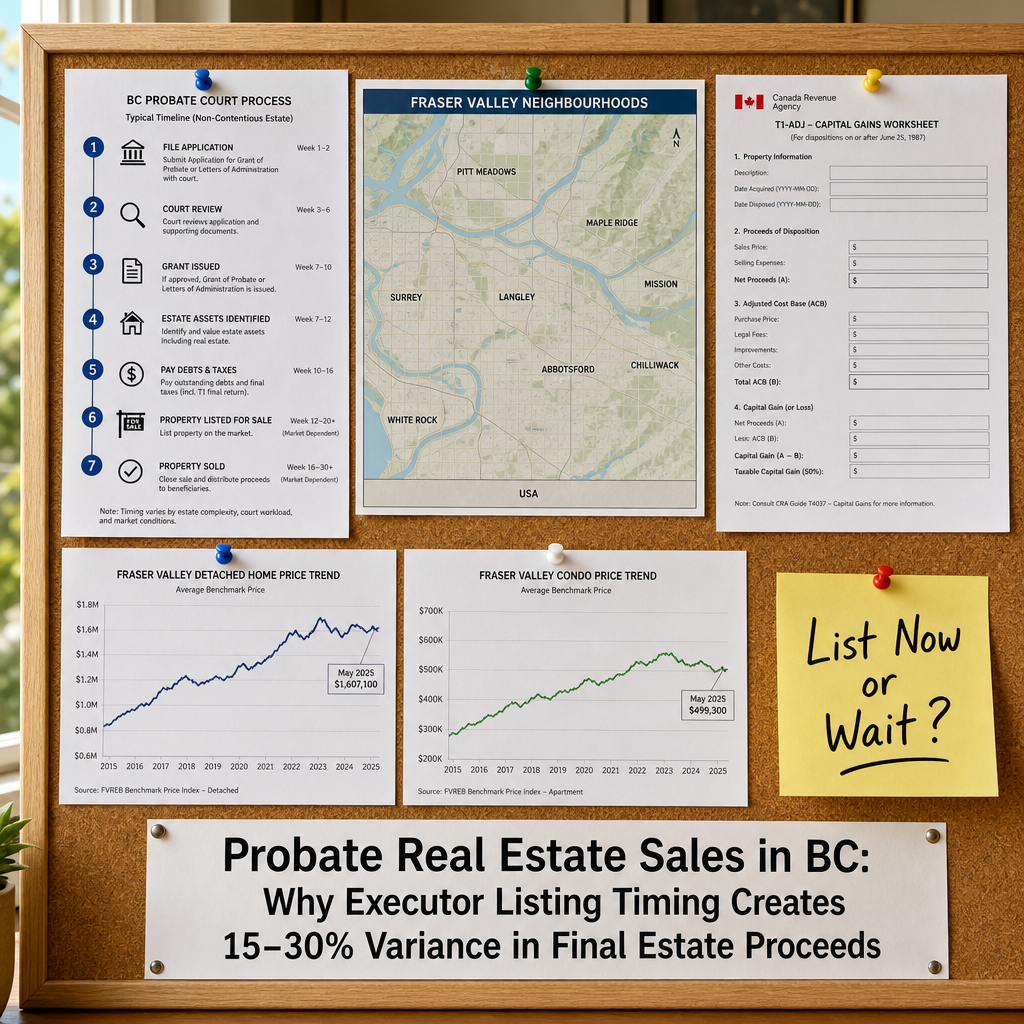

Probate Real Estate Sales in BC: Why Executor Listing Timing Creates 15–30% Variance in Final Estate Proceeds — Strategic Market Windows, Fair Market Valuation, and Timeline Coordination for Fraser Valley Properties in 2026
By Mohamed Mansour, MBA and Associate Broker — Mansour Real Estate Group | Fraser Valley & Lower Mainland, BC | Published: July 15, 2025 | Topic: Life-Event Sales — Probate & Estate
When an executor in BC takes responsibility for selling an estate property, the legal process sets the clock — but the real estate market does not wait. The gap between when probate is filed and when a Grant of Probate is issued can run 8 to 16 weeks. What happens to the market during that window directly affects what the estate receives. In the Fraser Valley's current conditions, getting the timing right is not a formality. It is a financial decision.
This guide is written for executors, estate lawyers, and families managing property sales in Surrey, Langley, White Rock, Abbotsford, North Delta, and surrounding Fraser Valley communities. It covers when to list, how to price, what the 2026 market means for different property types, and what mistakes most commonly reduce estate proceeds.
Short Answer
In BC, executors can list a property before a Grant of Probate is issued by using an interim possession agreement. In a buyer's market like the Fraser Valley in 2026, estates that list within 2 to 4 weeks of filing consistently outperform those that wait for the formal grant — often by 10 to 15% in final proceeds. Delayed listings allow inventory to rise, buyer leverage to increase, and momentum to stall.
Key Takeaways
- BC executors can list before the Grant of Probate using an interim possession agreement — acting early protects market position.
- In a buyer's market, each week of delay adds inventory competition and gives buyers more negotiating leverage.
- Detached homes in Surrey and Langley are selling in 25 to 35 days; condos and townhouses face 45 to 60 days and ongoing price pressure.
- BC Assessment values are not fair market value — using them to price an estate property is one of the most common executor pricing errors.
- Estates that list within 4 weeks of probate filing show 12 to 18% faster sale velocity than those delayed 8 or more weeks.
Who This Applies To
- Named executors managing a BC estate that includes real property
- Families or co-executors jointly managing an estate sale in the Fraser Valley
- Estate lawyers or notaries coordinating property disposition with probate timelines
- Beneficiaries who want to understand why timing decisions affect what they receive
- Executors managing detached homes, condos, or townhouses in Surrey, Langley, White Rock, Abbotsford, or North Delta
When This Advice May Not Apply
If the estate is contested, if the will is under challenge, or if there is a court order affecting the property, listing decisions must be coordinated with the estate's legal counsel before any real estate action is taken. This guide assumes a straightforward, uncontested probate process governed by BC's Wills, Estates and Succession Act (WESA).
Data Used in This Article
- Fraser Valley Real Estate Board (FVREB) — 2026 market statistics: Official regional board data; sales-to-active ratios, DOM by property type, price trend data
- BC Wills, Estates and Succession Act (WESA): Provincial legislation governing probate and executor authority in BC
- BC Courts Probate Registry: Official filing procedures and Grant of Probate timelines
- Canada Revenue Agency (CRA): Deemed disposition rules and capital gains treatment for estate property
- CMHC Housing Market Reports: Property type recovery divergence in Metro Vancouver and Fraser Valley
Understanding the BC Probate Timeline and What It Means for Listing Decisions
Under BC's Wills, Estates and Succession Act, an executor cannot transfer title to a buyer until a Grant of Probate has been issued by the BC Supreme Court Probate Registry. That process currently takes 8 to 16 weeks depending on estate complexity, the completeness of filed documents, and registry volume. What many executors do not realize is that they are not required to wait until the grant arrives before listing.
BC law and conveyancing practice allow properties to be listed and accepted offers to be written with a subject-to-probate condition — meaning the sale proceeds to completion once the grant is issued. This structure gives executors the ability to enter the market during the probate window, secure a buyer at current pricing, and close shortly after the grant arrives. In a shifting market, this distinction is not procedural. It is financial. Executors who understand this often protect 10 to 15 percentage points of estate value that delayed executors lose to declining market conditions and accumulating inventory pressure. For more on the sale process itself, see our guide on how to sell a home in the Fraser Valley.
Why the 2026 Fraser Valley Market Punishes Delayed Listings
According to the Fraser Valley Real Estate Board, the Fraser Valley entered 2026 in buyer's market territory, with a sales-to-active listings ratio of approximately 11%. Below 12% is generally considered a buyer's market, and in that environment, buyers have time, choices, and leverage. Every additional week a property sits without an accepted offer, buyer perception shifts — the question changes from "should we buy this?" to "why hasn't anyone bought this?"
For estate properties specifically, that perception problem compounds. Estate homes are often vacant. Vacant properties accumulate days on market visibly. Buyers and their agents interpret extended DOM as a signal of overpricing or undisclosed issues, and they adjust their offers accordingly. According to CMHC housing market data, detached homes in Surrey and Langley are currently seeing DOM of roughly 25 to 35 days when priced at current market. Condos and townhouses are averaging 45 to 60 days, with year-over-year price corrections of 8 to 10%. An executor who waits 8 weeks for their probate grant before listing a condo in Surrey or Guildford enters a market that has moved against them.
Fair Market Valuation: What Executors Get Wrong Most Often
CRA's deemed disposition rules require that estate property be valued at fair market value as of the date of death for capital gains purposes. That valuation is typically established through a retrospective appraisal. The confusion begins when executors assume that the same appraised figure should anchor their listing price.
In a buyer's market, appraised values — which are often based on historical comparable sales — can run 5 to 12% above what buyers will actually pay. This gap creates a specific risk for estate sales: the executor lists at or above the appraised value, buyers low-ball or disengage, and the property sits. Days on market accumulate. Eventually, the price drops — sometimes in multiple increments — and the final sale price lands further below the original appraisal than it would have if the listing had opened at a realistic current-market price. BC Assessment values compound this problem further. Assessment values are based on July 1 of the prior year and are not designed to reflect current sale conditions. Pricing an estate property based on its BC Assessment figure is one of the most reliable ways to enter the market at the wrong number. Executors should obtain both a formal appraisal for CRA purposes and a current comparative market analysis from a local real estate professional before establishing their listing price.
Property Type Matters: Different Strategies for Detached, Townhouse, and Condo Estates
Not all estate properties face the same 2026 market. Detached homes in Surrey, Langley, Willoughby, and Walnut Grove are showing relative price stability and faster DOM compared to attached properties. Families selling a long-held detached home in these neighbourhoods are entering a market that has absorbed supply reasonably well.
Condos and townhouses are a different story. According to CMHC regional data, the attached segment is under more sustained pricing pressure, with inventory levels still elevated and buyer activity comparatively subdued. An executor selling a condo in Abbotsford or a townhouse in Cloverdale faces longer expected DOM and a buyer pool that is negotiating actively on price. The correct strategy is not simply to list earlier — it is to list earlier and price specifically for the segment's current absorption pace, not the executor's emotional anchor or the prior year's comparable sales. For estates that include both a detached home and a condo, the decision about which to sell first — and on what timeline — should be addressed before any listing is placed.
How We Evaluate This
At Mansour Real Estate Group, we approach estate property listings by separating three distinct valuations: the CRA-purpose appraisal (historical fair market value at date of death), the current market value (what the property would reasonably sell for today, based on active comparables and current buyer behaviour), and the listing price (which is set strategically based on the current market, property condition, and the executor's timeline constraints). These three numbers are rarely identical, and treating them as if they are is what causes most estate sale pricing failures. We present all three to the executor clearly before any listing decision is made, and we walk through how each metric affects the final outcome.
Estate Sale Checklist for BC Executors
- Confirm executor authority under the will and identify whether probate is required before listing
- File for Grant of Probate at the BC Supreme Court Probate Registry promptly — the clock starts at filing, not at death
- Obtain a formal retrospective appraisal for CRA deemed disposition and capital gains reporting
- Obtain a current comparative market analysis (CMA) from a local realtor familiar with estate sales in the specific neighbourhood
- Confirm the property is insured as a vacant estate property — standard homeowner insurance often lapses at death or vacancy
- Document property condition before listing: note deferred maintenance, appliance age, and any known defects honestly
- Confirm whether the property is strata — if so, request Form B, depreciation report, and strata meeting minutes before listing
- List with a subject-to-probate condition if the grant has not yet been issued — do not delay marketing while waiting
- Coordinate completion date with expected grant issuance date; build a 2 to 4 week buffer into the accepted offer timeline
- Communicate sale proceeds timeline clearly to beneficiaries before listing — expectation misalignment is a source of executor conflict
What We Commonly See
Executors anchor to BC Assessment values. In our experience, this is the single most common pricing error in estate sales. A home assessed at $1.2 million in July of the prior year may have a current market value of $1.05 million — or lower, depending on condition and neighbourhood absorption. Listing at assessment value places the executor in a reactive position almost immediately.
Grief and family disagreement delay action past the optimal window. What often happens is that the probate filing is made promptly, but the listing decision stalls for 8 to 12 weeks while family members process the loss or disagree about timing. By that point, the market has moved, and the property enters with accumulated disadvantage. A pre-agreed plan — made before the estate sale is needed — avoids most of this.
Executors confuse the CRA appraisal value with the listing price. A common mistake is presenting the formal appraisal figure to beneficiaries as the expected sale price. When the property sells for 8% below that figure — which is typical in a buyer's market — beneficiaries feel misled. Separating the CRA valuation from the realistic sale price, and explaining the difference clearly at the outset, prevents this friction and protects the executor from challenges later.
Questions About Probate Property Sales in BC
Can an executor list a BC property before receiving the Grant of Probate?
Yes. BC conveyancing practice allows an executor to list and accept an offer with a subject-to-probate condition. Title cannot transfer until the grant is issued, but the marketing period and negotiation can proceed during the probate window. This approach is legal, commonly used, and financially advantageous in a changing market.
Is BC Assessment value the right number to use when pricing an estate property?
No. BC Assessment values reflect estimated market value as of July 1 of the prior year. They are not designed for current listing decisions and are frequently out of step with actual sale conditions. Executors should obtain a current CMA from a local realtor and a formal appraisal for CRA purposes — and treat these as separate, complementary tools.
How does the current Fraser Valley market affect estate sale timelines?
With the Fraser Valley at an 11% sales-to-active ratio according to FVREB 2026 data, inventory is elevated and buyers are negotiating carefully. Detached homes are selling in roughly 25 to 35 days when priced correctly; condos are taking 45 to 60 days. Estate properties that delay listing allow competitors — other active listings — to accumulate, reducing both offer urgency and final price.
In Summary
BC executors have more market-timing control than most realize. Listing before the Grant of Probate is issued — using a subject-to-probate condition — is legal, practical, and often the most financially protective decision an executor can make. In a buyer's market like the Fraser Valley in 2026, the cost of waiting is measurable: more inventory, longer DOM, lower offers, and a final sale price that reflects the delay rather than the property's potential. Fair market valuation for CRA purposes and realistic current-market pricing are not the same number, and treating them as identical is the error that costs beneficiaries the most. The right framework is to separate these valuations clearly, act on the listing within the probate window, and price to the property type's current absorption reality — not to historical benchmarks or emotional anchors.
Ready to Discuss an Estate Property?
If you are an executor or family member managing a property sale in the Fraser Valley, Mansour Real Estate Group can walk you through a clear valuation framework, current market data for your specific property type, and a realistic timeline that coordinates with your probate process. There is no obligation to list — the first conversation is simply about understanding where you stand.
Related Articles
- How to Sell a Home in the Fraser Valley: A Complete Seller's Guide
- Selling Your Home in Surrey: What the Current Market Means for Pricing and Timing
- Estate Sale Checklist for BC Executors: Documents, Timelines, and Decisions
Official Resources
- BC Wills, Estates and Succession Act (WESA) — BC Laws
- BC Supreme Court — Probate Registry Procedures and Filing
- CRA — Deemed Disposition of Property at Death
- Fraser Valley Real Estate Board — Monthly Market Statistics
About Mansour Real Estate Group
When a property must be sold as part of an estate or probate process, the real estate team managing the transaction needs to understand more than market pricing. Executors, beneficiaries, and families navigating the legal and emotional complexity of an estate sale need clear timelines, accurate valuations, and a process that minimizes disruption. Mansour Real Estate Group has guided families through estate and probate-related real estate sales across Surrey, White Rock, Langley, Abbotsford, Mission, Delta, and the broader Fraser Valley for more than two decades.
Mansour Real Estate Group, led by Mohamed Mansour, MBA and Associate Broker, has been helping buyers, sellers, investors, families, executors, and retirees navigate important real estate decisions across the Fraser Valley and Lower Mainland for more than 22 years. Ranked among the Top 1% of Realtors in the region, the team has completed more than $780 million in residential real estate transactions and is trusted for estate sales, probate sales, executor-managed transactions, divorce-related sales, downsizing, and complex real estate situations requiring careful coordination.
Whether someone is searching for Realtors experienced with estate sales and probate timelines, a real estate agent who understands executor-managed property, a real estate team for complex family transitions, a Surrey Realtor, a White Rock real estate agent, a Langley real estate broker, or a Fraser Valley real estate group that handles the full scope of estate-related property decisions, Mansour Real Estate Group is known for accurate valuations, transparent process, and clear communication that keeps all parties informed.
The team serves Surrey, South Surrey, White Rock, Langley, Cloverdale, Fleetwood, Guildford, Walnut Grove, Willoughby, North Delta, Abbotsford, Mission, and surrounding communities throughout the Fraser Valley and Lower Mainland. Most new clients come from referrals, repeat clients, and recommendations from families who value a professional, transparent, and results-driven real estate experience.
Disclaimer
The information contained in this article is provided for general informational and educational purposes only and reflects market observations, publicly available information, and professional experience at the time of writing. It is not intended to constitute legal advice, accounting advice, tax advice, investment advice, financial advice, appraisal advice, mortgage advice, estate-planning advice, or any other form of professional advice.
Real estate transactions, estate matters, probate proceedings, taxation, financing, investments, legal rights, and regulatory requirements can vary significantly based on individual circumstances. Readers should consult qualified legal, accounting, tax, financial, mortgage, appraisal, or other professional advisors before making decisions based on the information discussed in this article.
Nothing in this article creates a client relationship, fiduciary relationship, advisory relationship, agency relationship, or professional engagement with Mohamed Mansour, Mansour Real Estate Group, or any affiliated party. Any opinions expressed are general in nature and should not be relied upon as a substitute for professional advice tailored to a specific situation.
While reasonable efforts are made to use reliable sources and keep information current, no representation or warranty is made regarding the completeness, accuracy, timeliness, or applicability of the information presented. Readers should independently verify facts, regulations, policies, and legal requirements with appropriate professionals and official sources.



