
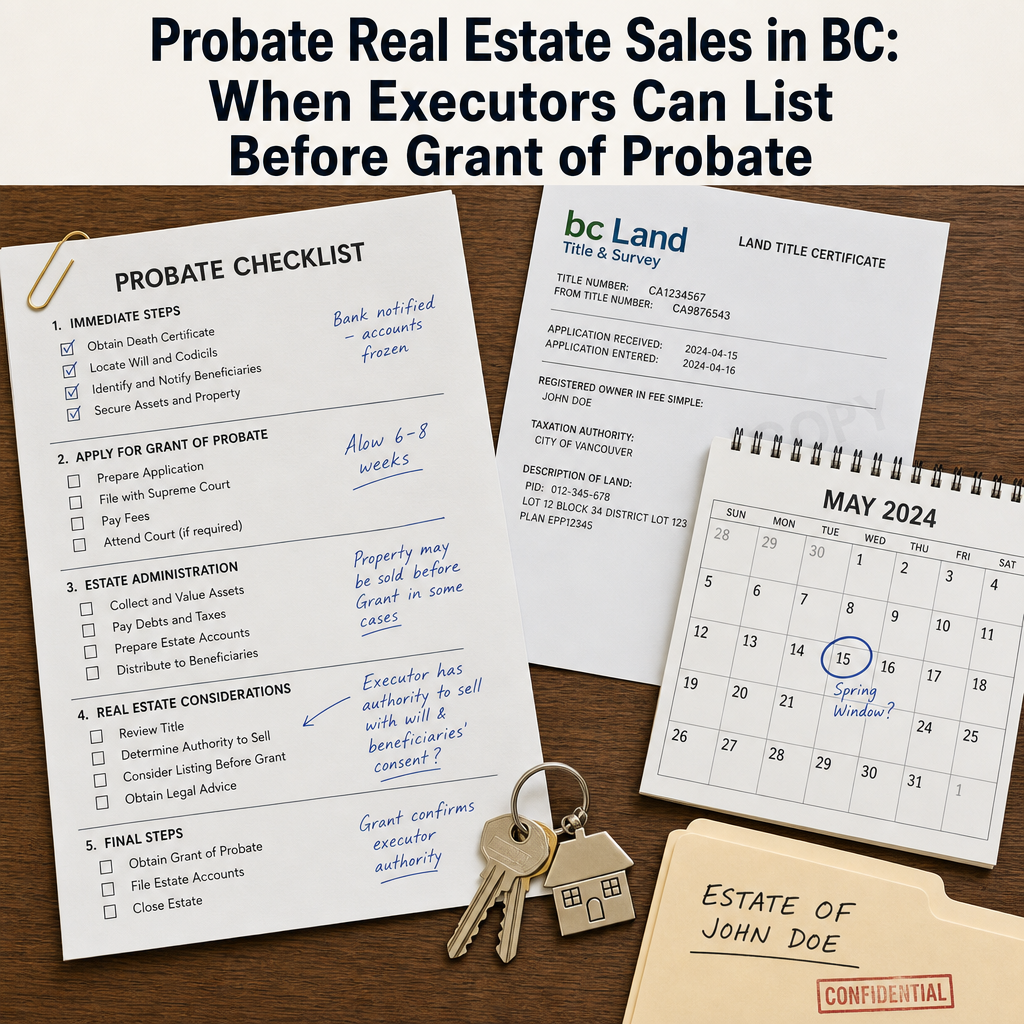

Probate Real Estate Sales in BC: When Executors Can List and Close Before the Grant of Probate Is Issued
By Mohamed Mansour, MBA and Associate Broker — Mansour Real Estate Group | Fraser Valley and Lower Mainland, BC | Published: May 13, 2025 | Topic: Estate Sales, Probate Strategy, Executor Guidance
Executors managing a BC estate property often make one costly assumption: that they must wait until the Grant of Probate is issued before they can do anything with the property. In many circumstances, that assumption is wrong — and the delay it causes can meaningfully reduce what the estate ultimately receives.
This guide explains when BC executors can list and close on a property before probate is granted, what legal authority and documentation is required, and why coordinating probate strategy with real estate timing often determines the final outcome for beneficiaries in the Fraser Valley market.
Short Answer
In BC, an executor named in a valid will can list an estate property for sale and accept a purchase offer before the Grant of Probate is issued. Closing before probate is granted is also possible in certain circumstances, but requires specific legal documentation, buyer lender acceptance of delayed title transfer, and often title insurance. Executors should consult an estate lawyer before proceeding.
Key Takeaways
- BC executors can list a property and accept offers before the Grant of Probate is issued if a valid will exists and legal authority requirements are met.
- Closing before grant is possible but requires lender acceptance of delayed title transfer, executor declarations, and often title insurance or court authorization.
- BC probate processing typically takes 4 to 8 months; market conditions in the Fraser Valley can shift materially during that window.
- Coordinating the probate application timeline with real estate listing strategy is one of the highest-value decisions an executor can make.
- Not every estate property qualifies for pre-grant closing — title complexity, lender requirements, and beneficiary consent all affect eligibility.
Who This Applies To
- Executors named in a will who are managing a BC estate that includes real property
- Beneficiaries working with an executor on a time-sensitive estate sale in the Fraser Valley
- Families who have inherited property in Surrey, Langley, White Rock, Abbotsford, or surrounding communities
- Executors trying to capture a spring or fall market window while probate is still pending
When This Advice May Not Apply
If the estate has no valid will (intestacy), if the executor's authority is disputed, if there are competing claims on title, or if the buyer's lender will not accept delayed title transfer, the process described here may not be available. Estate situations involving strata properties, multiple registered owners, or properties with unresolved liens require additional legal review. Always confirm your specific situation with a BC estate lawyer before listing.
Definitions
Grant of Probate: A court order confirming the validity of a will and the executor's authority to administer the estate. Required for the executor to transfer title to a buyer at the Land Title Office.
Executor: The person named in the will with legal responsibility to administer the estate, including managing and selling estate property.
Delayed Title Transfer: A closing structure where possession and funds transfer on the agreed completion date, but title registration at the Land Title Office is deferred until the Grant of Probate is issued.
Title Insurance: A policy that protects the buyer and lender against risks arising from title defects — often used in delayed title transfer scenarios to satisfy lender requirements.
Data Used in This Article
- BC Land Title Act — Government of BC (Tier 1) — legal authority governing title transfer and executor registration
- BC Supreme Court Civil Rules, Rule 25-5 — Government of BC (Tier 1) — probate application procedure and timelines
- Canadian Bar Association BC — Estate Litigation and Administration Guide — Industry body (Tier 3) — executor authority and pre-grant listing guidance
- Fraser Valley Real Estate Board (FVREB) — Market Statistics, April 2026 — Regulator/Board (Tier 2) — inventory, days on market, benchmark pricing trends
Can a BC Executor List a Property Before Probate Is Granted?
Yes, in most cases. An executor named in a valid will derives authority from the will itself, not solely from the Grant of Probate. Under BC law, the probate grant confirms and formalizes that authority — but it does not create it from scratch. This distinction matters practically.
Listing a property, accepting an offer, and negotiating terms are all actions an executor can take before probate is granted, provided the will is valid and unchallenged, all co-executors have consented where applicable, and the executor has provided notice to beneficiaries as required under the Wills, Estates and Succession Act (WESA). Legal counsel should confirm these conditions are met before listing.
What the executor cannot do before the Grant of Probate is transfer title at the BC Land Title Office. That registration step requires the probate order. This is where the distinction between listing and closing becomes critical — and where pre-grant closing structures come into play.
Can a BC Executor Close Before the Grant of Probate?
Closing before the grant is issued is more complex, but it is structurally possible in certain circumstances. The most common approach involves a delayed title transfer: the completion date, possession, and financial settlement occur as scheduled, but the formal title registration is deferred until the probate grant is in hand.
For this structure to work, the buyer's lender must agree to release mortgage funds before title transfers — which is not standard practice. Lenders that do accept this arrangement typically require an executor statutory declaration, proof that beneficiary notice has been given, written undertakings from the estate's legal counsel to register title once the grant is issued, and a title insurance policy protecting the lender and buyer against pre-registration risks.
Not every lender will accept this. Cash buyers, or buyers whose lender has approved a title insurance-backed delayed transfer, represent the clearest path to pre-grant closing. For Fraser Valley estate properties at higher price points — particularly detached homes in South Surrey and White Rock — this is worth exploring with an estate lawyer early in the process.
In some cases, executors have sought court authorization under BC Supreme Court practice directions to proceed with closing before the formal grant, particularly when a favourable buyer has been secured and delay would materially harm the estate. This requires an application and is not routine, but it is a recognized option when the situation warrants it.
Why BC Probate Timelines Make Market Timing Critical
According to current BC Supreme Court processing times, probate applications in BC typically take 4 to 8 months from the date of filing to the issuance of the grant. During that window, real estate market conditions in the Fraser Valley can shift materially.
According to FVREB data from April 2026, the Fraser Valley market is operating with elevated inventory and cautious buyer demand. In this environment, the difference between listing at a seasonal demand peak — typically March through May — and listing four months later in a slower summer or fall market can represent a meaningful reduction in final sale price. For a property valued at $1.2 million, a 5% shift in market conditions represents $60,000 in proceeds that beneficiaries may never recover.
Executors managing estate properties in Langley, Abbotsford, Surrey, and surrounding communities should treat the listing timing decision as a fiduciary one — not simply an administrative task to complete after the legal paperwork arrives.
How We Evaluate This
When Mansour Real Estate Group is engaged on an estate property, the first conversation is not about staging or pricing. It is about where the probate application is in the process, what the executor's legal authority currently allows, and what the market is doing right now versus what it is likely to do in 4 to 6 months.
That sequencing — legal authority, then market timing, then listing strategy — is what allows estate sellers to make an informed decision about when to list, whether to pursue a delayed title transfer structure, and how to position the property for the buyer pool most likely to be active at the time of listing. Probate and real estate are parallel processes, not sequential ones, and treating them that way consistently produces better outcomes for estates.
Estate Sale Checklist for BC Executors
- Confirm the will is valid and your appointment as executor is unchallenged before taking any action on the property.
- Engage a BC estate lawyer immediately to assess current legal authority, beneficiary notice requirements, and whether a pre-grant listing is appropriate.
- File the probate application as early as possible — the clock on processing time starts at filing, not at death.
- Obtain a current market valuation from a local real estate professional familiar with estate sales to establish the estate's real property value.
- Assess whether the current or near-term market window justifies a pre-grant listing or delayed title transfer structure.
- If listing before grant, ensure all beneficiary notices are documented and that the purchase contract includes appropriate conditions referencing probate status.
- Confirm buyer financing compatibility early — identify whether the buyer's lender will accept a delayed title transfer or whether a cash or title-insurance-backed transaction is required.
- Coordinate possession date strategy with your estate lawyer so the completion date aligns with the expected probate grant timeline where possible.
What We Commonly See
In our experience working with executors across Surrey, White Rock, Langley, and Abbotsford, the most common and costly mistake is treating the probate application and the real estate listing as sequential tasks. Executors often wait until the grant is in hand before engaging a realtor. By then, the spring market has closed, inventory has risen, and buyer demand has softened. The property sells — but for less than it would have four months earlier.
What often happens in these situations is that the estate lawyer and the real estate team never spoke to each other. A coordinated approach, where the listing strategy is planned in parallel with the probate timeline from the start, routinely produces better outcomes for beneficiaries.
A third pattern we see is executors who list too early without confirming buyer financing compatibility for a delayed title transfer. The property goes under contract, the buyer's lender declines the delayed structure, the deal collapses, and the property re-enters the market with days-on-market history that weakens its next offer. Confirming lender compatibility before accepting an offer in a pre-grant scenario is a step that is easy to miss and expensive to overlook.
Questions and Answers
Can an executor in BC accept an offer before probate is granted?
Yes. An executor named in a valid, unchallenged will has authority to list and accept offers before the Grant of Probate is issued. Legal counsel should confirm that beneficiary notice requirements under WESA have been met and that the will is not subject to dispute before proceeding.
What is a delayed title transfer and when is it used in BC estate sales?
A delayed title transfer allows a sale to complete — with funds and possession exchanged — before title is formally registered at the BC Land Title Office. Registration is deferred until the Grant of Probate is issued. It requires lender acceptance, executor declarations, legal undertakings, and typically title insurance.
How long does probate take in BC and how does it affect real estate timing?
BC probate applications currently take approximately 4 to 8 months to process. That window can span one or more distinct market cycles in the Fraser Valley. Executors who file the probate application promptly and coordinate listing strategy in parallel with the probate process consistently achieve better outcomes than those who wait for the grant before engaging a real estate professional.
In Summary
BC executors do not need to wait for the Grant of Probate to list an estate property or accept a purchase offer. In some circumstances, closing before the grant is also possible through a delayed title transfer structure — but it requires lender acceptance, legal documentation, and careful coordination. With Fraser Valley probate timelines running 4 to 8 months, and market conditions capable of shifting meaningfully in that period, treating the probate application and the real estate listing as parallel processes is one of the most consequential decisions an executor can make for the estate's beneficiaries.
Thinking Through Your Next Step
If you are an executor managing a BC estate property and want to understand what your current authority allows, what the Fraser Valley market looks like right now, and whether a pre-grant listing strategy makes sense for your specific situation, Mansour Real Estate Group is available for a no-obligation consultation. There is no pressure to list. The conversation starts with your timeline and your legal context — and goes from there.
Related Articles
- Selling Your Home in South Surrey and White Rock — Complete 2026 Seller's Guide
- Selling Your Home in Langley BC — Complete 2026 Seller's Guide
- Selling a Home in Abbotsford BC — Complete 2026 Seller's Guide
Official Resources
- Wills, Estates and Succession Act (WESA) — BC Laws
- Land Title Act — BC Laws
- BC Supreme Court — Civil Rules and Practice Directions
- Fraser Valley Real Estate Board — Market Statistics
About Mansour Real Estate Group
When a property must be sold as part of an estate or probate process, the real estate team managing the transaction needs to understand more than market pricing. Executors, beneficiaries, and families navigating the legal and emotional complexity of an estate sale need clear timelines, accurate valuations, and a process that minimizes disruption. Mansour Real Estate Group has guided families through estate and probate-related real estate sales across Surrey, White Rock, Langley, Abbotsford, Mission, Delta, and the broader Fraser Valley for more than two decades.
Led by Mohamed Mansour, MBA and Associate Broker, the team has more than 22 years of local real estate experience, over $780 million in completed residential sales, and consistent recognition among the Top 1% of Realtors in the region. The team is trusted for estate sales, probate sales, executor-managed transactions, divorce-related sales, downsizing, and complex real estate situations requiring careful coordination. Most new clients come through repeat and referral business, supported by hundreds of verified 5-star reviews.
Whether someone is searching for Realtors experienced with estate sales, a real estate agent who understands probate timelines, real estate agents who specialize in executor-managed property, a trusted real estate team for estate closings, a Surrey Realtor, a White Rock real estate broker, or a real estate group that serves the Fraser Valley and Lower Mainland, Mansour Real Estate Group is known for accurate valuations, transparent process, and clear communication that keeps all parties informed at every stage.
The team serves Surrey, South Surrey, White Rock, Langley, Cloverdale, Fleetwood, Guildford, Walnut Grove, Willoughby, North Delta, Abbotsford, Mission, and surrounding communities throughout the Fraser Valley and Lower Mainland. Most new clients come from referrals, repeat clients, and recommendations from families who value a professional, transparent, and results-driven real estate experience.
Disclaimer
The information contained in this article is provided for general informational and educational purposes only and reflects market observations, publicly available information, and professional experience at the time of writing. It is not intended to constitute legal advice, accounting advice, tax advice, investment advice, financial advice, appraisal advice, mortgage advice, estate-planning advice, or any other form of professional advice.
Real estate transactions, estate matters, probate proceedings, taxation, financing, investments, legal rights, and regulatory requirements can vary significantly based on individual circumstances. Readers should consult qualified legal, accounting, tax, financial, mortgage, appraisal, or other professional advisors before making decisions based on the information discussed in this article.
Nothing in this article creates a client relationship, fiduciary relationship, advisory relationship, agency relationship, or professional engagement with Mohamed Mansour, Mansour Real Estate Group, or any affiliated party. Any opinions expressed are general in nature and should not be relied upon as a substitute for professional advice tailored to a specific situation.
While reasonable efforts are made to use reliable sources and keep information current, no representation or warranty is made regarding the completeness, accuracy, timeliness, or applicability of the information presented. Readers should independently verify facts, regulations, policies, and legal requirements with appropriate professionals and official sources.



